
Homework Answers
Add Answer to:
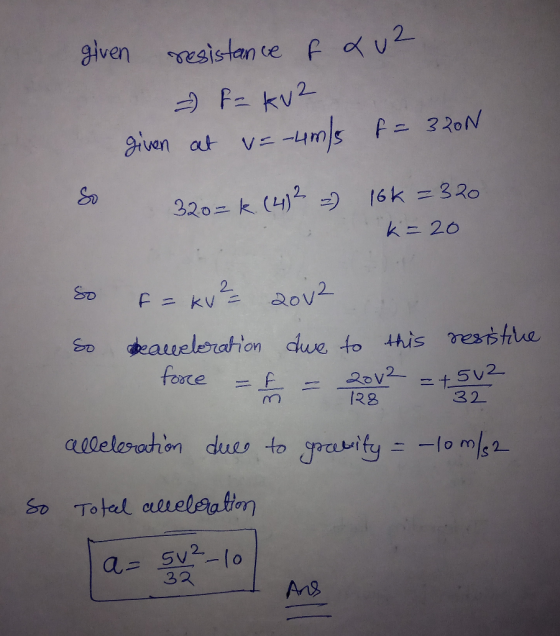
Show Intro/Instruct m -5-in a medium that exerts a resistive force with magnitude proportional to the...
A mass of 1.25kg stretches a spring 0.05m. The mass is in a medium that exerts a viscous resistance of 192N when the mass has a velocity of 6m/s. The viscous resistance is proportional to the speed of...
A mass of 1.25kg stretches a spring 0.05m. The mass is in a medium that exerts a viscous resistance of 192N when the mass has a velocity of 6m/s. The viscous resistance is proportional to the speed of the object. Suppose the object is displaced an additional 0.06m and released. Find a function u(t) to express the object's displacement from the spring's natural position, in m after t seconds. Let positive displacements indicate a stretched spring, and use 9.8m/s^2 as...
Differential Equation problem A mass of 0.25kg stretches a spring 0.1m. The mass is in a medium that exerts a viscous resistance of 14N when the mass has a velocity of 4m/s. The viscous resistance is...
Differential Equation problem A mass of 0.25kg stretches a spring 0.1m. The mass is in a medium that exerts a viscous resistance of 14N when the mass has a velocity of 4m/s. The viscous resistance is proportional to the speed of the object. Suppose the object is displaced an additional 0.08m and released. Find a function u(t) to express the object's displacement from the spring's natural position, in m after t seconds. Let positive displacements indicate a stretched spring, and...
helpful formulas: mu’’(t)+cu’(t)+ku(t)=0 m is the mass c is the damping coefficiant k is spring constant Fd=cu’(t) k=mg/(spring displacement) A mass of 1.5 kg stretches a spring 0.08 m. The mass...
 helpful formulas:
mu’’(t)+cu’(t)+ku(t)=0
m is the mass
c is the damping coefficiant
k is spring constant
Fd=cu’(t)
k=mg/(spring displacement)
A mass of 1.5 kg stretches a spring 0.08 m. The mass is in a medium that exerts a viscous resistance of 25 N when the mass has a velocity of 2 m. The viscous resistance is proportional to the speed of the object. Suppose the object is displaced an additional 0.03 m and released. Find an function to express the...
helpful formulas:
mu’’(t)+cu’(t)+ku(t)=0
m is the mass
c is the damping coefficiant
k is spring constant
Fd=cu’(t)
k=mg/(spring displacement)
A mass of 1.5 kg stretches a spring 0.08 m. The mass is in a medium that exerts a viscous resistance of 25 N when the mass has a velocity of 2 m. The viscous resistance is proportional to the speed of the object. Suppose the object is displaced an additional 0.03 m and released. Find an function to express the...
5. Let a be directly proportional to m and n2, and inversely proportional to y3. If a9 when m 4,n...
 Solving variation problem
5. Let a be directly proportional to m and n2, and inversely proportional to y3. If a9 when m 4,n-9, and y - 3, find a when m-6,n2, and y -5. 7. Current Flow In electric current flow, it is found that the resistance offered by a fixed length of wire of a given material varies inversely as the square of the diameter of the wire. If a wire 0.01 in. in diameter has a resistance of...
Solving variation problem
5. Let a be directly proportional to m and n2, and inversely proportional to y3. If a9 when m 4,n-9, and y - 3, find a when m-6,n2, and y -5. 7. Current Flow In electric current flow, it is found that the resistance offered by a fixed length of wire of a given material varies inversely as the square of the diameter of the wire. If a wire 0.01 in. in diameter has a resistance of...
this is differential equations practice problem part d should be t = 0, thank you in...
 this is differential equations practice problem
part d should be t = 0,
thank you in sdvancdd!
1. An object of mass m is fired vertically upward with an initial speed of vo. Suppose the air resistance is proportional to the square of velocity. Let k > O be the constant of proportionality. Use g as the acceleration due to gravity. Let v(t) be the velocity at time t. a) Write down the differential equation in effect for v(t) until...
this is differential equations practice problem
part d should be t = 0,
thank you in sdvancdd!
1. An object of mass m is fired vertically upward with an initial speed of vo. Suppose the air resistance is proportional to the square of velocity. Let k > O be the constant of proportionality. Use g as the acceleration due to gravity. Let v(t) be the velocity at time t. a) Write down the differential equation in effect for v(t) until...
5. (15 pts] A force acting on an object is proportional to the square root of...
 5. (15 pts] A force acting on an object is proportional to the square root of the distance the object moves. The equation for the distance r is: 19 = kyr, for some constant k. The object starts at t=0 with position r = 0 and velocity v = 0. The object moves four meters in the first second. That is, r(t = 1) = 4. (a) Find the object's velocity as a function of position, v(r). (b) Find the...
If a single constant force acts on an object that moves on a straight line
If a single constant force acts on an object that moves on a straight line, the object's velocity is a linear function of time. The equation v=vi + at gives its velocity v as a function of time, where a is its constant acceleration. What if velocity is instead a linear function of position? Assume that as a particular object moves through a resistive medium, its speed decreases as described by the equation v = vi-vx, where k is a...
NOTES: HI, PLEASE SOLVE BY USING ANALYTICAL METHOD WHICH IS RELATED TO FLUID MECHANICS(DRAG FORCE).TQ 25.19...
 NOTES: HI, PLEASE SOLVE BY USING ANALYTICAL METHOD WHICH IS
RELATED TO FLUID MECHANICS(DRAG FORCE).TQ
25.19 Assuming that drag is proportional to the square of velocity, we can model the velocity of a falling object like a parachutist with the following differential equation: dv dt where v is velocity (m/s), 1 = time (s), g is the acceleration due to gravity (9.81 m/s), c = a second-order drag coefficient (kg/m). and m 90-kg object with a drag coefficient of 0.225...
NOTES: HI, PLEASE SOLVE BY USING ANALYTICAL METHOD WHICH IS
RELATED TO FLUID MECHANICS(DRAG FORCE).TQ
25.19 Assuming that drag is proportional to the square of velocity, we can model the velocity of a falling object like a parachutist with the following differential equation: dv dt where v is velocity (m/s), 1 = time (s), g is the acceleration due to gravity (9.81 m/s), c = a second-order drag coefficient (kg/m). and m 90-kg object with a drag coefficient of 0.225...
Q.3) (7 Marks An object of mass m is being acted upon by a force F(x)...
 Q.3) (7 Marks An object of mass m is being acted upon by a force F(x) = Fosin (cx), where F. = 2 N and c = 0.5 rad/m are constants (a) Prove that this force is conservative. (b) Find the potential energy function V(x) (c) Make a graph of the potential energy V(x) as a functions of x in the interval [x = -a m,x = + m) d) Us previous graph to discuss the motion of the particle...
Help please and show all work to the answer. If written please have work legible. Will...
 Help please and show all work to the answer. If written please
have work legible. Will up vote for correct answer.
(1 point) A mass weighing 10 lb stretches a spring 6 in. Suppose the mass is displaced an additional 11 in in the positive (downward) direction and then released with an initial upward velocity of 3 ft/s. The mass is in a medium, that exerts a viscuouse resistance of 3 lb when the mass has a velocity of 2...
Help please and show all work to the answer. If written please
have work legible. Will up vote for correct answer.
(1 point) A mass weighing 10 lb stretches a spring 6 in. Suppose the mass is displaced an additional 11 in in the positive (downward) direction and then released with an initial upward velocity of 3 ft/s. The mass is in a medium, that exerts a viscuouse resistance of 3 lb when the mass has a velocity of 2...
 helpful formulas:
mu’’(t)+cu’(t)+ku(t)=0
m is the mass
c is the damping coefficiant
k is spring constant
Fd=cu’(t)
k=mg/(spring displacement)
A mass of 1.5 kg stretches a spring 0.08 m. The mass is in a medium that exerts a viscous resistance of 25 N when the mass has a velocity of 2 m. The viscous resistance is proportional to the speed of the object. Suppose the object is displaced an additional 0.03 m and released. Find an function to express the...
helpful formulas:
mu’’(t)+cu’(t)+ku(t)=0
m is the mass
c is the damping coefficiant
k is spring constant
Fd=cu’(t)
k=mg/(spring displacement)
A mass of 1.5 kg stretches a spring 0.08 m. The mass is in a medium that exerts a viscous resistance of 25 N when the mass has a velocity of 2 m. The viscous resistance is proportional to the speed of the object. Suppose the object is displaced an additional 0.03 m and released. Find an function to express the...
 Solving variation problem
5. Let a be directly proportional to m and n2, and inversely proportional to y3. If a9 when m 4,n-9, and y - 3, find a when m-6,n2, and y -5. 7. Current Flow In electric current flow, it is found that the resistance offered by a fixed length of wire of a given material varies inversely as the square of the diameter of the wire. If a wire 0.01 in. in diameter has a resistance of...
Solving variation problem
5. Let a be directly proportional to m and n2, and inversely proportional to y3. If a9 when m 4,n-9, and y - 3, find a when m-6,n2, and y -5. 7. Current Flow In electric current flow, it is found that the resistance offered by a fixed length of wire of a given material varies inversely as the square of the diameter of the wire. If a wire 0.01 in. in diameter has a resistance of...
 this is differential equations practice problem
part d should be t = 0,
thank you in sdvancdd!
1. An object of mass m is fired vertically upward with an initial speed of vo. Suppose the air resistance is proportional to the square of velocity. Let k > O be the constant of proportionality. Use g as the acceleration due to gravity. Let v(t) be the velocity at time t. a) Write down the differential equation in effect for v(t) until...
this is differential equations practice problem
part d should be t = 0,
thank you in sdvancdd!
1. An object of mass m is fired vertically upward with an initial speed of vo. Suppose the air resistance is proportional to the square of velocity. Let k > O be the constant of proportionality. Use g as the acceleration due to gravity. Let v(t) be the velocity at time t. a) Write down the differential equation in effect for v(t) until...
 5. (15 pts] A force acting on an object is proportional to the square root of the distance the object moves. The equation for the distance r is: 19 = kyr, for some constant k. The object starts at t=0 with position r = 0 and velocity v = 0. The object moves four meters in the first second. That is, r(t = 1) = 4. (a) Find the object's velocity as a function of position, v(r). (b) Find the...
 NOTES: HI, PLEASE SOLVE BY USING ANALYTICAL METHOD WHICH IS
RELATED TO FLUID MECHANICS(DRAG FORCE).TQ
25.19 Assuming that drag is proportional to the square of velocity, we can model the velocity of a falling object like a parachutist with the following differential equation: dv dt where v is velocity (m/s), 1 = time (s), g is the acceleration due to gravity (9.81 m/s), c = a second-order drag coefficient (kg/m). and m 90-kg object with a drag coefficient of 0.225...
NOTES: HI, PLEASE SOLVE BY USING ANALYTICAL METHOD WHICH IS
RELATED TO FLUID MECHANICS(DRAG FORCE).TQ
25.19 Assuming that drag is proportional to the square of velocity, we can model the velocity of a falling object like a parachutist with the following differential equation: dv dt where v is velocity (m/s), 1 = time (s), g is the acceleration due to gravity (9.81 m/s), c = a second-order drag coefficient (kg/m). and m 90-kg object with a drag coefficient of 0.225...
 Q.3) (7 Marks An object of mass m is being acted upon by a force F(x) = Fosin (cx), where F. = 2 N and c = 0.5 rad/m are constants (a) Prove that this force is conservative. (b) Find the potential energy function V(x) (c) Make a graph of the potential energy V(x) as a functions of x in the interval [x = -a m,x = + m) d) Us previous graph to discuss the motion of the particle...
 Help please and show all work to the answer. If written please
have work legible. Will up vote for correct answer.
(1 point) A mass weighing 10 lb stretches a spring 6 in. Suppose the mass is displaced an additional 11 in in the positive (downward) direction and then released with an initial upward velocity of 3 ft/s. The mass is in a medium, that exerts a viscuouse resistance of 3 lb when the mass has a velocity of 2...
Help please and show all work to the answer. If written please
have work legible. Will up vote for correct answer.
(1 point) A mass weighing 10 lb stretches a spring 6 in. Suppose the mass is displaced an additional 11 in in the positive (downward) direction and then released with an initial upward velocity of 3 ft/s. The mass is in a medium, that exerts a viscuouse resistance of 3 lb when the mass has a velocity of 2...
Most questions answered within 3 hours.
-
Where is the error in this code sequence?
String s1 = "Hello";
String s2 = "ello";...
asked 11 months ago -
Financial data for Joel de Paris, Inc., for last year
follow:
Joel de Paris, Inc.
Balance...
asked 11 months ago -
Consider this reaction:
Al2(SO4)3 (aq)+ BaCl3
(aq) Al2Cl6 (aq)- +
3BaSO4(s) . What is the...
asked 11 months ago -
Suppose that Savneet is considering increasing her
recent random sample from 20 car rentals to 40...
asked 11 months ago -
Trucks arrive at an unloading terminal at an average rate of 120
per hour.
Trucks arrive...
asked 11 months ago -
Why are methanol and ethanol completely soluble in water while
octanol is not very little soluble....
asked 11 months ago -
A facilities manager at a university reads in a research report
that the mean amount of...
asked 11 months ago -
When the CuSO4 is rehydrated by adding water to the anhydrous
compound, is this an endothermic...
asked 11 months ago -
A ray of sunlight is passing from diamond into crown glass; the
angle of incidence is...
asked 11 months ago -
A block of mass 0.249 kg is placed on top of a light, vertical
spring of...
asked 11 months ago -
how do the kidneys compensate in the presences of acidosis
a) trigger hyperventilate
b) reserve acid...
asked 11 months ago -
Question 501 pts
The rental rate of capital to the firm increases. Which of the
following...
asked 11 months ago