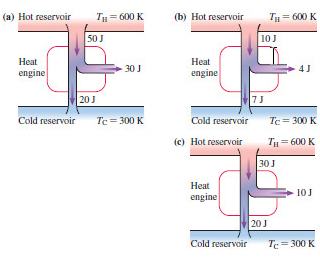
Part A For each engine calculate ?E = QH?Wout?QC, where QH is the amount of heat transferred...
Part A
For each engine calculate ?E = QH?Wout?QC, where QH is the amount of heat transferred from the hot reservoir, QC is the amount of heat transferred to the cold reservoir, Wout is the energy output of the heat engine. QH, Wout, QC are positive quantities.
?E(a), ?E(b), ?E(c) =
Part B
For each engine calculate the theoretical maximum efficiency (Carnot efficiency) emax.
emax,(a), emax,(b), emax,(c) =
Part C
For each engine calculate the actual efficiency e.
e(a), e(b), e(c) =
Homework Answers
Request Answer!
We need at least 10 more requests to produce the answer.
0 / 10 have requested this problem solution
The more requests, the faster the answer.
Add Answer to:
Part A For each engine calculate ?E = QH?Wout?QC, where QH is the amount of heat transferred...
Qh and Qc are the amount of heat transferred to or from a hot or cold...
Qh and Qc are the amount of heat transferred to or from a hot or cold reservoir, respectively. By definition, Qh and Qc are positive quantities, why?
The input heat of a Carnot engine is 3,000 J. The temperature of a hot reservoir...
The input heat of a Carnot engine is 3,000 J. The temperature of a hot reservoir is 600 K and that of a cold reservoir is 300 K. What is the work done? Hint: The efficiency e of a Carnot engine is defined as the ratio of the work done, W, by the engine to the input heat QH : e=W/QH. W=QH – QC, where Qc is the output heat. That is, e=1-Qc/QH =1-Tc/TH, where Tc for a temperature of...
Dr. Terror uses a heat engine like the one shown at the right. It has the...
 Dr. Terror uses a heat engine like the one shown at the right. It has the following operational parameters: High-temperature thermal reservoir W Low-temperature thermal reservoir TH QH TL 1. TH = 1330.0 K 2. TL = 336 K 3. QH = 3820.0 J 4. € = 12.9 % (the efficiency of the engine) QL Heat engine Part A: What is the work output (W) of the engine? W = J Part B: How much heat is exhausted (Qc) to...
High-temperature thermal reservoir Low-temperature thermal reservoir Dr. Terror uses a heat engine like the one shown...
 High-temperature thermal reservoir Low-temperature thermal reservoir Dr. Terror uses a heat engine like the one shown at the right. It has the following operational parameters: 1. Tu = 1430.0 K 2. TL = 306 K 3. OH = 3620.0J 4. E = 12.9% (the efficiency of the engine) TH QH T Q Heat engine Part A: What is the work output (W) of the engine? W = J Part B: How much heat is exhausted (Q.) to the low-temperature reservoir?...
Part A A heat engine is designed to do work. This is possible only if certain relationships between the heats and temp...
Part A A heat engine is designed to do work. This is possible only if certain relationships between the heats and temperatures at the input and output hold true. Which of the following sets of statements must apply for the heat engine to do work? A) Qh < Qc and Th < Tc B) Qh > Qc and Th < Tc C) Qh < Qc and Th > Tc D) Qh > Qc and Th > Tc Part B Find...
As shown in the figure, a reversible power cycle receives energy QH by heat transfer from...
 As shown in the figure, a reversible power cycle receives energy
QH by heat transfer from a hot reservoir at TH and rejects energy
QC by heat transfer to a cold reservoir at TC.
a) If TH = 1600 K, TC = 400 K, what is the thermal
efficiency?
b) If TH = 500oC, TC = 20oC, and Wcycle = 1000 kJ, what are QH and
QC, each in kJ?
c) If ? = 60% and TC = 40oF, what...
As shown in the figure, a reversible power cycle receives energy
QH by heat transfer from a hot reservoir at TH and rejects energy
QC by heat transfer to a cold reservoir at TC.
a) If TH = 1600 K, TC = 400 K, what is the thermal
efficiency?
b) If TH = 500oC, TC = 20oC, and Wcycle = 1000 kJ, what are QH and
QC, each in kJ?
c) If ? = 60% and TC = 40oF, what...
SP3. A Carnot engine operating in reverse as a heat pump moves heat from a cold...
 SP3. A Carnot engine operating in reverse as a heat pump moves heat from a cold reservoir at 7°C to a warmer one at 22°C. a) What is the efficiency of a Carnot engine operating between these two temperatures? b) If the Carnot heat pump releases 250 J of heat into the higher-temperature reservoir e co in each cycle, how much work must be provided in each cycle? c) How much heat is removed from the 7°C reservoir in each...
Learning Goal: To understand what a heat engine is and its theoretical limitations. Ever since Hero...
 Learning Goal:
To understand what a heat engine is and its theoretical
limitations.
Ever since Hero demonstrated a crude steam turbine in ancient
Greece, humans have dreamed of converting heat into work. If a fire
can boil a pot and make the lid jump up and down, why can't heat be
made to do useful work?
A heat engine is a device designed to convert heat into work.
The heat engines we will study will be cyclic: The working
substance...
Learning Goal:
To understand what a heat engine is and its theoretical
limitations.
Ever since Hero demonstrated a crude steam turbine in ancient
Greece, humans have dreamed of converting heat into work. If a fire
can boil a pot and make the lid jump up and down, why can't heat be
made to do useful work?
A heat engine is a device designed to convert heat into work.
The heat engines we will study will be cyclic: The working
substance...
earning Goal: To understand that a heat engine run backward is a heat pump that can be used as a refrigerator....
earning Goal: To understand that a heat engine run backward is a heat pump that can be used as a refrigerator. By now you should be familiar with heat engines--devices, theoretical or actual, designed to convert heat into work. You should understand the following: Heat engines must be cyclical; that is, they must return to their original state some time after having absorbed some heat and done some work). Heat engines cannot convert heat into work without generating some waste...
Part A A Carnot engine has an efficiency e = 0.25. The temperature of the cold...
Part A A Carnot engine has an efficiency e = 0.25. The temperature of the cold reservoir is 250 K. What is the temperature of the hot reservoir? Express your answer in kelvins. Part B What is the change of entropy of the engine if it absorbs 160 J of heat energy during an isothermal expansion? Express your answer in joules per kelvin.
 Dr. Terror uses a heat engine like the one shown at the right. It has the following operational parameters: High-temperature thermal reservoir W Low-temperature thermal reservoir TH QH TL 1. TH = 1330.0 K 2. TL = 336 K 3. QH = 3820.0 J 4. € = 12.9 % (the efficiency of the engine) QL Heat engine Part A: What is the work output (W) of the engine? W = J Part B: How much heat is exhausted (Qc) to...
 High-temperature thermal reservoir Low-temperature thermal reservoir Dr. Terror uses a heat engine like the one shown at the right. It has the following operational parameters: 1. Tu = 1430.0 K 2. TL = 306 K 3. OH = 3620.0J 4. E = 12.9% (the efficiency of the engine) TH QH T Q Heat engine Part A: What is the work output (W) of the engine? W = J Part B: How much heat is exhausted (Q.) to the low-temperature reservoir?...
 As shown in the figure, a reversible power cycle receives energy
QH by heat transfer from a hot reservoir at TH and rejects energy
QC by heat transfer to a cold reservoir at TC.
a) If TH = 1600 K, TC = 400 K, what is the thermal
efficiency?
b) If TH = 500oC, TC = 20oC, and Wcycle = 1000 kJ, what are QH and
QC, each in kJ?
c) If ? = 60% and TC = 40oF, what...
As shown in the figure, a reversible power cycle receives energy
QH by heat transfer from a hot reservoir at TH and rejects energy
QC by heat transfer to a cold reservoir at TC.
a) If TH = 1600 K, TC = 400 K, what is the thermal
efficiency?
b) If TH = 500oC, TC = 20oC, and Wcycle = 1000 kJ, what are QH and
QC, each in kJ?
c) If ? = 60% and TC = 40oF, what...
 SP3. A Carnot engine operating in reverse as a heat pump moves heat from a cold reservoir at 7°C to a warmer one at 22°C. a) What is the efficiency of a Carnot engine operating between these two temperatures? b) If the Carnot heat pump releases 250 J of heat into the higher-temperature reservoir e co in each cycle, how much work must be provided in each cycle? c) How much heat is removed from the 7°C reservoir in each...
 Learning Goal:
To understand what a heat engine is and its theoretical
limitations.
Ever since Hero demonstrated a crude steam turbine in ancient
Greece, humans have dreamed of converting heat into work. If a fire
can boil a pot and make the lid jump up and down, why can't heat be
made to do useful work?
A heat engine is a device designed to convert heat into work.
The heat engines we will study will be cyclic: The working
substance...
Learning Goal:
To understand what a heat engine is and its theoretical
limitations.
Ever since Hero demonstrated a crude steam turbine in ancient
Greece, humans have dreamed of converting heat into work. If a fire
can boil a pot and make the lid jump up and down, why can't heat be
made to do useful work?
A heat engine is a device designed to convert heat into work.
The heat engines we will study will be cyclic: The working
substance...
Most questions answered within 3 hours.
-
Where is the error in this code sequence?
String s1 = "Hello";
String s2 = "ello";...
asked 10 months ago -
Financial data for Joel de Paris, Inc., for last year
follow:
Joel de Paris, Inc.
Balance...
asked 10 months ago -
Consider this reaction:
Al2(SO4)3 (aq)+ BaCl3
(aq) Al2Cl6 (aq)- +
3BaSO4(s) . What is the...
asked 10 months ago -
Suppose that Savneet is considering increasing her
recent random sample from 20 car rentals to 40...
asked 10 months ago -
Trucks arrive at an unloading terminal at an average rate of 120
per hour.
Trucks arrive...
asked 10 months ago -
Why are methanol and ethanol completely soluble in water while
octanol is not very little soluble....
asked 10 months ago -
A facilities manager at a university reads in a research report
that the mean amount of...
asked 10 months ago -
When the CuSO4 is rehydrated by adding water to the anhydrous
compound, is this an endothermic...
asked 10 months ago -
A ray of sunlight is passing from diamond into crown glass; the
angle of incidence is...
asked 10 months ago -
A block of mass 0.249 kg is placed on top of a light, vertical
spring of...
asked 10 months ago -
how do the kidneys compensate in the presences of acidosis
a) trigger hyperventilate
b) reserve acid...
asked 10 months ago -
Question 501 pts
The rental rate of capital to the firm increases. Which of the
following...
asked 10 months ago