
Homework Answers
![.761 U=2.282x10% mis B= = 2.282x10⁸ m/s 3x10⁸ m/s [ B = 0.761] In relativity the Kinetic energy is given by K= mc²(8-1) where](http://img.homeworklib.com/questions/21f233e0-3769-11ea-96b9-09275e7e4dc2.png?x-oss-process=image/resize,w_560)
Add Answer to:
An electron is accelerated inside a parallel plate capacitor. The electron leaves the negative plate with...
An electron is accelerated inside a parallel plate capacitor, The electron leaves the negative plate with...
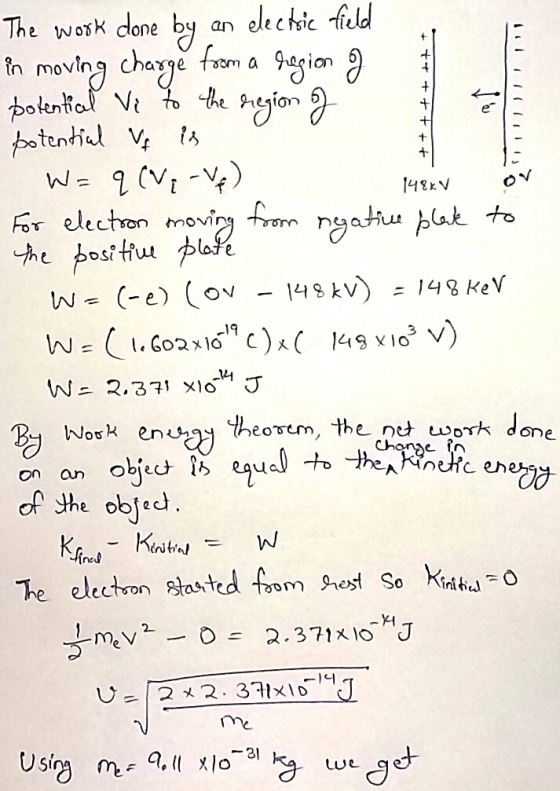
 An electron is accelerated inside a parallel plate capacitor, The electron leaves the negative plate with a negligible initial velocity and then after the acceleration it hits the positive plate with a final velocity ß. The distance between the plates is 13.8 cm, and the voltage difference is 115 kV. Determine the final velocity B of the electron using classical mechanics. (The rest mass of the electron is 9.11x10⁻³¹ kg, the rest energy of the electron is 511 keV.) HETA...
An electron initially at rest passes from one plate of a charged capacitor to another. The...
An electron initially at rest passes from one plate of a charged capacitor to another. The voltage difference between plates is 10^7 V. Use (relativistic) conservation of energy to find the final velocity of the electron.
An electron is accelerated from rest across the gap of a capacitor (two parallel plates charged...
An electron is accelerated from rest across the gap of a capacitor (two parallel plates charged -Q and +Q respectively). A hole in the top plate allows the electron to emerge with a constant velocity of v = 71 m/s. If the gap between the plates is d = 0.47 m, what is the magnitude of the electric field between the plates?
An electron is released from rest at the negative plate of a parallel plate capacitor and...
An electron is released from rest at the negative plate of a parallel plate capacitor and accelerates to the positive plate. The plates are separated by a distance of 1.2 cm and the electric field within the capacitor has a magnitude of 2.1 * 10^6 V/m. What is the speed of the electron just as it reaches the positive plate?
An electron is released from rest at the negative plate of a parallel plate capacitor and...
 An electron is released from rest at the negative plate of a
parallel plate capacitor and accelerates to the positive plate (see
the drawing). The plates are separated by a distance of 1.7 cm, and
the electric field within the capacitor has a magnitude of 2.7 x
106 V/m. What is the kinetic energy of the electron just as it
reaches the positive plate? The figure shows a vertical plate on
the left that is negatively charged and another vertical...
An electron is released from rest at the negative plate of a
parallel plate capacitor and accelerates to the positive plate (see
the drawing). The plates are separated by a distance of 1.7 cm, and
the electric field within the capacitor has a magnitude of 2.7 x
106 V/m. What is the kinetic energy of the electron just as it
reaches the positive plate? The figure shows a vertical plate on
the left that is negatively charged and another vertical...
An electron is released from rest at the negative plate of a parallel plate capacitor and...
 An electron is released from rest at the negative plate of a parallel plate capacitor and accelerates to the positive plate (see the drawing). The plates are separated by a distance of 2.4 cm, and the electric field within the capacitor has a magnitude of 1.8 x 10% v/m. What is the kinetic energy of the electron just as it reaches the positive pliate? KEpositive- Electric ield Electron
An electron is released from rest at the negative plate of a parallel plate capacitor. The...
An electron is released from rest at the negative plate of a parallel plate capacitor. The charge per unit area on each plate is = 1.9 × 10⁻⁷ C/m2, and the plates are separated by a distance of 1.5 × 10⁻² m. How fast is the electron moving just before it reaches the positive plate?
An electron is released from rest at the negative plate of a parallel plate capacitor. The...
An electron is released from rest at the negative plate of a parallel plate capacitor. The charge per unit area on each plate is = 2.1 × 10⁻⁷ C/m2, and the plates are separated by a distance of 1.7 × 10⁻² m. How fast is the electron moving just before it reaches the positive plate?
An electron is a accelerated through a potential difference of 750.0 kV so that it leaves...
 An electron is a accelerated through a potential difference of 750.0 kV so that it leaves this region with a kinetic energy of 750.0 keV. a) Calculate the mass of the electron in units of eV/c^2 correct to 4 decimal places. b) Calculate the total energy E of the electron in Joules and electron-Volts. c) Calculate the speed of the electron using the relativistic kinetic energy, and the non-relativistic kinetic energy. Express your answer as a fraction times c. d)...
An electron is released from rest at the negative plate of a parallel plate capacitor. The...
An electron is released from rest at the negative plate of a parallel plate capacitor. The charge per unit area on each plate is = 2.0 × 10⁻⁷ C/m2, and the plates are separated by a distance of 1.9 × 10⁻² m. How fast is the electron moving just before it reaches the positive plate? help!!
 An electron is accelerated inside a parallel plate capacitor, The electron leaves the negative plate with a negligible initial velocity and then after the acceleration it hits the positive plate with a final velocity ß. The distance between the plates is 13.8 cm, and the voltage difference is 115 kV. Determine the final velocity B of the electron using classical mechanics. (The rest mass of the electron is 9.11x10⁻³¹ kg, the rest energy of the electron is 511 keV.) HETA...
 An electron is released from rest at the negative plate of a
parallel plate capacitor and accelerates to the positive plate (see
the drawing). The plates are separated by a distance of 1.7 cm, and
the electric field within the capacitor has a magnitude of 2.7 x
106 V/m. What is the kinetic energy of the electron just as it
reaches the positive plate? The figure shows a vertical plate on
the left that is negatively charged and another vertical...
An electron is released from rest at the negative plate of a
parallel plate capacitor and accelerates to the positive plate (see
the drawing). The plates are separated by a distance of 1.7 cm, and
the electric field within the capacitor has a magnitude of 2.7 x
106 V/m. What is the kinetic energy of the electron just as it
reaches the positive plate? The figure shows a vertical plate on
the left that is negatively charged and another vertical...
 An electron is released from rest at the negative plate of a parallel plate capacitor and accelerates to the positive plate (see the drawing). The plates are separated by a distance of 2.4 cm, and the electric field within the capacitor has a magnitude of 1.8 x 10% v/m. What is the kinetic energy of the electron just as it reaches the positive pliate? KEpositive- Electric ield Electron
 An electron is a accelerated through a potential difference of 750.0 kV so that it leaves this region with a kinetic energy of 750.0 keV. a) Calculate the mass of the electron in units of eV/c^2 correct to 4 decimal places. b) Calculate the total energy E of the electron in Joules and electron-Volts. c) Calculate the speed of the electron using the relativistic kinetic energy, and the non-relativistic kinetic energy. Express your answer as a fraction times c. d)...
Most questions answered within 3 hours.
-
Where is the error in this code sequence?
String s1 = "Hello";
String s2 = "ello";...
asked 11 months ago -
Financial data for Joel de Paris, Inc., for last year
follow:
Joel de Paris, Inc.
Balance...
asked 11 months ago -
Consider this reaction:
Al2(SO4)3 (aq)+ BaCl3
(aq) Al2Cl6 (aq)- +
3BaSO4(s) . What is the...
asked 11 months ago -
Suppose that Savneet is considering increasing her
recent random sample from 20 car rentals to 40...
asked 11 months ago -
Trucks arrive at an unloading terminal at an average rate of 120
per hour.
Trucks arrive...
asked 1 year ago -
Why are methanol and ethanol completely soluble in water while
octanol is not very little soluble....
asked 11 months ago -
A facilities manager at a university reads in a research report
that the mean amount of...
asked 1 year ago -
When the CuSO4 is rehydrated by adding water to the anhydrous
compound, is this an endothermic...
asked 11 months ago -
A ray of sunlight is passing from diamond into crown glass; the
angle of incidence is...
asked 1 year ago -
A block of mass 0.249 kg is placed on top of a light, vertical
spring of...
asked 1 year ago -
how do the kidneys compensate in the presences of acidosis
a) trigger hyperventilate
b) reserve acid...
asked 1 year ago -
Question 501 pts
The rental rate of capital to the firm increases. Which of the
following...
asked 1 year ago