
Homework Answers
An emulsion is a mixture of two or more liquids that are normally immiscible.
During extraction of liquid liquid Emulsions commonly occur when a sample contains a high amount of surfactant-like compounds (that is, phospholipids, free fatty acids, triglycerides, and so on). These surfactant-like molecules are large and will have mutual solubility in the aqueous and organic solvents which results in the formation of an emulsion in a mid-zone between the two phases
Add Answer to:
Post lab Questions: 1. What is an emulsion? How would an emulsion form during a liquid/liquid...
1. What is an emulsion? How would an emulsion form during a liquid/liquid extraction? 2. Draw...
1. What is an emulsion? How would an emulsion form during a liquid/liquid extraction? 2. Draw the structure for caffeine. What part of caffeine is basic? 3. What form is caffeine in when dissolved in soda? Draw the structure.
Post-Lab Report Extraction of Caffeine from Tea Leaves 1. What is liquid-liquid extraction? Explain its principle...
 Post-Lab Report Extraction of Caffeine from Tea Leaves
1. What is liquid-liquid extraction? Explain its principle and show illustrations. 2. What are alkaloids and xanthines? 3. Aside from being a natural stimulant, what are the other effects of caffeine in the human body? 4. What are tannins? What are the manifestations of tannins in tea? why is it necessary to boil the solution when extracting the components from the tea leaves? 6. What can be done to avoid tannins from...
Post-Lab Report Extraction of Caffeine from Tea Leaves
1. What is liquid-liquid extraction? Explain its principle and show illustrations. 2. What are alkaloids and xanthines? 3. Aside from being a natural stimulant, what are the other effects of caffeine in the human body? 4. What are tannins? What are the manifestations of tannins in tea? why is it necessary to boil the solution when extracting the components from the tea leaves? 6. What can be done to avoid tannins from...
soap making lab organic chem 2 Post Lab Questions 1. What is an emulsion? Which mixture...
 soap making lab organic chem 2
Post Lab Questions 1. What is an emulsion? Which mixture was the better at maintaining an emulsion, Olland or soap, oil and water? Explain why on a molecular level. 2. How can soap remove oil or dirt from clothes? 3. What was the role of the ethyl alcohol that was originally added to the reaction mixture 4. Explain chemically what happens when soap is added to hard water and the problems can occur when...
soap making lab organic chem 2
Post Lab Questions 1. What is an emulsion? Which mixture was the better at maintaining an emulsion, Olland or soap, oil and water? Explain why on a molecular level. 2. How can soap remove oil or dirt from clothes? 3. What was the role of the ethyl alcohol that was originally added to the reaction mixture 4. Explain chemically what happens when soap is added to hard water and the problems can occur when...
Post-Lab 3. You vigourously shake a separatory funnel, and notice an emulsion forming. What can you...
 Post-Lab 3. You vigourously shake a separatory funnel, and notice an emulsion forming. What can you do to help break up the emulsion? 4. Complete the following acid-base reaction and provide the keq. Is sodium bicarbonate (NaHCO) a suitable base in this situation? + NaHCO, 5. A mixture of benzoic acid and a neutral nonpolar compound is dissolved in ether and mixed thoroughly with aqueous sodium bicarbonate. What is the organic chemical species that is present in the ether layer?...
1) Explain how saturated NaCl solution would help draw the water away from the organic layer in the emulsion layer....
 1) Explain how saturated NaCl solution would help draw the water away from the organic layer in the emulsion layer. 2) You have a solution of 30 mg of caffeine dissolved in 100 mL of water. The partition coefficient for aqueous caffeine extracted with Dichloromethane (CH2C12) is 4.6. Show all work for the following calculations: a. Calculate the total mg extracted by using a single 30 mL portion of dichloromethane. b. Calculate the total mg extracted by using a three...
Pre-Lab Questions of Exp.4 Extraction (liquid-liquid and liquid –solid) Define extraction? How you choose solvent for...
Pre-Lab Questions of Exp.4 Extraction (liquid-liquid and liquid –solid) Define extraction? How you choose solvent for proper extraction? What is the difference between liquid-liquid and liquid-solid extraction? What are nutrients? Give two examples
Post Lab Questions 1. Suggest how you might make "honey" from table sugar. 2. Draw the...
 Post Lab Questions 1. Suggest how you might make "honey" from table sugar. 2. Draw the structure of a segment of an amylose molecule, and then show the reaction with water to break the acetal bonds. 3. What type of monosaccharide polymerizes to form inulin? 4. On the basis of today's experiment, suggest a way to determine whether a compound is amylose or inulin. 5. Compare the product that would be obtained from hydrolysis of a 50:50 mixture of inulin...
2. When using the separatory funnel you may have observed a oily emulsion between the aqueous and...
 2. When using the separatory funnel you may have observed a oily emulsion between the aqueous and DCM layers. What components of tea are responsible for this emulsion? How can one minimize the size of the emulsion layer? 3. How does adding the anhydrous sodium sulfate to the dichloromethane solution remove water? 4. If the above step was omitted in the isolation procedure, how would this be reflected in the yield of caffeine? 5. A student used 8.23 g of...
4. When a separatory funnel is shaken too vigorously, an emulsion may form. What would be...
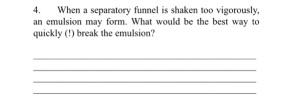 4. When a separatory funnel is shaken too vigorously, an emulsion may form. What would be the best way to quickly (!) break the emulsion?
1)-Briefly explain the role of the hydrochloric acid during the liquid-liquid extraction procedure. Draw the acid-base...
1)-Briefly explain the role of the hydrochloric acid during the liquid-liquid extraction procedure. Draw the acid-base reaction between lidocaine freebase and hydronium chloride to help your discussion and circle the organic species that is more soluble in water. 2)- Briefly explain the role of the potassium hydroxide during the liquid-liquid extraction procedure. Draw the acid-base reaction between lidocaine hydrochloride and potassium hydroxide to help your discussion and circle the organic species that is would be more soluble in the organic...
 Post-Lab Report Extraction of Caffeine from Tea Leaves
1. What is liquid-liquid extraction? Explain its principle and show illustrations. 2. What are alkaloids and xanthines? 3. Aside from being a natural stimulant, what are the other effects of caffeine in the human body? 4. What are tannins? What are the manifestations of tannins in tea? why is it necessary to boil the solution when extracting the components from the tea leaves? 6. What can be done to avoid tannins from...
Post-Lab Report Extraction of Caffeine from Tea Leaves
1. What is liquid-liquid extraction? Explain its principle and show illustrations. 2. What are alkaloids and xanthines? 3. Aside from being a natural stimulant, what are the other effects of caffeine in the human body? 4. What are tannins? What are the manifestations of tannins in tea? why is it necessary to boil the solution when extracting the components from the tea leaves? 6. What can be done to avoid tannins from...
 soap making lab organic chem 2
Post Lab Questions 1. What is an emulsion? Which mixture was the better at maintaining an emulsion, Olland or soap, oil and water? Explain why on a molecular level. 2. How can soap remove oil or dirt from clothes? 3. What was the role of the ethyl alcohol that was originally added to the reaction mixture 4. Explain chemically what happens when soap is added to hard water and the problems can occur when...
soap making lab organic chem 2
Post Lab Questions 1. What is an emulsion? Which mixture was the better at maintaining an emulsion, Olland or soap, oil and water? Explain why on a molecular level. 2. How can soap remove oil or dirt from clothes? 3. What was the role of the ethyl alcohol that was originally added to the reaction mixture 4. Explain chemically what happens when soap is added to hard water and the problems can occur when...
 Post-Lab 3. You vigourously shake a separatory funnel, and notice an emulsion forming. What can you do to help break up the emulsion? 4. Complete the following acid-base reaction and provide the keq. Is sodium bicarbonate (NaHCO) a suitable base in this situation? + NaHCO, 5. A mixture of benzoic acid and a neutral nonpolar compound is dissolved in ether and mixed thoroughly with aqueous sodium bicarbonate. What is the organic chemical species that is present in the ether layer?...
 1) Explain how saturated NaCl solution would help draw the water away from the organic layer in the emulsion layer. 2) You have a solution of 30 mg of caffeine dissolved in 100 mL of water. The partition coefficient for aqueous caffeine extracted with Dichloromethane (CH2C12) is 4.6. Show all work for the following calculations: a. Calculate the total mg extracted by using a single 30 mL portion of dichloromethane. b. Calculate the total mg extracted by using a three...
 Post Lab Questions 1. Suggest how you might make "honey" from table sugar. 2. Draw the structure of a segment of an amylose molecule, and then show the reaction with water to break the acetal bonds. 3. What type of monosaccharide polymerizes to form inulin? 4. On the basis of today's experiment, suggest a way to determine whether a compound is amylose or inulin. 5. Compare the product that would be obtained from hydrolysis of a 50:50 mixture of inulin...
 2. When using the separatory funnel you may have observed a oily emulsion between the aqueous and DCM layers. What components of tea are responsible for this emulsion? How can one minimize the size of the emulsion layer? 3. How does adding the anhydrous sodium sulfate to the dichloromethane solution remove water? 4. If the above step was omitted in the isolation procedure, how would this be reflected in the yield of caffeine? 5. A student used 8.23 g of...
 4. When a separatory funnel is shaken too vigorously, an emulsion may form. What would be the best way to quickly (!) break the emulsion?
Most questions answered within 3 hours.
-
Where is the error in this code sequence?
String s1 = "Hello";
String s2 = "ello";...
asked 10 months ago -
Financial data for Joel de Paris, Inc., for last year
follow:
Joel de Paris, Inc.
Balance...
asked 10 months ago -
Consider this reaction:
Al2(SO4)3 (aq)+ BaCl3
(aq) Al2Cl6 (aq)- +
3BaSO4(s) . What is the...
asked 10 months ago -
Suppose that Savneet is considering increasing her
recent random sample from 20 car rentals to 40...
asked 10 months ago -
Trucks arrive at an unloading terminal at an average rate of 120
per hour.
Trucks arrive...
asked 10 months ago -
Why are methanol and ethanol completely soluble in water while
octanol is not very little soluble....
asked 10 months ago -
A facilities manager at a university reads in a research report
that the mean amount of...
asked 10 months ago -
When the CuSO4 is rehydrated by adding water to the anhydrous
compound, is this an endothermic...
asked 10 months ago -
A ray of sunlight is passing from diamond into crown glass; the
angle of incidence is...
asked 10 months ago -
A block of mass 0.249 kg is placed on top of a light, vertical
spring of...
asked 10 months ago -
how do the kidneys compensate in the presences of acidosis
a) trigger hyperventilate
b) reserve acid...
asked 10 months ago -
Question 501 pts
The rental rate of capital to the firm increases. Which of the
following...
asked 10 months ago