

Homework Answers
Ans. 3) you should stop shaking ang let the separating funnel hang on stand and let it stand still for some time. The two immisible liquids will form two layers and then you can separate them.
Ans. 4)
It's ok.
Add Answer to:
Post-Lab 3. You vigourously shake a separatory funnel, and notice an emulsion forming. What can you...
Attached below are the pages from this lab report to help give context to the questions....
 Attached below are the pages from this lab report to help give
context to the questions. Please be as detailed as possible when
answering the questions and include any relevant information about
intermolecular forces at play. Thank you for your help!
Here are the questions which I need answered. Thank you in
advance for your help! :) Please be as detailed as possible and
discuss any intermolecular forces in detail if they are relevant to
the question. Thanks!
PARTA. SEPARATION...
Attached below are the pages from this lab report to help give
context to the questions. Please be as detailed as possible when
answering the questions and include any relevant information about
intermolecular forces at play. Thank you for your help!
Here are the questions which I need answered. Thank you in
advance for your help! :) Please be as detailed as possible and
discuss any intermolecular forces in detail if they are relevant to
the question. Thanks!
PARTA. SEPARATION...
The compounds below are dissolved in diethyl ether. The solution is transferred to a separatory funnel...
 The compounds below are dissolved in diethyl ether. The solution is transferred to a separatory funnel and shaken with 10 % NaOH. (a) Which of the organic compounds (or their ions) will be in the aqueous layer? Draw the structure of each (for ions, clearly indicate the location of the charge). (b) Which of the organic compounds (or their ions) will be in the organic layer? Draw the structure of each (for ions, clearly indicate the location of the charge)....
pre-laboratory Questions A 1 Explain why it is more efficient to make several extractions using small...
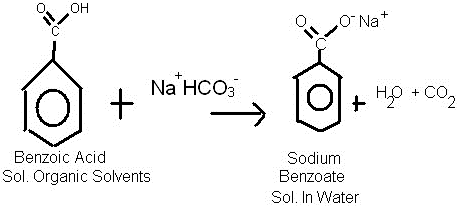
pre-laboratory Questions A 1 Explain why it is more efficient to make several extractions using small portions rather than one extraction using the same total volume. 2 Define the following terms: Drying agent intensity Drying agent capacity 3 Select the upper layer in each pair of mixed solvents (see Appendix C): Water and benzene Water and carbon tetrachloride Water and ether 4 Write an equation for the reaction of a benzoic acid with aqueous sodium bicarbonate. 5 Complete the following...
What is the purpose of shaking the ether layer with a saturated NaCl solution? What is...
What is the purpose of shaking the ether layer with a saturated NaCl solution? What is the purpose of adding CaCl2 to the ether layer? In this experiment you separated a mixture of benzoic acid, 4-t-butylphenol, and 1,4-dimethoxybenzene. You were instructed to dissolve the mixture in tert-butyl ether and extract with sodium bicarbonate first. Why can’t you extract with sodium hydroxide first? Explain. A mixture of lactic acid (pKa 3.86) and ascorbic acid (pKa 11.80) are dissolved in an organic...
Would the methylene chloride layer be above or below the experiment? Justify your answer. 1. aqueous layer in today...
 Would the methylene chloride layer be above or below the experiment? Justify your answer. 1. aqueous layer in today's ium carbonate used in the isolation of caffeine? Be specific as to the 2. Why is potass chemical species the carbonate may act on. Why was sodium sulfate used? 3. 4. After introducing 1.0 g of potassium carbonate into the centri hot water extract, it was capped, shaken, and then cooled to room temperature. Following this, roug minute. Why wasn't the...
please help :( to the separatory funnel and shake a rate the layers (Step 3), Return...
 please help :(
to the separatory funnel and shake a rate the layers (Step 3), Return the mu we aqueous layer with 10 ml of dichloromethane observations in your laboratory notebook dichloromethane layers and return the ane layers and return them to the separatory funne With 10 mL of IM NaOH (Step 8). Describe w OF IM NaOH (Step 8). Describe what happened in yo . Separate the layers (Step 9) and extract the organ e times (Steps 10 -...
please help :(
to the separatory funnel and shake a rate the layers (Step 3), Return the mu we aqueous layer with 10 ml of dichloromethane observations in your laboratory notebook dichloromethane layers and return the ane layers and return them to the separatory funne With 10 mL of IM NaOH (Step 8). Describe w OF IM NaOH (Step 8). Describe what happened in yo . Separate the layers (Step 9) and extract the organ e times (Steps 10 -...
Draw an extraction flow chart for the Extraction experiment you completed. experiment below Separation of a...
Draw an extraction flow chart for the Extraction experiment you completed. experiment below Separation of a Benzoic Acid/Biphenyl Mixture by Acid-Base Extraction Prepare the solution to be extracted by dissolving 2.5 g of a 1:1 mixture of benzoic acid/ biphenyl in 25 mL of tert-butyl methyl ether (MTBE) . Using a 125 mL separatory funnel extract the ether solution with a mixture containing 10 mL of distilled water and 15 mL of saturated NaHCO3 . Repeat After removing the aqueous...
Experiment: A mixture of equal proportions of benzoic acid, ethyl 4-aminobenzoate, and 1,4-dimethoxybenzene are to be...
Experiment: A mixture of equal proportions of benzoic acid, ethyl 4-aminobenzoate, and 1,4-dimethoxybenzene are to be separated by extraction using the solvent diethyl ether. Day 1: Part A. Isolation of the basic component: In a small beaker, dissolve 3 g of the mixture (benzoic acid, ethyl 4-aminobenzoate, and 1,4-dimethoxybenzene) in 30 mL of diethyl ether and transfer the mixture to a 125- mL separatory funnel (see Fig. 1) using a little diethyl ether to complete the transfer. Add 10 mL...
SYNTHESIS OF T-PENTYL CHLORIDE LAB Provide a stoichiometry table for the reaction being performed in this...
 SYNTHESIS OF T-PENTYL CHLORIDE LAB
Provide a stoichiometry table for the reaction being performed
in this lab.
PROCEDURE Preparation oft-Pentyl Chloride In a 125-mL separatory funnel, place 10.0 mL of tert-pentyl alcohol (2-methyl-2- butanol, MW = 88.2, d = 0.805 g/mL) and 25 mL of concentrated hydrochloric acid (d 1.18 g/mL). Do not stopper the funnel. Gently swirl the mixture in the separa- tory funnel for about 1 minute. After this period of swirling, stopper the separatory funnel and carefully...
SYNTHESIS OF T-PENTYL CHLORIDE LAB
Provide a stoichiometry table for the reaction being performed
in this lab.
PROCEDURE Preparation oft-Pentyl Chloride In a 125-mL separatory funnel, place 10.0 mL of tert-pentyl alcohol (2-methyl-2- butanol, MW = 88.2, d = 0.805 g/mL) and 25 mL of concentrated hydrochloric acid (d 1.18 g/mL). Do not stopper the funnel. Gently swirl the mixture in the separa- tory funnel for about 1 minute. After this period of swirling, stopper the separatory funnel and carefully...
Provide a flow chart detailing the acid/base extraction/separation of the compounds show below. Your answer must...
 Provide a flow chart detailing the acid/base extraction/separation of the compounds show below. Your answer must employ the following reagents: methylene chloride, hydrochloric acid (1M & 6M), sodium hydroxide (1M & 6M), 10% sodium bicarbonate (aq). Clearly indicate the product(s) and layers formed following each step of your separation scheme. IMPORTANT: p-cresol is soluble in sodium hydroxide solution but insoluble in neutral water or sodium bicarbonate solution. 2-ethylbenzoic acid is soluble in both sodium hydroxide and sodium bicarbonate solutions. Use...
 Attached below are the pages from this lab report to help give
context to the questions. Please be as detailed as possible when
answering the questions and include any relevant information about
intermolecular forces at play. Thank you for your help!
Here are the questions which I need answered. Thank you in
advance for your help! :) Please be as detailed as possible and
discuss any intermolecular forces in detail if they are relevant to
the question. Thanks!
PARTA. SEPARATION...
Attached below are the pages from this lab report to help give
context to the questions. Please be as detailed as possible when
answering the questions and include any relevant information about
intermolecular forces at play. Thank you for your help!
Here are the questions which I need answered. Thank you in
advance for your help! :) Please be as detailed as possible and
discuss any intermolecular forces in detail if they are relevant to
the question. Thanks!
PARTA. SEPARATION...
 The compounds below are dissolved in diethyl ether. The solution is transferred to a separatory funnel and shaken with 10 % NaOH. (a) Which of the organic compounds (or their ions) will be in the aqueous layer? Draw the structure of each (for ions, clearly indicate the location of the charge). (b) Which of the organic compounds (or their ions) will be in the organic layer? Draw the structure of each (for ions, clearly indicate the location of the charge)....
 Would the methylene chloride layer be above or below the experiment? Justify your answer. 1. aqueous layer in today's ium carbonate used in the isolation of caffeine? Be specific as to the 2. Why is potass chemical species the carbonate may act on. Why was sodium sulfate used? 3. 4. After introducing 1.0 g of potassium carbonate into the centri hot water extract, it was capped, shaken, and then cooled to room temperature. Following this, roug minute. Why wasn't the...
 please help :(
to the separatory funnel and shake a rate the layers (Step 3), Return the mu we aqueous layer with 10 ml of dichloromethane observations in your laboratory notebook dichloromethane layers and return the ane layers and return them to the separatory funne With 10 mL of IM NaOH (Step 8). Describe w OF IM NaOH (Step 8). Describe what happened in yo . Separate the layers (Step 9) and extract the organ e times (Steps 10 -...
please help :(
to the separatory funnel and shake a rate the layers (Step 3), Return the mu we aqueous layer with 10 ml of dichloromethane observations in your laboratory notebook dichloromethane layers and return the ane layers and return them to the separatory funne With 10 mL of IM NaOH (Step 8). Describe w OF IM NaOH (Step 8). Describe what happened in yo . Separate the layers (Step 9) and extract the organ e times (Steps 10 -...
 SYNTHESIS OF T-PENTYL CHLORIDE LAB
Provide a stoichiometry table for the reaction being performed
in this lab.
PROCEDURE Preparation oft-Pentyl Chloride In a 125-mL separatory funnel, place 10.0 mL of tert-pentyl alcohol (2-methyl-2- butanol, MW = 88.2, d = 0.805 g/mL) and 25 mL of concentrated hydrochloric acid (d 1.18 g/mL). Do not stopper the funnel. Gently swirl the mixture in the separa- tory funnel for about 1 minute. After this period of swirling, stopper the separatory funnel and carefully...
SYNTHESIS OF T-PENTYL CHLORIDE LAB
Provide a stoichiometry table for the reaction being performed
in this lab.
PROCEDURE Preparation oft-Pentyl Chloride In a 125-mL separatory funnel, place 10.0 mL of tert-pentyl alcohol (2-methyl-2- butanol, MW = 88.2, d = 0.805 g/mL) and 25 mL of concentrated hydrochloric acid (d 1.18 g/mL). Do not stopper the funnel. Gently swirl the mixture in the separa- tory funnel for about 1 minute. After this period of swirling, stopper the separatory funnel and carefully...
 Provide a flow chart detailing the acid/base extraction/separation of the compounds show below. Your answer must employ the following reagents: methylene chloride, hydrochloric acid (1M & 6M), sodium hydroxide (1M & 6M), 10% sodium bicarbonate (aq). Clearly indicate the product(s) and layers formed following each step of your separation scheme. IMPORTANT: p-cresol is soluble in sodium hydroxide solution but insoluble in neutral water or sodium bicarbonate solution. 2-ethylbenzoic acid is soluble in both sodium hydroxide and sodium bicarbonate solutions. Use...
Most questions answered within 3 hours.
-
Where is the error in this code sequence?
String s1 = "Hello";
String s2 = "ello";...
asked 10 months ago -
Financial data for Joel de Paris, Inc., for last year
follow:
Joel de Paris, Inc.
Balance...
asked 10 months ago -
Consider this reaction:
Al2(SO4)3 (aq)+ BaCl3
(aq) Al2Cl6 (aq)- +
3BaSO4(s) . What is the...
asked 10 months ago -
Suppose that Savneet is considering increasing her
recent random sample from 20 car rentals to 40...
asked 10 months ago -
Trucks arrive at an unloading terminal at an average rate of 120
per hour.
Trucks arrive...
asked 10 months ago -
Why are methanol and ethanol completely soluble in water while
octanol is not very little soluble....
asked 10 months ago -
A facilities manager at a university reads in a research report
that the mean amount of...
asked 10 months ago -
When the CuSO4 is rehydrated by adding water to the anhydrous
compound, is this an endothermic...
asked 10 months ago -
A ray of sunlight is passing from diamond into crown glass; the
angle of incidence is...
asked 10 months ago -
A block of mass 0.249 kg is placed on top of a light, vertical
spring of...
asked 10 months ago -
how do the kidneys compensate in the presences of acidosis
a) trigger hyperventilate
b) reserve acid...
asked 10 months ago -
Question 501 pts
The rental rate of capital to the firm increases. Which of the
following...
asked 10 months ago