
Homework Answers
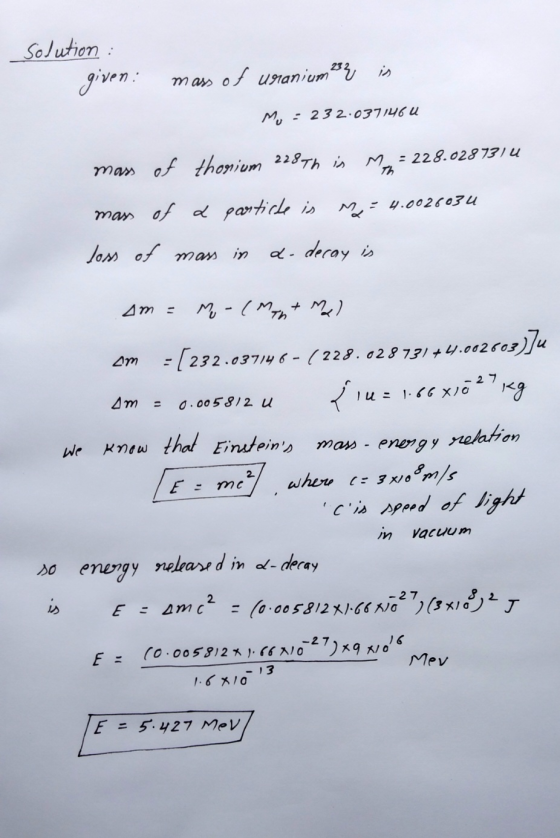
SOLUTION :
mass lost in decay
= mu - mt - m particle
= 232.037146 - 228.02873 - 4.002603
= 0.005813 amu .
= 0.005813 * (1.6 * 10^(-27) ) kg (1 amu = 1.6*10^(-27) kg)
= 9.3008 * 10^(-30) kg
Now, energy released , E
= m c^2
= 9.3008 * 10^(-30) * (3*10^8)^2 (c = speed of light = 3*10^8 m/s)
= 8.37072 * 10^(-13) kg.m/s^2 * m (= N-m = J)
= 8.3702 * 10^(-13) J
= 8.3702 * 10^(-13) / (1.6 * 10^(-19)) ev ( 1 ev = 1.6*10^(-19) J)
= 5.231375 * 10^6
= 5.231375 Mev (ANSWER).
Add Answer to:
Calculate the energy (in MeV) released when a decay converts uranium 232u (atomic mass = 232.037146...
Calculate the energy (in MeV) released when ? decay converts uranium 232U (atomic mass = 232.037146...
Calculate the energy (in MeV) released when ? decay converts uranium 232U (atomic mass = 232.037146 u) into thorium 228Th (atomic mass = 228.028731 u). The atomic mass of an ? particle is 4.002603 u.
Find the energy (in MeV) released when + decay converts 12X23 (atomic mass = 22.994124 u)...
Find the energy (in MeV) released when + decay converts 12X23 (atomic mass = 22.994124 u) into 11X23 (atomic mass = 22.989769 u). Notice that the first atomic mass includes the mass of 12 electrons, while the second atomic mass includes the mass of only 11 electrons.
Thorium (with half-life T1/2 = 1.913 yr. and atomic mass 228.0287 u) undergoes alpha decay and...
Thorium (with half-life T1/2 = 1.913 yr. and atomic mass 228.0287 u) undergoes alpha decay and produces radium (atomic mass 224.0202 u) as a daughter nucleus. (Assume the alpha particle has atomic mass 4.002603 u.) 1) What is the decay constant of thorium? (Note that the answer must be in units of hrs-1.) λ = 2) What percent of thorium is left after 200 days? 3) The energy released from the decay of 10 g of thorium is used to...
86X212 (atomic mass = 211.99068 u) undergoes decay. Assuming all the released energy is in the...
86X212 (atomic mass = 211.99068 u) undergoes decay. Assuming all the released energy is in the form of kinetic energy of the particle (atomic mass = 4.002603 u) and ignoring the recoil of the daughter nucleus (84X1208 atomic mass = 207.98123 u), find the speed of the particle. Ignore relativistic effects. Number Units
A uranium-238 nucleus at rest undergoes radioactive decay, splitting into an alpha particle (helium nucleus) with...
A uranium-238 nucleus at rest undergoes radioactive decay, splitting into an alpha particle (helium nucleus) with mass 6.64×10⁻²⁷ kg and a thorium nucleus with mass 3.89×10⁻²⁵ kg. The measured kinetic energy of the alpha particle is 4.49×10⁻¹³ J. After the decay, what is the magnitude of the momentum of the thorium nucleus? Incorrect. Tries 1/20 Previous Tries After the decay, what is the kinetic energy of the thorium nucleus? 7.664×10⁻¹⁵ J You are correct. Your receipt no. is 158-4017
When a stationary plutonium-239, 239/94 Pu, decays into uranium-235 plus an alpha particle, the energy released...
When a stationary plutonium-239, 239/94 Pu, decays into uranium-235 plus an alpha particle, the energy released in the process is 5.24 MeV. The following masses are known: 4/2 He: 4.002603 u 235/92 U: 235.043924 u What is the mass of the 239/94 Pu nucleus, in amu? (1 u = 931.494 MeV/c2)
Can someone explain why the answer is A? 8) Uranium - 238 decays into thorium -...
 Can someone explain why the answer is A?
8) Uranium - 238 decays into thorium - 234 plus an alpha particle. How much energy is released in this process? 1 u = 931.491 MeV/c^2. The relevant mass values are: 4/2 He, 4.002603 u: 234 90 Th, 234.043583 u; 238 92 U, 238.050786 u. A) 4.28 MeV B) 3.76 MeV C) 3.18 MeV D) 2.89 MeV E) 5.05 MeV Answer: A
Can someone explain why the answer is A?
8) Uranium - 238 decays into thorium - 234 plus an alpha particle. How much energy is released in this process? 1 u = 931.491 MeV/c^2. The relevant mass values are: 4/2 He, 4.002603 u: 234 90 Th, 234.043583 u; 238 92 U, 238.050786 u. A) 4.28 MeV B) 3.76 MeV C) 3.18 MeV D) 2.89 MeV E) 5.05 MeV Answer: A
What is the energy Q released in the first step of the thorium-232 decay chain? The...
What is the energy Q released in the first step of the thorium-232 decay chain? The atomic mass of 232 90Th is 232.038054 u and the atomic mass of 228 88Ra is 228.0301069 u. answers that were not correct: Q = 3731.39 MeV Q = 3733.402 MeV
Suppose some nucleus undergoes decay, releasing 5.4 MeV of energy. If the daughter product of this...
 Suppose some nucleus undergoes decay, releasing 5.4 MeV of
energy. If the daughter product of this reaction is 93X237 (atomic
mass = 237.04816) , it will recoil away as the particle leaves.
Determine (a) the energy of the daughter product and (b) the energy
of the particle (atomic mass = 4.002603 u). Assume that the energy
of each particle is kinetic energy, and ignore any other small
amounts of energy that might be carried away by other emissions. In
addition,...
Suppose some nucleus undergoes decay, releasing 5.4 MeV of
energy. If the daughter product of this reaction is 93X237 (atomic
mass = 237.04816) , it will recoil away as the particle leaves.
Determine (a) the energy of the daughter product and (b) the energy
of the particle (atomic mass = 4.002603 u). Assume that the energy
of each particle is kinetic energy, and ignore any other small
amounts of energy that might be carried away by other emissions. In
addition,...
 Can someone explain why the answer is A?
8) Uranium - 238 decays into thorium - 234 plus an alpha particle. How much energy is released in this process? 1 u = 931.491 MeV/c^2. The relevant mass values are: 4/2 He, 4.002603 u: 234 90 Th, 234.043583 u; 238 92 U, 238.050786 u. A) 4.28 MeV B) 3.76 MeV C) 3.18 MeV D) 2.89 MeV E) 5.05 MeV Answer: A
Can someone explain why the answer is A?
8) Uranium - 238 decays into thorium - 234 plus an alpha particle. How much energy is released in this process? 1 u = 931.491 MeV/c^2. The relevant mass values are: 4/2 He, 4.002603 u: 234 90 Th, 234.043583 u; 238 92 U, 238.050786 u. A) 4.28 MeV B) 3.76 MeV C) 3.18 MeV D) 2.89 MeV E) 5.05 MeV Answer: A
 Suppose some nucleus undergoes decay, releasing 5.4 MeV of
energy. If the daughter product of this reaction is 93X237 (atomic
mass = 237.04816) , it will recoil away as the particle leaves.
Determine (a) the energy of the daughter product and (b) the energy
of the particle (atomic mass = 4.002603 u). Assume that the energy
of each particle is kinetic energy, and ignore any other small
amounts of energy that might be carried away by other emissions. In
addition,...
Suppose some nucleus undergoes decay, releasing 5.4 MeV of
energy. If the daughter product of this reaction is 93X237 (atomic
mass = 237.04816) , it will recoil away as the particle leaves.
Determine (a) the energy of the daughter product and (b) the energy
of the particle (atomic mass = 4.002603 u). Assume that the energy
of each particle is kinetic energy, and ignore any other small
amounts of energy that might be carried away by other emissions. In
addition,...
Most questions answered within 3 hours.
-
Where is the error in this code sequence?
String s1 = "Hello";
String s2 = "ello";...
asked 10 months ago -
Financial data for Joel de Paris, Inc., for last year
follow:
Joel de Paris, Inc.
Balance...
asked 10 months ago -
Consider this reaction:
Al2(SO4)3 (aq)+ BaCl3
(aq) Al2Cl6 (aq)- +
3BaSO4(s) . What is the...
asked 10 months ago -
Suppose that Savneet is considering increasing her
recent random sample from 20 car rentals to 40...
asked 10 months ago -
Trucks arrive at an unloading terminal at an average rate of 120
per hour.
Trucks arrive...
asked 10 months ago -
Why are methanol and ethanol completely soluble in water while
octanol is not very little soluble....
asked 10 months ago -
A facilities manager at a university reads in a research report
that the mean amount of...
asked 10 months ago -
When the CuSO4 is rehydrated by adding water to the anhydrous
compound, is this an endothermic...
asked 10 months ago -
A ray of sunlight is passing from diamond into crown glass; the
angle of incidence is...
asked 10 months ago -
A block of mass 0.249 kg is placed on top of a light, vertical
spring of...
asked 10 months ago -
how do the kidneys compensate in the presences of acidosis
a) trigger hyperventilate
b) reserve acid...
asked 10 months ago -
Question 501 pts
The rental rate of capital to the firm increases. Which of the
following...
asked 10 months ago