
Homework Answers
b. The amount of debt and equity used to finance a company.
Capital Structure refers to the amount of debt and/or equity employed by a firm to fund its operations and finance its assets.
Add Answer to:
26. Capital Structure refers to: a. The profitability of a proposed project b. The amount of...
25. Capital budgeting discusses the following activities: The profitability of a proposed project The amount of...
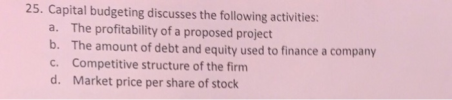 25. Capital budgeting discusses the following activities: The profitability of a proposed project The amount of debt and equity used to finance a company Competitive structure of the firm Market price per share of stock a. b. c. d.
What is a firm's optimal capital structure? The optimal capital structure refers to a capital structure...
 What is a firm's optimal capital structure? The optimal capital structure refers to a capital structure that: (Select the best choice below.) A. is comprised of 99.9% equity capital B. will minimize the composite cost of a firm's capital for raising a given amount of funds C. will minimize the firm's common stock price D. is comprised of 99.9% debt capital.
A proposed project has a positive NPV when evaluated at the company cost of capital. If...
A proposed project has a positive NPV when evaluated at the company cost of capital. If the firm employs debt in its capital structure, will the project remain acceptable after evaluation with the WACC? A) there will be no change in the project's NPV. B) the project may now become unacceptable. C) Yes, using the WACC will increase the NPV. D) No, using the WACC will decrease the NPV. Which one?
2. Washington Corporation has the following capital structure. The company's before-tax cost of debt is 8...
 2. Washington Corporation has the following capital structure. The company's before-tax cost of debt is 8 % The company's cost of preferred stock is 10%. The company's cost of common equity is 14.5 %. The company's tax rate is 30% . Debt Preferred Stock Capital Structure (in millions) $2,000 500 Common Equity Total 2.500 $5,000 a. What are weights for the capital structure? b. What is the company's WACC? c. If the company has the following proposed independent projects that...
Southern Corporation has a capital structure of 40% debt and 60% common equity. This capital structure...
Southern Corporation has a capital structure of 40% debt and 60% common equity. This capital structure is expected not to change. The firm's tax rate is 34%. The firm can issue the following securities to finance capital investments: Debt: Capital can be raised through bank loans at a pretax cost of 8.5%. Also, bonds can be issued at a pretax cost of 10%. Common Stock: Retained earnings will be available for investment. In addition, new common stock can be issued...
23. Capital structure decisions refer to the: A. dividend yield of the firm's stock B. blend...
 23. Capital structure decisions refer to the: A. dividend yield of the firm's stock B. blend of equity and debe used by the fim C. capital gains available on the firms stock D. maturity date for the firm's securities 24. If the line measuring a stock's historic returns against the market's historic returns has a slope greater than 1.0, then the: A. stock is currently underpriced B, market risk peemium is increasing. C. stock has a significant amount of unique...
Company E is debating whether to convert its all-equity capital structure to one that is 40%...
Company E is debating whether to convert its all-equity capital structure to one that is 40% debt. Currently, there are 8,000 shares outstanding, and the price per share is $55. EBIT is expected to remain at $32,000 per year forever. The interest rate on new debt is 8%, and there are no taxes. (a) XYZ, a shareholder of the firm, owns 100 shares of stock. What is her cash flow under the current capital structure, assuming the firm has a...
Reed Corporation has a capital budget of $2.25 million
Reed Corporation has a capital budget of $2.25 million. The company wants to maintain a target capital structure which is 60% debt and 40% equity. The company forecasts that its net income this year will be $800,000.a. If the firm uses a payout ratio of 25%, what dividend will Reed pay?b. How much will be added to retained earnings?c. If the company wishes to maintain its debt-equity ratio to finance the capital budget, how much debt must the firm issue?d. ...
Practice Questions - Chapter 9 1. McCall Corporation has a capital structure consisting of 55 percent...
 Practice Questions - Chapter 9 1. McCall Corporation has a capital structure consisting of 55 percent common equity, 30 percent debt, and 15 percent preferred stock. Any debt issues would have a pre-tax cost of 9.5%. Preferred stock can be issued for a cost of 11.5%. Common equity can be issued, but flotation costs of $4.25 per share of common stock would be paid. McCall common stock is currently selling in the market at $65 per share McCall recently paid...
A capital structure decision concerns Select one: a. how much capital is needed to invest in...
A capital structure decision concerns Select one: a. how much capital is needed to invest in positive net present value projects. b. the mix of debt and equity used to finance a firm's operations. c. the evaluation of projects based on their estimated cash flows and net present values. d. the ranking of capital in terms of riskiness and the choice based on this ranking. e. the organizational structure that will allow a firm to obtain the best cost of...
 25. Capital budgeting discusses the following activities: The profitability of a proposed project The amount of debt and equity used to finance a company Competitive structure of the firm Market price per share of stock a. b. c. d.
 What is a firm's optimal capital structure? The optimal capital structure refers to a capital structure that: (Select the best choice below.) A. is comprised of 99.9% equity capital B. will minimize the composite cost of a firm's capital for raising a given amount of funds C. will minimize the firm's common stock price D. is comprised of 99.9% debt capital.
 2. Washington Corporation has the following capital structure. The company's before-tax cost of debt is 8 % The company's cost of preferred stock is 10%. The company's cost of common equity is 14.5 %. The company's tax rate is 30% . Debt Preferred Stock Capital Structure (in millions) $2,000 500 Common Equity Total 2.500 $5,000 a. What are weights for the capital structure? b. What is the company's WACC? c. If the company has the following proposed independent projects that...
 23. Capital structure decisions refer to the: A. dividend yield of the firm's stock B. blend of equity and debe used by the fim C. capital gains available on the firms stock D. maturity date for the firm's securities 24. If the line measuring a stock's historic returns against the market's historic returns has a slope greater than 1.0, then the: A. stock is currently underpriced B, market risk peemium is increasing. C. stock has a significant amount of unique...
 Practice Questions - Chapter 9 1. McCall Corporation has a capital structure consisting of 55 percent common equity, 30 percent debt, and 15 percent preferred stock. Any debt issues would have a pre-tax cost of 9.5%. Preferred stock can be issued for a cost of 11.5%. Common equity can be issued, but flotation costs of $4.25 per share of common stock would be paid. McCall common stock is currently selling in the market at $65 per share McCall recently paid...
Most questions answered within 3 hours.
-
Where is the error in this code sequence?
String s1 = "Hello";
String s2 = "ello";...
asked 10 months ago -
Financial data for Joel de Paris, Inc., for last year
follow:
Joel de Paris, Inc.
Balance...
asked 10 months ago -
Consider this reaction:
Al2(SO4)3 (aq)+ BaCl3
(aq) Al2Cl6 (aq)- +
3BaSO4(s) . What is the...
asked 10 months ago -
Suppose that Savneet is considering increasing her
recent random sample from 20 car rentals to 40...
asked 10 months ago -
Trucks arrive at an unloading terminal at an average rate of 120
per hour.
Trucks arrive...
asked 10 months ago -
Why are methanol and ethanol completely soluble in water while
octanol is not very little soluble....
asked 10 months ago -
A facilities manager at a university reads in a research report
that the mean amount of...
asked 10 months ago -
When the CuSO4 is rehydrated by adding water to the anhydrous
compound, is this an endothermic...
asked 10 months ago -
A ray of sunlight is passing from diamond into crown glass; the
angle of incidence is...
asked 10 months ago -
A block of mass 0.249 kg is placed on top of a light, vertical
spring of...
asked 10 months ago -
how do the kidneys compensate in the presences of acidosis
a) trigger hyperventilate
b) reserve acid...
asked 10 months ago -
Question 501 pts
The rental rate of capital to the firm increases. Which of the
following...
asked 10 months ago