Explain the significance of cell differentiation in the development and prognosis of a tumor. Please help!!
Explain the significance of cell differentiation in the development and prognosis of a tumor.
Please help!!
Homework Answers
Cell differentiation is the process by which young and immature cell evolves into a specialised cell reaching its mature form and function. In cancer, this describes how much or how little tumour tissue looks like a normal tissue it came from.
Differentiation is used in tumour grading systems which are different for each type of cancer. Cell differentiation helps in histopathological classification of solid malignancies.
Differentiation stage is strongly associated with the behaviour of the tumour and an immature tumour is more aggressive than more differentiated one.
The tumour cells become differentiated and the body’s regulatory system is no longer able to control the changes taking place and so eventually cancerous tissues begin to spread.
Cancer cell differentiation grade refers to the graded classification of tumours according to how differentiated a tumour is. A tumour closely resembles the structure of tissue it started in is described as well differentiated . The closer the structure of cancer cell is to that of normal cell structure, the better it is differentiated. A tumour which resembles the original tissue to a lesser extend is known as anaplastic or poorly differentiated.
When the tumour cells are poorly differentiated, it is difficult to identify the tissue from where they started in and targeting treatment.
Cell differentiation helps in grading the tumour. There are four grades.
Grade 1- well differentiated tumour
This mostly resembles the normal tissue and has a good prognosis.
Grade 2 - Moderately differentiated
Intermediate forms of tumour with both good and poor prognosis.
Grade 3 - Badly differentiated tumour
Grade 4- Undifferentiated
Both Grade 3 and 4 tumours spread easier than other tumour and they have very poor prognosis.
Hence cell differentiation plays an important role in development and prognosis of tumour.
Add Answer to:
Explain the significance of cell differentiation in the development and prognosis of a tumor. Please help!!
Ubiquitin–mediated proteolysis regulates of A. Cell cycle B. Differentiation & development C. Extracellular effectors D. Cell...
Ubiquitin–mediated proteolysis regulates of A. Cell cycle B. Differentiation & development C. Extracellular effectors D. Cell surface receptors & ion channels E. Immune and inflammatory responses
Ubiquitin-mediated proteolysis regulates of A. Cell cycle B. Differentiation & development C. Extracellular effectors D. Cell...
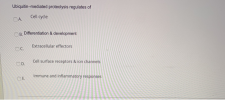 Ubiquitin-mediated proteolysis regulates of A. Cell cycle B. Differentiation & development C. Extracellular effectors D. Cell surface receptors & ion channels ОЕ. Immune and inflammatory responses
Explain how a cell could lose a remaining good copy of a tumor suppressor gene
Explain how a cell could lose a remaining good copy of a tumor suppressor gene
At a particular point in the differentiation process the cell becomes “determined”. Explain the concept of...
At a particular point in the differentiation process the cell becomes “determined”. Explain the concept of determination, i.e. what genes and signals are required for this?
Retinoblastoma (resulting in eye tumor) results from inactivation of Rb gene, a tumor suppressor. A).List the molecular events that lead to the development of hereditary retinoblastoma? _____________...
Retinoblastoma (resulting in eye tumor) results from inactivation of Rb gene, a tumor suppressor. A).List the molecular events that lead to the development of hereditary retinoblastoma? ________________________________________________________________________________________________________________________________________________________________________________________________ B). How the development of sporadic retinoblastoma will be different from the hereditary one? Mention the molecular steps that will be unique for the sporadic retinoblastoma? _________________________________________________________________________________________________________________________________________________________________________________________________________________________________________________________________________________________________ C). Is the loss of Rb function dominant or recessive and why? ________________________________________________________________________________________________________________________________________________________________________________________________ D). Knowing the Rb binds to E2F, which is transcription factor activating expression...
Both proto-oncogenes and tumor suppressor genes help control the cell cycle. Genes called encode for cyclins...
 Both proto-oncogenes and tumor suppressor genes help control the cell cycle. Genes called encode for cyclins that promote the cell cycle, while encode for cyclins that stop the cell cycle. Mutations within these genes cause cells to continue replication without regulation and form Both proto-oncogenes and tumor suppressor genes help control the cell cycle. Genes called encode for cyclins that promote the cell cycle, while encode for cyclins that stop the cell cycle.
Both proto-oncogenes and tumor suppressor genes help control the cell cycle. Genes called encode for cyclins...
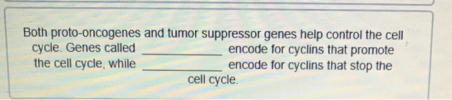 Both proto-oncogenes and tumor suppressor genes help control the cell cycle. Genes called encode for cyclins that promote the cell cycle, while encode for cyclins that stop the cell cycle.
Explain the terms below with examples: (i) Cost Leadership Strategy (ii) Differentiation Strategy please help answer...
Explain the terms below with examples: (i) Cost Leadership Strategy (ii) Differentiation Strategy please help answer this question in essay form . pleas give example with answer. please do not copy from internet use your own wodrs to answer t q so much
Describe and explain the significance of the National War Labor Board in the development of U.S....
Describe and explain the significance of the National War Labor Board in the development of U.S. labor relations
Explain the significance of growth fraction and the cell cycle to the success of chemotherapy. Explain...
Explain the significance of growth fraction and the cell cycle to the success of chemotherapy. Explain the three primary therapies for cancer: surgery, radiation, and chemotherapy.
 Ubiquitin-mediated proteolysis regulates of A. Cell cycle B. Differentiation & development C. Extracellular effectors D. Cell surface receptors & ion channels ОЕ. Immune and inflammatory responses
 Both proto-oncogenes and tumor suppressor genes help control the cell cycle. Genes called encode for cyclins that promote the cell cycle, while encode for cyclins that stop the cell cycle. Mutations within these genes cause cells to continue replication without regulation and form Both proto-oncogenes and tumor suppressor genes help control the cell cycle. Genes called encode for cyclins that promote the cell cycle, while encode for cyclins that stop the cell cycle.
 Both proto-oncogenes and tumor suppressor genes help control the cell cycle. Genes called encode for cyclins that promote the cell cycle, while encode for cyclins that stop the cell cycle.
Most questions answered within 3 hours.
-
Where is the error in this code sequence?
String s1 = "Hello";
String s2 = "ello";...
asked 10 months ago -
Financial data for Joel de Paris, Inc., for last year
follow:
Joel de Paris, Inc.
Balance...
asked 10 months ago -
Consider this reaction:
Al2(SO4)3 (aq)+ BaCl3
(aq) Al2Cl6 (aq)- +
3BaSO4(s) . What is the...
asked 10 months ago -
Suppose that Savneet is considering increasing her
recent random sample from 20 car rentals to 40...
asked 10 months ago -
Trucks arrive at an unloading terminal at an average rate of 120
per hour.
Trucks arrive...
asked 10 months ago -
Why are methanol and ethanol completely soluble in water while
octanol is not very little soluble....
asked 10 months ago -
A facilities manager at a university reads in a research report
that the mean amount of...
asked 10 months ago -
When the CuSO4 is rehydrated by adding water to the anhydrous
compound, is this an endothermic...
asked 10 months ago -
A ray of sunlight is passing from diamond into crown glass; the
angle of incidence is...
asked 10 months ago -
A block of mass 0.249 kg is placed on top of a light, vertical
spring of...
asked 10 months ago -
how do the kidneys compensate in the presences of acidosis
a) trigger hyperventilate
b) reserve acid...
asked 10 months ago -
Question 501 pts
The rental rate of capital to the firm increases. Which of the
following...
asked 10 months ago