Ubiquitin–mediated proteolysis regulates of A. Cell cycle B. Differentiation & development C. Extracellular effectors D. Cell...
Ubiquitin–mediated proteolysis regulates of
| A. |
Cell cycle |
|
| B. |
Differentiation & development |
|
| C. |
Extracellular effectors |
|
| D. |
Cell surface receptors & ion channels |
|
| E. |
Immune and inflammatory responses |
Homework Answers

Add Answer to:
Ubiquitin–mediated proteolysis regulates of
A.
Cell cycle
B.
Differentiation & development
C.
Extracellular effectors
D.
Cell...
Ubiquitin-mediated proteolysis regulates of A. Cell cycle B. Differentiation & development C. Extracellular effectors D. Cell...
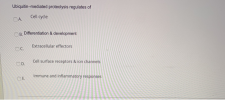 Ubiquitin-mediated proteolysis regulates of A. Cell cycle B. Differentiation & development C. Extracellular effectors D. Cell surface receptors & ion channels ОЕ. Immune and inflammatory responses
b) hyaluronic acid O c) proteoglycase O d) fibronectin 27. In animals, the extracellular matrix plays...
 b) hyaluronic acid O c) proteoglycase O d) fibronectin 27. In animals, the extracellular matrix plays important roles in each of the following processes EXCEPT (1 Point) O E) cell adhesion O D ) cell differentiation O C) cell motility O A ) cell division O B) DNA replication Submit Never give out your password Report abuse earch Polo
1. In paracrine signaling, the signaling molecules affects only: Target cells close to the cell from...
 1. In paracrine signaling, the signaling molecules affects only: Target cells close to the cell from which it was secreted a. b. Target cells distant from its site of synthesis in cells of an endocrine organ Both a. and b. с. d. None of these 2. Below are listed the events that occur in cell to cell communication. Signal transduction occurs 1. 2. Plasma membrane receptor binds with a ligand A cellular response is effected 3. 4. Ligand is released...
o o cell receptors, c, the type of nucleic acid it cell d viral enzymes e,...
 o o cell receptors, c, the type of nucleic acid it cell d viral enzymes e, the presence or absence of an envelope. The second step in viral replication is entry. For bacteriophage, entry usually involves Select one: a, receptor-mediated endocytosis, b. direct entry of the nucleic acid into the cell. c. membrane fusion mechanism of entry. d. phagocytosis, e. digestion of the peptidoglycan o The product(s) of the light reactions of photosynthesis
66. Neurons in the control motor reflexes. a. Thalamus b. Spinal cord c. Parietal lobe d....
66. Neurons in the control motor reflexes. a. Thalamus b. Spinal cord c. Parietal lobe d. Hippocampus e. B & C 67. The connects the two cerebral hemispheres. a. Limbic system b. Corpus Callosum c. Cerebellum d. Pituitary 68. Where are parasympathetic preganglionic cell bodies located? a. Cerebellum b. Brain Stem c. Dorsal root ganglia d. Skin 69. Patients with ADHD are given which type of medication: a. Anti-Seizure b. Tranquilizer c. SSRI d. Stimulant 70. The structure of peptide...
2s Antigen-Antibody interactons ooour in which of the foliowing ways? A Opsonization BNecation A D. Complement...
 2s Antigen-Antibody interactons ooour in which of the foliowing ways? A Opsonization BNecation A D. Complement Fixation EAl the above are cormect 26 Antigen binding sites of an anibody are locaed in the A. Light chains alone D. Fab regions of the antbody B Heavy chains sioneCF ion of the antbody E. Soft chains alone 27 Nonspecific chemical defenses include D stomach hydrochlorie acid A. lysozyme E. All of the choices are corredt Blacic acid and electrolytes of sweat Cskins...
Where in a prokaryotic cell does the Kreb’s cycle take place? A)nucleus. B)cytoplasm. C)Cell membrane. D)Golgi...
Where in a prokaryotic cell does the Kreb’s cycle take place? A)nucleus. B)cytoplasm. C)Cell membrane. D)Golgi apparatus E)mitochondria. _______ How many ATP does glycolysis yield? A)34 B)36-38 C)2 D)12 E) 0 _______ Hydrogen peroxide is clinically effective at what dose commonly used on humans? A)30% B) 70% C)3% D)95% E) 10%.
Answer all questions on this page!! B. It hyperpolarizes the membrane C. t changs he membrane...
 Answer all questions on this page!!
B. It hyperpolarizes the membrane C. t changs he membrane potenatal suh ht voltage-gated Kchambed Na channels are D. It releases calcium from intracellular stores 36. Compared to the cy toplasm, which of the following is generally true about the lumen of the endoplasmie reticulum in our cells? A. It has a more redacing environment B. It bas a moch higher calcium ion concentration. C. It has a higher density of ribosomes. D. All...
Answer all questions on this page!!
B. It hyperpolarizes the membrane C. t changs he membrane potenatal suh ht voltage-gated Kchambed Na channels are D. It releases calcium from intracellular stores 36. Compared to the cy toplasm, which of the following is generally true about the lumen of the endoplasmie reticulum in our cells? A. It has a more redacing environment B. It bas a moch higher calcium ion concentration. C. It has a higher density of ribosomes. D. All...
1. Mature B cells require particular receptors to be engaged by ligand to stimulate these cells...
1. Mature B cells require particular receptors to be engaged by ligand to stimulate these cells to become antibody-secreting cells. Fill-in the table below with the receptor(s) on naïve B cells that transmit each signal and the corresponding ligand(s) that engage that receptor. (6 pts) Receptor(s) on B cell Ligand(s) Location in body where receptor engagement occurs Signal 1 Signal 2 b. Briefly describe what happens to mature B cells that receive Signal 1, but not Signal 2? (2 pts)...
93. IL-2 acts on several cell types thus regulating multiple immune processes. IL-2 is said to...
93. IL-2 acts on several cell types thus regulating multiple immune processes. IL-2 is said to be: A. Antagonistic B. Cascade inducible C. Synergistic D. Pleiotropic 94. All of the following reasons contribute to the current low usages of cytokine therapy in medicine EXCEPT: A. Cytokines have a short half-life, usually less than 10 min. B. Cytokines may be bound by soluble receptors and never reach their target cell. C. Cytokine injections often cause an allergic reaction because rabbits make...
 Ubiquitin-mediated proteolysis regulates of A. Cell cycle B. Differentiation & development C. Extracellular effectors D. Cell surface receptors & ion channels ОЕ. Immune and inflammatory responses
 b) hyaluronic acid O c) proteoglycase O d) fibronectin 27. In animals, the extracellular matrix plays important roles in each of the following processes EXCEPT (1 Point) O E) cell adhesion O D ) cell differentiation O C) cell motility O A ) cell division O B) DNA replication Submit Never give out your password Report abuse earch Polo
 1. In paracrine signaling, the signaling molecules affects only: Target cells close to the cell from which it was secreted a. b. Target cells distant from its site of synthesis in cells of an endocrine organ Both a. and b. с. d. None of these 2. Below are listed the events that occur in cell to cell communication. Signal transduction occurs 1. 2. Plasma membrane receptor binds with a ligand A cellular response is effected 3. 4. Ligand is released...
 o o cell receptors, c, the type of nucleic acid it cell d viral enzymes e, the presence or absence of an envelope. The second step in viral replication is entry. For bacteriophage, entry usually involves Select one: a, receptor-mediated endocytosis, b. direct entry of the nucleic acid into the cell. c. membrane fusion mechanism of entry. d. phagocytosis, e. digestion of the peptidoglycan o The product(s) of the light reactions of photosynthesis
 2s Antigen-Antibody interactons ooour in which of the foliowing ways? A Opsonization BNecation A D. Complement Fixation EAl the above are cormect 26 Antigen binding sites of an anibody are locaed in the A. Light chains alone D. Fab regions of the antbody B Heavy chains sioneCF ion of the antbody E. Soft chains alone 27 Nonspecific chemical defenses include D stomach hydrochlorie acid A. lysozyme E. All of the choices are corredt Blacic acid and electrolytes of sweat Cskins...
 Answer all questions on this page!!
B. It hyperpolarizes the membrane C. t changs he membrane potenatal suh ht voltage-gated Kchambed Na channels are D. It releases calcium from intracellular stores 36. Compared to the cy toplasm, which of the following is generally true about the lumen of the endoplasmie reticulum in our cells? A. It has a more redacing environment B. It bas a moch higher calcium ion concentration. C. It has a higher density of ribosomes. D. All...
Answer all questions on this page!!
B. It hyperpolarizes the membrane C. t changs he membrane potenatal suh ht voltage-gated Kchambed Na channels are D. It releases calcium from intracellular stores 36. Compared to the cy toplasm, which of the following is generally true about the lumen of the endoplasmie reticulum in our cells? A. It has a more redacing environment B. It bas a moch higher calcium ion concentration. C. It has a higher density of ribosomes. D. All...
Most questions answered within 3 hours.
-
Where is the error in this code sequence?
String s1 = "Hello";
String s2 = "ello";...
asked 11 months ago -
Financial data for Joel de Paris, Inc., for last year
follow:
Joel de Paris, Inc.
Balance...
asked 11 months ago -
Consider this reaction:
Al2(SO4)3 (aq)+ BaCl3
(aq) Al2Cl6 (aq)- +
3BaSO4(s) . What is the...
asked 11 months ago -
Suppose that Savneet is considering increasing her
recent random sample from 20 car rentals to 40...
asked 11 months ago -
Trucks arrive at an unloading terminal at an average rate of 120
per hour.
Trucks arrive...
asked 11 months ago -
Why are methanol and ethanol completely soluble in water while
octanol is not very little soluble....
asked 11 months ago -
A facilities manager at a university reads in a research report
that the mean amount of...
asked 11 months ago -
When the CuSO4 is rehydrated by adding water to the anhydrous
compound, is this an endothermic...
asked 11 months ago -
A ray of sunlight is passing from diamond into crown glass; the
angle of incidence is...
asked 11 months ago -
A block of mass 0.249 kg is placed on top of a light, vertical
spring of...
asked 11 months ago -
how do the kidneys compensate in the presences of acidosis
a) trigger hyperventilate
b) reserve acid...
asked 11 months ago -
Question 501 pts
The rental rate of capital to the firm increases. Which of the
following...
asked 11 months ago