
Homework Answers
2.
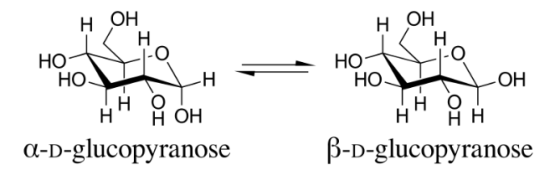
The enzyme mutarotase catalyzes the interconversion of alpha and beta anomeric forms of cyclic sugar. It results in change in optical rotation. The phenomenon is known as mutarotation.
Shown below is an interconvertion between alpha-D-glucopyranose and beta-D-glucopyranose.
Add Answer to:
2. What does the enzyme mutarotase catalyze? Show by an equation using the glucose isomers. 3....
CH401 Biochemistry I Homework Assignment #6, Carbohydrates 1. Indicate whether each of the following pairs of...
 CH401 Biochemistry I Homework Assignment #6, Carbohydrates 1. Indicate whether each of the following pairs of sugars consists of anomers, epimers, enantiomers, or none of these relationships. a. D-glyceraldehyde and dihydroxyacetone. annos b. D-glucose and D-mannose - epimers c. D-erythrose and L-erythrose er m ers d. a-D-glucose and B-D-glucose - enoshowers e. D-ribose and D-arabinose - f. D-galactose and D-glucose - 2. What does the enzyme mutarotase catalyze? Show by an equation using the glucose isomers. 3. Draw the Haworth...
4 and 5 .320dit-C to arriol 92006Tyq bris 92001Tt- od ws7C. obitedoobeib gniwollot dt hot (mot...
 4 and 5
.320dit-C to arriol 92006Tyq bris 92001Tt- od ws7C. obitedoobeib gniwollot dt hot (mot toda bas gftol) smise pitbra1912y2 9dt svið .a но,НО HO,HO HO HO CH401 Biochemistry I Homework Assignment #6, Carbohydrates 1. Indicate whether each of the following pairs of sugars consists of anomers, cpimers, enantiomers, or none of these relationships. a. D-glyceraldehyde and dihydroxyacetone - anomos b. D-glucose and D-mannose - epimers c. D-erythrose and L-erythrose - er hurts d. a-D-glucose and B-D-glucose - ena...
4 and 5
.320dit-C to arriol 92006Tyq bris 92001Tt- od ws7C. obitedoobeib gniwollot dt hot (mot toda bas gftol) smise pitbra1912y2 9dt svið .a но,НО HO,HO HO HO CH401 Biochemistry I Homework Assignment #6, Carbohydrates 1. Indicate whether each of the following pairs of sugars consists of anomers, cpimers, enantiomers, or none of these relationships. a. D-glyceraldehyde and dihydroxyacetone - anomos b. D-glucose and D-mannose - epimers c. D-erythrose and L-erythrose - er hurts d. a-D-glucose and B-D-glucose - ena...
1. Which of the following is an aldohexose? 2. Which of the following is a cetopentose? 3. Which of the following best d...
 1.
Which of the following is an aldohexose?
2. Which of the following is a cetopentose?
3. Which of the following best describes the relationship
between D-glucose and D-fructose?
4. Which of the following is (are) L-alfohexose(s)?
5. Which of the following aldohexose(s) is (are)
dextrorotatory?
6. How many stereoisomers are possible for L-galactose? Draw
or look for its structure.
7. Which of the following conpounds is a pair of
enantiomers?
8. Draw the fisher projection for L-sedoheptulose and also...
1.
Which of the following is an aldohexose?
2. Which of the following is a cetopentose?
3. Which of the following best describes the relationship
between D-glucose and D-fructose?
4. Which of the following is (are) L-alfohexose(s)?
5. Which of the following aldohexose(s) is (are)
dextrorotatory?
6. How many stereoisomers are possible for L-galactose? Draw
or look for its structure.
7. Which of the following conpounds is a pair of
enantiomers?
8. Draw the fisher projection for L-sedoheptulose and also...
Question: You buy a sample of glucose that has the radioactive carbon-14 (C) isotope at the...
 Question: You buy a sample of glucose that has the radioactive carbon-14 (C) isotope at the second position (Carbon #2). All other carbon positions in the glucose molecules have the "C isotope. "C is only a label and does not alter the biochemical behavior of the molecules in which it is found. This glucose sample is mixed with all the enzymes derived from liver cells, which initially contain no other C-labeled chemicals. A) Draw the Haworth structure of glucose and...
A derivative of sucrose that is found in sugar beets and higher plants was analyzed and...
A derivative of sucrose that is found in sugar beets and higher plants was analyzed and found to have the properties listed in the following. (a) Mol. Formula: C18H22O16 MW = 504.4 Assuming the compound is made up of C6 sugars, how many sugars to you expect to find in the molecule? (b) The compound was subjected to acid hydrolysis and gas chromatographic (GC) analysis of its sugar components by means of their per-O-trimethylsilyl ether derivatives. The sugar components...
You wi be assigned to a team of 2 to 4 students. This team wll carry out the design/solve the problem described below Problem 1: Using the following equation (a) Show that the free-space pathloss is...
 You wi be assigned to a team of 2 to 4 students. This team wll carry out the design/solve the problem described below Problem 1: Using the following equation (a) Show that the free-space pathloss is L,(dB) 32.44 + 20Log(fM20Log(dkM) (b) with f = 1900MHz, Plot Lp & RSL as a function of d (Use XCEL) Problem 2: Given: .Free Space Propagation . ERP= 100 Watts Frequency- 1 GHz RSL90dBm ERP=100W RSL -90dBm) Find: d-? The distance d in km...
Please show any equation manipluation. Problem 3 A particle with charge of 2 (UC), mass of...
 Please show any equation manipluation.
Problem 3 A particle with charge of 2 (UC), mass of 2x10-20 (kg) and velocity of 200 (m/s) enters into a magnetic field of 0.06 (T). The particle experiences a force of 1.01X10S(N) in the magnetic field. A) Calculate the angle between velocity and magnetic field directions. B) Calculate the acceleration of charged particle in the magnetic field. C) Draw a diagram showing direction of velocity, magnetic field, force and the angle between velocity and...
Please show any equation manipluation.
Problem 3 A particle with charge of 2 (UC), mass of 2x10-20 (kg) and velocity of 200 (m/s) enters into a magnetic field of 0.06 (T). The particle experiences a force of 1.01X10S(N) in the magnetic field. A) Calculate the angle between velocity and magnetic field directions. B) Calculate the acceleration of charged particle in the magnetic field. C) Draw a diagram showing direction of velocity, magnetic field, force and the angle between velocity and...
Please complete for Tuesday, we will go through the questions and mark them in class. pg 156 - 4.23,...
 Please complete for Tuesday, we will go through the questions and mark them in class. pg 156 - 4.23, 4.24, 4.26 pg 170 - 4.29, 4.31, pg 171-4.36 pg 175 - 4.59 pg 176- 4.74, 4.75, 4.80 pg 177-4.81, 4.82 pg 188- 5.1, 5.4, 5.5, 5.6, 5.11 - Using Table 5.1 pg 198-5.22, 5.25 pg 203 - 5.29 pg 206 - 5.37 pg 209 - 5.39 pg 2.14 5.61 pg 235-6.11, 6.14, 6.16 156 CHAPTER 4 Introduction to Organic Compounds...
Using the book, write another paragraph or two: write 170 words: Q: Compare the assumptions of...
 Using the book, write another paragraph or two: write 170
words:
Q: Compare the assumptions of physician-centered and
collaborative communication. How is the caregiver’s role different
in each model? How is the patient’s role different?
Answer: Physical-centered communication involves the specialists
taking control of the conversation. They decide on the topics of
discussion and when to end the process. The patient responds to the
issues raised by the caregiver and acts accordingly. On the other
hand, Collaborative communication involves a...
Using the book, write another paragraph or two: write 170
words:
Q: Compare the assumptions of physician-centered and
collaborative communication. How is the caregiver’s role different
in each model? How is the patient’s role different?
Answer: Physical-centered communication involves the specialists
taking control of the conversation. They decide on the topics of
discussion and when to end the process. The patient responds to the
issues raised by the caregiver and acts accordingly. On the other
hand, Collaborative communication involves a...
 CH401 Biochemistry I Homework Assignment #6, Carbohydrates 1. Indicate whether each of the following pairs of sugars consists of anomers, epimers, enantiomers, or none of these relationships. a. D-glyceraldehyde and dihydroxyacetone. annos b. D-glucose and D-mannose - epimers c. D-erythrose and L-erythrose er m ers d. a-D-glucose and B-D-glucose - enoshowers e. D-ribose and D-arabinose - f. D-galactose and D-glucose - 2. What does the enzyme mutarotase catalyze? Show by an equation using the glucose isomers. 3. Draw the Haworth...
 4 and 5
.320dit-C to arriol 92006Tyq bris 92001Tt- od ws7C. obitedoobeib gniwollot dt hot (mot toda bas gftol) smise pitbra1912y2 9dt svið .a но,НО HO,HO HO HO CH401 Biochemistry I Homework Assignment #6, Carbohydrates 1. Indicate whether each of the following pairs of sugars consists of anomers, cpimers, enantiomers, or none of these relationships. a. D-glyceraldehyde and dihydroxyacetone - anomos b. D-glucose and D-mannose - epimers c. D-erythrose and L-erythrose - er hurts d. a-D-glucose and B-D-glucose - ena...
4 and 5
.320dit-C to arriol 92006Tyq bris 92001Tt- od ws7C. obitedoobeib gniwollot dt hot (mot toda bas gftol) smise pitbra1912y2 9dt svið .a но,НО HO,HO HO HO CH401 Biochemistry I Homework Assignment #6, Carbohydrates 1. Indicate whether each of the following pairs of sugars consists of anomers, cpimers, enantiomers, or none of these relationships. a. D-glyceraldehyde and dihydroxyacetone - anomos b. D-glucose and D-mannose - epimers c. D-erythrose and L-erythrose - er hurts d. a-D-glucose and B-D-glucose - ena...
 1.
Which of the following is an aldohexose?
2. Which of the following is a cetopentose?
3. Which of the following best describes the relationship
between D-glucose and D-fructose?
4. Which of the following is (are) L-alfohexose(s)?
5. Which of the following aldohexose(s) is (are)
dextrorotatory?
6. How many stereoisomers are possible for L-galactose? Draw
or look for its structure.
7. Which of the following conpounds is a pair of
enantiomers?
8. Draw the fisher projection for L-sedoheptulose and also...
1.
Which of the following is an aldohexose?
2. Which of the following is a cetopentose?
3. Which of the following best describes the relationship
between D-glucose and D-fructose?
4. Which of the following is (are) L-alfohexose(s)?
5. Which of the following aldohexose(s) is (are)
dextrorotatory?
6. How many stereoisomers are possible for L-galactose? Draw
or look for its structure.
7. Which of the following conpounds is a pair of
enantiomers?
8. Draw the fisher projection for L-sedoheptulose and also...
 Question: You buy a sample of glucose that has the radioactive carbon-14 (C) isotope at the second position (Carbon #2). All other carbon positions in the glucose molecules have the "C isotope. "C is only a label and does not alter the biochemical behavior of the molecules in which it is found. This glucose sample is mixed with all the enzymes derived from liver cells, which initially contain no other C-labeled chemicals. A) Draw the Haworth structure of glucose and...
 You wi be assigned to a team of 2 to 4 students. This team wll carry out the design/solve the problem described below Problem 1: Using the following equation (a) Show that the free-space pathloss is L,(dB) 32.44 + 20Log(fM20Log(dkM) (b) with f = 1900MHz, Plot Lp & RSL as a function of d (Use XCEL) Problem 2: Given: .Free Space Propagation . ERP= 100 Watts Frequency- 1 GHz RSL90dBm ERP=100W RSL -90dBm) Find: d-? The distance d in km...
 Please show any equation manipluation.
Problem 3 A particle with charge of 2 (UC), mass of 2x10-20 (kg) and velocity of 200 (m/s) enters into a magnetic field of 0.06 (T). The particle experiences a force of 1.01X10S(N) in the magnetic field. A) Calculate the angle between velocity and magnetic field directions. B) Calculate the acceleration of charged particle in the magnetic field. C) Draw a diagram showing direction of velocity, magnetic field, force and the angle between velocity and...
Please show any equation manipluation.
Problem 3 A particle with charge of 2 (UC), mass of 2x10-20 (kg) and velocity of 200 (m/s) enters into a magnetic field of 0.06 (T). The particle experiences a force of 1.01X10S(N) in the magnetic field. A) Calculate the angle between velocity and magnetic field directions. B) Calculate the acceleration of charged particle in the magnetic field. C) Draw a diagram showing direction of velocity, magnetic field, force and the angle between velocity and...
 Please complete for Tuesday, we will go through the questions and mark them in class. pg 156 - 4.23, 4.24, 4.26 pg 170 - 4.29, 4.31, pg 171-4.36 pg 175 - 4.59 pg 176- 4.74, 4.75, 4.80 pg 177-4.81, 4.82 pg 188- 5.1, 5.4, 5.5, 5.6, 5.11 - Using Table 5.1 pg 198-5.22, 5.25 pg 203 - 5.29 pg 206 - 5.37 pg 209 - 5.39 pg 2.14 5.61 pg 235-6.11, 6.14, 6.16 156 CHAPTER 4 Introduction to Organic Compounds...
 Using the book, write another paragraph or two: write 170
words:
Q: Compare the assumptions of physician-centered and
collaborative communication. How is the caregiver’s role different
in each model? How is the patient’s role different?
Answer: Physical-centered communication involves the specialists
taking control of the conversation. They decide on the topics of
discussion and when to end the process. The patient responds to the
issues raised by the caregiver and acts accordingly. On the other
hand, Collaborative communication involves a...
Using the book, write another paragraph or two: write 170
words:
Q: Compare the assumptions of physician-centered and
collaborative communication. How is the caregiver’s role different
in each model? How is the patient’s role different?
Answer: Physical-centered communication involves the specialists
taking control of the conversation. They decide on the topics of
discussion and when to end the process. The patient responds to the
issues raised by the caregiver and acts accordingly. On the other
hand, Collaborative communication involves a...
Most questions answered within 3 hours.
-
Where is the error in this code sequence?
String s1 = "Hello";
String s2 = "ello";...
asked 10 months ago -
Financial data for Joel de Paris, Inc., for last year
follow:
Joel de Paris, Inc.
Balance...
asked 10 months ago -
Consider this reaction:
Al2(SO4)3 (aq)+ BaCl3
(aq) Al2Cl6 (aq)- +
3BaSO4(s) . What is the...
asked 10 months ago -
Suppose that Savneet is considering increasing her
recent random sample from 20 car rentals to 40...
asked 10 months ago -
Trucks arrive at an unloading terminal at an average rate of 120
per hour.
Trucks arrive...
asked 10 months ago -
Why are methanol and ethanol completely soluble in water while
octanol is not very little soluble....
asked 10 months ago -
A facilities manager at a university reads in a research report
that the mean amount of...
asked 10 months ago -
When the CuSO4 is rehydrated by adding water to the anhydrous
compound, is this an endothermic...
asked 10 months ago -
A ray of sunlight is passing from diamond into crown glass; the
angle of incidence is...
asked 10 months ago -
A block of mass 0.249 kg is placed on top of a light, vertical
spring of...
asked 10 months ago -
how do the kidneys compensate in the presences of acidosis
a) trigger hyperventilate
b) reserve acid...
asked 10 months ago -
Question 501 pts
The rental rate of capital to the firm increases. Which of the
following...
asked 10 months ago