
Homework Answers

![3) pilafouti of Mycencim (130) lomas phier leg CHT} ] concentation of it or 1₂0 lone in solution. formulae but I SoMERS Subst](http://img.homeworklib.com/questions/2729e020-4013-11ea-abae-a357b77063db.png?x-oss-process=image/resize,w_560)
Add Answer to:
please answer all numbered and lettered questions Chapter 2 & 3 1. Atoms and structure of...
1) Define the following: matter, element, atom, trace element, proton, electron, neutron, atomic number, mass number,...
1) Define the following: matter, element, atom, trace element, proton, electron, neutron, atomic number, mass number, isotopes, radioisotope, molecule, compound, salt, ion. 2) List the 6 elements that make up about 99% of the weight of an organism. 3) What are the functions of the trace elements iron, fluorine (fluoride), and iodine? 4) An iodine deficiency can result in goiter. True/False 5) Where are protons, neutrons and electrons located? 6) Can you determine the atomic number and mass number from...
Answer 1-4 (#3 and #4 are tables) shell provides stability to the atom. Different chemical bonds...
 Answer 1-4 (#3 and #4 are tables)
shell provides stability to the atom. Different chemical bonds are based on the way in which the atoms fill their valence shells. The major types of chemical bonds include: ionic bonds covalent bonds (both types, i.c. polar covalent and non-polar covalent bonds), and hydrogen bonds. Atoms can use two strategies to fill their valence shell: they can share electrons between their valence shells, or they can give or take electrons from other nearby...
Answer 1-4 (#3 and #4 are tables)
shell provides stability to the atom. Different chemical bonds are based on the way in which the atoms fill their valence shells. The major types of chemical bonds include: ionic bonds covalent bonds (both types, i.c. polar covalent and non-polar covalent bonds), and hydrogen bonds. Atoms can use two strategies to fill their valence shell: they can share electrons between their valence shells, or they can give or take electrons from other nearby...
14. When are atoms most stable? A) when they have the fewest possible yale (B) when...
 14. When are atoms most stable? A) when they have the fewest possible yale (B) when they have the ma C) when all of the electron Orbit D) when all electrons are paired e the fewest possible valence electrons they have the maximum number of unpaired electrons in all of the electron orbitals in the valence shell are filled ods with 15. Water molecules can form hydrogen bonds with Acompounds that have polar covalent bonds B) compounds that have non-polar...
1. Describe the basic structure of atoms and atomic stability. 2. Differentiate between ionic, covalent (polar...
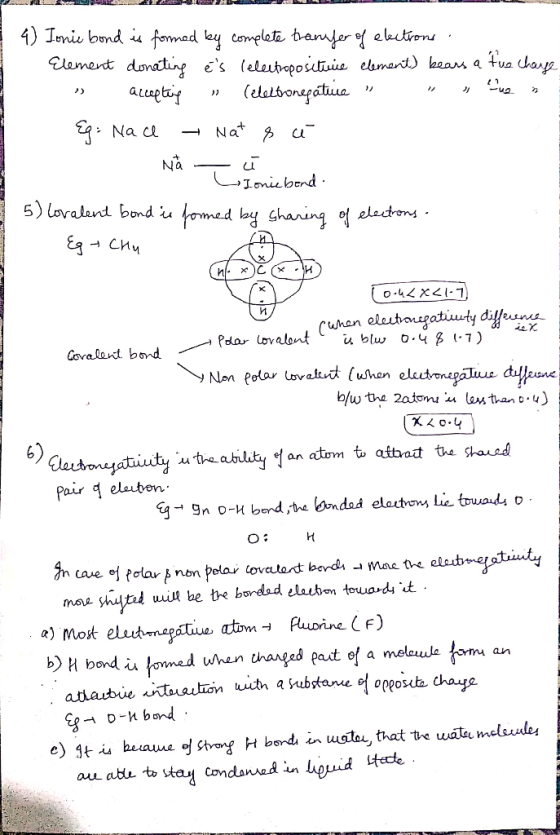
1. Describe the basic structure of atoms and atomic stability. 2. Differentiate between ionic, covalent (polar vs. nonpolar) and hydrogen bonds. 3. Discuss the unique characteristics of water. 4. Identify the different types of biological molecules, and explain their basic structures and functions. 5. Differentiate monomers from polymers, and be able to list monomers (subunits) for each type of biological molecule.
QUESTIONS RELATE TO: HYDROCODONE 1. A.) Draw the expanded structural formula of HYDROCODONE (showing all atoms...
QUESTIONS RELATE TO: HYDROCODONE 1. A.) Draw the expanded structural formula of HYDROCODONE (showing all atoms and all covalent bonds). If it contains atoms other than C or H add lone pairs of electrons to each until the octet rule is satisfied for that atom. B.) Determine molecular geometry of each central atom. C.) For each central atom decide if it is polar or non polar. 2. Illustrate all ways that hydrocodone molecule could form hydrogen bonds with water. Do...
Atoms and Isotopes 1 Activity: Atoms and Isotopes Why? Atoms and isotopes are identified by the...
 Atoms and Isotopes 1 Activity: Atoms and Isotopes Why? Atoms and isotopes are identified by the numbers of protons, electrons, and neutrons that they contain The number of protons, electrons, and neutrons in atoms determines the chemical properties of the elements .A knowledge of the number of protons and electrons in an atom will help you understand how atoms combine to form molecules Identify the composition of atoms in terms of protons, neutrons, and electrons Use atomic symbols to represent...
e. 18 Test Your Knowledge MULTIPLE CHOICE: Choose the one best answer. 1. Each element has...
 e. 18 Test Your Knowledge MULTIPLE CHOICE: Choose the one best answer. 1. Each element has its own characteristic atom in which a. the atomic mass is constant. b. the atomic number is constant. c. the mass number is constant. d. Two of the above are correct. e. All of the above are correct. 2. Which of the following is not a trace element in the human body? a. iodine b. zinc c. iron d. calcium e. fluorine 3. A...
Multiple choice. Please answer all questions 1) Which material can display Van der Waals Bonding? Metals Cer...
Multiple choice. Please answer all questions 1) Which material can display Van der Waals Bonding? Metals Ceramics Metals Molecular Solids Semi-Metals 2) Which type of bonding is a secondary bonding? Metallic Covelant Ionic Pair bonding Van Der Waals 3) What type of bonding do semi-metals have? Ionic Van der Waals Mixed covalent-metallic Covalent Mixed metallic-ionic 4) Which of the following are a primary atomic bond? hybridize valence van der Waals electrical metallic 5) In Hydrogen bonds: highly polar molecules form...
Do not refer to the text when taking this test. An element has an atomic number...
 Do not refer to the text when taking this test. An element has an atomic number of 11 and an atomic weight of 23. Its number of neutrons is a. 11. b. 12. c. 23. d. 24. The atom of an clement has 1 proton and 2 neutrons. Its atomic number is a. 1. b. 2. c. 3. d. 6. The atom of an element has 6 protons and 8 neutrons. The number of electrons in this atom is a....
Hello, I was wondering if you could check my answers 27. Within wi:1.PBLSteatorn withthe Small stttomic...
 Hello, I was wondering if you could check my answers
27. Within wi:1.PBLSteatorn withthe Small stttomic radius a) Bi c) As 2nd is Sma lles S mall 28. Within Group 14, which of the following is the, most metallic elemen b Si Ge 29. Which of the following has an ionic radius that is smaller than its atomic radius? a) neon Nc nitrogen c) sodiuma sulfur 30. Which of the following molecules does not have a polar covalent bond? a)...
Hello, I was wondering if you could check my answers
27. Within wi:1.PBLSteatorn withthe Small stttomic radius a) Bi c) As 2nd is Sma lles S mall 28. Within Group 14, which of the following is the, most metallic elemen b Si Ge 29. Which of the following has an ionic radius that is smaller than its atomic radius? a) neon Nc nitrogen c) sodiuma sulfur 30. Which of the following molecules does not have a polar covalent bond? a)...
 Answer 1-4 (#3 and #4 are tables)
shell provides stability to the atom. Different chemical bonds are based on the way in which the atoms fill their valence shells. The major types of chemical bonds include: ionic bonds covalent bonds (both types, i.c. polar covalent and non-polar covalent bonds), and hydrogen bonds. Atoms can use two strategies to fill their valence shell: they can share electrons between their valence shells, or they can give or take electrons from other nearby...
Answer 1-4 (#3 and #4 are tables)
shell provides stability to the atom. Different chemical bonds are based on the way in which the atoms fill their valence shells. The major types of chemical bonds include: ionic bonds covalent bonds (both types, i.c. polar covalent and non-polar covalent bonds), and hydrogen bonds. Atoms can use two strategies to fill their valence shell: they can share electrons between their valence shells, or they can give or take electrons from other nearby...
 14. When are atoms most stable? A) when they have the fewest possible yale (B) when they have the ma C) when all of the electron Orbit D) when all electrons are paired e the fewest possible valence electrons they have the maximum number of unpaired electrons in all of the electron orbitals in the valence shell are filled ods with 15. Water molecules can form hydrogen bonds with Acompounds that have polar covalent bonds B) compounds that have non-polar...
 Atoms and Isotopes 1 Activity: Atoms and Isotopes Why? Atoms and isotopes are identified by the numbers of protons, electrons, and neutrons that they contain The number of protons, electrons, and neutrons in atoms determines the chemical properties of the elements .A knowledge of the number of protons and electrons in an atom will help you understand how atoms combine to form molecules Identify the composition of atoms in terms of protons, neutrons, and electrons Use atomic symbols to represent...
 e. 18 Test Your Knowledge MULTIPLE CHOICE: Choose the one best answer. 1. Each element has its own characteristic atom in which a. the atomic mass is constant. b. the atomic number is constant. c. the mass number is constant. d. Two of the above are correct. e. All of the above are correct. 2. Which of the following is not a trace element in the human body? a. iodine b. zinc c. iron d. calcium e. fluorine 3. A...
 Do not refer to the text when taking this test. An element has an atomic number of 11 and an atomic weight of 23. Its number of neutrons is a. 11. b. 12. c. 23. d. 24. The atom of an clement has 1 proton and 2 neutrons. Its atomic number is a. 1. b. 2. c. 3. d. 6. The atom of an element has 6 protons and 8 neutrons. The number of electrons in this atom is a....
 Hello, I was wondering if you could check my answers
27. Within wi:1.PBLSteatorn withthe Small stttomic radius a) Bi c) As 2nd is Sma lles S mall 28. Within Group 14, which of the following is the, most metallic elemen b Si Ge 29. Which of the following has an ionic radius that is smaller than its atomic radius? a) neon Nc nitrogen c) sodiuma sulfur 30. Which of the following molecules does not have a polar covalent bond? a)...
Hello, I was wondering if you could check my answers
27. Within wi:1.PBLSteatorn withthe Small stttomic radius a) Bi c) As 2nd is Sma lles S mall 28. Within Group 14, which of the following is the, most metallic elemen b Si Ge 29. Which of the following has an ionic radius that is smaller than its atomic radius? a) neon Nc nitrogen c) sodiuma sulfur 30. Which of the following molecules does not have a polar covalent bond? a)...
Most questions answered within 3 hours.
-
Where is the error in this code sequence?
String s1 = "Hello";
String s2 = "ello";...
asked 11 months ago -
Financial data for Joel de Paris, Inc., for last year
follow:
Joel de Paris, Inc.
Balance...
asked 11 months ago -
Consider this reaction:
Al2(SO4)3 (aq)+ BaCl3
(aq) Al2Cl6 (aq)- +
3BaSO4(s) . What is the...
asked 11 months ago -
Suppose that Savneet is considering increasing her
recent random sample from 20 car rentals to 40...
asked 11 months ago -
Trucks arrive at an unloading terminal at an average rate of 120
per hour.
Trucks arrive...
asked 11 months ago -
Why are methanol and ethanol completely soluble in water while
octanol is not very little soluble....
asked 11 months ago -
A facilities manager at a university reads in a research report
that the mean amount of...
asked 11 months ago -
When the CuSO4 is rehydrated by adding water to the anhydrous
compound, is this an endothermic...
asked 11 months ago -
A ray of sunlight is passing from diamond into crown glass; the
angle of incidence is...
asked 11 months ago -
A block of mass 0.249 kg is placed on top of a light, vertical
spring of...
asked 11 months ago -
how do the kidneys compensate in the presences of acidosis
a) trigger hyperventilate
b) reserve acid...
asked 11 months ago -
Question 501 pts
The rental rate of capital to the firm increases. Which of the
following...
asked 11 months ago