
Homework Answers
Add Answer to:
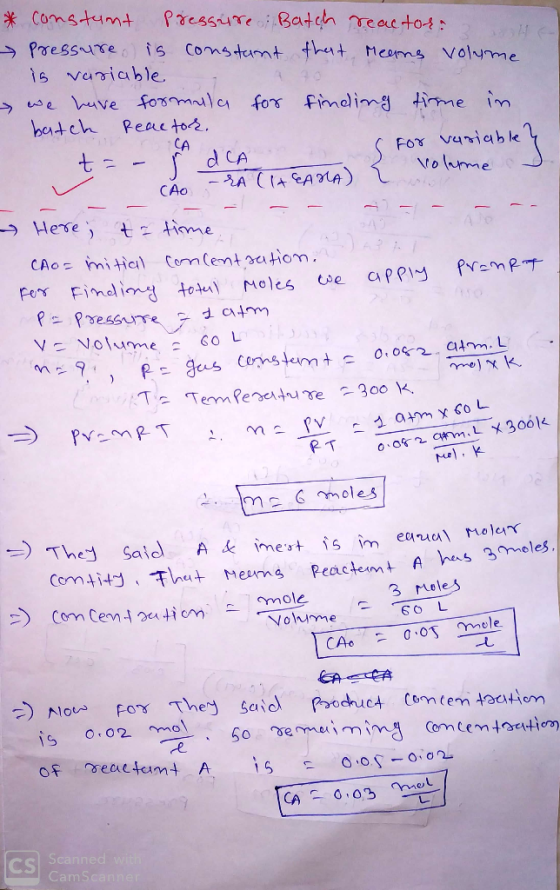
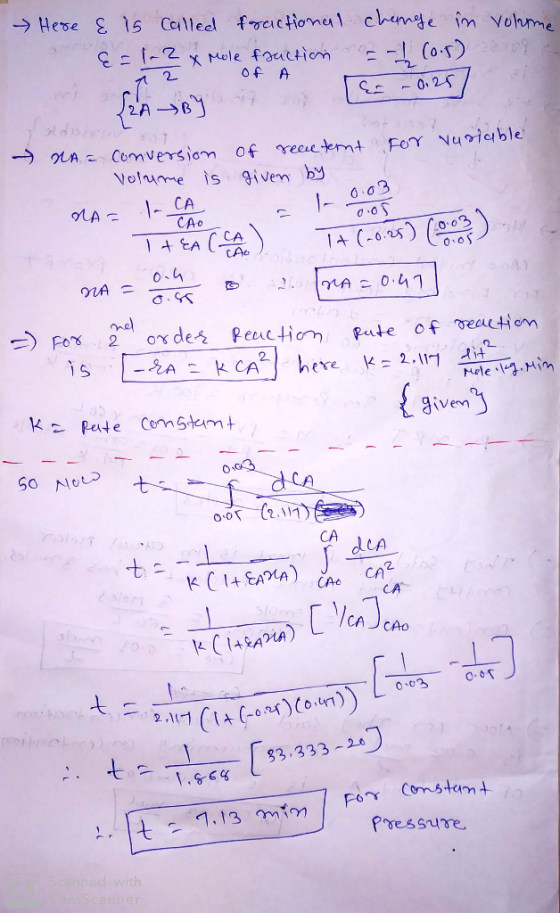
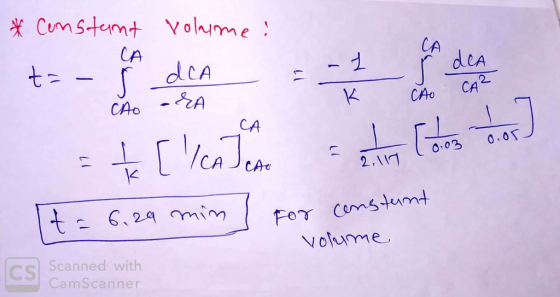
The second order gas phase irreversible reaction: 2.4-B is carried out in an isothermal batch reactor...
Data possibly uselul to all prouteS Im-1000 dm, R-0.082 (Latm)(mole K)-8.314 J/(mol K)- 1.987 cal/(mol )...
 Data possibly uselul to all prouteS Im-1000 dm, R-0.082 (Latm)(mole K)-8.314 J/(mol K)- 1.987 cal/(mol ) Problem 1 (6 out of 30 points) The second order gas phase irreversible reaction: 2.4-B is carried out in an isothermal batch reactor containing 40 kg of catalyst and with an initial volume of 60-liter. The reactor is initially filled with equal molar quantities of A and inert I at 300 K and 2.5 atm. Calculate the time needed for the concentration of product...
Total Grade: 30 out of 30-Answer all questions Data possibly mseful to all problems Im-1000 dm...
 Total Grade: 30 out of 30-Answer all questions Data possibly mseful to all problems Im-1000 dm R-0.082 (L"atmYmole K)-8 .314 1(mol K) - 1.987 cal/(mol K) Problem 1 (6 out of 30 points): he second order gas phase irreversible reaction: 24- 8 is carried out in an isothermal batch reactor containing 40 kg of catalyst and with an initial volume of 60-iter. The reactor is initially filled with equal molar quantities of A and inert at 300 K and 2.5...
Exercise 4.4: Catalyst deactivation in a batch reactor Consider the irreversible, liquid-phase isomerization reaction carried out...
 Exercise 4.4: Catalyst deactivation in a batch reactor Consider the irreversible, liquid-phase isomerization reaction carried out in a solvent containing dissolved catalyst at 25°C in a batch reactor Aka B The apparent first-order reaction-rate constant, ka, decreases with time because of cat- alyst deterioration. A chemist colleague of yours has studied the catalyst deactivation process and has proposed that it can be modeled by ka= Tt kat in which k is the fresh catalyst rate constant and ka is the...
3. The endothemic irreversible 2nd order reaction A +B C is carried out in a pressurised...
 3. The endothemic irreversible 2nd order reaction A +B C is carried out in a pressurised adiabatic batch reactor. The initial temperature is 120°C and the initial concentrations of both A and B are 2.0 kmol m2 Kinetic studies showed that the reaction rate constant is given by: 6000 k 2 x 10⁵ exp(- m3kmol 1s1 T (8) (a) Derive the mass and energy balances for the reactor. Calculate the conversion achieved and the reactor temperature (b) (12) after 30...
The first order irreversible reaction A -> B is carried out in a CSTR. The rate...
The first order irreversible reaction A -> B is carried out in a CSTR. The rate constant is 0.05 s^-1 and the volumetric flowrate is 0.02 m^3 s^-1. What volume of reactor is required in order to achieve a conversion of 80%? Hint:(Conversation of Ca to molar flowrate/volumetric flowrate)
Question 5 (8 Marks): The first order irreversible gas phase reaction a- A B is to be carried out in a packed bed react...
 Question 5 (8 Marks): The first order irreversible gas phase reaction a- A B is to be carried out in a packed bed reactor with a 1,000 kg of reforming catalyst are packed. The entering pressure is 20 atm and the pressure at the exit of the reactor is 1.0 atm. Calculate the pressure drop parameter. b- Sketch one reactor that is normally used to maximize the selectivity Briefly describe the two terms in the Arrhenius equation C-
Question 5...
Question 5 (8 Marks): The first order irreversible gas phase reaction a- A B is to be carried out in a packed bed reactor with a 1,000 kg of reforming catalyst are packed. The entering pressure is 20 atm and the pressure at the exit of the reactor is 1.0 atm. Calculate the pressure drop parameter. b- Sketch one reactor that is normally used to maximize the selectivity Briefly describe the two terms in the Arrhenius equation C-
Question 5...
Question 1: Design of isothermal reactors 30 Marks The irreversible, gas-phase reaction A+B D is to be carried out...
 Question 1: Design of isothermal reactors 30 Marks The irreversible, gas-phase reaction A+B D is to be carried out in an isotherma °C) plug-flow reactor (PFR) at 5.0 atm. The mole fractions of the feed streams are A 0 B 0.50, and inerts 0.30. The activation energy for the above reaction is 80 000 cal/mol. the pressure drop due to fluid friction in the reactor is so small that it can be ignored, perform the following tasks: 2T a s...
The elementary irreversible organic liquid-phase reaction. a+b==>c is carried out adiabatically in a flow reactor. An...
The elementary irreversible organic liquid-phase reaction. a+b==>c is carried out adiabatically in a flow reactor. An equal molar feed in A and 8 enters at 27'C, and the volumetric flow rate is 2 dm3/sa nd CAo= 0.I k molfm3 graphically.on exal
The irreversible, endothermic, elementary, liquid-phase reaction: 2A ---> B, is carried out adiabatically in a 100 li...
The irreversible, endothermic, elementary, liquid-phase reaction: 2A ---> B, is carried out adiabatically in a 100 liter PRF. Species A and inert liquid are fed to the reactor with concentrations CAo = 1.5 mol/l and CIo = 1.5 mol/l, while FAo=20 mol/min. The entering temperature is 400 K. Calculate the conversion and temperature at the exit of the reactor, given the additional information below: k = 0.0003 l/(mol*min) at 300 K E= 12000 cal/(mol* K) CpA = 10 cal/(mol*K), CpB...
An acid-catalyzed irreversible liquid-phase reaction A B is carried out adiabatically in a CSTR. The reaction is second...
 An acid-catalyzed irreversible liquid-phase reaction A B is carried out adiabatically in a CSTR. The reaction is second order in A. The feed is equimolar A and solvent (S, which contains catalyst), and enters the reactor at a total volumetric flow rate of 10 dm3/min at a concentration of A of 4 mol/L. The feed enters at 300 K. The product and reactant heat capacities are 15 cal/(mol°C), the solvent is 18 cal/(mol°C). The reaction rate constant at 300 K...
 Data possibly uselul to all prouteS Im-1000 dm, R-0.082 (Latm)(mole K)-8.314 J/(mol K)- 1.987 cal/(mol ) Problem 1 (6 out of 30 points) The second order gas phase irreversible reaction: 2.4-B is carried out in an isothermal batch reactor containing 40 kg of catalyst and with an initial volume of 60-liter. The reactor is initially filled with equal molar quantities of A and inert I at 300 K and 2.5 atm. Calculate the time needed for the concentration of product...
 Total Grade: 30 out of 30-Answer all questions Data possibly mseful to all problems Im-1000 dm R-0.082 (L"atmYmole K)-8 .314 1(mol K) - 1.987 cal/(mol K) Problem 1 (6 out of 30 points): he second order gas phase irreversible reaction: 24- 8 is carried out in an isothermal batch reactor containing 40 kg of catalyst and with an initial volume of 60-iter. The reactor is initially filled with equal molar quantities of A and inert at 300 K and 2.5...
 Exercise 4.4: Catalyst deactivation in a batch reactor Consider the irreversible, liquid-phase isomerization reaction carried out in a solvent containing dissolved catalyst at 25°C in a batch reactor Aka B The apparent first-order reaction-rate constant, ka, decreases with time because of cat- alyst deterioration. A chemist colleague of yours has studied the catalyst deactivation process and has proposed that it can be modeled by ka= Tt kat in which k is the fresh catalyst rate constant and ka is the...
 3. The endothemic irreversible 2nd order reaction A +B C is carried out in a pressurised adiabatic batch reactor. The initial temperature is 120°C and the initial concentrations of both A and B are 2.0 kmol m2 Kinetic studies showed that the reaction rate constant is given by: 6000 k 2 x 10⁵ exp(- m3kmol 1s1 T (8) (a) Derive the mass and energy balances for the reactor. Calculate the conversion achieved and the reactor temperature (b) (12) after 30...
 Question 5 (8 Marks): The first order irreversible gas phase reaction a- A B is to be carried out in a packed bed reactor with a 1,000 kg of reforming catalyst are packed. The entering pressure is 20 atm and the pressure at the exit of the reactor is 1.0 atm. Calculate the pressure drop parameter. b- Sketch one reactor that is normally used to maximize the selectivity Briefly describe the two terms in the Arrhenius equation C-
Question 5...
Question 5 (8 Marks): The first order irreversible gas phase reaction a- A B is to be carried out in a packed bed reactor with a 1,000 kg of reforming catalyst are packed. The entering pressure is 20 atm and the pressure at the exit of the reactor is 1.0 atm. Calculate the pressure drop parameter. b- Sketch one reactor that is normally used to maximize the selectivity Briefly describe the two terms in the Arrhenius equation C-
Question 5...
 Question 1: Design of isothermal reactors 30 Marks The irreversible, gas-phase reaction A+B D is to be carried out in an isotherma °C) plug-flow reactor (PFR) at 5.0 atm. The mole fractions of the feed streams are A 0 B 0.50, and inerts 0.30. The activation energy for the above reaction is 80 000 cal/mol. the pressure drop due to fluid friction in the reactor is so small that it can be ignored, perform the following tasks: 2T a s...
 An acid-catalyzed irreversible liquid-phase reaction A B is carried out adiabatically in a CSTR. The reaction is second order in A. The feed is equimolar A and solvent (S, which contains catalyst), and enters the reactor at a total volumetric flow rate of 10 dm3/min at a concentration of A of 4 mol/L. The feed enters at 300 K. The product and reactant heat capacities are 15 cal/(mol°C), the solvent is 18 cal/(mol°C). The reaction rate constant at 300 K...
Most questions answered within 3 hours.
-
Where is the error in this code sequence?
String s1 = "Hello";
String s2 = "ello";...
asked 10 months ago -
Financial data for Joel de Paris, Inc., for last year
follow:
Joel de Paris, Inc.
Balance...
asked 10 months ago -
Consider this reaction:
Al2(SO4)3 (aq)+ BaCl3
(aq) Al2Cl6 (aq)- +
3BaSO4(s) . What is the...
asked 10 months ago -
Suppose that Savneet is considering increasing her
recent random sample from 20 car rentals to 40...
asked 10 months ago -
Trucks arrive at an unloading terminal at an average rate of 120
per hour.
Trucks arrive...
asked 10 months ago -
Why are methanol and ethanol completely soluble in water while
octanol is not very little soluble....
asked 10 months ago -
A facilities manager at a university reads in a research report
that the mean amount of...
asked 10 months ago -
When the CuSO4 is rehydrated by adding water to the anhydrous
compound, is this an endothermic...
asked 10 months ago -
A ray of sunlight is passing from diamond into crown glass; the
angle of incidence is...
asked 10 months ago -
A block of mass 0.249 kg is placed on top of a light, vertical
spring of...
asked 10 months ago -
how do the kidneys compensate in the presences of acidosis
a) trigger hyperventilate
b) reserve acid...
asked 10 months ago -
Question 501 pts
The rental rate of capital to the firm increases. Which of the
following...
asked 10 months ago