In the figure below, ?1 = 23? , ?2 = 67? , ?3 = 33? ,...
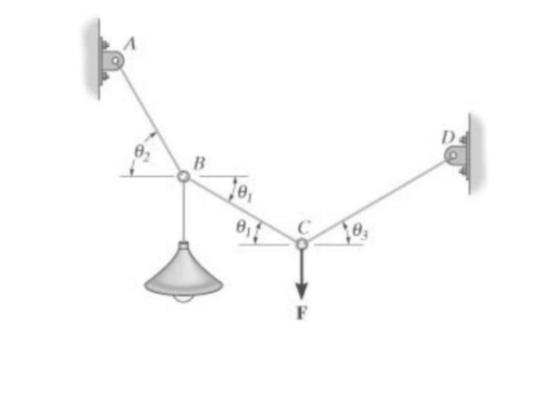
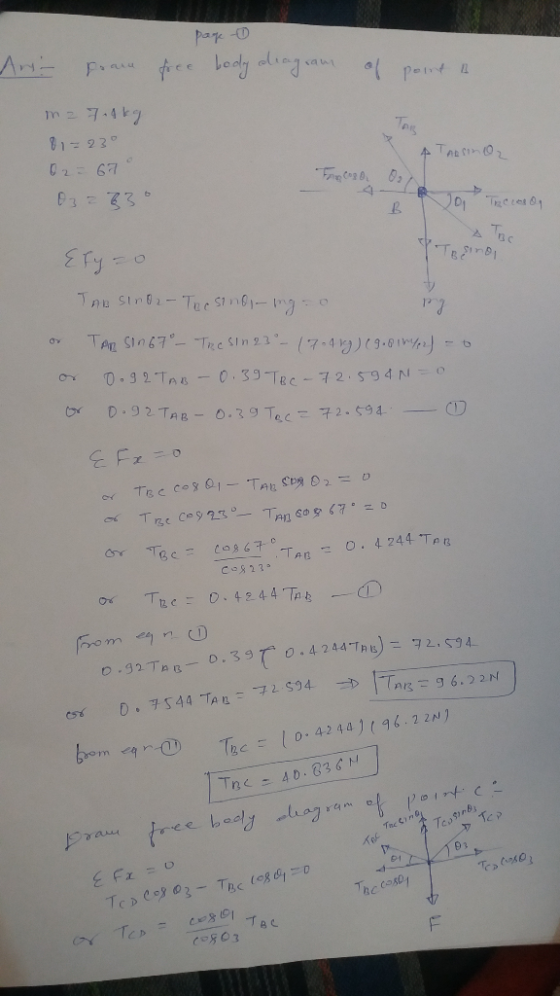
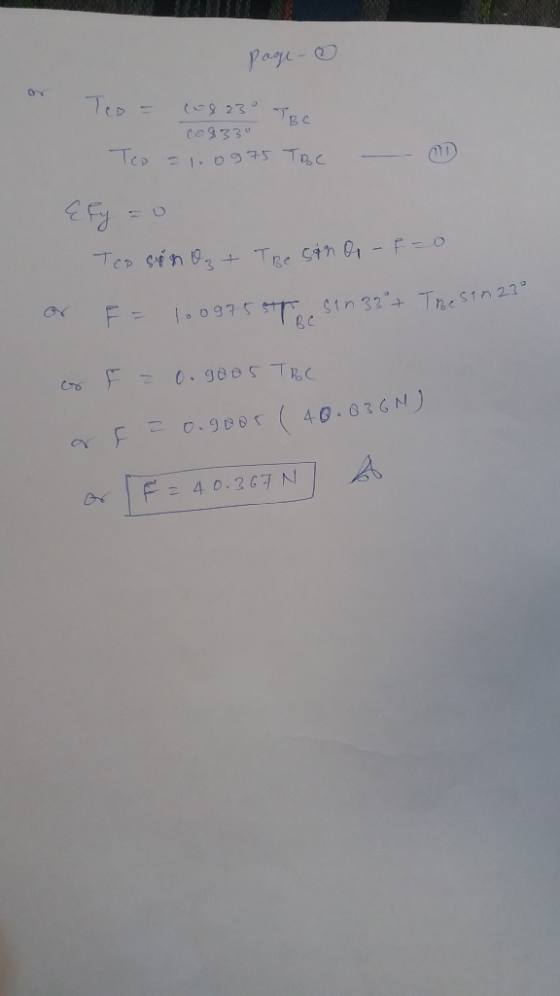
In the figure below, ?1 = 23? , ?2 = 67? , ?3 = 33? , and the light has a mass of 7.4 ??. Determine the force ? that puts the system in static equilibrium.
Homework Answers
Consider the mass-spring-damper system depicted in the figure below, where the input of the system is...
 Consider the mass-spring-damper system depicted in the figure below, where the input of the system is the applied force F(t) and the output of the system is xít) that is the displacement of the mass according to the coordinate system defined in that figure. Assume that force F(t) is applied for t> 0 and the system is in static equilibrium before t=0 and z(t) is measured from the static equilibrium. b m F Also, the mass of the block, the...
Q8. (6 pts.) Physics 211 Review: Static Equilibrium, Vector Addition & Trigonometry The figure below shows...
 Q8. (6 pts.) Physics 211 Review: Static Equilibrium, Vector Addition & Trigonometry The figure below shows a mass M suspended from a vertical string. A horizontal force F is applied to the mass as shown, so that it is deflected by an angle 6 from the vertical. The entire system is in static equilibrium. Draw the free body diagram for the forces acting on the mass and determine an expression that relates F to the mass Mand the angle e....
2. Consider the system shown in the figure below, comprised of the same motor, steel beam,...
 2. Consider the system shown in the figure below, comprised of the same motor, steel beam, steel cable and crate All assumptions and properties are the same with one exception; the cable is no longer considered as rigid Cable properties: length = 4 m, diameter = 0.007 m, E = 207 GPa, Calculate the equivalent stiffness of the cable, in units of N/m. (See table 4.1.1 in your textbook) Draw an equivalent system diagram where the beam and cable each...
QUESTION 23 Through (-4,-33) and (10, 79) O y = -8x - 65 67 Oy--8-2 O...
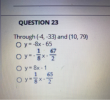 QUESTION 23 Through (-4,-33) and (10, 79) O y = -8x - 65 67 Oy--8-2 O y = 8x - 1 65 Oy- gx 2
The system shown in the following figure is in static equilibrium and the angle θ =...
The system shown in the following figure is in static equilibrium and the angle θ = 33°. Given that the mass m1 is 8.80 kg and the coefficient of static friction between mass m1 and the surface on which it rests is 0.32, what is the maximum mass that m2 can have for which the system will still remain in equilibrium?
Please use Lagrange's Equation and solve both parts. 2. (30 Points) For the figure shown below,...
 Please use Lagrange's Equation and solve both parts.
2. (30 Points) For the figure shown below, find the equations of motion by Lagrange's equations. Assume that all variables are measured from static equilibrium. (20 Points) Determine the condition under which the steady-state displacement of the mass m will be zero. Assume the Disc of mass M is described by the coordinate and has mass moment of inertia J. Disc, mass M Rolls without slipping Pulley Cord Fisin (0) Figure 2:...
Please use Lagrange's Equation and solve both parts.
2. (30 Points) For the figure shown below, find the equations of motion by Lagrange's equations. Assume that all variables are measured from static equilibrium. (20 Points) Determine the condition under which the steady-state displacement of the mass m will be zero. Assume the Disc of mass M is described by the coordinate and has mass moment of inertia J. Disc, mass M Rolls without slipping Pulley Cord Fisin (0) Figure 2:...
2. Determine the forces P and Q in the force system shown in the figure below....
 2. Determine the forces P and Q in the force system shown in the figure below. All the forces are in equilibrium YE) 50 lb
Consider the system of blocks in the figure below, with m2 = 4.9 kg and θ...
Consider the system of blocks in the figure below, with m2 = 4.9 kg and θ = 33°. If the coefficient of static friction between block #1 and the inclined plane is μS = 0.25, what is the largest mass m1 for which the blocks will remain at rest?
Consider the exhibit below for the following questions. Figure 33-4 Refer to Figure 33-4. The economy...
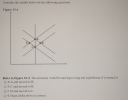 Consider the exhibit below for the following questions. Figure 33-4 Refer to Figure 33-4. The economy would be moving to long-run equilibrium if it started at a. A and moved to B. b. C and moved to B. C. D and moved to C. d. None of the above is correct.
Please solve 3-1, 3-2, 3-3. I am most interested in the solution for 3-3 however. Please...
 Please solve 3-1, 3-2, 3-3.
I am most interested in the solution for 3-3 however.
Please show all steps clearly
Thank you
Figure (a) shows a mechanical vibratory system. When 2 N of force (step input) is applied to system, the mass Oscillates, as shown in Figure (b). Assuming that the mechanical system show here is at rest before excitation force f(t) = 2 N is given. The displacement x is measured from the equilibrium position. f(t) = 2 N...
Please solve 3-1, 3-2, 3-3.
I am most interested in the solution for 3-3 however.
Please show all steps clearly
Thank you
Figure (a) shows a mechanical vibratory system. When 2 N of force (step input) is applied to system, the mass Oscillates, as shown in Figure (b). Assuming that the mechanical system show here is at rest before excitation force f(t) = 2 N is given. The displacement x is measured from the equilibrium position. f(t) = 2 N...
 Consider the mass-spring-damper system depicted in the figure below, where the input of the system is the applied force F(t) and the output of the system is xít) that is the displacement of the mass according to the coordinate system defined in that figure. Assume that force F(t) is applied for t> 0 and the system is in static equilibrium before t=0 and z(t) is measured from the static equilibrium. b m F Also, the mass of the block, the...
 Q8. (6 pts.) Physics 211 Review: Static Equilibrium, Vector Addition & Trigonometry The figure below shows a mass M suspended from a vertical string. A horizontal force F is applied to the mass as shown, so that it is deflected by an angle 6 from the vertical. The entire system is in static equilibrium. Draw the free body diagram for the forces acting on the mass and determine an expression that relates F to the mass Mand the angle e....
 2. Consider the system shown in the figure below, comprised of the same motor, steel beam, steel cable and crate All assumptions and properties are the same with one exception; the cable is no longer considered as rigid Cable properties: length = 4 m, diameter = 0.007 m, E = 207 GPa, Calculate the equivalent stiffness of the cable, in units of N/m. (See table 4.1.1 in your textbook) Draw an equivalent system diagram where the beam and cable each...
 QUESTION 23 Through (-4,-33) and (10, 79) O y = -8x - 65 67 Oy--8-2 O y = 8x - 1 65 Oy- gx 2
 Please use Lagrange's Equation and solve both parts.
2. (30 Points) For the figure shown below, find the equations of motion by Lagrange's equations. Assume that all variables are measured from static equilibrium. (20 Points) Determine the condition under which the steady-state displacement of the mass m will be zero. Assume the Disc of mass M is described by the coordinate and has mass moment of inertia J. Disc, mass M Rolls without slipping Pulley Cord Fisin (0) Figure 2:...
Please use Lagrange's Equation and solve both parts.
2. (30 Points) For the figure shown below, find the equations of motion by Lagrange's equations. Assume that all variables are measured from static equilibrium. (20 Points) Determine the condition under which the steady-state displacement of the mass m will be zero. Assume the Disc of mass M is described by the coordinate and has mass moment of inertia J. Disc, mass M Rolls without slipping Pulley Cord Fisin (0) Figure 2:...
 2. Determine the forces P and Q in the force system shown in the figure below. All the forces are in equilibrium YE) 50 lb
 Consider the exhibit below for the following questions. Figure 33-4 Refer to Figure 33-4. The economy would be moving to long-run equilibrium if it started at a. A and moved to B. b. C and moved to B. C. D and moved to C. d. None of the above is correct.
 Please solve 3-1, 3-2, 3-3.
I am most interested in the solution for 3-3 however.
Please show all steps clearly
Thank you
Figure (a) shows a mechanical vibratory system. When 2 N of force (step input) is applied to system, the mass Oscillates, as shown in Figure (b). Assuming that the mechanical system show here is at rest before excitation force f(t) = 2 N is given. The displacement x is measured from the equilibrium position. f(t) = 2 N...
Please solve 3-1, 3-2, 3-3.
I am most interested in the solution for 3-3 however.
Please show all steps clearly
Thank you
Figure (a) shows a mechanical vibratory system. When 2 N of force (step input) is applied to system, the mass Oscillates, as shown in Figure (b). Assuming that the mechanical system show here is at rest before excitation force f(t) = 2 N is given. The displacement x is measured from the equilibrium position. f(t) = 2 N...
Most questions answered within 3 hours.
-
Where is the error in this code sequence?
String s1 = "Hello";
String s2 = "ello";...
asked 11 months ago -
Financial data for Joel de Paris, Inc., for last year
follow:
Joel de Paris, Inc.
Balance...
asked 11 months ago -
Consider this reaction:
Al2(SO4)3 (aq)+ BaCl3
(aq) Al2Cl6 (aq)- +
3BaSO4(s) . What is the...
asked 11 months ago -
Suppose that Savneet is considering increasing her
recent random sample from 20 car rentals to 40...
asked 11 months ago -
Trucks arrive at an unloading terminal at an average rate of 120
per hour.
Trucks arrive...
asked 11 months ago -
Why are methanol and ethanol completely soluble in water while
octanol is not very little soluble....
asked 11 months ago -
A facilities manager at a university reads in a research report
that the mean amount of...
asked 11 months ago -
When the CuSO4 is rehydrated by adding water to the anhydrous
compound, is this an endothermic...
asked 11 months ago -
A ray of sunlight is passing from diamond into crown glass; the
angle of incidence is...
asked 11 months ago -
A block of mass 0.249 kg is placed on top of a light, vertical
spring of...
asked 11 months ago -
how do the kidneys compensate in the presences of acidosis
a) trigger hyperventilate
b) reserve acid...
asked 11 months ago -
Question 501 pts
The rental rate of capital to the firm increases. Which of the
following...
asked 11 months ago