One yak, (m1) with a mass 500 kg is sitting still on a frictionless surface when...
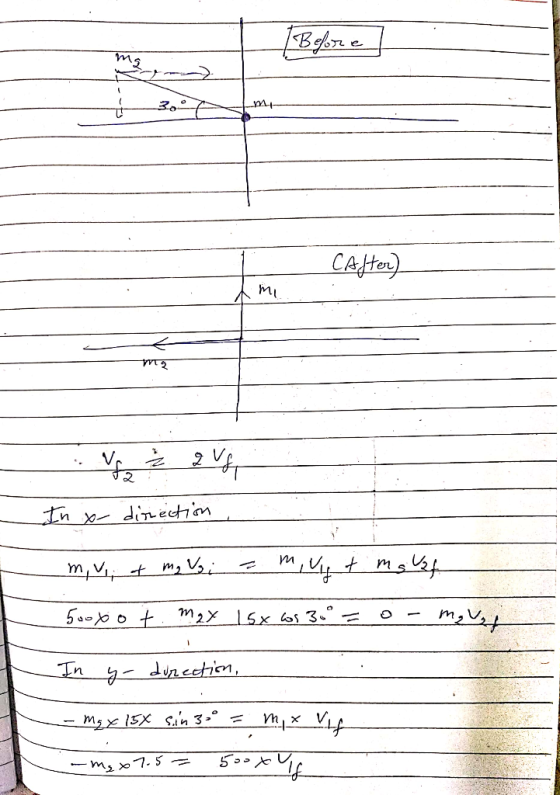
One yak, (m1) with a mass 500 kg is sitting still on a frictionless surface when a smaller yak (m2) charges into it at a velocity of 15 m/s in a direction 30° north of west. After the two collide the smaller yak is traveling due west while the larger yak is traveling due north. The smaller yak’s final speed is twice that of the larger yak.
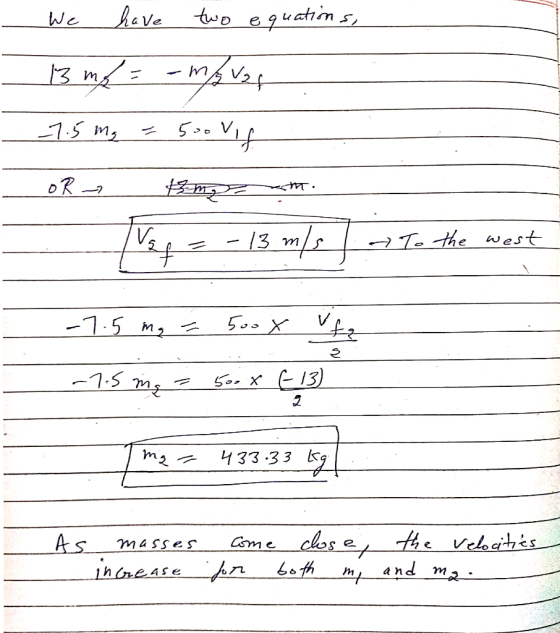
(a) What is the mass of the smaller yak?
(b) What is the final speed of the smaller yak?
(c) Use Proportionality in conjunction with Special Cases sense-making to check your answer in part (b). How would the final speed change as their masses get more disparate or closer together? What happens as the ratio of the masses goes to zero or infinity?
Homework Answers
Add Answer to:
One yak, (m1) with a mass 500 kg is sitting still on a frictionless surface when...
Car mass m1 is traveling due east at 45 mph and car with mass m2 is...
Car mass m1 is traveling due east at 45 mph and car with mass m2 is traveling due north. After they collide they stick together and travel at the 29 mph at 39 degrees North of East. What is the original speed of car traveling north?
2. A block of mass of 12.0 kg is sitting on a frictionless surface. If the...
2. A block of mass of 12.0 kg is sitting on a frictionless surface. If the block is initially at rest, and a force of 5.0 N parallel to the surface is applied for 13.0 seconds, what is the final speed of the block?
An object with total mass mtotal = 6.4 kg is sitting at rest when it explodes...
An object with total mass mtotal = 6.4 kg is sitting at rest when it explodes into two pieces. The two pieces, after the explosion, have masses of m and 3m. During the explosion, the pieces are given a total energy of E = 45 J. What is the speed of the smaller piece after the collision? What is the speed of the larger piece after the collision? If the explosion lasted for a time t = 0.029 s, what...
Two blocks ona horizontal frictionless surface, one with mass m1, and one with mass m2 have...
Two blocks ona horizontal frictionless surface, one with mass m1, and one with mass m2 have a compressed spring in between them. The potential energy of the spring is E. Suppose the spring is allowed to decompress so that it has no potential energy, and the blocks have gained that energy in the form of kinetic energy. What is the final speed of each of the two blocks?
Incorrect Question 8 0/5 pts A mass m1 = 77-kg block sitting on a frictionless table...
 Incorrect Question 8 0/5 pts A mass m1 = 77-kg block sitting on a frictionless table is connected to a hanging mass m2 = 32-kg block through a string and a pulley as shown below. If the pulley is massless, what is the magnitude of the acceleration, in m/s2, of both blocks? Take the acceleration due to gravity as 9.80 m/s2. Use the equations given below to find a. Please round your answer to two decimal places. m Equations: T...
objects a and b are moving toward one another on a frictionless surface. Object B has...
objects a and b are moving toward one another on a frictionless surface. Object B has twice the mass and twice the speed as object A. the two objects collide and stick together. what is true about the magnitude of the final momentum of the two-object system?
A mass m1 = 5.7 kg rests on a frictionless table and connected by a massless...
A mass m1 = 5.7 kg rests on a frictionless table and connected by a massless string to another mass m2 = 5.8 kg. A force of magnitude F = 44 N pulls m1 to the left a distance d = 0.89 m. How much work is done by the force F on the two block system? How much work is done by the normal force on m1 and m2? What is the final speed of the two blocks? How...
Two cars, one with mass m1 = 1200 kgis traveling north, and the other a large...
Two cars, one with mass m1 = 1200 kgis traveling north, and the other a large car with massm2= 3000 kg is traveling East. If they collidewhile each car is traveling with a speed v = 5.0 m/s, what is the car's final speed and direction (vector notation can be given as well). Assume the collision is perfectly inelastic.
Block 1, of mass m1, moves across a frictionless surface with speed ui. It collides elastically with block 2, of mass m2...
 Block 1, of mass m1,
moves across a frictionless surface with speed ui. It collides
elastically with block 2, of mass m2, which is at rest (vi=0).
(Figure 1) After the collision, block 1 moves with speed uf, while
block 2 moves with speed vf. Assume that m1>m2, so that after
the collision, the two objects move off in the direction of the
first object before the collision.Part
BWhat is the final speed uf of block 1?Express uf in terms...
Block 1, of mass m1,
moves across a frictionless surface with speed ui. It collides
elastically with block 2, of mass m2, which is at rest (vi=0).
(Figure 1) After the collision, block 1 moves with speed uf, while
block 2 moves with speed vf. Assume that m1>m2, so that after
the collision, the two objects move off in the direction of the
first object before the collision.Part
BWhat is the final speed uf of block 1?Express uf in terms...
Ablock of mass m,-1.9 kg is held againsta spring ofspring constantk=410 N/m and compressedx frictionless surface...
 Ablock of mass m,-1.9 kg is held againsta spring ofspring constantk=410 N/m and compressedx frictionless surface towards mass m2 4.3 kg. The two masses collide and mass mi rebounds back towards the spring at a speed of 2.1 m/s, while mass m2 slides up the frictionless hill. 3/ 0.75 m. When released, it is pushed along the a. What is the speed of mass mi right before the collision? b. What is the speed of mass m2 after the collision?...
 Incorrect Question 8 0/5 pts A mass m1 = 77-kg block sitting on a frictionless table is connected to a hanging mass m2 = 32-kg block through a string and a pulley as shown below. If the pulley is massless, what is the magnitude of the acceleration, in m/s2, of both blocks? Take the acceleration due to gravity as 9.80 m/s2. Use the equations given below to find a. Please round your answer to two decimal places. m Equations: T...
 Block 1, of mass m1,
moves across a frictionless surface with speed ui. It collides
elastically with block 2, of mass m2, which is at rest (vi=0).
(Figure 1) After the collision, block 1 moves with speed uf, while
block 2 moves with speed vf. Assume that m1>m2, so that after
the collision, the two objects move off in the direction of the
first object before the collision.Part
BWhat is the final speed uf of block 1?Express uf in terms...
Block 1, of mass m1,
moves across a frictionless surface with speed ui. It collides
elastically with block 2, of mass m2, which is at rest (vi=0).
(Figure 1) After the collision, block 1 moves with speed uf, while
block 2 moves with speed vf. Assume that m1>m2, so that after
the collision, the two objects move off in the direction of the
first object before the collision.Part
BWhat is the final speed uf of block 1?Express uf in terms...
 Ablock of mass m,-1.9 kg is held againsta spring ofspring constantk=410 N/m and compressedx frictionless surface towards mass m2 4.3 kg. The two masses collide and mass mi rebounds back towards the spring at a speed of 2.1 m/s, while mass m2 slides up the frictionless hill. 3/ 0.75 m. When released, it is pushed along the a. What is the speed of mass mi right before the collision? b. What is the speed of mass m2 after the collision?...
Most questions answered within 3 hours.
-
Where is the error in this code sequence?
String s1 = "Hello";
String s2 = "ello";...
asked 11 months ago -
Financial data for Joel de Paris, Inc., for last year
follow:
Joel de Paris, Inc.
Balance...
asked 11 months ago -
Consider this reaction:
Al2(SO4)3 (aq)+ BaCl3
(aq) Al2Cl6 (aq)- +
3BaSO4(s) . What is the...
asked 11 months ago -
Suppose that Savneet is considering increasing her
recent random sample from 20 car rentals to 40...
asked 11 months ago -
Trucks arrive at an unloading terminal at an average rate of 120
per hour.
Trucks arrive...
asked 11 months ago -
Why are methanol and ethanol completely soluble in water while
octanol is not very little soluble....
asked 11 months ago -
A facilities manager at a university reads in a research report
that the mean amount of...
asked 11 months ago -
When the CuSO4 is rehydrated by adding water to the anhydrous
compound, is this an endothermic...
asked 11 months ago -
A ray of sunlight is passing from diamond into crown glass; the
angle of incidence is...
asked 11 months ago -
A block of mass 0.249 kg is placed on top of a light, vertical
spring of...
asked 11 months ago -
how do the kidneys compensate in the presences of acidosis
a) trigger hyperventilate
b) reserve acid...
asked 11 months ago -
Question 501 pts
The rental rate of capital to the firm increases. Which of the
following...
asked 11 months ago