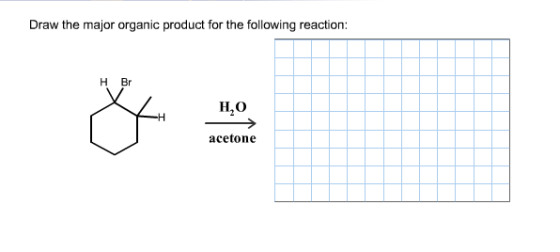
HINT: Note that the solvent is a water and acetone mixture. The water makes the solvent mixture polar and protic, while the acetone is present to enhance the solubility of the organic molecule. Identify the nucleophile and consider the structure of the intermediate formed in the reaction. Can there be a rearrangement?
Homework Answers


Add Answer to:
HINT: Note that the solvent is a water and acetone mixture. The
water makes the solvent...
structure for water, showing that it is a polar solvent. for CCle carbon tetrachloride. Is this...
 structure for water, showing that it is a polar solvent. for CCle carbon tetrachloride. Is this a polar or non-polar solvent carbon 2 Draw a paw a structure Generally what effect does increasing temperature have on the solubility of a substance? 3. Vhy are "spectator ions" not included in the net ionic reaction? What did you observe in this experiment that tells us whether wax is polar or non-polar? 5. 6. Why does a precipitate form when certain solutions are...
7. Which of the following statements is TRUE? A) SN2 reactions occur with the same rate regardless of the structure...
 7. Which of the following statements is TRUE? A) SN2 reactions occur with the same rate regardless of the structure of alkyl halide or substrate B) S2 reactions are concerted with no intermediate C) S 2 reactions proceed with the same rate regardless of the nucleophile used D) S2 reactions are best performed in polar protic solvents E) In an S 2 reaction, loss of the leaving group to give a carbocation is the rate-limiting step 8. Consider the following...
Dropdown Menus: 1. methyl, primary (unhindered), primary (hindered), secondary, tertiary 2. poor, weakly basic, strong...
 Dropdown Menus:
1. methyl, primary (unhindered), primary (hindered), secondary,
tertiary
2. poor, weakly basic, strongly basic (hindered), strongly basic
(unhindered)
3. protic, aprotic
4. SN2, SN1, E1, E2, SN2 AND E2, SN1 AND E1, No Reaction
5. randomized, inverted, predictable but not inverted,
unchanged
6. a planar carbocation intermediate, backside attack transition
state, anti-periplanar transition state, other
CH3CH2ONa ??? CH3CH2OH Br OH OH OH De on an or rega ang Look at the given reaction and select the most appropriate...
Dropdown Menus:
1. methyl, primary (unhindered), primary (hindered), secondary,
tertiary
2. poor, weakly basic, strongly basic (hindered), strongly basic
(unhindered)
3. protic, aprotic
4. SN2, SN1, E1, E2, SN2 AND E2, SN1 AND E1, No Reaction
5. randomized, inverted, predictable but not inverted,
unchanged
6. a planar carbocation intermediate, backside attack transition
state, anti-periplanar transition state, other
CH3CH2ONa ??? CH3CH2OH Br OH OH OH De on an or rega ang Look at the given reaction and select the most appropriate...
Pre lab Introduction Your instructor has prepared an extract of chloroplast pigments from fresh green grass...
 Pre lab
Introduction Your instructor has prepared an extract of chloroplast pigments from fresh green grass or fresh spinach. A blender was used to rupture the cells, and the pigments were then extracted with acetone, an organic solvent. Work- ing with one other student, begin this exercise by separating the pigments extracted using paper chromatography. To do this, you will apply the pig- ment extract to a cylinder of chromatographic paper. You will then place the ylinder in a jar...
Pre lab
Introduction Your instructor has prepared an extract of chloroplast pigments from fresh green grass or fresh spinach. A blender was used to rupture the cells, and the pigments were then extracted with acetone, an organic solvent. Work- ing with one other student, begin this exercise by separating the pigments extracted using paper chromatography. To do this, you will apply the pig- ment extract to a cylinder of chromatographic paper. You will then place the ylinder in a jar...
Post-Lab Questions Write your answers in pen and include tontits 1. Draw a structure for water, showing that it...
 Post-Lab Questions Write your answers in pen and include tontits 1. Draw a structure for water, showing that it is a polar solvent. 2. Draw a structure for CCL, carbon tetrachloride. Is this a polar or non-polar solvent? 3. Generally, what effect does increasing temperature have on the solubility of a substance? 4. Why are "spectator ions" not included in the net ionic reaction? 5. What did you observe in this experiment that tells us whether wax is polar or...
9) What are we removing with the water wash? Why don’t we just add the sodium...
 9) What are we removing with the water wash? Why don’t we just
add the sodium bicarbonate directly to the reaction mixture instead
of doing a water wash? 10) Provide the results of the silver
nitrate test.
Introduction Alkyl halides can be prepared from alcohols by reactions with hydrogen halides (HCl, HBr, or HI) via nucleophilic substitution. In this type of reaction, the nucleophile displaces a leaving group from a carbon atom of an organic substrate (here the alcohol once...
9) What are we removing with the water wash? Why don’t we just
add the sodium bicarbonate directly to the reaction mixture instead
of doing a water wash? 10) Provide the results of the silver
nitrate test.
Introduction Alkyl halides can be prepared from alcohols by reactions with hydrogen halides (HCl, HBr, or HI) via nucleophilic substitution. In this type of reaction, the nucleophile displaces a leaving group from a carbon atom of an organic substrate (here the alcohol once...
7. Draw all monochloro derivatives that might be formed when the following molecule is allowed to...
 7. Draw all monochloro derivatives that might be formed when the
following molecule is allowed to react with Cl2 under UV
irradiation (light). For each structure, indicate, with an
asterisk, any stereocenters (chiral centers) that might be present.
(Hint: 7 products)
8. What is the major organic product obtained from the following
reactions?
Page 2 of 5 7. Draw all monochloro derivatives that might be formed when the following molecule is allowed to react with Cl2 under UV irradiation (light)....
7. Draw all monochloro derivatives that might be formed when the
following molecule is allowed to react with Cl2 under UV
irradiation (light). For each structure, indicate, with an
asterisk, any stereocenters (chiral centers) that might be present.
(Hint: 7 products)
8. What is the major organic product obtained from the following
reactions?
Page 2 of 5 7. Draw all monochloro derivatives that might be formed when the following molecule is allowed to react with Cl2 under UV irradiation (light)....
Dropdown Menus: 1. methyl, primary (unhindered), primary (hindered), secondary, tertiary 2. poor, weakly basic, strongly basic...
 Dropdown Menus:
1. methyl, primary (unhindered), primary (hindered), secondary,
tertiary
2. poor, weakly basic, strongly basic (hindered), strongly basic
(unhindered)
3. protic, aprotic
4. SN2, SN1, E1, E2, SN2 AND E2, SN1 AND E1, No Reaction
5. randomized, inverted, predictable but not inverted,
unchanged
6. a planar carbocation intermediate, backside attack transition
state, anti-periplanar transition state, other
OH Hom 유 용 The Tone The ♡ ♡ Tñ y OH H OH E OH F HO3 G Look at the given...
Dropdown Menus:
1. methyl, primary (unhindered), primary (hindered), secondary,
tertiary
2. poor, weakly basic, strongly basic (hindered), strongly basic
(unhindered)
3. protic, aprotic
4. SN2, SN1, E1, E2, SN2 AND E2, SN1 AND E1, No Reaction
5. randomized, inverted, predictable but not inverted,
unchanged
6. a planar carbocation intermediate, backside attack transition
state, anti-periplanar transition state, other
OH Hom 유 용 The Tone The ♡ ♡ Tñ y OH H OH E OH F HO3 G Look at the given...
I. Nylon 6-6 is a condensation polymer. The last two lab handouts pointed out that "condensation...
 I. Nylon 6-6 is a condensation polymer. The last two lab handouts pointed out that "condensation reactions are extremely common among a variety of organic functional groups." Pick two appropriate functional groups (your choice) and draw structures to show the condensation reaction between them. Identify the functional groups that are reacting, as well as the linkage formed by the condensation. 2. Rather than use a carboxylic acid for the nylon condensation, you'll use the more reactive acid chloride. This must...
seperation of acid neutral Experiment 5: Separation of Acid-Neutral Mixture Post-Lab Questions 1. Draw and label...
 seperation of acid neutral
Experiment 5: Separation of Acid-Neutral Mixture Post-Lab Questions 1. Draw and label the structures of the major and minor components of the acidic and neutral mixtures. 2. Although acetic acid - water may be used as a "solvent pair", why are dilute solutions of an inorganic acid/water (or, inorganic base/water) avoided in recrystallization attempts? (Hint: see Wade Ed: Sections 21-12, 21- 13. Consider functional-group possibilities.] 3. Using a flow diagram, show the separation of a mixture...
seperation of acid neutral
Experiment 5: Separation of Acid-Neutral Mixture Post-Lab Questions 1. Draw and label the structures of the major and minor components of the acidic and neutral mixtures. 2. Although acetic acid - water may be used as a "solvent pair", why are dilute solutions of an inorganic acid/water (or, inorganic base/water) avoided in recrystallization attempts? (Hint: see Wade Ed: Sections 21-12, 21- 13. Consider functional-group possibilities.] 3. Using a flow diagram, show the separation of a mixture...
 structure for water, showing that it is a polar solvent. for CCle carbon tetrachloride. Is this a polar or non-polar solvent carbon 2 Draw a paw a structure Generally what effect does increasing temperature have on the solubility of a substance? 3. Vhy are "spectator ions" not included in the net ionic reaction? What did you observe in this experiment that tells us whether wax is polar or non-polar? 5. 6. Why does a precipitate form when certain solutions are...
 7. Which of the following statements is TRUE? A) SN2 reactions occur with the same rate regardless of the structure of alkyl halide or substrate B) S2 reactions are concerted with no intermediate C) S 2 reactions proceed with the same rate regardless of the nucleophile used D) S2 reactions are best performed in polar protic solvents E) In an S 2 reaction, loss of the leaving group to give a carbocation is the rate-limiting step 8. Consider the following...
 Dropdown Menus:
1. methyl, primary (unhindered), primary (hindered), secondary,
tertiary
2. poor, weakly basic, strongly basic (hindered), strongly basic
(unhindered)
3. protic, aprotic
4. SN2, SN1, E1, E2, SN2 AND E2, SN1 AND E1, No Reaction
5. randomized, inverted, predictable but not inverted,
unchanged
6. a planar carbocation intermediate, backside attack transition
state, anti-periplanar transition state, other
CH3CH2ONa ??? CH3CH2OH Br OH OH OH De on an or rega ang Look at the given reaction and select the most appropriate...
Dropdown Menus:
1. methyl, primary (unhindered), primary (hindered), secondary,
tertiary
2. poor, weakly basic, strongly basic (hindered), strongly basic
(unhindered)
3. protic, aprotic
4. SN2, SN1, E1, E2, SN2 AND E2, SN1 AND E1, No Reaction
5. randomized, inverted, predictable but not inverted,
unchanged
6. a planar carbocation intermediate, backside attack transition
state, anti-periplanar transition state, other
CH3CH2ONa ??? CH3CH2OH Br OH OH OH De on an or rega ang Look at the given reaction and select the most appropriate...
 Pre lab
Introduction Your instructor has prepared an extract of chloroplast pigments from fresh green grass or fresh spinach. A blender was used to rupture the cells, and the pigments were then extracted with acetone, an organic solvent. Work- ing with one other student, begin this exercise by separating the pigments extracted using paper chromatography. To do this, you will apply the pig- ment extract to a cylinder of chromatographic paper. You will then place the ylinder in a jar...
Pre lab
Introduction Your instructor has prepared an extract of chloroplast pigments from fresh green grass or fresh spinach. A blender was used to rupture the cells, and the pigments were then extracted with acetone, an organic solvent. Work- ing with one other student, begin this exercise by separating the pigments extracted using paper chromatography. To do this, you will apply the pig- ment extract to a cylinder of chromatographic paper. You will then place the ylinder in a jar...
 Post-Lab Questions Write your answers in pen and include tontits 1. Draw a structure for water, showing that it is a polar solvent. 2. Draw a structure for CCL, carbon tetrachloride. Is this a polar or non-polar solvent? 3. Generally, what effect does increasing temperature have on the solubility of a substance? 4. Why are "spectator ions" not included in the net ionic reaction? 5. What did you observe in this experiment that tells us whether wax is polar or...
 9) What are we removing with the water wash? Why don’t we just
add the sodium bicarbonate directly to the reaction mixture instead
of doing a water wash? 10) Provide the results of the silver
nitrate test.
Introduction Alkyl halides can be prepared from alcohols by reactions with hydrogen halides (HCl, HBr, or HI) via nucleophilic substitution. In this type of reaction, the nucleophile displaces a leaving group from a carbon atom of an organic substrate (here the alcohol once...
9) What are we removing with the water wash? Why don’t we just
add the sodium bicarbonate directly to the reaction mixture instead
of doing a water wash? 10) Provide the results of the silver
nitrate test.
Introduction Alkyl halides can be prepared from alcohols by reactions with hydrogen halides (HCl, HBr, or HI) via nucleophilic substitution. In this type of reaction, the nucleophile displaces a leaving group from a carbon atom of an organic substrate (here the alcohol once...
 7. Draw all monochloro derivatives that might be formed when the
following molecule is allowed to react with Cl2 under UV
irradiation (light). For each structure, indicate, with an
asterisk, any stereocenters (chiral centers) that might be present.
(Hint: 7 products)
8. What is the major organic product obtained from the following
reactions?
Page 2 of 5 7. Draw all monochloro derivatives that might be formed when the following molecule is allowed to react with Cl2 under UV irradiation (light)....
7. Draw all monochloro derivatives that might be formed when the
following molecule is allowed to react with Cl2 under UV
irradiation (light). For each structure, indicate, with an
asterisk, any stereocenters (chiral centers) that might be present.
(Hint: 7 products)
8. What is the major organic product obtained from the following
reactions?
Page 2 of 5 7. Draw all monochloro derivatives that might be formed when the following molecule is allowed to react with Cl2 under UV irradiation (light)....
 Dropdown Menus:
1. methyl, primary (unhindered), primary (hindered), secondary,
tertiary
2. poor, weakly basic, strongly basic (hindered), strongly basic
(unhindered)
3. protic, aprotic
4. SN2, SN1, E1, E2, SN2 AND E2, SN1 AND E1, No Reaction
5. randomized, inverted, predictable but not inverted,
unchanged
6. a planar carbocation intermediate, backside attack transition
state, anti-periplanar transition state, other
OH Hom 유 용 The Tone The ♡ ♡ Tñ y OH H OH E OH F HO3 G Look at the given...
Dropdown Menus:
1. methyl, primary (unhindered), primary (hindered), secondary,
tertiary
2. poor, weakly basic, strongly basic (hindered), strongly basic
(unhindered)
3. protic, aprotic
4. SN2, SN1, E1, E2, SN2 AND E2, SN1 AND E1, No Reaction
5. randomized, inverted, predictable but not inverted,
unchanged
6. a planar carbocation intermediate, backside attack transition
state, anti-periplanar transition state, other
OH Hom 유 용 The Tone The ♡ ♡ Tñ y OH H OH E OH F HO3 G Look at the given...
 I. Nylon 6-6 is a condensation polymer. The last two lab handouts pointed out that "condensation reactions are extremely common among a variety of organic functional groups." Pick two appropriate functional groups (your choice) and draw structures to show the condensation reaction between them. Identify the functional groups that are reacting, as well as the linkage formed by the condensation. 2. Rather than use a carboxylic acid for the nylon condensation, you'll use the more reactive acid chloride. This must...
 seperation of acid neutral
Experiment 5: Separation of Acid-Neutral Mixture Post-Lab Questions 1. Draw and label the structures of the major and minor components of the acidic and neutral mixtures. 2. Although acetic acid - water may be used as a "solvent pair", why are dilute solutions of an inorganic acid/water (or, inorganic base/water) avoided in recrystallization attempts? (Hint: see Wade Ed: Sections 21-12, 21- 13. Consider functional-group possibilities.] 3. Using a flow diagram, show the separation of a mixture...
seperation of acid neutral
Experiment 5: Separation of Acid-Neutral Mixture Post-Lab Questions 1. Draw and label the structures of the major and minor components of the acidic and neutral mixtures. 2. Although acetic acid - water may be used as a "solvent pair", why are dilute solutions of an inorganic acid/water (or, inorganic base/water) avoided in recrystallization attempts? (Hint: see Wade Ed: Sections 21-12, 21- 13. Consider functional-group possibilities.] 3. Using a flow diagram, show the separation of a mixture...
Most questions answered within 3 hours.
-
Where is the error in this code sequence?
String s1 = "Hello";
String s2 = "ello";...
asked 10 months ago -
Financial data for Joel de Paris, Inc., for last year
follow:
Joel de Paris, Inc.
Balance...
asked 10 months ago -
Consider this reaction:
Al2(SO4)3 (aq)+ BaCl3
(aq) Al2Cl6 (aq)- +
3BaSO4(s) . What is the...
asked 10 months ago -
Suppose that Savneet is considering increasing her
recent random sample from 20 car rentals to 40...
asked 10 months ago -
Trucks arrive at an unloading terminal at an average rate of 120
per hour.
Trucks arrive...
asked 10 months ago -
Why are methanol and ethanol completely soluble in water while
octanol is not very little soluble....
asked 10 months ago -
A facilities manager at a university reads in a research report
that the mean amount of...
asked 10 months ago -
When the CuSO4 is rehydrated by adding water to the anhydrous
compound, is this an endothermic...
asked 10 months ago -
A ray of sunlight is passing from diamond into crown glass; the
angle of incidence is...
asked 10 months ago -
A block of mass 0.249 kg is placed on top of a light, vertical
spring of...
asked 10 months ago -
how do the kidneys compensate in the presences of acidosis
a) trigger hyperventilate
b) reserve acid...
asked 10 months ago -
Question 501 pts
The rental rate of capital to the firm increases. Which of the
following...
asked 10 months ago