1. (3 POINTS) An insurance policy pays a individual $500 per day for up to 3...
1. (3 POINTS) An insurance policy pays a individual $500 per day for up to 3 days of hospitalization and $100 per day for each day of hospitalization thereafter. The number of days of hospitalization is a random variable X with
P(X=x) = (6-x)/15, if x = 1,2,3,4,5.
Calculate the expected payment for hospitalization under this policy.
2. (4 POINTS) An insurance policy reimburses a loss up to a benefit limit 0f $10. There is no deductible. The policyholder’s loss X (in $) has probability density function
f(x) = 2/ x^3, if x > 1; and f(x) = 0, otherwise.
What is the expected value of the benefit paid under the insurance policy?
Hint: Find E(Y) where Y = min (X,10).
3. (4 POINTS) The probability distribution of claim sizes for an auto insurance policy is as follows:
Claim Amount (in $): 200 300 400 500 600 700 800
Probability: 0.15 0.10 0.05 0.20 0.10 0.10 0.30
What percentage of the claims is within one standard deviation of the expected claim size?
4. (4 POINTS) Compute the expected value and the standard deviation of the number of spades in a poker hand.
Homework Answers
(1). Let X denote the numbe of days in the hospital and Y the total payment, the given information can be summarized in the following table:

Hence, the expected payment is



(2). The amount paid under this policy is
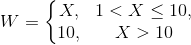
The expected amount paid is


(3).
The mean claim size is


The second moment of the claim size is




Therefore, the variance of the claim size is

The standard deviation is

The claim sizes within one standard deviation of the mean claim size of 550 are those claim sizes between
550 - 217.9 = 332.1 and 550 + 217.9 = 767.9
Those claim sizes are 400, 500, 600 and 700. The total probability of those claim sizes is
0.5 + 0.20 + 0.1 + 0.1 = 0.45
Thus the answer is 0.45 or 45 %
(4). Define a random variable X as the number of spades in a poker hand. We know that

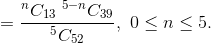


![Var(X) = \sum_{n=0}^{5}[n-E(X)]^{2} P(X=n) \approx 0.866](http://img.homeworklib.com/questions/5c0e4830-41a6-11ea-ae79-e15b1007543f.png?x-oss-process=image/resize,w_560)

Add Answer to:
1. (3 POINTS) An insurance policy pays a individual $500 per day for up to 3...
An insurance policy pays $1000 per day for up to 2 days of hospitalization and $500...
An insurance policy pays $1000 per day for up to 2 days of hospitalization and $500 per day for each day of hospitalization thereafter. The number of days of hospitalization, X, is a discrete random variable with probability function f(x)={ k(5−x) x=1,2,3,4 0 otherwise What is the expected payment for hospitalization under this policy?
An insurance policy pays for a random loss X subject to a deductible of 550. The...
 An insurance policy pays for a random loss X subject to a deductible of 550. The loss amount is modeled as a continuous random variable with density function 4500 for x > 500 f(x) = { otherwise Determine the expected payment made under this insurance policy.
Once an employee gets sick, a policy pays 100 each day for up to five days....
Once an employee gets sick, a policy pays 100 each day for up to five days. The number of days a policy must pay for sick employees under this policy is Poisson distributed with mean 2. Find the expected amount the policy will need to pay per employee.
An insurance company has 10,000 automobile policyholders. The expected yearly claim per policy holder is $240...
An insurance company has 10,000 automobile policyholders. The expected yearly claim per policy holder is $240 with a standard deviation of $800. Approximate the probability that the yearly claim exceeds $2.7 million.
You are considering the purchase of a simple insurance policy on your home. The annual premium...
You are considering the purchase of a simple insurance policy on your home. The annual premium is $1,500. For this simplified example, let’s assume that the probability of no loss occurring during the policy year is 95%. In that case, your net financial benefit is the full premium amount, so the net impact is -$1,500. The probability of a small loss ($1,000) is 3%, in which case your net financial impact would be -$500 (the premium you paid plus the...
The number of heavy snowfalls at a ski resort has the following distribution: Number of heavy...
The number of heavy snowfalls at a ski resort has the following distribution: Number of heavy snowfalls 0 1 2 3 4 5 or more Probability 0.10 0.25 0.30 0.20 0.10 0.05 An insurance policy pays a benefit of: 5, 000(X − 5)^2 where X is the number of heavy snowfalls in a given year, up to a maximum of 5. Calculate the expected benefit under this policy. A. 37,500 B. 42,500 C. 45,000 D. 49,500 E. 50,500
7. An insurance policy is written to cover a loss X where X has density function...
 7. An insurance policy is written to cover a loss X where X has density function f(x)x3 0 elsewhere The time T (in hours) to process a claim of size x, where 0 < x <3, is uniformly distributed on the interval from x/2 to 3x. Calculate the probability that a randomly chosen claim on this policy is processed in four hours or more. In a small metropolitan area, annual losses due to storm, fire, and theft are assumed to...
The number of complaints per day, X, received by a cable TV distributor has the probability...
 The number of complaints per day, X, received by a cable TV distributor has the probability distribution 2. 0 .4 .2 a) Find the expected number of complaints per day 0C6. 4)I(o.3)2 (0.1) 3( 0,2) b) Find the standard deviation of the number of complaints What is the approximate probability that the distributor receives a total of more than 100 complaints in 90 days? c)
assumptions: (1) underwriting costs is 30% of pure premium; (2) interest rate is 5%; (3) fair...
 assumptions: (1) underwriting costs is 30% of pure premium; (2) interest rate is 5%; (3) fair profit is 10% of pure premium. 3. Suppose that Annie's loss distribution is as follows: $ 5.000 with probability 0.004 $1,000 with probability 0.006 Loss = $ 250 with probability 0.055 $ 0 with probability 0.935 Assume that the only administrative cost is the cost of processing a claim, which equals $500 regardless of the claim size. Ignoring moral hazard, adverse selection, the time...
A homeowners' policy will typically pay up to $500 per plant that is damaged by a...
 A homeowners' policy will typically pay up to $500 per plant that is damaged by a covered peril. This is an example of: an aggregate dollar limit an open perils dollar limit C. a specific dollar limit a mixed dollar limit none of the above e. You purchase an annuity for which you will make one payment of $15,000 on your 50 birthday. The annuity will start paying you $400 a month on your 67" birthday until you die. What...
 An insurance policy pays for a random loss X subject to a deductible of 550. The loss amount is modeled as a continuous random variable with density function 4500 for x > 500 f(x) = { otherwise Determine the expected payment made under this insurance policy.
 7. An insurance policy is written to cover a loss X where X has density function f(x)x3 0 elsewhere The time T (in hours) to process a claim of size x, where 0 < x <3, is uniformly distributed on the interval from x/2 to 3x. Calculate the probability that a randomly chosen claim on this policy is processed in four hours or more. In a small metropolitan area, annual losses due to storm, fire, and theft are assumed to...
 The number of complaints per day, X, received by a cable TV distributor has the probability distribution 2. 0 .4 .2 a) Find the expected number of complaints per day 0C6. 4)I(o.3)2 (0.1) 3( 0,2) b) Find the standard deviation of the number of complaints What is the approximate probability that the distributor receives a total of more than 100 complaints in 90 days? c)
 assumptions: (1) underwriting costs is 30% of pure premium; (2) interest rate is 5%; (3) fair profit is 10% of pure premium. 3. Suppose that Annie's loss distribution is as follows: $ 5.000 with probability 0.004 $1,000 with probability 0.006 Loss = $ 250 with probability 0.055 $ 0 with probability 0.935 Assume that the only administrative cost is the cost of processing a claim, which equals $500 regardless of the claim size. Ignoring moral hazard, adverse selection, the time...
 A homeowners' policy will typically pay up to $500 per plant that is damaged by a covered peril. This is an example of: an aggregate dollar limit an open perils dollar limit C. a specific dollar limit a mixed dollar limit none of the above e. You purchase an annuity for which you will make one payment of $15,000 on your 50 birthday. The annuity will start paying you $400 a month on your 67" birthday until you die. What...
Most questions answered within 3 hours.
-
Where is the error in this code sequence?
String s1 = "Hello";
String s2 = "ello";...
asked 11 months ago -
Financial data for Joel de Paris, Inc., for last year
follow:
Joel de Paris, Inc.
Balance...
asked 11 months ago -
Consider this reaction:
Al2(SO4)3 (aq)+ BaCl3
(aq) Al2Cl6 (aq)- +
3BaSO4(s) . What is the...
asked 11 months ago -
Suppose that Savneet is considering increasing her
recent random sample from 20 car rentals to 40...
asked 11 months ago -
Trucks arrive at an unloading terminal at an average rate of 120
per hour.
Trucks arrive...
asked 11 months ago -
Why are methanol and ethanol completely soluble in water while
octanol is not very little soluble....
asked 11 months ago -
A facilities manager at a university reads in a research report
that the mean amount of...
asked 11 months ago -
When the CuSO4 is rehydrated by adding water to the anhydrous
compound, is this an endothermic...
asked 11 months ago -
A ray of sunlight is passing from diamond into crown glass; the
angle of incidence is...
asked 11 months ago -
A block of mass 0.249 kg is placed on top of a light, vertical
spring of...
asked 11 months ago -
how do the kidneys compensate in the presences of acidosis
a) trigger hyperventilate
b) reserve acid...
asked 11 months ago -
Question 501 pts
The rental rate of capital to the firm increases. Which of the
following...
asked 11 months ago