
Homework Answers
(a)
Mass flow rate of water,
m =  * volume flow rate
m = 1000 * 64*10-3 = 64 kg/s
Change in mechanical energy of fluid,
 E
= m [(P2 - P1 /
) + (V22 - V12 / 2) + g(h2 - h1)]
E
= m [(P2 - P1 /
) + (V22 - V12 / 2) + g(h2 - h1)]
E
= 64 [0 + 0 + 9.8*(18 - 0)]
E
= 11289.6 W = 11.28 kW
Efficiency of pump motor unit,
 =
E / W = 11.28 / 21.2
=
E / W = 11.28 / 21.2
= 0.5325
= 53.25 %
(b)
Pressure b/w inlet and the exit of the pump,
P
= E
/ volume flow rate
P
= 11.28 / 64*10-3
P
= 176.4 kPa
Add Answer to:
Storage tank 18 m Pump Water is pumped from a lake to a storage tank 18...
4. Water is pumped from a lake to a storage tank 20 m above at a...
 4. Water is pumped from a lake to a storage tank 20 m above at a rate of 90 Ls while consuming 25.4 kW of electric power. Disregarding any frictional losses in the pipes and any changes in kinetic energy, determine (a) the overall efficiency of the pump motor unit and (b) the pressure difference between the inlet and the exit of the pump. he 20m
9. The absolute pressure in water at a depth of 5 m is 145 kPa. What...
 9. The absolute pressure in water at a depth of 5 m is 145 kPa. What is the absolute pressure in a liquid whose specific gravity is 1.34 at the same depth? Hint: Determine the atmaspheric pressure first 10. Water is pumped from a lake to a storage tank 30 m above at a rate of 55 L/s, while consuming 22.6 kW of electrie power to run the motor. Detemine the overall efficiency of the motor-pump unit. .A hydraulic power...
ater to be pumped from a lake to a storage tank in a ranch. Water temperature...
 ater to be pumped from a lake to a storage tank in a ranch. Water temperature is 60 F.The clevation of the pipe exit that will feed the tank is 50 ft higher than the lake water surface. It is required that a 4-hour pumping time will feed the storage tank by 1,200 gallons of water. While operating at the required flow rate, the pump will generate a head of 60 n. Coeflicients of minor loss due to filtering, fittings,...
Question 18 (10 April 2020) 51.5 kW 12 cm Pump An oil pump is drawing 51.5...
 Question 18 (10 April 2020) 51.5 kW 12 cm Pump An oil pump is drawing 51.5 kW of electric power while pumping oil with p= 860 kg/m3 at a rate of 0.23 m3/s. The inlet and outlet diameters of the piper are 8 cm and 12 cm, respectively. If the pressure rise of oil in the pump is measured to be 500 kPa and the motor efficiency is 87.5 percent, determine the mechanical efficiency of the pump. Motor 8 cm...
A water pump operating at 85% motor efficiency is used to transfer water from a lake...
 A water pump operating at 85% motor efficiency is used to transfer water from a lake reservoir to a storage tank 100 ft above the lake level. The inlet to the pump is 2 inches. Thfae outlet of the pump is 2 inches. The storage tank is open to atmosphere. Useful Constants: Density of water is 624 lbm/ft. g-322 ft/s, &-32.2 Ibmt/Ibhs) Generalized 1st Law Iul2 dt dt dt ρν HINT: Must use 2 Control Volumes to solve problem Useful...
(5 pts) A pump is pumping water from a lake to the top of a mountain...
 (5 pts) A pump is pumping water from a lake to the top of a mountain through a constant- diameter pipe. Water exits the pipe at a volumetric flow rate of 0.04 m/s. The vertical distance between the lake surface and the pipe exit at the top of the mountain is 100 m. The diameter of the pipe is 10 cm. All mechanical energy losses are negligible and the flow is steady and incompressible. (Water density-I g/cm, ?-I.) Determine a)...
1. A pump steadily delivers 13.7 kg/s of water at the conditions given below. Calculate the...
1. A pump steadily delivers 13.7 kg/s of water at the conditions given below. Calculate the pump power (hp). There is no heat transfer from the pump to the surroundings (i.e., adiabatic conditions). Pump Inlet Temperature = 20oC Pump Inlet Pressure = 182 kPa Pump Inlet Diameter = 11.1 cm Pump Inlet Elevation = 20 m Pump Exit Temperature = 20oC Pump Exit Pressure = 601 kPa Pump Exit Diameter = 7.8 cm Pump Exit Elevation = 20 m Answer...
Water tanks are used to provide storage of water for use in many applications, such as...
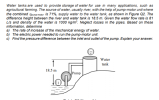 Water tanks are used to provide storage of water for use in many applications, such as agricultural farming. The source of water, usually river, with the help of pump-motor unit where the combined npump-motor is 71%, supply water to the water tank, as shown in Figure Q2. The difference height between the river and water tank is 18.5 m. Given the water flow rate is 81 Us and density of the water is 1000 kg/mº. Neglect losses in the pipes....
Water is pumped from a tank (elev. 110 m) to the top of a hill (elev....
Water is pumped from a tank (elev. 110 m) to the top of a hill (elev. 150 m) through 1,000 m of 500-mm diameter steel pipe (ε = 0.0003 m). The pump motor is rated at 150 kW (i.e. brake horsepower). Assume pump efficiency of 70%. a) Develop an equation to determine discharge flow rate by trial and error b) Solve equation developed in part a) c) Briefly explain why a centrifugal pump is appropriate for this application. If answer...
QUESTION 5 A pump steadily delivers 17.2 kg/s of water at the conditions given below. Calculate...
 QUESTION 5 A pump steadily delivers 17.2 kg/s of water at the conditions given below. Calculate the pump power (kW). There is no heat transfer from the pump to the surroundings (i.e., adiabatic conditions). Pump Inlet Temperature = 20°C Pump Inlet Pressure - 192 kPa Pump Inlet Diameter = 13.3 cm Pump Inlet Elevation = 22 m Pump Exit Temperature = 20°C Pump Exit Pressure - 419 kPa Pump Exit Diameter = 3.9 cm Pump Exit Elevation = 41.4 m...
 4. Water is pumped from a lake to a storage tank 20 m above at a rate of 90 Ls while consuming 25.4 kW of electric power. Disregarding any frictional losses in the pipes and any changes in kinetic energy, determine (a) the overall efficiency of the pump motor unit and (b) the pressure difference between the inlet and the exit of the pump. he 20m
 9. The absolute pressure in water at a depth of 5 m is 145 kPa. What is the absolute pressure in a liquid whose specific gravity is 1.34 at the same depth? Hint: Determine the atmaspheric pressure first 10. Water is pumped from a lake to a storage tank 30 m above at a rate of 55 L/s, while consuming 22.6 kW of electrie power to run the motor. Detemine the overall efficiency of the motor-pump unit. .A hydraulic power...
 ater to be pumped from a lake to a storage tank in a ranch. Water temperature is 60 F.The clevation of the pipe exit that will feed the tank is 50 ft higher than the lake water surface. It is required that a 4-hour pumping time will feed the storage tank by 1,200 gallons of water. While operating at the required flow rate, the pump will generate a head of 60 n. Coeflicients of minor loss due to filtering, fittings,...
 Question 18 (10 April 2020) 51.5 kW 12 cm Pump An oil pump is drawing 51.5 kW of electric power while pumping oil with p= 860 kg/m3 at a rate of 0.23 m3/s. The inlet and outlet diameters of the piper are 8 cm and 12 cm, respectively. If the pressure rise of oil in the pump is measured to be 500 kPa and the motor efficiency is 87.5 percent, determine the mechanical efficiency of the pump. Motor 8 cm...
 A water pump operating at 85% motor efficiency is used to transfer water from a lake reservoir to a storage tank 100 ft above the lake level. The inlet to the pump is 2 inches. Thfae outlet of the pump is 2 inches. The storage tank is open to atmosphere. Useful Constants: Density of water is 624 lbm/ft. g-322 ft/s, &-32.2 Ibmt/Ibhs) Generalized 1st Law Iul2 dt dt dt ρν HINT: Must use 2 Control Volumes to solve problem Useful...
 (5 pts) A pump is pumping water from a lake to the top of a mountain through a constant- diameter pipe. Water exits the pipe at a volumetric flow rate of 0.04 m/s. The vertical distance between the lake surface and the pipe exit at the top of the mountain is 100 m. The diameter of the pipe is 10 cm. All mechanical energy losses are negligible and the flow is steady and incompressible. (Water density-I g/cm, ?-I.) Determine a)...
 Water tanks are used to provide storage of water for use in many applications, such as agricultural farming. The source of water, usually river, with the help of pump-motor unit where the combined npump-motor is 71%, supply water to the water tank, as shown in Figure Q2. The difference height between the river and water tank is 18.5 m. Given the water flow rate is 81 Us and density of the water is 1000 kg/mº. Neglect losses in the pipes....
 QUESTION 5 A pump steadily delivers 17.2 kg/s of water at the conditions given below. Calculate the pump power (kW). There is no heat transfer from the pump to the surroundings (i.e., adiabatic conditions). Pump Inlet Temperature = 20°C Pump Inlet Pressure - 192 kPa Pump Inlet Diameter = 13.3 cm Pump Inlet Elevation = 22 m Pump Exit Temperature = 20°C Pump Exit Pressure - 419 kPa Pump Exit Diameter = 3.9 cm Pump Exit Elevation = 41.4 m...
Most questions answered within 3 hours.
-
Where is the error in this code sequence?
String s1 = "Hello";
String s2 = "ello";...
asked 10 months ago -
Financial data for Joel de Paris, Inc., for last year
follow:
Joel de Paris, Inc.
Balance...
asked 10 months ago -
Consider this reaction:
Al2(SO4)3 (aq)+ BaCl3
(aq) Al2Cl6 (aq)- +
3BaSO4(s) . What is the...
asked 10 months ago -
Suppose that Savneet is considering increasing her
recent random sample from 20 car rentals to 40...
asked 10 months ago -
Trucks arrive at an unloading terminal at an average rate of 120
per hour.
Trucks arrive...
asked 10 months ago -
Why are methanol and ethanol completely soluble in water while
octanol is not very little soluble....
asked 10 months ago -
A facilities manager at a university reads in a research report
that the mean amount of...
asked 10 months ago -
When the CuSO4 is rehydrated by adding water to the anhydrous
compound, is this an endothermic...
asked 10 months ago -
A ray of sunlight is passing from diamond into crown glass; the
angle of incidence is...
asked 10 months ago -
A block of mass 0.249 kg is placed on top of a light, vertical
spring of...
asked 10 months ago -
how do the kidneys compensate in the presences of acidosis
a) trigger hyperventilate
b) reserve acid...
asked 10 months ago -
Question 501 pts
The rental rate of capital to the firm increases. Which of the
following...
asked 10 months ago