Please answer both, thank you! Rewrite this unbalanced half-reaction I−→IO3− such that it is balanced with...
Please answer both, thank you!
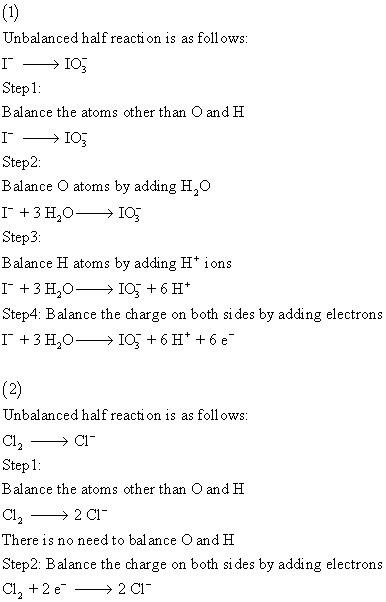
Rewrite this unbalanced half-reaction I−→IO3− such that it is balanced with respect to mass and charge. Do not include phases in your answer. Express your answer as a chemical equation. Use the symbol e- for an electron.
Rewrite this unbalanced half-reaction Cl2→Cl− such that it is balanced with respect to mass and charge. Do not include phases in your answer. Express your answer as a chemical equation. Use the symbol e- for an electron.
Homework Answers
Add Answer to:
Please answer both, thank you!
Rewrite this unbalanced half-reaction I−→IO3− such that it is
balanced with...
Write unbalanced oxidation half-reaction for the following process. Mn3+(aq)→MnO2(s)+Mn2+(aq) Express your answer as a chemical equation....
Write unbalanced oxidation half-reaction for the following process. Mn3+(aq)→MnO2(s)+Mn2+(aq) Express your answer as a chemical equation. Identify all of the phases in your answer. Write unbalanced oxidation half-reaction for the following process. Fe2O3(s)+CO(g)→Fe(s)+CO2(g) Express your answer as a chemical equation. Identify all of the phases in your answer. Write unbalanced reduction half-reaction for the following process. Fe2O3(s)+CO(g)→Fe(s)+CO2(g) Express your answer as a chemical equation. Identify all of the phases in your answer.
Use the half-reaction method to balance each redox reaction occurring in acidic aqueous solution. Cl−(aq)+MnO4−(aq)→Cl2(g)+Mn2+(aq) Express...
Use the half-reaction method to balance each redox reaction occurring in acidic aqueous solution. Cl−(aq)+MnO4−(aq)→Cl2(g)+Mn2+(aq) Express your answer as a chemical equation. Identify all of the phases in your answer.
Given these balanced half-reactions 3H2O+I^- ---> IO_3^- +6H^+ +6e^- Cl_2+2e^- ---> 2Cl^- enter the overall balanced...
Given these balanced half-reactions 3H2O+I^- ---> IO_3^- +6H^+ +6e^- Cl_2+2e^- ---> 2Cl^- enter the overall balanced redox reaction. Do not include phases in your answer. Enter your answer as a chemical equation.
Question 1: Consider the following oxidation-reduction reaction: I−(aq)+Cu+(aq)→IO4−(aq)+Cu(s) A: What are the initial a...
Question 1: Consider the following oxidation-reduction reaction: I−(aq)+Cu+(aq)→IO4−(aq)+Cu(s) A: What are the initial and final oxidation states of iodine? B: What are the initial and final oxidation states of copper? C: What element is reduced? D:What is the reducing agent? E: What element is oxidized? F: What is the oxidizing agent? G: Give the atom- and electron-balanced oxidation half-reaction occurring in acidic solution. Express your answer as a chemical equation. Include all phases. H: Give the atom- and electron-balanced reduction...
Part A Write a balanced equation for the overall cell reaction in the following galvanic cell...
 Part A Write a balanced equation for the overall cell reaction in the following galvanic cell Pt(s) Br (aq) Br2 () || Cl2 (g) | Cl- (aq) Pt(s) Express your answer as a chemical equation including phases. ΑΣφ ? а а ха х Хъ b b Request Answer Submit 11L
stion 9 of 20 Separate this redox reaction into its balanced component half-reactions. Use the symbol...
 stion 9 of 20 Separate this redox reaction into its balanced component half-reactions. Use the symbol e for an electron. Cl+2 Na 2 NaCl oxidation half-reaction: reduction half-reaction:
Write balanced net ionic equation for the reaction HF(aq) + NaOH(aq) + Express your answer as...
 Write balanced net ionic equation for the reaction HF(aq) + NaOH(aq) + Express your answer as a chemical equation. Identify all of the phases in your answer. Templates Symbols u t keyboard shortcuts help Submit Request Answer Part E Write balanced complete ionic equation for the reaction HC2H3 02 (aq) + CsOH(aq) + Express your answer as a chemical equation. Identify all of the phases in your answer. Templates Symbols uñdo redo redet keyboard shortcuts help Submit Request Answer Part...
Use the reduction potentials, the unbalanced half reactions and the unbalanced chemical equation below to answer...
Use the reduction potentials, the unbalanced half reactions and the unbalanced chemical equation below to answer the following questions: Reaction E° (V) In+(aq) + e− → In(s) -0.140 In3+(aq) + e− → In(s) -0.338 In(s) + In3+(aq) → In+(aq) + In(s) 1. Determine Ecell (in V) for this reaction in the direction shown. Report your answer to three decimal places in standard notation (i.e. 1.234 V). Tries 0/5 2. Determine ΔG° (in kJ) for this reaction. Report your answer to...
Write balanced complete ionic equation for the reaction HCl(aq)NaOH(aq) Express your answer as a chemical equation....
 Write balanced complete ionic equation for the reaction HCl(aq)NaOH(aq) Express your answer as a chemical equation. Identify all of the phases in your answer. ΑΣφ ? а ха х, b Previous Answers Request Answer Submit X Incorrect; Try Again; 8 attempts remaining Part B Write balanced net ionic equation for the reaction HС(ад) + NaOН (ад) — Express your answer as a chemical equation. Identify all of the phases in your answer. ΑΣφ. Submit Request Answer Part C Write balanced...
Enter a balanced chemical equation for the reaction between sodium and chlorine gas. Express your answer...
Enter a balanced chemical equation for the reaction between sodium and chlorine gas. Express your answer as a chemical equation including phases.
 Part A Write a balanced equation for the overall cell reaction in the following galvanic cell Pt(s) Br (aq) Br2 () || Cl2 (g) | Cl- (aq) Pt(s) Express your answer as a chemical equation including phases. ΑΣφ ? а а ха х Хъ b b Request Answer Submit 11L
 stion 9 of 20 Separate this redox reaction into its balanced component half-reactions. Use the symbol e for an electron. Cl+2 Na 2 NaCl oxidation half-reaction: reduction half-reaction:
 Write balanced net ionic equation for the reaction HF(aq) + NaOH(aq) + Express your answer as a chemical equation. Identify all of the phases in your answer. Templates Symbols u t keyboard shortcuts help Submit Request Answer Part E Write balanced complete ionic equation for the reaction HC2H3 02 (aq) + CsOH(aq) + Express your answer as a chemical equation. Identify all of the phases in your answer. Templates Symbols uñdo redo redet keyboard shortcuts help Submit Request Answer Part...
 Write balanced complete ionic equation for the reaction HCl(aq)NaOH(aq) Express your answer as a chemical equation. Identify all of the phases in your answer. ΑΣφ ? а ха х, b Previous Answers Request Answer Submit X Incorrect; Try Again; 8 attempts remaining Part B Write balanced net ionic equation for the reaction HС(ад) + NaOН (ад) — Express your answer as a chemical equation. Identify all of the phases in your answer. ΑΣφ. Submit Request Answer Part C Write balanced...
Most questions answered within 3 hours.
-
Where is the error in this code sequence?
String s1 = "Hello";
String s2 = "ello";...
asked 10 months ago -
Financial data for Joel de Paris, Inc., for last year
follow:
Joel de Paris, Inc.
Balance...
asked 10 months ago -
Consider this reaction:
Al2(SO4)3 (aq)+ BaCl3
(aq) Al2Cl6 (aq)- +
3BaSO4(s) . What is the...
asked 10 months ago -
Suppose that Savneet is considering increasing her
recent random sample from 20 car rentals to 40...
asked 10 months ago -
Trucks arrive at an unloading terminal at an average rate of 120
per hour.
Trucks arrive...
asked 10 months ago -
Why are methanol and ethanol completely soluble in water while
octanol is not very little soluble....
asked 10 months ago -
A facilities manager at a university reads in a research report
that the mean amount of...
asked 10 months ago -
When the CuSO4 is rehydrated by adding water to the anhydrous
compound, is this an endothermic...
asked 10 months ago -
A ray of sunlight is passing from diamond into crown glass; the
angle of incidence is...
asked 10 months ago -
A block of mass 0.249 kg is placed on top of a light, vertical
spring of...
asked 10 months ago -
how do the kidneys compensate in the presences of acidosis
a) trigger hyperventilate
b) reserve acid...
asked 10 months ago -
Question 501 pts
The rental rate of capital to the firm increases. Which of the
following...
asked 10 months ago