
Homework Answers
Add Answer to:
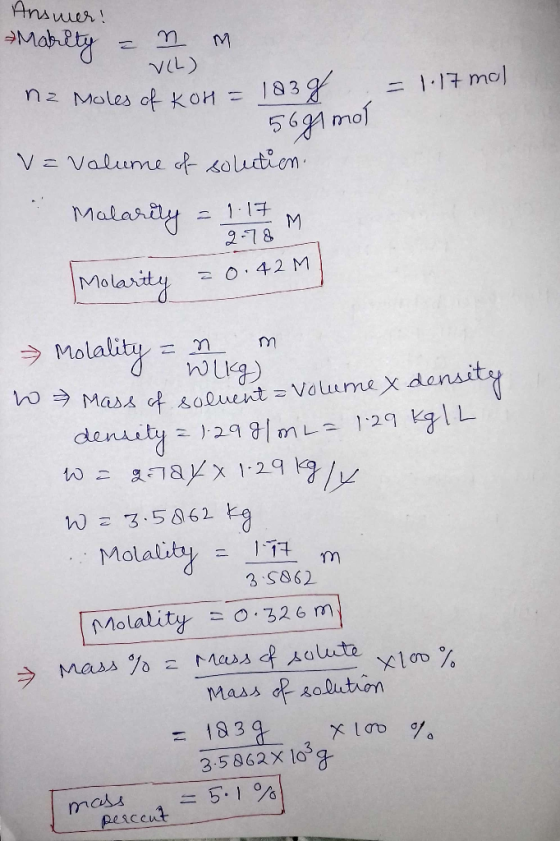
A 2.78 L aqueous solution of KOH contains 183 g of KOH. The solution has a...
2. Concentration measures We have a 0.16% aqueous solution by mass of KOH that has a...
2. Concentration measures We have a 0.16% aqueous solution by mass of KOH that has a density of 1.04 g / mL. The molarity of the solution in moles / L. a. The molarity of this solution is_____. b. The molality of this solution is approximately_______. c. The concentration in parts per thousand is______. d. . The concentration in parts per million is______. e. The concentration in parts per billion is______. f. Explain, why can't we determine the exact molal...
An aqueous KNO3 solution is made using 83.8 g of KNO3diluted to a total solution volume...
An aqueous KNO3 solution is made using 83.8 g of KNO3diluted to a total solution volume of 2.08 L. (Assume a density of 1.05 g/mL for the solution.) Part A Calculate the molarity of the solution. Express the molarity to three significant figures. molarity = nothing M M SubmitRequest Answer Part B Calculate the molality of the solution. Express the molality to three significant figures. molality = nothing m m SubmitRequest Answer Part C Calculate the mass percent...
1a. An aqueous solution has a Molarity of 1.632 M. The density of the solution is...
1a. An aqueous solution has a Molarity of 1.632 M. The density of the solution is (1.150x10^0) g/mL and the solute has a molar mass of (1.33x10^2) g/mol. What is the molality of this solution? 1b. An aqueous solution has a mass percent of solute of 18.4%. The density of the solution is (1.400x10^0) g/mL and the solute has a molar mass of (1.77x10^2) g/mol. What is the molality of this solution? 1c. An aqueous solution has a molality of...
An aqueous solution of silver nitrate, AgNO3, has a concentration of 2.54 mol/L and has a...
An aqueous solution of silver nitrate, AgNO3, has a concentration of 2.54 mol/L and has a density of 1.35 g/mL. What are the mass percent and molality of AgNO3 in this solution? Mass percent AgNO3 = % Molality AgNO3 = mol AgNO3/kg H2O
An aqueous KNO3 solution is made using 82.5 g of KNO3 diluted to a total solution...
An aqueous KNO3 solution is made using 82.5 g of KNO3 diluted to a total solution volume of 1.83 L . (Assume a density of 1.05 g/mL for the solution.) calculate molarity, molality and mass percent Need help finding molality
An aqueous KNO3 solution is made using 77.8 g of KNO3 diluted to a total solution...
An aqueous KNO3 solution is made using 77.8 g of KNO3 diluted to a total solution volume of 1.98 L . (Assume a density of 1.05 g/mL for the solution.) Calculate the molarity of the solution. Calculate molality of the solution. Calculate the mass percent of the solution.
We have an aqueous solution with a mass percent of 44.2 % for C2H5OH (C2H5OH is...
 We have an aqueous solution with a mass percent of
44.2 % for C2H5OH (C2H5OH is the only solute). The density of this
solution is 0.947 g/mL. Calculate the molarity, molality, and mole
fraction of C2H5OH in this aqueous solution.
We have an aqueous solution with a mass percent of 44.2% for C2H5OH (C2H5OH is the only solute). The density of this solution is 0.947 g/ml. Calculate the molarity, molality, and mole fraction of C2H5OH in this aqueous solution.
We have an aqueous solution with a mass percent of
44.2 % for C2H5OH (C2H5OH is the only solute). The density of this
solution is 0.947 g/mL. Calculate the molarity, molality, and mole
fraction of C2H5OH in this aqueous solution.
We have an aqueous solution with a mass percent of 44.2% for C2H5OH (C2H5OH is the only solute). The density of this solution is 0.947 g/ml. Calculate the molarity, molality, and mole fraction of C2H5OH in this aqueous solution.
An aqueous NaCl solution is made using 119 g of NaCl diluted to a total solution...
An aqueous NaCl solution is made using 119 g of NaCl diluted to a total solution volume of 1.25 L . Part A Calculate the molarity of the solution. Part B Calculate the molality of the solution. (Assume a density of 1.08 g/mL for the solution.) Express your answer using two significant figures. Part C Calculate the mass percent of the solution. (Assume a density of 1.08 g/mL for the solution.)
An aqueous NaCl solution is made using 126 g ofNaCl diluted to a total solution volume...
An aqueous NaCl solution is made using 126 g ofNaCl diluted to a total solution volume of 1.00 L . Calculate the molarity of the solution. Express your answer using three significant figures. M = 2.16 M Part B Calculate the molality of the solution. (Assume a density of 1.08 g/mL for the solution.) Express your answer using two significant figures. m = 2.3 m Part C Calculate the mass percent of the solution. (Assume a density of 1.08 g/mL...
An aqueous NaCl solution contains 1.343x10* ppm NaCl. The density of water is 1.000g/ml. The density...
An aqueous NaCl solution contains 1.343x10* ppm NaCl. The density of water is 1.000g/ml. The density of the solution is 1.08 g/mL. The molar mass of NaCl is 58.44g/mol. Keep the correct number of significant figures. a) What is the molality of NaCl? b) What is the molarity of NaCl? c) What is the (mass/volume)% is unit of (kg/L)%? d) What is mass percent? e) What is mole fraction of NaCl?
 We have an aqueous solution with a mass percent of
44.2 % for C2H5OH (C2H5OH is the only solute). The density of this
solution is 0.947 g/mL. Calculate the molarity, molality, and mole
fraction of C2H5OH in this aqueous solution.
We have an aqueous solution with a mass percent of 44.2% for C2H5OH (C2H5OH is the only solute). The density of this solution is 0.947 g/ml. Calculate the molarity, molality, and mole fraction of C2H5OH in this aqueous solution.
We have an aqueous solution with a mass percent of
44.2 % for C2H5OH (C2H5OH is the only solute). The density of this
solution is 0.947 g/mL. Calculate the molarity, molality, and mole
fraction of C2H5OH in this aqueous solution.
We have an aqueous solution with a mass percent of 44.2% for C2H5OH (C2H5OH is the only solute). The density of this solution is 0.947 g/ml. Calculate the molarity, molality, and mole fraction of C2H5OH in this aqueous solution.
Most questions answered within 3 hours.
-
Where is the error in this code sequence?
String s1 = "Hello";
String s2 = "ello";...
asked 11 months ago -
Financial data for Joel de Paris, Inc., for last year
follow:
Joel de Paris, Inc.
Balance...
asked 11 months ago -
Consider this reaction:
Al2(SO4)3 (aq)+ BaCl3
(aq) Al2Cl6 (aq)- +
3BaSO4(s) . What is the...
asked 11 months ago -
Suppose that Savneet is considering increasing her
recent random sample from 20 car rentals to 40...
asked 11 months ago -
Trucks arrive at an unloading terminal at an average rate of 120
per hour.
Trucks arrive...
asked 11 months ago -
Why are methanol and ethanol completely soluble in water while
octanol is not very little soluble....
asked 11 months ago -
A facilities manager at a university reads in a research report
that the mean amount of...
asked 11 months ago -
When the CuSO4 is rehydrated by adding water to the anhydrous
compound, is this an endothermic...
asked 11 months ago -
A ray of sunlight is passing from diamond into crown glass; the
angle of incidence is...
asked 11 months ago -
A block of mass 0.249 kg is placed on top of a light, vertical
spring of...
asked 11 months ago -
how do the kidneys compensate in the presences of acidosis
a) trigger hyperventilate
b) reserve acid...
asked 11 months ago -
Question 501 pts
The rental rate of capital to the firm increases. Which of the
following...
asked 11 months ago