
Homework Answers


Add Answer to:
The two springs, each of stiffness k = 1.20 kN/m, are of equal length and undeformed...
The two springs, each of stiffness k 1.09 kN/m, are of equal length and undeformed when...
 The two springs, each of stiffness k 1.09 kN/m, are of equal length and undeformed when 0-0. If the mechanism is released from rest in the position e-27°, determine its angular velocity when e-0. The mass m of each sphere is 2.4 kg. Treat the spheres as particles and neglect the masses of the light rods and springs 0.40 m Answer: 0 rad/s
Chapter 3, Problem 3/119 The two springs, each of stiffness k = 1.17 kN/m, are of...
 Chapter 3, Problem 3/119 The two springs, each of stiffness k = 1.17 kN/m, are of equal length and undeformed when e = 0. If the mechanism is released from rest in the position = 34°, determine its angular velocity when = 0. The mass m of each sphere is 2.7 kg. Treat the spheres as particles and neglect the masses of the light rods and springs. m 0.26 m m rad/s Answer:
Chapter 3, Problem 3/119 The two springs,...
Chapter 3, Problem 3/119 The two springs, each of stiffness k = 1.17 kN/m, are of equal length and undeformed when e = 0. If the mechanism is released from rest in the position = 34°, determine its angular velocity when = 0. The mass m of each sphere is 2.7 kg. Treat the spheres as particles and neglect the masses of the light rods and springs. m 0.26 m m rad/s Answer:
Chapter 3, Problem 3/119 The two springs,...
Chapter 3, Problem 3/119 The two springs, each of stiffness k = 1.24 kN/m, are of...
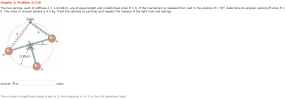 Chapter 3, Problem 3/119 The two springs, each of stiffness k = 1.24 kN/m, are of equal length and undeformed when 0 = 0. If the mechanism is released from rest in the position 0 = 35°, determine its angular velocity O when 0 = 0. The mass m of each sphere is 4.0 kg. Treat the spheres as particles and neglect the masses of the light rods and springs. m 0.29 m Answer: 0 = rad/s The number of...
Two equal length springs having a stiffness of : K A = 300 N/m KB =...
Two equal length springs having a stiffness of : K A = 300 N/m KB = 200 N/m Are nested together in order to form a shock absorber. If a two kilogram block is dropped from an at rest position 0.6 meters above the springs, what is the deformation of the springs when the block momentarily stops at the bottom of its path of travel ?
A wheel-axle assembly is attached to a spring as shown in the figure below. The wheel-axel assembly has a mass of m=3 kg and a radius of gyration about the polar axis of kG=75mm. The spring has a stiffness of k=0.5 kN/m ( Note the units!). The system i
A wheel-axle assembly is attached to a spring as shown in the figure below. The wheel-axel assembly has a mass of m=3 kg and a radius of gyration about the polar axis of kG=75mm. The spring has a stiffness of k=0.5 kN/m ( Note the units!). The system is released from rest with a spring extension of x1=0.2 m. Calculate the maximum angular velocity. Assume friction can be ignored. Provide your answers in rad/s.
Review The spring has a stiffness k = 50 N/m and an unstretched length of 0.3...
 Review The spring has a stiffness k = 50 N/m and an unstretched length of 0.3 m It is attached to the 2.8-kg smooth collar and the collar is released from rest at A (@= 0°). The motion occurs in the horizontal plane. Neglect the size of the collar. (Figure 1) Part A Determine the speed of the collar when = 60° Express your answer to three significant figures and include the appropriate units. Figure < 1 of 1 >...
Can someone help me with part B? Part A A centrifugal governor consists of a central...
 Can someone help me with part B?
Part A A centrifugal governor consists of a central rotating shaft that has two thin, pin-connected rods attached to it, a heavy sphere caps the end of each rod. (Figure 1) A centrifugal governor mechanically limits an engine's speed. A part of the engine turns the centrifugal governor, and if the speed exceeds a set amount, the height of the spheres decreases the driving force of the engine by reducing the fuel fow....
Can someone help me with part B?
Part A A centrifugal governor consists of a central rotating shaft that has two thin, pin-connected rods attached to it, a heavy sphere caps the end of each rod. (Figure 1) A centrifugal governor mechanically limits an engine's speed. A part of the engine turns the centrifugal governor, and if the speed exceeds a set amount, the height of the spheres decreases the driving force of the engine by reducing the fuel fow....
A light, rigid rod of length ℓ=1.00 m joins two particles, with masses m₁=4.00 kg and m₂=3.00 kg
 (a) A light, rigid rod of length ℓ=1.00 m joins two particles, with masses m₁=4.00 kg and m₂=3.00 kg, at its ends. The combination rotates in the x y-plane about a pivot through the center of the rod (see figure below). Determine the angular momentum of the system about the origin when the speed of each particle is 7.60 m / s. (Enter the magnitude to at least two decimal places in kg · m² / s.)(b) What If? What...
(a) A light, rigid rod of length ℓ=1.00 m joins two particles, with masses m₁=4.00 kg and m₂=3.00 kg
 (a) A light, rigid rod of length ℓ=1.00 m joins two particles, with masses m₁=4.00 kg and m₂=3.00 kg, at its ends. The combination rotates in the x y-plane about a pivot through the center of the rod (see figure below). Determine the angular momentum of the system about the origin when the speed of each particle is 7.60 m / s. (Enter the magnitude to at least two decimal places in kg · m² / s.)(b) What If? What...
A light, rigid rod of length ℓ = 1.00 m joins two particles, with masses m1...
A light, rigid rod of length ℓ = 1.00 m joins two particles, with masses m1 = 4.00 kg and m2 = 3.00 kg, at its ends. The combination rotates in the xy-plane about a pivot through the center of the rod (see figure below). Determine the angular momentum of the system about the origin when the speed of each particle is 5.60 m/s. (Enter the magnitude to at least two decimal places in kg · m2/s.) (a) magnitude direction...
 The two springs, each of stiffness k 1.09 kN/m, are of equal length and undeformed when 0-0. If the mechanism is released from rest in the position e-27°, determine its angular velocity when e-0. The mass m of each sphere is 2.4 kg. Treat the spheres as particles and neglect the masses of the light rods and springs 0.40 m Answer: 0 rad/s
 Chapter 3, Problem 3/119 The two springs, each of stiffness k = 1.17 kN/m, are of equal length and undeformed when e = 0. If the mechanism is released from rest in the position = 34°, determine its angular velocity when = 0. The mass m of each sphere is 2.7 kg. Treat the spheres as particles and neglect the masses of the light rods and springs. m 0.26 m m rad/s Answer:
Chapter 3, Problem 3/119 The two springs,...
Chapter 3, Problem 3/119 The two springs, each of stiffness k = 1.17 kN/m, are of equal length and undeformed when e = 0. If the mechanism is released from rest in the position = 34°, determine its angular velocity when = 0. The mass m of each sphere is 2.7 kg. Treat the spheres as particles and neglect the masses of the light rods and springs. m 0.26 m m rad/s Answer:
Chapter 3, Problem 3/119 The two springs,...
 Chapter 3, Problem 3/119 The two springs, each of stiffness k = 1.24 kN/m, are of equal length and undeformed when 0 = 0. If the mechanism is released from rest in the position 0 = 35°, determine its angular velocity O when 0 = 0. The mass m of each sphere is 4.0 kg. Treat the spheres as particles and neglect the masses of the light rods and springs. m 0.29 m Answer: 0 = rad/s The number of...
 Review The spring has a stiffness k = 50 N/m and an unstretched length of 0.3 m It is attached to the 2.8-kg smooth collar and the collar is released from rest at A (@= 0°). The motion occurs in the horizontal plane. Neglect the size of the collar. (Figure 1) Part A Determine the speed of the collar when = 60° Express your answer to three significant figures and include the appropriate units. Figure < 1 of 1 >...
 Can someone help me with part B?
Part A A centrifugal governor consists of a central rotating shaft that has two thin, pin-connected rods attached to it, a heavy sphere caps the end of each rod. (Figure 1) A centrifugal governor mechanically limits an engine's speed. A part of the engine turns the centrifugal governor, and if the speed exceeds a set amount, the height of the spheres decreases the driving force of the engine by reducing the fuel fow....
Can someone help me with part B?
Part A A centrifugal governor consists of a central rotating shaft that has two thin, pin-connected rods attached to it, a heavy sphere caps the end of each rod. (Figure 1) A centrifugal governor mechanically limits an engine's speed. A part of the engine turns the centrifugal governor, and if the speed exceeds a set amount, the height of the spheres decreases the driving force of the engine by reducing the fuel fow....
Most questions answered within 3 hours.
-
Where is the error in this code sequence?
String s1 = "Hello";
String s2 = "ello";...
asked 10 months ago -
Financial data for Joel de Paris, Inc., for last year
follow:
Joel de Paris, Inc.
Balance...
asked 10 months ago -
Consider this reaction:
Al2(SO4)3 (aq)+ BaCl3
(aq) Al2Cl6 (aq)- +
3BaSO4(s) . What is the...
asked 10 months ago -
Suppose that Savneet is considering increasing her
recent random sample from 20 car rentals to 40...
asked 10 months ago -
Trucks arrive at an unloading terminal at an average rate of 120
per hour.
Trucks arrive...
asked 10 months ago -
Why are methanol and ethanol completely soluble in water while
octanol is not very little soluble....
asked 10 months ago -
A facilities manager at a university reads in a research report
that the mean amount of...
asked 10 months ago -
When the CuSO4 is rehydrated by adding water to the anhydrous
compound, is this an endothermic...
asked 10 months ago -
A ray of sunlight is passing from diamond into crown glass; the
angle of incidence is...
asked 10 months ago -
A block of mass 0.249 kg is placed on top of a light, vertical
spring of...
asked 10 months ago -
how do the kidneys compensate in the presences of acidosis
a) trigger hyperventilate
b) reserve acid...
asked 10 months ago -
Question 501 pts
The rental rate of capital to the firm increases. Which of the
following...
asked 10 months ago