
Homework Answers
Please don't hesitate to give a "thumbs up" for the answer, if you're satisfied with it.
A and B are independent. Then :
P(Ac Intersection Bc) = 1-P(A U B) = 1- (P(A)+P(B)-P(A
Intersection B).......1
Since A and B are independent , P(A intersection B) =
P(A)*P(B)
Therefore, 1 reduces to:
P(Ac Intersection Bc)
= 1-P(A U B)
= 1- (P(A)+P(B)-P(A)*P(B)).......1
= (1-P(A))*(1-P(B))
= P(Ac)*P(Bc)
So, P(Ac intersection Bc) = P(Ac)*P(Bc)
<Hence, proved>
a. Prove: If A and B are independent, then so are A and B. b. Prove: If A and B are independent, then so are and . c. G...
a. Prove: If A and B are independent, then so are A and B. b. Prove: If A and B are independent, then so are and . c. Give an example of events A, B, and C such that but We were unable to transcribe this imageWe were unable to transcribe this imageP(An Bn C) = P(A)P(B)P(C), P(AnBn C) P(A)P(B)P(C) P(An Bn C) = P(A)P(B)P(C), P(AnBn C) P(A)P(B)P(C)
Prove that if A and B are independent events, then (a) A and B are independent....
 Prove that if A and B are independent events, then (a) A and B are independent. (b) A and Bc are independent.
Prove that (for two events A and B) if A and Bc are independent, then A...
Prove that (for two events A and B) if A and Bc are independent, then A and B are independent
Prove or disprove: Two events A and B are independent if and only if they are...
Prove or disprove: Two events A and B are independent if and only if they are disjoint.
Prove or disprove: Two events A and B are independent if and only if they are...
Prove or disprove: Two events A and B are independent if and only if they are disjoint.
Prove that conditional independence is symmetric (i.e. if A is independent of B given C then...
Prove that conditional independence is symmetric (i.e. if A is independent of B given C then B is independent of A given C). Please type the answer for my notes thanks!
1. Consider two independent events, A and B, where 0< P(A) <1,0< P(B)< 1. Prove that...
 1. Consider two independent events, A and B, where 0< P(A) <1,0< P(B)< 1. Prove that A and B' are independent as well.
6. (15 points) Let B = (2, 1, 1). Prove that B is linearly independent and...
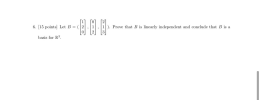 6. (15 points) Let B = (2, 1, 1). Prove that B is linearly independent and conclude that B is a o] [2] 3] basis for R3.
tarks) Does A - B = imply B - A = 0? If so, prove it....
 tarks) Does A - B = imply B - A = 0? If so, prove it. If not, give a counterexample.' A-B=0 means A=B
Consider two independent events, A and B, where 0くP(A) < 1,0くP(8)く1. Prove that A' and B'...
 Consider two independent events, A and B, where 0くP(A) < 1,0くP(8)く1. Prove that A' and B' are independent as well.
 Prove that if A and B are independent events, then (a) A and B are independent. (b) A and Bc are independent.
 1. Consider two independent events, A and B, where 0< P(A) <1,0< P(B)< 1. Prove that A and B' are independent as well.
 6. (15 points) Let B = (2, 1, 1). Prove that B is linearly independent and conclude that B is a o] [2] 3] basis for R3.
 tarks) Does A - B = imply B - A = 0? If so, prove it. If not, give a counterexample.' A-B=0 means A=B
 Consider two independent events, A and B, where 0くP(A) < 1,0くP(8)く1. Prove that A' and B' are independent as well.
Most questions answered within 3 hours.
-
Where is the error in this code sequence?
String s1 = "Hello";
String s2 = "ello";...
asked 11 months ago -
Financial data for Joel de Paris, Inc., for last year
follow:
Joel de Paris, Inc.
Balance...
asked 11 months ago -
Consider this reaction:
Al2(SO4)3 (aq)+ BaCl3
(aq) Al2Cl6 (aq)- +
3BaSO4(s) . What is the...
asked 11 months ago -
Suppose that Savneet is considering increasing her
recent random sample from 20 car rentals to 40...
asked 11 months ago -
Trucks arrive at an unloading terminal at an average rate of 120
per hour.
Trucks arrive...
asked 11 months ago -
Why are methanol and ethanol completely soluble in water while
octanol is not very little soluble....
asked 11 months ago -
A facilities manager at a university reads in a research report
that the mean amount of...
asked 11 months ago -
When the CuSO4 is rehydrated by adding water to the anhydrous
compound, is this an endothermic...
asked 11 months ago -
A ray of sunlight is passing from diamond into crown glass; the
angle of incidence is...
asked 11 months ago -
A block of mass 0.249 kg is placed on top of a light, vertical
spring of...
asked 11 months ago -
how do the kidneys compensate in the presences of acidosis
a) trigger hyperventilate
b) reserve acid...
asked 11 months ago -
Question 501 pts
The rental rate of capital to the firm increases. Which of the
following...
asked 11 months ago