
Homework Answers
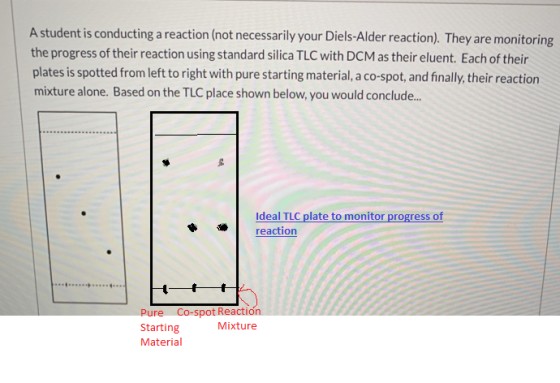
If the sequence of the spotted samples in the TLC plate from left to right is pure starting material, co-spot, and the final reaction mixture respectively, the final reaction mixture cannot be below the co-spot! It should at least travel to the height of co-spot (actually it should travel to the height of starting material giving a blur spot too!). So clearly there is something wrong in the TLC and the option is-
Option 4. that something is amiss with their TLC plate and that they should run another before making any decision about how to proceed.
The following is the TLC plate that should have been obtained to monitor the reaction progress-
Add Answer to:
A student is conducting a reaction (not necessarily your Diels-Alder reaction). They are monitoring the progress...
References Predict the product of the Diels-Alder reaction of this compound with cyclopentadiene. Draw your product...
 References Predict the product of the Diels-Alder reaction of this compound with cyclopentadiene. Draw your product in the window below. CI CH . You do not have to consider stereochemistry Potential bicyclic templates are provided in the starting pointsdropdown menu should you require them. ChemDoodle" | -starting points
A student monitored the reaction progress of the reduction of 4-Nitrobenzaldehyde to 4-Nitrobenzyl alcohol using TLC....
 A student monitored the reaction progress of the reduction of
4-Nitrobenzaldehyde to 4-Nitrobenzyl alcohol using TLC. 30% ethyl
acetate in petroleum ether was used as the elution solvent. TLC
plates available in the laboratory were coated with the common
absorbent silica gel (SiO2.xH2O) which
contains polar hydroxyl (OH-) groups.
c. The crude product moves slower
than the starting material with the mobile
phase in the TLC plate. Briefly
explain a possible reason for the
observation based on the chemical
structures...
A student monitored the reaction progress of the reduction of
4-Nitrobenzaldehyde to 4-Nitrobenzyl alcohol using TLC. 30% ethyl
acetate in petroleum ether was used as the elution solvent. TLC
plates available in the laboratory were coated with the common
absorbent silica gel (SiO2.xH2O) which
contains polar hydroxyl (OH-) groups.
c. The crude product moves slower
than the starting material with the mobile
phase in the TLC plate. Briefly
explain a possible reason for the
observation based on the chemical
structures...
What is the reaction product(s) of oleic acid & sodium methoxide? Show the structure(s). Part A:...
What is the reaction product(s) of oleic acid & sodium methoxide? Show the structure(s). Part A: Acid Catalyzed Fischer Esterification of Free Fatty Acids Add 20 mL of canola oil and a magnetic stir bar to a 125-mL Erlenmeyer flask, and place the flask on a magnetic stirring plate. Add 2–3 mL of methanol and up to three drops of concentrated sulfuric acid Perform this step with caution, as this is a strong acid! Immerse a thermometer into the reaction...
Only need help with 5,6,7 and mechanism FTIR and NMR Spectra After completing a reaction and...
 Only need help with 5,6,7
and mechanism
FTIR and NMR Spectra After completing a reaction and working up the products, it is still necessary to confirm that the correct product was formed. The most common tools used for this analysis are Fourier Transform Infrared (FTIR) and Nuclear Magnetic Resonance (NMR) spectroscopy. In the virtual laboratory, 'H and C NMR spectra are available. Details on interpreting FTIR and NMR spectra are found in your textbook. Your instructor may or may not...
Only need help with 5,6,7
and mechanism
FTIR and NMR Spectra After completing a reaction and working up the products, it is still necessary to confirm that the correct product was formed. The most common tools used for this analysis are Fourier Transform Infrared (FTIR) and Nuclear Magnetic Resonance (NMR) spectroscopy. In the virtual laboratory, 'H and C NMR spectra are available. Details on interpreting FTIR and NMR spectra are found in your textbook. Your instructor may or may not...
1 - Provide a balanced equation for this reaction 2 - Provide a mechanism for the...
 1 - Provide a balanced equation for this reaction
2 - Provide a mechanism for the transformation of cyclohexanol
into cyclohexanone
3 - Provide a flow chart for the workup procedure for isolating
cyclohexane from all the by-products, making sure to note in which
layer you expect to find your product in each extraction.
4 - Provide the theoretical yield of cyclohexane in this
experiment.
PROCEDURE OXIDATION OF CYCLOHEXANOL TO CYCLOHEXANONE Set up a water bath as the heat source...
1 - Provide a balanced equation for this reaction
2 - Provide a mechanism for the transformation of cyclohexanol
into cyclohexanone
3 - Provide a flow chart for the workup procedure for isolating
cyclohexane from all the by-products, making sure to note in which
layer you expect to find your product in each extraction.
4 - Provide the theoretical yield of cyclohexane in this
experiment.
PROCEDURE OXIDATION OF CYCLOHEXANOL TO CYCLOHEXANONE Set up a water bath as the heat source...
Attached is the lab experiment. Here are the questions I need help with: 1. What is...
 Attached is the lab experiment. Here are the questions I need
help with:
1. What is the purpose of each of the following steps in this
experiment?
a. Adding solid NaCl to the reaction mixture
b. Repeated washings with water, sat'd NAHCO3, and brine
c. the pipet column chromatography
2. Which compound, cyclohexanol or cyclohexanone will have a
higher Rf on a TLC plate?
3. What is the advantage of using sodium hypochlorite as an
oxidant over CrO3 or Na2Cr2O7...
Attached is the lab experiment. Here are the questions I need
help with:
1. What is the purpose of each of the following steps in this
experiment?
a. Adding solid NaCl to the reaction mixture
b. Repeated washings with water, sat'd NAHCO3, and brine
c. the pipet column chromatography
2. Which compound, cyclohexanol or cyclohexanone will have a
higher Rf on a TLC plate?
3. What is the advantage of using sodium hypochlorite as an
oxidant over CrO3 or Na2Cr2O7...
Preparation of Benzoic Acid using a Grignard Reagent URGENT 1. During your Grignard formation, a small...
Preparation of Benzoic Acid using a Grignard Reagent URGENT 1. During your Grignard formation, a small amount of benzene is formed. Provide a brief explanation and mechanism to explain this observation. 2. During your Grignard formation, a small amount of biphenyl is formed. Provide a brief explanation and mechanism to explain this observation. 3. What mass of water would be required to destroy the phenylmagnesium bromide that you prepared in this experiment? What volume does this represent? 4. Why is...
I need help with questions 5, 6, & 7. The FTIR and NMR is provided. I...
 I need help with questions 5,
6, & 7. The FTIR and NMR is provided. I also need help creating
a reaction mechanism using the following:
Starting material: methyl acetate.
Solvent: diethyl ether
Reagent: sodium methoxide
Product: methyl acetoacetate
THANK YOU!!!!!
11-8: Claisen Condensation - 1 For this assignment, the target compound that you should synthesize is methyl acetoacetate.This is another carbonyl addition variation. Examine the product and determine which ester is the nucleophile and which is the electrophile. Keep...
I need help with questions 5,
6, & 7. The FTIR and NMR is provided. I also need help creating
a reaction mechanism using the following:
Starting material: methyl acetate.
Solvent: diethyl ether
Reagent: sodium methoxide
Product: methyl acetoacetate
THANK YOU!!!!!
11-8: Claisen Condensation - 1 For this assignment, the target compound that you should synthesize is methyl acetoacetate.This is another carbonyl addition variation. Examine the product and determine which ester is the nucleophile and which is the electrophile. Keep...
the weight if the initial product was 3.4 grams of methyl benzoate. Who |o yald foR 3.91SSg st prodoc...
 the
weight if the initial product was 3.4 grams of methyl
benzoate.
Who |o yald foR 3.91SSg st prodoct nd product 2.14143 EXPERIMENTAL PROCEDURE SAFETY WEAR nitrile gloves for this experiment. The nitrating moture of sulfuric acidnitric acid (1:1) is a very strong acid system. Do not allow it to come in contact with your skin or clothing. It will cause acid burns if it comes in contact with your skin (and holes an your clothes). Wash any affected area...
the
weight if the initial product was 3.4 grams of methyl
benzoate.
Who |o yald foR 3.91SSg st prodoct nd product 2.14143 EXPERIMENTAL PROCEDURE SAFETY WEAR nitrile gloves for this experiment. The nitrating moture of sulfuric acidnitric acid (1:1) is a very strong acid system. Do not allow it to come in contact with your skin or clothing. It will cause acid burns if it comes in contact with your skin (and holes an your clothes). Wash any affected area...
I need help with questions 5, 6, & 7. The FTIR and NMR is provided. I...
 I need help with questions 5, 6, & 7. The FTIR and NMR is
provided. I also need help creating a reaction mechanism using the
following:
Starting material: 1,7-Dimethyl-heptanedioate
Solvent: Diethyl ether
Reagent: sodium methoxide
Product: 3-oxo-cyclohexane carboxylic acid methyl ester
THANK YOU!!!!!
Ö 11-11: Dieckmann Reaction For this assignment, the target compound that you should synthesize is 2-oxo-cyclohexane carboxylic acid methyl ester.This is an intramolecular carbonyl addition variation. Examine the product and determine which ester is the nucleophile and...
I need help with questions 5, 6, & 7. The FTIR and NMR is
provided. I also need help creating a reaction mechanism using the
following:
Starting material: 1,7-Dimethyl-heptanedioate
Solvent: Diethyl ether
Reagent: sodium methoxide
Product: 3-oxo-cyclohexane carboxylic acid methyl ester
THANK YOU!!!!!
Ö 11-11: Dieckmann Reaction For this assignment, the target compound that you should synthesize is 2-oxo-cyclohexane carboxylic acid methyl ester.This is an intramolecular carbonyl addition variation. Examine the product and determine which ester is the nucleophile and...
 References Predict the product of the Diels-Alder reaction of this compound with cyclopentadiene. Draw your product in the window below. CI CH . You do not have to consider stereochemistry Potential bicyclic templates are provided in the starting pointsdropdown menu should you require them. ChemDoodle" | -starting points
 A student monitored the reaction progress of the reduction of
4-Nitrobenzaldehyde to 4-Nitrobenzyl alcohol using TLC. 30% ethyl
acetate in petroleum ether was used as the elution solvent. TLC
plates available in the laboratory were coated with the common
absorbent silica gel (SiO2.xH2O) which
contains polar hydroxyl (OH-) groups.
c. The crude product moves slower
than the starting material with the mobile
phase in the TLC plate. Briefly
explain a possible reason for the
observation based on the chemical
structures...
A student monitored the reaction progress of the reduction of
4-Nitrobenzaldehyde to 4-Nitrobenzyl alcohol using TLC. 30% ethyl
acetate in petroleum ether was used as the elution solvent. TLC
plates available in the laboratory were coated with the common
absorbent silica gel (SiO2.xH2O) which
contains polar hydroxyl (OH-) groups.
c. The crude product moves slower
than the starting material with the mobile
phase in the TLC plate. Briefly
explain a possible reason for the
observation based on the chemical
structures...
 Only need help with 5,6,7
and mechanism
FTIR and NMR Spectra After completing a reaction and working up the products, it is still necessary to confirm that the correct product was formed. The most common tools used for this analysis are Fourier Transform Infrared (FTIR) and Nuclear Magnetic Resonance (NMR) spectroscopy. In the virtual laboratory, 'H and C NMR spectra are available. Details on interpreting FTIR and NMR spectra are found in your textbook. Your instructor may or may not...
Only need help with 5,6,7
and mechanism
FTIR and NMR Spectra After completing a reaction and working up the products, it is still necessary to confirm that the correct product was formed. The most common tools used for this analysis are Fourier Transform Infrared (FTIR) and Nuclear Magnetic Resonance (NMR) spectroscopy. In the virtual laboratory, 'H and C NMR spectra are available. Details on interpreting FTIR and NMR spectra are found in your textbook. Your instructor may or may not...
 1 - Provide a balanced equation for this reaction
2 - Provide a mechanism for the transformation of cyclohexanol
into cyclohexanone
3 - Provide a flow chart for the workup procedure for isolating
cyclohexane from all the by-products, making sure to note in which
layer you expect to find your product in each extraction.
4 - Provide the theoretical yield of cyclohexane in this
experiment.
PROCEDURE OXIDATION OF CYCLOHEXANOL TO CYCLOHEXANONE Set up a water bath as the heat source...
1 - Provide a balanced equation for this reaction
2 - Provide a mechanism for the transformation of cyclohexanol
into cyclohexanone
3 - Provide a flow chart for the workup procedure for isolating
cyclohexane from all the by-products, making sure to note in which
layer you expect to find your product in each extraction.
4 - Provide the theoretical yield of cyclohexane in this
experiment.
PROCEDURE OXIDATION OF CYCLOHEXANOL TO CYCLOHEXANONE Set up a water bath as the heat source...
 Attached is the lab experiment. Here are the questions I need
help with:
1. What is the purpose of each of the following steps in this
experiment?
a. Adding solid NaCl to the reaction mixture
b. Repeated washings with water, sat'd NAHCO3, and brine
c. the pipet column chromatography
2. Which compound, cyclohexanol or cyclohexanone will have a
higher Rf on a TLC plate?
3. What is the advantage of using sodium hypochlorite as an
oxidant over CrO3 or Na2Cr2O7...
Attached is the lab experiment. Here are the questions I need
help with:
1. What is the purpose of each of the following steps in this
experiment?
a. Adding solid NaCl to the reaction mixture
b. Repeated washings with water, sat'd NAHCO3, and brine
c. the pipet column chromatography
2. Which compound, cyclohexanol or cyclohexanone will have a
higher Rf on a TLC plate?
3. What is the advantage of using sodium hypochlorite as an
oxidant over CrO3 or Na2Cr2O7...
 I need help with questions 5,
6, & 7. The FTIR and NMR is provided. I also need help creating
a reaction mechanism using the following:
Starting material: methyl acetate.
Solvent: diethyl ether
Reagent: sodium methoxide
Product: methyl acetoacetate
THANK YOU!!!!!
11-8: Claisen Condensation - 1 For this assignment, the target compound that you should synthesize is methyl acetoacetate.This is another carbonyl addition variation. Examine the product and determine which ester is the nucleophile and which is the electrophile. Keep...
I need help with questions 5,
6, & 7. The FTIR and NMR is provided. I also need help creating
a reaction mechanism using the following:
Starting material: methyl acetate.
Solvent: diethyl ether
Reagent: sodium methoxide
Product: methyl acetoacetate
THANK YOU!!!!!
11-8: Claisen Condensation - 1 For this assignment, the target compound that you should synthesize is methyl acetoacetate.This is another carbonyl addition variation. Examine the product and determine which ester is the nucleophile and which is the electrophile. Keep...
 the
weight if the initial product was 3.4 grams of methyl
benzoate.
Who |o yald foR 3.91SSg st prodoct nd product 2.14143 EXPERIMENTAL PROCEDURE SAFETY WEAR nitrile gloves for this experiment. The nitrating moture of sulfuric acidnitric acid (1:1) is a very strong acid system. Do not allow it to come in contact with your skin or clothing. It will cause acid burns if it comes in contact with your skin (and holes an your clothes). Wash any affected area...
the
weight if the initial product was 3.4 grams of methyl
benzoate.
Who |o yald foR 3.91SSg st prodoct nd product 2.14143 EXPERIMENTAL PROCEDURE SAFETY WEAR nitrile gloves for this experiment. The nitrating moture of sulfuric acidnitric acid (1:1) is a very strong acid system. Do not allow it to come in contact with your skin or clothing. It will cause acid burns if it comes in contact with your skin (and holes an your clothes). Wash any affected area...
 I need help with questions 5, 6, & 7. The FTIR and NMR is
provided. I also need help creating a reaction mechanism using the
following:
Starting material: 1,7-Dimethyl-heptanedioate
Solvent: Diethyl ether
Reagent: sodium methoxide
Product: 3-oxo-cyclohexane carboxylic acid methyl ester
THANK YOU!!!!!
Ö 11-11: Dieckmann Reaction For this assignment, the target compound that you should synthesize is 2-oxo-cyclohexane carboxylic acid methyl ester.This is an intramolecular carbonyl addition variation. Examine the product and determine which ester is the nucleophile and...
I need help with questions 5, 6, & 7. The FTIR and NMR is
provided. I also need help creating a reaction mechanism using the
following:
Starting material: 1,7-Dimethyl-heptanedioate
Solvent: Diethyl ether
Reagent: sodium methoxide
Product: 3-oxo-cyclohexane carboxylic acid methyl ester
THANK YOU!!!!!
Ö 11-11: Dieckmann Reaction For this assignment, the target compound that you should synthesize is 2-oxo-cyclohexane carboxylic acid methyl ester.This is an intramolecular carbonyl addition variation. Examine the product and determine which ester is the nucleophile and...
Most questions answered within 3 hours.
-
Where is the error in this code sequence?
String s1 = "Hello";
String s2 = "ello";...
asked 10 months ago -
Financial data for Joel de Paris, Inc., for last year
follow:
Joel de Paris, Inc.
Balance...
asked 10 months ago -
Consider this reaction:
Al2(SO4)3 (aq)+ BaCl3
(aq) Al2Cl6 (aq)- +
3BaSO4(s) . What is the...
asked 10 months ago -
Suppose that Savneet is considering increasing her
recent random sample from 20 car rentals to 40...
asked 10 months ago -
Trucks arrive at an unloading terminal at an average rate of 120
per hour.
Trucks arrive...
asked 10 months ago -
Why are methanol and ethanol completely soluble in water while
octanol is not very little soluble....
asked 10 months ago -
A facilities manager at a university reads in a research report
that the mean amount of...
asked 10 months ago -
When the CuSO4 is rehydrated by adding water to the anhydrous
compound, is this an endothermic...
asked 10 months ago -
A ray of sunlight is passing from diamond into crown glass; the
angle of incidence is...
asked 10 months ago -
A block of mass 0.249 kg is placed on top of a light, vertical
spring of...
asked 10 months ago -
how do the kidneys compensate in the presences of acidosis
a) trigger hyperventilate
b) reserve acid...
asked 10 months ago -
Question 501 pts
The rental rate of capital to the firm increases. Which of the
following...
asked 10 months ago