Identify the following compound: C10H10O2: NMR: δ 2.82 (6 H, s), δ 8.13 (4 H, s)...
Identify the following compound:
C10H10O2:
NMR: δ 2.82 (6 H, s), δ 8.13 (4 H, s)
IR: 1681 cm-1, no O-H stretch
Homework Answers
1H NMR Spectroscopy:
• Nuclear magnetic resonance spectroscopy is one of the techniques in analytical chemistry that is widely used to determine the purity of sample, and also to predict the structure of the organic compounds.
• The  spectroscopy is a phenomenon that is observed, when the frequency of nuclei of atoms (sample) resonates with frequency of the rotating magnetic field.
• The  spectroscopy determines different types of hydrogens (chemically non-equivalent hydrogens) that are present in a molecule.
Infrared Spectroscopy (IR):
• Infrared spectroscopy is an important analytical tool to determine the functional groups in the chemical compounds.
• It is also called as the vibrational spectroscopy.
• Any compound having covalent bonds absorbs a range of frequencies of the electromagnetic radiation in the infrared region of the electromagnetic spectrum.
• The IR radiations lie in the wavelength range of 400 - 800 nm.
1H NMR Spin-Spin Coupling Patterns:

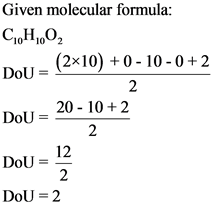
The degree of Unsaturation or index of hydrogen deficiency:
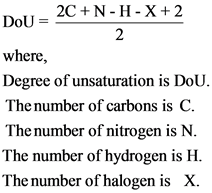
The molecular formula represents the total number of atoms that are present in the compound. In Chemistry,
IHD refers to the index of hydrogen deficiency which is also called as the degree of unsaturation. IHD (index of hydrogen deficiency) is a formula, which is used to determine the chemical structure from the molecular formula.
A cyclic structure, which is a double and triple bond in structure, can be determined with the help of the degree of unsaturation values.
For example:
IHD = 0, no unsaturation in the molecule. The structure is saturated hydrocarbon. All bonds are single bonds in the compound.
IHD = 1, the structure may contain 1 double bond or 1 ring.
IHD = 2, the structure may contain 2 double bonds or 1 ring with 1 double bond.
IHD = 3, the structure may contain 3 double bonds or 1 ring with 2 double bonds.
IHD = 4, the structure may contain 4 double bonds or 2 triple bonds, or 1 ring with three double bonds or 2 rings with 2 double bonds or 3 rings with 1 double bond.
The mathematical equation for the IR wavenumber:

Where,
Wavenumber of absorption =  .
.
Velocity of light =  .
.
Force constant =  .
.
Reduced mass =  .
.
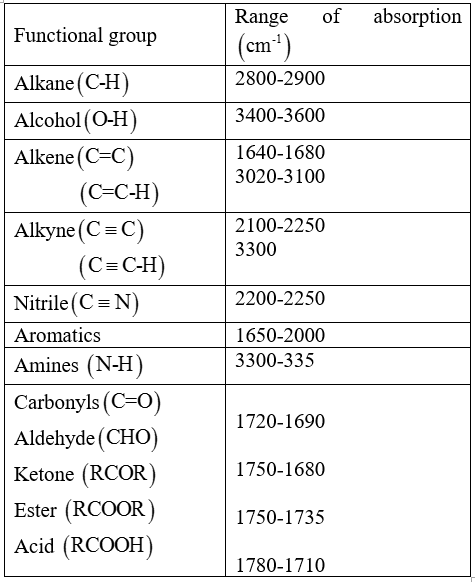
IR frequency and range of absorption:


The structure of the compound is:
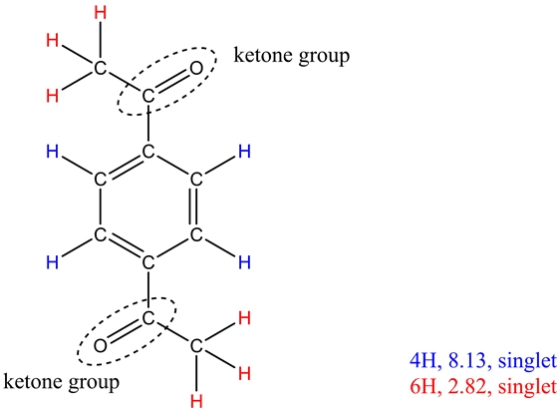
The structure for the given chemical formulae is:

Add Answer to:
Identify the following compound:
C10H10O2:
NMR: δ 2.82 (6 H, s), δ 8.13 (4 H, s)...
Identify the following compound. C10H10O2: NMR: δ 2.82 (6H, s), δ 8.13 (4H, s) IR: 1681...
Identify the following compound. C10H10O2: NMR: δ 2.82 (6H, s), δ 8.13 (4H, s) IR: 1681 cm–1, no O–H stretch
Identify the following compound. C10H10O2: NMR: δ 2.82 (6H, s), δ 8.13 (4H, s) IR: 1681...
Identify the following compound. C10H10O2: NMR: δ 2.82 (6H, s), δ 8.13 (4H, s) IR: 1681 cm-1, no O-H stretch
Identify the following compound C10H10O2 NMR: S 2.82 (6H,singlet); S 8.13 (4H, singlet) IR: 1681 cm^-1;...
Identify the following compound C10H10O2 NMR: S 2.82 (6H,singlet); S 8.13 (4H, singlet) IR: 1681 cm^-1; no O-H stretch
NMR: 2.82 shift (6H, singlet), 8.13 shift (4H, singlet) IR: 1681 1/cm, no OH stretch
NMR: 2.82 shift (6H, singlet), 8.13 shift (4H, singlet) IR: 1681 1/cm, no OH stretch
Identify the following compound: C5H10O NMR: δ 9.8 (1 H, s), δ 1.1 (9 H, s)
Identify the following compound: C5H10O NMR: δ 9.8 (1 H, s), δ 1.1 (9 H, s)
Identify the following compound. C5H10O: NMR: δ 9.8 (1H, s), δ 1.1 (9H, s)
Identify the following compound. C5H10O: NMR: δ 9.8 (1H, s), δ 1.1 (9H, s)
Propose a structure for a compound whose(M)" is 86 and (M-1)", is 5% of the molecular ion. Its ir shows an absorption at 1720 cm1 and its 'H NMR displays δ 1.1 (d, 6H), δ 2.1 (s, 3 H), an...
 Propose a structure for a compound whose(M)" is 86 and (M-1)", is 5% of the molecular ion. Its ir shows an absorption at 1720 cm1 and its 'H NMR displays δ 1.1 (d, 6H), δ 2.1 (s, 3 H), and δ 2.7 (septet/heptet, 1H).
Propose a structure for a compound whose(M)" is 86 and (M-1)", is 5% of the molecular ion. Its ir shows an absorption at 1720 cm1 and its 'H NMR displays δ 1.1 (d, 6H), δ 2.1...
Propose a structure for a compound whose(M)" is 86 and (M-1)", is 5% of the molecular ion. Its ir shows an absorption at 1720 cm1 and its 'H NMR displays δ 1.1 (d, 6H), δ 2.1 (s, 3 H), and δ 2.7 (septet/heptet, 1H).
Propose a structure for a compound whose(M)" is 86 and (M-1)", is 5% of the molecular ion. Its ir shows an absorption at 1720 cm1 and its 'H NMR displays δ 1.1 (d, 6H), δ 2.1...
Identify the following compound from its IR and proton NMR spectra. C6H10O: NMR: 3.31 (3H, s);...
 Identify the following compound from its IR and proton NMR spectra. C6H10O: NMR: 3.31 (3H, s); 2.41 (1H, s); 1.43(6H, s) IR: 2110, 3300 cm - 1 (sharp)
10) Identify the unknown compound with the formula C&H O using the following 'H NMR,"C NMR,...
 10) Identify the unknown compound with the formula C&H O using the following 'H NMR,"C NMR, and IR spectra. Label all peaks used to make your identification as appropriate. Draw the structure of the unknown compound in the box provided. Answer (structure) deguer of insulation 200 180 160 140 120 100 ppm 30 0 40 20 0
10. Identify which compound best matches the following spectral data. (6 points) NMR 10.5 ppm, singlet (1 H) 8.5 pp...
 10. Identify which compound best matches the following spectral data. (6 points) NMR 10.5 ppm, singlet (1 H) 8.5 ppm, doublet (2 H) 7.5 ppm, doublet (2 H) 3.8 ppm, singlet (3 H) IR strong signal 1715 cm"!; MS parent peak 136 O=C-H ОН H2 HC-C-c-C-ochz H2 OCH; CH3
 Propose a structure for a compound whose(M)" is 86 and (M-1)", is 5% of the molecular ion. Its ir shows an absorption at 1720 cm1 and its 'H NMR displays δ 1.1 (d, 6H), δ 2.1 (s, 3 H), and δ 2.7 (septet/heptet, 1H).
Propose a structure for a compound whose(M)" is 86 and (M-1)", is 5% of the molecular ion. Its ir shows an absorption at 1720 cm1 and its 'H NMR displays δ 1.1 (d, 6H), δ 2.1...
Propose a structure for a compound whose(M)" is 86 and (M-1)", is 5% of the molecular ion. Its ir shows an absorption at 1720 cm1 and its 'H NMR displays δ 1.1 (d, 6H), δ 2.1 (s, 3 H), and δ 2.7 (septet/heptet, 1H).
Propose a structure for a compound whose(M)" is 86 and (M-1)", is 5% of the molecular ion. Its ir shows an absorption at 1720 cm1 and its 'H NMR displays δ 1.1 (d, 6H), δ 2.1...
 Identify the following compound from its IR and proton NMR spectra. C6H10O: NMR: 3.31 (3H, s); 2.41 (1H, s); 1.43(6H, s) IR: 2110, 3300 cm - 1 (sharp)
 10) Identify the unknown compound with the formula C&H O using the following 'H NMR,"C NMR, and IR spectra. Label all peaks used to make your identification as appropriate. Draw the structure of the unknown compound in the box provided. Answer (structure) deguer of insulation 200 180 160 140 120 100 ppm 30 0 40 20 0
 10. Identify which compound best matches the following spectral data. (6 points) NMR 10.5 ppm, singlet (1 H) 8.5 ppm, doublet (2 H) 7.5 ppm, doublet (2 H) 3.8 ppm, singlet (3 H) IR strong signal 1715 cm"!; MS parent peak 136 O=C-H ОН H2 HC-C-c-C-ochz H2 OCH; CH3
Most questions answered within 3 hours.
-
Where is the error in this code sequence?
String s1 = "Hello";
String s2 = "ello";...
asked 11 months ago -
Financial data for Joel de Paris, Inc., for last year
follow:
Joel de Paris, Inc.
Balance...
asked 11 months ago -
Consider this reaction:
Al2(SO4)3 (aq)+ BaCl3
(aq) Al2Cl6 (aq)- +
3BaSO4(s) . What is the...
asked 11 months ago -
Suppose that Savneet is considering increasing her
recent random sample from 20 car rentals to 40...
asked 11 months ago -
Trucks arrive at an unloading terminal at an average rate of 120
per hour.
Trucks arrive...
asked 11 months ago -
Why are methanol and ethanol completely soluble in water while
octanol is not very little soluble....
asked 11 months ago -
A facilities manager at a university reads in a research report
that the mean amount of...
asked 11 months ago -
When the CuSO4 is rehydrated by adding water to the anhydrous
compound, is this an endothermic...
asked 11 months ago -
A ray of sunlight is passing from diamond into crown glass; the
angle of incidence is...
asked 11 months ago -
A block of mass 0.249 kg is placed on top of a light, vertical
spring of...
asked 11 months ago -
how do the kidneys compensate in the presences of acidosis
a) trigger hyperventilate
b) reserve acid...
asked 11 months ago -
Question 501 pts
The rental rate of capital to the firm increases. Which of the
following...
asked 11 months ago