
Homework Answers
Add Answer to:
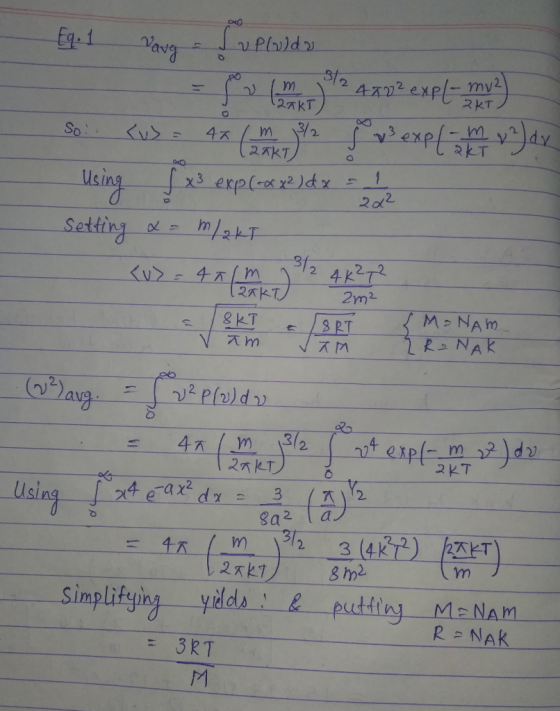
Do the integration for equation 1 and 2. Equation 1: vavg - Jo vP(v)dv Equation 2:...
Assuming we know from contour integration that r log(t Jo t (1+t) Deduce that 1 log2(t)dt-T3 o t1/2(1 +t) 2 Without further integration Assuming we know from contour integration that r log(t Jo...
 Assuming we know from contour integration that r log(t Jo t (1+t) Deduce that 1 log2(t)dt-T3 o t1/2(1 +t) 2 Without further integration
Assuming we know from contour integration that r log(t Jo t (1+t) Deduce that 1 log2(t)dt-T3 o t1/2(1 +t) 2 Without further integration
Assuming we know from contour integration that r log(t Jo t (1+t) Deduce that 1 log2(t)dt-T3 o t1/2(1 +t) 2 Without further integration
Solve the thermodynamic equation: B(C_P/K_T)=? where: B= 1/V(dV/dT)_P K_T=-1/V(dV/dP)_T C_P= (dH/dT)_P
Solve the thermodynamic equation: B(C_P/K_T)=? where: B= 1/V(dV/dT)_P K_T=-1/V(dV/dP)_T C_P= (dH/dT)_P
Identify u and dv when integrating this expression using integration by parts. 1) u = 2) dv = ( ) dx 3) ∫ ( ) d The integral can be found in more than one way. First use integration by parts, then e...
 Identify u and dv when integrating this expression using
integration by parts.
1) u =
2) dv = ( ) dx
3) ∫ ( ) d
The integral can be found in more than one way. First use integration by parts, then expand the expression and integrate the result. -4)x+5 dx
The integral can be found in more than one way. First use integration by parts, then expand the expression and integrate the result. -4)x+5 dx
Identify u and dv when integrating this expression using
integration by parts.
1) u =
2) dv = ( ) dx
3) ∫ ( ) d
The integral can be found in more than one way. First use integration by parts, then expand the expression and integrate the result. -4)x+5 dx
The integral can be found in more than one way. First use integration by parts, then expand the expression and integrate the result. -4)x+5 dx
Exercise 1. Evaluate the following integrals by reversing the oder of integration: 1 c3 2 a) Jo J3y dy dx; (d,) ev dy d...
 Exercise 1. Evaluate the following integrals by reversing the oder of integration: 1 c3 2 a) Jo J3y dy dx; (d,) ev dy dx.
Exercise 1. Evaluate the following integrals by reversing the oder of integration: 1 c3 2 a) Jo J3y dy dx; (d,) ev dy dx.
Exercise 1. Evaluate the following integrals by reversing the oder of integration: 1 c3 2 a) Jo J3y dy dx; (d,) ev dy dx.
Compute the volume SSSx 1 dV where X is the solid defined by x2 + y2...
 Compute the volume SSSx 1 dV where X is the solid defined by x2 + y2 < 4,0 Sz<10., A) 20 B) 407 C) 201 D) 801 ОА ОС OD OB Question 20 What is the absolute value of the Jacobian of : x = uv, y = u2 + v2 at the input point (u, v) = (2, 3)?
Q1: Change the order of integration 1 rx-2 61 xy dy dx xy dy dx Jo...
 Q1: Change the order of integration 1 rx-2 61 xy dy dx xy dy dx Jo x2 Evaluate the reversed integral and sketch the region.
Solve the given integral equation or integro-differential equation for y(t). y (1)+ Ja-vy(v) dv=5t, y(0) =...
 Solve the given integral equation or integro-differential equation for y(t). y (1)+ Ja-vy(v) dv=5t, y(0) = 0 0 y(t)=D
Question 1 (1 point) 1. Find P , where Q = lijkU;V;Wk and U1=3, U2=2, 43=1,...
 Question 1 (1 point) 1. Find P , where Q = lijkU;V;Wk and U1=3, U2=2, 43=1, v1=2, v2=1, v3=3, W1=1, W2=2, W3=3
Do magnitude plots only. 8.2. Draw the bode plot for the network equation o + 8)jo+2...
 Do magnitude plots only.
8.2. Draw the bode plot for the network equation o + 8)jo+2 .Jw
Do magnitude plots only.
8.2. Draw the bode plot for the network equation o + 8)jo+2 .Jw
QUESTION 2 a) (5 p) Interpret the rocket equation dv(OM(t)=-udMO [EQ.1) within the framework of the...
 QUESTION 2 a) (5 p) Interpret the rocket equation dv(OM(t)=-udMO [EQ.1) within the framework of the law of momentum conservation, written in a closed system, here Mt) is the rocket mass, time t, whereas M(t) is by definition, dM(t)=M(t+dt)-M(t): -dM(t)-dM(t), is the mass of the gas thrown by the rocket through the infinitely small period of time dt: on the other hand, dv(t) is, still by definition, dv(t)v(t+dt)-vít), i.e. the increase in the velocity of the rocket through the period...
 Assuming we know from contour integration that r log(t Jo t (1+t) Deduce that 1 log2(t)dt-T3 o t1/2(1 +t) 2 Without further integration
Assuming we know from contour integration that r log(t Jo t (1+t) Deduce that 1 log2(t)dt-T3 o t1/2(1 +t) 2 Without further integration
Assuming we know from contour integration that r log(t Jo t (1+t) Deduce that 1 log2(t)dt-T3 o t1/2(1 +t) 2 Without further integration
 Identify u and dv when integrating this expression using
integration by parts.
1) u =
2) dv = ( ) dx
3) ∫ ( ) d
The integral can be found in more than one way. First use integration by parts, then expand the expression and integrate the result. -4)x+5 dx
The integral can be found in more than one way. First use integration by parts, then expand the expression and integrate the result. -4)x+5 dx
Identify u and dv when integrating this expression using
integration by parts.
1) u =
2) dv = ( ) dx
3) ∫ ( ) d
The integral can be found in more than one way. First use integration by parts, then expand the expression and integrate the result. -4)x+5 dx
The integral can be found in more than one way. First use integration by parts, then expand the expression and integrate the result. -4)x+5 dx
 Exercise 1. Evaluate the following integrals by reversing the oder of integration: 1 c3 2 a) Jo J3y dy dx; (d,) ev dy dx.
Exercise 1. Evaluate the following integrals by reversing the oder of integration: 1 c3 2 a) Jo J3y dy dx; (d,) ev dy dx.
Exercise 1. Evaluate the following integrals by reversing the oder of integration: 1 c3 2 a) Jo J3y dy dx; (d,) ev dy dx.
 Compute the volume SSSx 1 dV where X is the solid defined by x2 + y2 < 4,0 Sz<10., A) 20 B) 407 C) 201 D) 801 ОА ОС OD OB Question 20 What is the absolute value of the Jacobian of : x = uv, y = u2 + v2 at the input point (u, v) = (2, 3)?
 Q1: Change the order of integration 1 rx-2 61 xy dy dx xy dy dx Jo x2 Evaluate the reversed integral and sketch the region.
 Solve the given integral equation or integro-differential equation for y(t). y (1)+ Ja-vy(v) dv=5t, y(0) = 0 0 y(t)=D
 Question 1 (1 point) 1. Find P , where Q = lijkU;V;Wk and U1=3, U2=2, 43=1, v1=2, v2=1, v3=3, W1=1, W2=2, W3=3
 Do magnitude plots only.
8.2. Draw the bode plot for the network equation o + 8)jo+2 .Jw
Do magnitude plots only.
8.2. Draw the bode plot for the network equation o + 8)jo+2 .Jw
 QUESTION 2 a) (5 p) Interpret the rocket equation dv(OM(t)=-udMO [EQ.1) within the framework of the law of momentum conservation, written in a closed system, here Mt) is the rocket mass, time t, whereas M(t) is by definition, dM(t)=M(t+dt)-M(t): -dM(t)-dM(t), is the mass of the gas thrown by the rocket through the infinitely small period of time dt: on the other hand, dv(t) is, still by definition, dv(t)v(t+dt)-vít), i.e. the increase in the velocity of the rocket through the period...
Most questions answered within 3 hours.
-
Where is the error in this code sequence?
String s1 = "Hello";
String s2 = "ello";...
asked 11 months ago -
Financial data for Joel de Paris, Inc., for last year
follow:
Joel de Paris, Inc.
Balance...
asked 11 months ago -
Consider this reaction:
Al2(SO4)3 (aq)+ BaCl3
(aq) Al2Cl6 (aq)- +
3BaSO4(s) . What is the...
asked 11 months ago -
Suppose that Savneet is considering increasing her
recent random sample from 20 car rentals to 40...
asked 11 months ago -
Trucks arrive at an unloading terminal at an average rate of 120
per hour.
Trucks arrive...
asked 11 months ago -
Why are methanol and ethanol completely soluble in water while
octanol is not very little soluble....
asked 11 months ago -
A facilities manager at a university reads in a research report
that the mean amount of...
asked 11 months ago -
When the CuSO4 is rehydrated by adding water to the anhydrous
compound, is this an endothermic...
asked 11 months ago -
A ray of sunlight is passing from diamond into crown glass; the
angle of incidence is...
asked 11 months ago -
A block of mass 0.249 kg is placed on top of a light, vertical
spring of...
asked 11 months ago -
how do the kidneys compensate in the presences of acidosis
a) trigger hyperventilate
b) reserve acid...
asked 11 months ago -
Question 501 pts
The rental rate of capital to the firm increases. Which of the
following...
asked 11 months ago