Consider an amphoteric hydroxide, M(OH)2(s), where M is a generic metal.
Consider an amphoteric hydroxide, M(OH)2(s), where M is a
generic metal.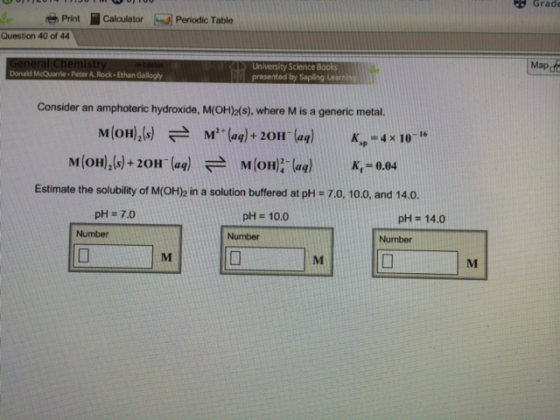
Homework Answers
Add Answer to:
Consider an amphoteric hydroxide, M(OH)2(s), where M is a
generic metal.
Consider an amphoteric hydroxide, M(OH)2(s), where M is a generic metal. Estimate the solubility of M(OH)2...
Consider an amphoteric hydroxide, M(OH)2(s), where M is a generic metal. Estimate the solubility of M(OH)2 in a solution buffered at pH = 7.0, 10.0, and 14.0. Kf=0.08. Ksp=4x10^-16.
Consider an amphoteric hydroxide, M(OH)2 (s), where M is a generic metal. M(OH)2(s) = M2+(aq) +...
 Consider an amphoteric hydroxide, M(OH)2 (s), where M is a generic metal. M(OH)2(s) = M2+(aq) + 2OH- (aq) Ksp = 6 x 10-16 M(OH)2(s) + 2 OH- (aq) = [M(OH)412-(aq) Kf = 0.03 Estimate the solubility of M(OH), in a solution buffered at pH = 7.0, 10.0, and 14.0. solubility at pH = 7.0 O m M solubility at pH = 10,0 solubility at pH = 10.0 solubility at pH = 14.0
Consider an amphoteric hydroxide, M(OH)2 (s), where M is a generic metal. M(OH)2(s) = M2+(aq) +...
 Consider an amphoteric hydroxide, M(OH)2 (s), where M is a generic metal. M(OH)2(s) = M2+(aq) + 2OH- (aq) Ksp = 6 x 10-16 M(OH)2(s) + 2 OH- (aq) = [M(OH)412-(aq) Kf = 0.03 Estimate the solubility of M(OH), in a solution buffered at pH = 7.0, 10.0, and 14.0. solubility at pH = 7.0 O m M solubility at pH = 10,0 solubility at pH = 10.0 solubility at pH = 14.0
Consider an amphoteric hydroxide, M(OH)2(s), where M is a generic metal. Ksp=7x10-16 Kf=0.07 Estimate the solubility...
Consider an amphoteric hydroxide, M(OH)2(s), where M is a generic metal. Ksp=7x10-16 Kf=0.07 Estimate the solubility of M(OH)2 in a solution buffered at pH = 7.0, 10.0, and 14.0.
Consider an amphoteric hydroxide, M(OH),(s), where M is a generic metal. M(OH),(s) M2+ (aq) + 2OH-(aq)...
 Consider an amphoteric hydroxide, M(OH),(s), where M is a generic metal. M(OH),(s) M2+ (aq) + 2OH-(aq) M(OH),(s) + 2OH(aq) = M(OH)2-(aq) Ksp = 2 10-16 M3 Ke=0.02 M- Estimate the solubility of M(OH), in a solution buffered at pH = 7.0, pH = 10.0, and pH = 14.0. solubility at pH = 7.0 solubility at pH = 10.0 Enter numeric value solubility at pH = 14.0
Consider an amphoteric hydroxide, M(OH)2(s), where M is a generic metal М(ОН), (8) — м?" (aq)...
 Consider an amphoteric hydroxide, M(OH)2(s), where M is a generic metal М(ОН), (8) — м?" (aq) + 2 ОН (аq) Кр — 6х 10-16 М(ОН), (s) + 2 ОН (аф) — [М(ОН), F (aq) Kt=0.08 Estimate the solubility of M(OH), in a solution buffered at pH 7.0, 10.0, and 14.0 solubility at pH 7.0 solubility at pH= 10.0 М М solubility at pH= 14.0 М
Please show all work! Ch 13B, 22 Consider an amphoteric hydroxide, M(OH)_2(s). where M is a...
 Please show all work!
Ch 13B, 22
Consider an amphoteric hydroxide, M(OH)_2(s). where M is a generic metal. m(OH)_2(s) Estimate the solubility of M(OH)_2 in a solution buffered at pH = 7.0, 10.0, and 14.0.
Please show all work!
Ch 13B, 22
Consider an amphoteric hydroxide, M(OH)_2(s). where M is a generic metal. m(OH)_2(s) Estimate the solubility of M(OH)_2 in a solution buffered at pH = 7.0, 10.0, and 14.0.
Consider an amphoteric hydroxide, M(OH)2(s)M(OH)2(s), where MM is a generic metal. M(OH)2(s)−⇀↽−M2+(aq)+2OH−(aq)Ksp=2×10⁻¹⁶M(OH)2(s)↽−−⇀M2+(aq)+2OH−(aq)Ksp=2×10⁻¹⁶ M(OH)2(s)+2OH−(aq)−⇀↽−[M(OH)4]2−(aq)Kf=0.02M(OH)2(s)+2OH−(aq)↽−−⇀[M(OH)4]2−(aq)Kf=0.02 Es
Consider an amphoteric hydroxide, M(OH)2(s)M(OH)2(s), where MM is a generic metal. M(OH)2(s)−⇀↽−M2+(aq)+2OH−(aq)Ksp=2×10⁻¹⁶M(OH)2(s)↽−−⇀M2+(aq)+2OH−(aq)Ksp=2×10⁻¹⁶ M(OH)2(s)+2OH−(aq)−⇀↽−[M(OH)4]2−(aq)Kf=0.02M(OH)2(s)+2OH−(aq)↽−−⇀[M(OH)4]2−(aq)Kf=0.02 Estimate the solubility of M(OH)2M(OH)2 in a solution buffered at pH = 7.0, 10.0, and 14.0. solubility at pH = 7.0 MM solubility at pH = 10.0 MM solubility at pH = 14.0 M
Estimate the solubility of M(OH)2 in a solution buffered at pH = 7.0, and 14.0. Consider...
 Estimate the solubility of M(OH)2 in a solution buffered at pH =
7.0, and 14.0.
Consider an amphoteric hydroxide, M(OH)2(s). where M is a generic metal.
Estimate the solubility of M(OH)2 in a solution buffered at pH =
7.0, and 14.0.
Consider an amphoteric hydroxide, M(OH)2(s). where M is a generic metal.
Consider the dissolution of AB(s): AB(s)⇌A+(aq)+B−(aq) The generic metal hydroxide M(OH)2 has Ksp...
Consider the dissolution of AB(s): AB(s)⇌A+(aq)+B−(aq) The generic metal hydroxide M(OH)2 has Ksp = 6.85×10⁻¹². (NOTE: In this particular problem, because of the magnitude of the Ksp and the stoichiometry of the compound, the contribution of OH− from water can be ignored. However, this may not always be the case.) 1. Le Châtelier's principle tells us that an increase in either [A+] or [B−] will shift this equilibrium to the left, reducing the solubility of AB. In other words, AB...
 Consider an amphoteric hydroxide, M(OH)2 (s), where M is a generic metal. M(OH)2(s) = M2+(aq) + 2OH- (aq) Ksp = 6 x 10-16 M(OH)2(s) + 2 OH- (aq) = [M(OH)412-(aq) Kf = 0.03 Estimate the solubility of M(OH), in a solution buffered at pH = 7.0, 10.0, and 14.0. solubility at pH = 7.0 O m M solubility at pH = 10,0 solubility at pH = 10.0 solubility at pH = 14.0
 Consider an amphoteric hydroxide, M(OH)2 (s), where M is a generic metal. M(OH)2(s) = M2+(aq) + 2OH- (aq) Ksp = 6 x 10-16 M(OH)2(s) + 2 OH- (aq) = [M(OH)412-(aq) Kf = 0.03 Estimate the solubility of M(OH), in a solution buffered at pH = 7.0, 10.0, and 14.0. solubility at pH = 7.0 O m M solubility at pH = 10,0 solubility at pH = 10.0 solubility at pH = 14.0
 Consider an amphoteric hydroxide, M(OH),(s), where M is a generic metal. M(OH),(s) M2+ (aq) + 2OH-(aq) M(OH),(s) + 2OH(aq) = M(OH)2-(aq) Ksp = 2 10-16 M3 Ke=0.02 M- Estimate the solubility of M(OH), in a solution buffered at pH = 7.0, pH = 10.0, and pH = 14.0. solubility at pH = 7.0 solubility at pH = 10.0 Enter numeric value solubility at pH = 14.0
 Consider an amphoteric hydroxide, M(OH)2(s), where M is a generic metal М(ОН), (8) — м?" (aq) + 2 ОН (аq) Кр — 6х 10-16 М(ОН), (s) + 2 ОН (аф) — [М(ОН), F (aq) Kt=0.08 Estimate the solubility of M(OH), in a solution buffered at pH 7.0, 10.0, and 14.0 solubility at pH 7.0 solubility at pH= 10.0 М М solubility at pH= 14.0 М
 Please show all work!
Ch 13B, 22
Consider an amphoteric hydroxide, M(OH)_2(s). where M is a generic metal. m(OH)_2(s) Estimate the solubility of M(OH)_2 in a solution buffered at pH = 7.0, 10.0, and 14.0.
Please show all work!
Ch 13B, 22
Consider an amphoteric hydroxide, M(OH)_2(s). where M is a generic metal. m(OH)_2(s) Estimate the solubility of M(OH)_2 in a solution buffered at pH = 7.0, 10.0, and 14.0.
 Estimate the solubility of M(OH)2 in a solution buffered at pH =
7.0, and 14.0.
Consider an amphoteric hydroxide, M(OH)2(s). where M is a generic metal.
Estimate the solubility of M(OH)2 in a solution buffered at pH =
7.0, and 14.0.
Consider an amphoteric hydroxide, M(OH)2(s). where M is a generic metal.
Most questions answered within 3 hours.
-
Where is the error in this code sequence?
String s1 = "Hello";
String s2 = "ello";...
asked 10 months ago -
Financial data for Joel de Paris, Inc., for last year
follow:
Joel de Paris, Inc.
Balance...
asked 10 months ago -
Consider this reaction:
Al2(SO4)3 (aq)+ BaCl3
(aq) Al2Cl6 (aq)- +
3BaSO4(s) . What is the...
asked 10 months ago -
Suppose that Savneet is considering increasing her
recent random sample from 20 car rentals to 40...
asked 10 months ago -
Trucks arrive at an unloading terminal at an average rate of 120
per hour.
Trucks arrive...
asked 10 months ago -
Why are methanol and ethanol completely soluble in water while
octanol is not very little soluble....
asked 10 months ago -
A facilities manager at a university reads in a research report
that the mean amount of...
asked 10 months ago -
When the CuSO4 is rehydrated by adding water to the anhydrous
compound, is this an endothermic...
asked 10 months ago -
A ray of sunlight is passing from diamond into crown glass; the
angle of incidence is...
asked 10 months ago -
A block of mass 0.249 kg is placed on top of a light, vertical
spring of...
asked 10 months ago -
how do the kidneys compensate in the presences of acidosis
a) trigger hyperventilate
b) reserve acid...
asked 10 months ago -
Question 501 pts
The rental rate of capital to the firm increases. Which of the
following...
asked 10 months ago