
Homework Answers
Add Answer to:
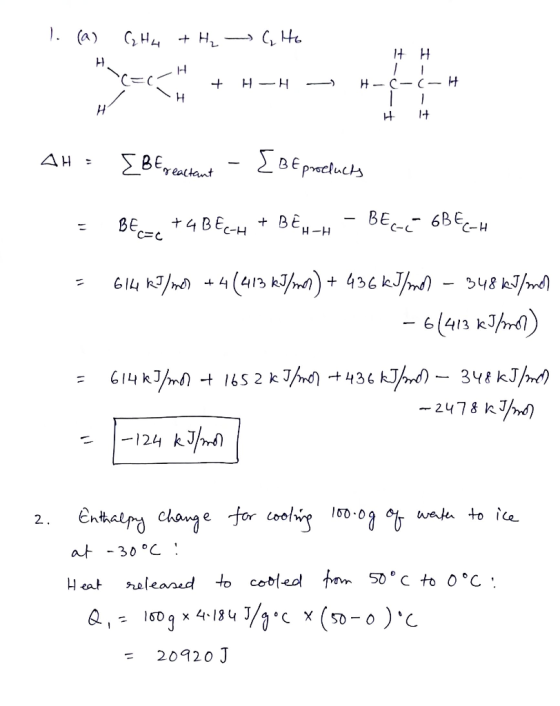
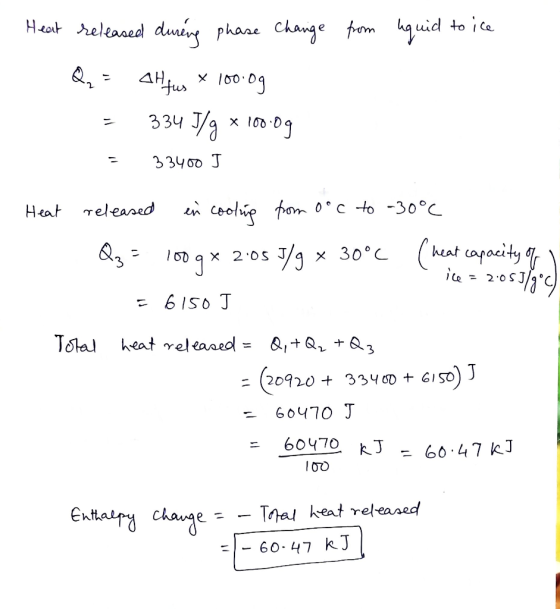
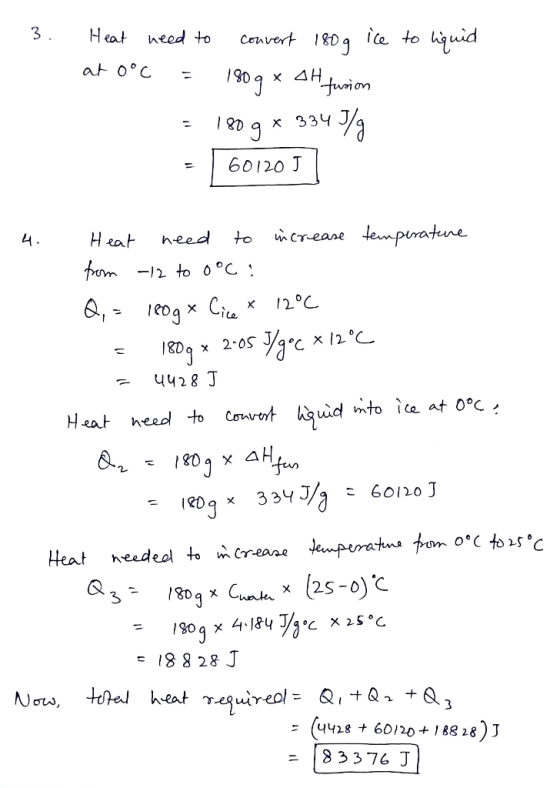
why is the first one wrong and what are the answers to the rest of the...
if u can show how u do each one, that would be amazing! How much heat...
 if u can show how u do each one, that would be
amazing!
How much heat is required to convert 90 g of ice at - 40.0°C into water at 60.0°C? The specific heats (Cs) of ice, water, and steam are 2.09 J/gK, 4.18 J/gK, and 1.84 J/gK, respectively. For H0 AH A) 60.1 kJ = 6.01 kJ/mol, and AH B) 18.8 kJ -40.67 kJ/mol. C) 45.1 kJ D) 37.6 kJ E) 30.5 kJ 11. What is correct for a...
if u can show how u do each one, that would be
amazing!
How much heat is required to convert 90 g of ice at - 40.0°C into water at 60.0°C? The specific heats (Cs) of ice, water, and steam are 2.09 J/gK, 4.18 J/gK, and 1.84 J/gK, respectively. For H0 AH A) 60.1 kJ = 6.01 kJ/mol, and AH B) 18.8 kJ -40.67 kJ/mol. C) 45.1 kJ D) 37.6 kJ E) 30.5 kJ 11. What is correct for a...
1. Estimate the boiling point for water at 1 atm. Please explain your choice of equation. 2. What...
 1. Estimate the boiling point for water at 1 atm. Please explain
your choice of equation.
2. What is the vapor pressure for liquid water at 50oC? Explain
your choice of equation.
In this workshop we will solve a few problems from our old exams. To solve problems in this page please use the thermodynamic data provided in the table. Estimate the boiling point for water at 1 |Name atm. Please explain your choice of equation. H2,g) O2(g) H20(g) H2O(I)...
1. Estimate the boiling point for water at 1 atm. Please explain
your choice of equation.
2. What is the vapor pressure for liquid water at 50oC? Explain
your choice of equation.
In this workshop we will solve a few problems from our old exams. To solve problems in this page please use the thermodynamic data provided in the table. Estimate the boiling point for water at 1 |Name atm. Please explain your choice of equation. H2,g) O2(g) H20(g) H2O(I)...
What quantity of energy does it take to convert 1.29 kg of ice at -23 degree...
 What quantity of energy does it take to convert 1.29 kg of ice at -23 degree C to water at 35 degree C? Specific heat capacities: ice 2.03 J/(g degree C) and liquid water 4.184 J/(g degree C) Delta H_vap = 40.7 kJ/mol; Delta H_fus = 6.02 kJ/mol A) 680 kJ B) 257 kJ C) 6.04 times 10^4 kJ D) 3.59 times 10^3 kJ
13,16,19 1. Which unit of measure represents the greater change amount of temperature change: Fahremheit or...
 13,16,19
1. Which unit of measure represents the greater change amount of temperature change: Fahremheit or Celsius EXPLAIN YOUR ANSWER in a few words. 14 A) Convert 42 degC to degF. B) At what temperature, if any, do the Fahremheit and Celsius scales read the same number? 15. 180 dęgF to Kelvin degrees 80'F-32)xA+213.15:355.372K 16. Given a temperature of so degC, what would be the new temperature in degC if the temperature of the material were to triple? 17. How...
13,16,19
1. Which unit of measure represents the greater change amount of temperature change: Fahremheit or Celsius EXPLAIN YOUR ANSWER in a few words. 14 A) Convert 42 degC to degF. B) At what temperature, if any, do the Fahremheit and Celsius scales read the same number? 15. 180 dęgF to Kelvin degrees 80'F-32)xA+213.15:355.372K 16. Given a temperature of so degC, what would be the new temperature in degC if the temperature of the material were to triple? 17. How...
What mass of water (in kg) at 1000 degree C could be completely vaporized with 2.70E^3...
 What mass of water (in kg) at 1000 degree C could be completely vaporized with 2.70E^3 cal of energy: 5.00E^-3 kg How many joules (J) of energy are released when 6.80 times 103g of steam at 100.0 degree C are completely frozen to ice at 0.0 degree C: 2.05E^7 J Convert the H_f value for water (80 cal/g) to units of J/mol: 6025 J/mol How much energy (in J) is required to completely melt 205.0 mol of ice at 0.0...
4. How much energy is needed to convert 74.0 grams of ice at -25.0°C to liquid...
 4. How much energy is needed to convert 74.0 grams of ice at -25.0°C to liquid at 75.0°C? specific heat (ice) = 2.10 J/(g°C) specific heat (water) = 4.18 J/(g°C) heat of fusion = 333 J/g 5. Shown below is a phase diagram for compound X. a) At 25°C and 1 atm X will exist as b) At 50°C and 0.5 atm X will exist as c) At 10°C and 1 atm X will exist as d) At 30°C and...
1.) The specific heat of a certain type of metal is 0.128 J/(g⋅∘C). What is the...
1.) The specific heat of a certain type of metal is 0.128 J/(g⋅∘C). What is the final temperature if 305J of heat is added to 41.7 g of this metal, initially at 20.0 ∘C? 2.) When 1723 J of heat energy is added to 42.3 g of hexane, C6H14, the temperature increases by 18.0 ∘C. Calculate the molar heat capacity of C6H14 3.) Liquid sodium is being considered as an engine coolant. How many grams of liquid sodium (minimum) are...
Research Paper Criterion 1. The first draft paper should contain the following a DO NOT include...
 Research Paper Criterion 1. The first draft paper should contain the following a DO NOT include a title page with the first draf (minimum 800 words), Insert name, class, ar right corner. The header will be removed to b. in text footnotes (citations) corresponding to With numerical citations, references should b repeated, do not give it number; rathe ams. In-text Chem 111 Lab Start to Name: Sufian Allah od Calelations Due Date: 11/22 Station Reaction tenergy. heat of wald ange,...
POGIL-Stoichiometry How do chemists use balanced chemical equations? got bit D 23 mosquitoes? 10 He got...
 POGIL-Stoichiometry How do chemists use balanced chemical equations? got bit D 23 mosquitoes? 10 He got Mol-aria Why? Chemists use balanced chemical equations as a basis to calculate how much reactant is needed or product is formed in a reaction. This is called Stoichiometry- (stoi-key-ah-meh-tree) Another way of looking at it is using the mole ratio from the balanced equation and information about one compound in the reaction to determine information about another compound in the equation. A mole ratio...
The lesson is about First Law of Thermodynamic. The problems have answers but i need solutions....
 The lesson is about First Law of Thermodynamic. The problems
have answers but i need solutions. PLEASE HELP ME! THANK
YOU!
38. Calculate the maximum work that could be obtained if 2.00 mol of an ideal gas, initially at STP, is allowed to expand to 100 L isothermally. Answer-36.0 L-atm 39. If 5.00 mol of an ideal gas is heated at constant pressure from 300 K to 500 K, how much work is done by the expansion of the gas?...
The lesson is about First Law of Thermodynamic. The problems
have answers but i need solutions. PLEASE HELP ME! THANK
YOU!
38. Calculate the maximum work that could be obtained if 2.00 mol of an ideal gas, initially at STP, is allowed to expand to 100 L isothermally. Answer-36.0 L-atm 39. If 5.00 mol of an ideal gas is heated at constant pressure from 300 K to 500 K, how much work is done by the expansion of the gas?...
 if u can show how u do each one, that would be
amazing!
How much heat is required to convert 90 g of ice at - 40.0°C into water at 60.0°C? The specific heats (Cs) of ice, water, and steam are 2.09 J/gK, 4.18 J/gK, and 1.84 J/gK, respectively. For H0 AH A) 60.1 kJ = 6.01 kJ/mol, and AH B) 18.8 kJ -40.67 kJ/mol. C) 45.1 kJ D) 37.6 kJ E) 30.5 kJ 11. What is correct for a...
if u can show how u do each one, that would be
amazing!
How much heat is required to convert 90 g of ice at - 40.0°C into water at 60.0°C? The specific heats (Cs) of ice, water, and steam are 2.09 J/gK, 4.18 J/gK, and 1.84 J/gK, respectively. For H0 AH A) 60.1 kJ = 6.01 kJ/mol, and AH B) 18.8 kJ -40.67 kJ/mol. C) 45.1 kJ D) 37.6 kJ E) 30.5 kJ 11. What is correct for a...
 1. Estimate the boiling point for water at 1 atm. Please explain
your choice of equation.
2. What is the vapor pressure for liquid water at 50oC? Explain
your choice of equation.
In this workshop we will solve a few problems from our old exams. To solve problems in this page please use the thermodynamic data provided in the table. Estimate the boiling point for water at 1 |Name atm. Please explain your choice of equation. H2,g) O2(g) H20(g) H2O(I)...
1. Estimate the boiling point for water at 1 atm. Please explain
your choice of equation.
2. What is the vapor pressure for liquid water at 50oC? Explain
your choice of equation.
In this workshop we will solve a few problems from our old exams. To solve problems in this page please use the thermodynamic data provided in the table. Estimate the boiling point for water at 1 |Name atm. Please explain your choice of equation. H2,g) O2(g) H20(g) H2O(I)...
 What quantity of energy does it take to convert 1.29 kg of ice at -23 degree C to water at 35 degree C? Specific heat capacities: ice 2.03 J/(g degree C) and liquid water 4.184 J/(g degree C) Delta H_vap = 40.7 kJ/mol; Delta H_fus = 6.02 kJ/mol A) 680 kJ B) 257 kJ C) 6.04 times 10^4 kJ D) 3.59 times 10^3 kJ
 13,16,19
1. Which unit of measure represents the greater change amount of temperature change: Fahremheit or Celsius EXPLAIN YOUR ANSWER in a few words. 14 A) Convert 42 degC to degF. B) At what temperature, if any, do the Fahremheit and Celsius scales read the same number? 15. 180 dęgF to Kelvin degrees 80'F-32)xA+213.15:355.372K 16. Given a temperature of so degC, what would be the new temperature in degC if the temperature of the material were to triple? 17. How...
13,16,19
1. Which unit of measure represents the greater change amount of temperature change: Fahremheit or Celsius EXPLAIN YOUR ANSWER in a few words. 14 A) Convert 42 degC to degF. B) At what temperature, if any, do the Fahremheit and Celsius scales read the same number? 15. 180 dęgF to Kelvin degrees 80'F-32)xA+213.15:355.372K 16. Given a temperature of so degC, what would be the new temperature in degC if the temperature of the material were to triple? 17. How...
 What mass of water (in kg) at 1000 degree C could be completely vaporized with 2.70E^3 cal of energy: 5.00E^-3 kg How many joules (J) of energy are released when 6.80 times 103g of steam at 100.0 degree C are completely frozen to ice at 0.0 degree C: 2.05E^7 J Convert the H_f value for water (80 cal/g) to units of J/mol: 6025 J/mol How much energy (in J) is required to completely melt 205.0 mol of ice at 0.0...
 4. How much energy is needed to convert 74.0 grams of ice at -25.0°C to liquid at 75.0°C? specific heat (ice) = 2.10 J/(g°C) specific heat (water) = 4.18 J/(g°C) heat of fusion = 333 J/g 5. Shown below is a phase diagram for compound X. a) At 25°C and 1 atm X will exist as b) At 50°C and 0.5 atm X will exist as c) At 10°C and 1 atm X will exist as d) At 30°C and...
 Research Paper Criterion 1. The first draft paper should contain the following a DO NOT include a title page with the first draf (minimum 800 words), Insert name, class, ar right corner. The header will be removed to b. in text footnotes (citations) corresponding to With numerical citations, references should b repeated, do not give it number; rathe ams. In-text Chem 111 Lab Start to Name: Sufian Allah od Calelations Due Date: 11/22 Station Reaction tenergy. heat of wald ange,...
 POGIL-Stoichiometry How do chemists use balanced chemical equations? got bit D 23 mosquitoes? 10 He got Mol-aria Why? Chemists use balanced chemical equations as a basis to calculate how much reactant is needed or product is formed in a reaction. This is called Stoichiometry- (stoi-key-ah-meh-tree) Another way of looking at it is using the mole ratio from the balanced equation and information about one compound in the reaction to determine information about another compound in the equation. A mole ratio...
 The lesson is about First Law of Thermodynamic. The problems
have answers but i need solutions. PLEASE HELP ME! THANK
YOU!
38. Calculate the maximum work that could be obtained if 2.00 mol of an ideal gas, initially at STP, is allowed to expand to 100 L isothermally. Answer-36.0 L-atm 39. If 5.00 mol of an ideal gas is heated at constant pressure from 300 K to 500 K, how much work is done by the expansion of the gas?...
The lesson is about First Law of Thermodynamic. The problems
have answers but i need solutions. PLEASE HELP ME! THANK
YOU!
38. Calculate the maximum work that could be obtained if 2.00 mol of an ideal gas, initially at STP, is allowed to expand to 100 L isothermally. Answer-36.0 L-atm 39. If 5.00 mol of an ideal gas is heated at constant pressure from 300 K to 500 K, how much work is done by the expansion of the gas?...
Most questions answered within 3 hours.
-
Where is the error in this code sequence?
String s1 = "Hello";
String s2 = "ello";...
asked 10 months ago -
Financial data for Joel de Paris, Inc., for last year
follow:
Joel de Paris, Inc.
Balance...
asked 10 months ago -
Consider this reaction:
Al2(SO4)3 (aq)+ BaCl3
(aq) Al2Cl6 (aq)- +
3BaSO4(s) . What is the...
asked 10 months ago -
Suppose that Savneet is considering increasing her
recent random sample from 20 car rentals to 40...
asked 10 months ago -
Trucks arrive at an unloading terminal at an average rate of 120
per hour.
Trucks arrive...
asked 10 months ago -
Why are methanol and ethanol completely soluble in water while
octanol is not very little soluble....
asked 10 months ago -
A facilities manager at a university reads in a research report
that the mean amount of...
asked 10 months ago -
When the CuSO4 is rehydrated by adding water to the anhydrous
compound, is this an endothermic...
asked 10 months ago -
A ray of sunlight is passing from diamond into crown glass; the
angle of incidence is...
asked 10 months ago -
A block of mass 0.249 kg is placed on top of a light, vertical
spring of...
asked 10 months ago -
how do the kidneys compensate in the presences of acidosis
a) trigger hyperventilate
b) reserve acid...
asked 10 months ago -
Question 501 pts
The rental rate of capital to the firm increases. Which of the
following...
asked 10 months ago