
Homework Answers
Add Answer to:
A student runs the reaction shown here and obtains the 'H NMR spectrum shown. Determine the...
b. NMR and IR When the second student runs a 'H NMR of the reaction (shown...
 b. NMR and IR When the second student runs a 'H NMR of the reaction (shown below) the compound present appears to be rl 8.0 7.5 7.0 4.5 4.0 3.5 3.0 2.5 2.0 1.5 1.0 0s ppm Fill in the missing data in the table below as it pertains to the second student's 'H NMR spectrum above c. Proton peak Integration Chemical Shift Neighbors (n) Splitting pattern (n+) (ppm) 2.4 Report as singlet/doublet/triplet/ete. triplet singlet multiplet な 1.6 0.9 3....
7. Reaction shown below produces two products. NMR of one of these products is shown below....
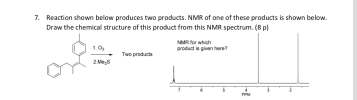 7. Reaction shown below produces two products. NMR of one of these products is shown below. Draw the chemical structure of this product from this NMR spectrum. (8 p) 1. O NMR for which product is given here? Two products 2. Mezs PPM
What chemical shift (in ppm, in a 1H NMR spectrum) might you expect for the H...
 What chemical shift (in ppm, in a 1H NMR spectrum) might you expect for the H atom, shown in red, in the molecule below? O 0.8 O 1.4 O 2.5 O 3.2 O 5.6 Submit Answer Tries 0/1 What chemical shift (in ppm, in a 1H NMR spectrum) might you cxpcct for the H atom, shown in red, in the molecule below? 생 O 0.8 O 5.8 O 7.5 O 9.1 Submit Answer Tries 0/1 What chemical shift (in ppm,...
The H-NMR spectrum of an unknown compound (formula CaHgO2) is shown below. Draw the structure of...
 The H-NMR spectrum of an unknown compound (formula CaHgO2) is shown below. Draw the structure of the unknown compound. Question 5 4 1 6 5 8 10 11 Ppm The 13C-NMR spectrum of an unknown compound (formula CgH180) is shown below. Its 1H-NMR spectrum only shows one singlet at 1.2 ppm. Draw the structure of this unknown compound. uestion 2 220 200 160 140 120 PPM 100 80 240 180 60 40 20 Create OscerSketch Answer 2 What would be...
2. The 13C NMR spectrum is shown below for the major product of the following reaction....
 2. The 13C NMR spectrum is shown below for the major product of the following reaction. Draw the structure of this product. Note that there is an important peak at ca. 166 ppm and that the peak at ca. 40 ppm is due to a contaminant. excess KMnO4 H H. aq. NaOH 200 180 100 80 40 20 160 140 120 60
4. Draw a clear and accurate NMR spectrum for the molecule shown below. Clearly show the...
 4. Draw a clear and accurate NMR spectrum for the molecule shown below. Clearly show the number of peaks, and the integration, chemical shift and splitting of each peak. PP 5. Use the chemspider.com to look up the NMR spectrum for the compound in 4. Compare that spectrum to your answer in 4. Draw that spectrum here, explaining the differences between the actual spectrum and what you predicted. Don't worry if you what you initially drew was incorect PPM
Assume that the 1H NMR spectrum shown below was obtained on your isolated reaction product. Note...
Assume that the 1H NMR spectrum shown below was obtained on your isolated reaction product. Note that the frequency range of the original spectrum was -0.5 – 12 ppm, but the downfield range (~8.5 – 12 ppm) and upfield (< 4 ppm) were deleted in the printout because no signals were detected on those regions. a) Draw the chemical structure of the B-hydroxyketone intermediate. b) Is there any B-hydroxyketone contained in your reaction product? Why or why not? Refer to...
1. The cyclopropyl derivative hs the H NMR spectrum (300 MHz in CDCs, with TMS) is...
 1. The cyclopropyl derivative hs the H NMR spectrum (300 MHz in CDCs, with TMS) is shown below, along with expanded resonances at the following 4.6, 3.7, 3.4, 3.2, 2.8, and 2.6 ppm chemical shifts. CI CI 0 pom 4 ppm 7 ppm 3.4 ppm 2& pm 28 pom a. Assign the resonances at 4.6, 3.7, 3.4, 3.2, 2.8, and 2.6 ppm to the various protons in the molecule, by writing the chemical shift next to the protons on the...
HO HW2. A student ran the Grignard reaction below: CH3MgBr diethyl ether 2-pentanone 2-methyl-2-pentanol HW 3....
 HO HW2. A student ran the Grignard reaction below: CH3MgBr diethyl ether 2-pentanone 2-methyl-2-pentanol HW 3. A second student tries to run the same Grignard reaction as in HW 2 and obtains the following FT-IR spectrum: ) transmittance 000 2000 1500 1000 wavenumber(cm) a. Based solely on the IR data, did the second student's reaction go to completion? In other words, was all of the ketone starting material used up? Yes or No and explain. b. When the second student...
Draw the structure of the compound C3H4Cl2O from its proton NMR spectrum below. Please explain. Draw...
 Draw the structure of the compound C3H4Cl2O from its proton NMR
spectrum below. Please explain.
Draw the structure of the compound CH CI O from its proton (1) NMR spectrum below. Fust-order spin-spin splitting rules and equal coupling constants can be assumed. (Detailed analysis of any non-first order portions of the spectrum will not be required) Integral ratios to the nearest whole number are left to right) 1:3 Flash Installation and Troubleshooting Used with from At Checa Co Inc (purty...
Draw the structure of the compound C3H4Cl2O from its proton NMR
spectrum below. Please explain.
Draw the structure of the compound CH CI O from its proton (1) NMR spectrum below. Fust-order spin-spin splitting rules and equal coupling constants can be assumed. (Detailed analysis of any non-first order portions of the spectrum will not be required) Integral ratios to the nearest whole number are left to right) 1:3 Flash Installation and Troubleshooting Used with from At Checa Co Inc (purty...
 b. NMR and IR When the second student runs a 'H NMR of the reaction (shown below) the compound present appears to be rl 8.0 7.5 7.0 4.5 4.0 3.5 3.0 2.5 2.0 1.5 1.0 0s ppm Fill in the missing data in the table below as it pertains to the second student's 'H NMR spectrum above c. Proton peak Integration Chemical Shift Neighbors (n) Splitting pattern (n+) (ppm) 2.4 Report as singlet/doublet/triplet/ete. triplet singlet multiplet な 1.6 0.9 3....
 7. Reaction shown below produces two products. NMR of one of these products is shown below. Draw the chemical structure of this product from this NMR spectrum. (8 p) 1. O NMR for which product is given here? Two products 2. Mezs PPM
 What chemical shift (in ppm, in a 1H NMR spectrum) might you expect for the H atom, shown in red, in the molecule below? O 0.8 O 1.4 O 2.5 O 3.2 O 5.6 Submit Answer Tries 0/1 What chemical shift (in ppm, in a 1H NMR spectrum) might you cxpcct for the H atom, shown in red, in the molecule below? 생 O 0.8 O 5.8 O 7.5 O 9.1 Submit Answer Tries 0/1 What chemical shift (in ppm,...
 The H-NMR spectrum of an unknown compound (formula CaHgO2) is shown below. Draw the structure of the unknown compound. Question 5 4 1 6 5 8 10 11 Ppm The 13C-NMR spectrum of an unknown compound (formula CgH180) is shown below. Its 1H-NMR spectrum only shows one singlet at 1.2 ppm. Draw the structure of this unknown compound. uestion 2 220 200 160 140 120 PPM 100 80 240 180 60 40 20 Create OscerSketch Answer 2 What would be...
 2. The 13C NMR spectrum is shown below for the major product of the following reaction. Draw the structure of this product. Note that there is an important peak at ca. 166 ppm and that the peak at ca. 40 ppm is due to a contaminant. excess KMnO4 H H. aq. NaOH 200 180 100 80 40 20 160 140 120 60
 4. Draw a clear and accurate NMR spectrum for the molecule shown below. Clearly show the number of peaks, and the integration, chemical shift and splitting of each peak. PP 5. Use the chemspider.com to look up the NMR spectrum for the compound in 4. Compare that spectrum to your answer in 4. Draw that spectrum here, explaining the differences between the actual spectrum and what you predicted. Don't worry if you what you initially drew was incorect PPM
 1. The cyclopropyl derivative hs the H NMR spectrum (300 MHz in CDCs, with TMS) is shown below, along with expanded resonances at the following 4.6, 3.7, 3.4, 3.2, 2.8, and 2.6 ppm chemical shifts. CI CI 0 pom 4 ppm 7 ppm 3.4 ppm 2& pm 28 pom a. Assign the resonances at 4.6, 3.7, 3.4, 3.2, 2.8, and 2.6 ppm to the various protons in the molecule, by writing the chemical shift next to the protons on the...
 HO HW2. A student ran the Grignard reaction below: CH3MgBr diethyl ether 2-pentanone 2-methyl-2-pentanol HW 3. A second student tries to run the same Grignard reaction as in HW 2 and obtains the following FT-IR spectrum: ) transmittance 000 2000 1500 1000 wavenumber(cm) a. Based solely on the IR data, did the second student's reaction go to completion? In other words, was all of the ketone starting material used up? Yes or No and explain. b. When the second student...
 Draw the structure of the compound C3H4Cl2O from its proton NMR
spectrum below. Please explain.
Draw the structure of the compound CH CI O from its proton (1) NMR spectrum below. Fust-order spin-spin splitting rules and equal coupling constants can be assumed. (Detailed analysis of any non-first order portions of the spectrum will not be required) Integral ratios to the nearest whole number are left to right) 1:3 Flash Installation and Troubleshooting Used with from At Checa Co Inc (purty...
Draw the structure of the compound C3H4Cl2O from its proton NMR
spectrum below. Please explain.
Draw the structure of the compound CH CI O from its proton (1) NMR spectrum below. Fust-order spin-spin splitting rules and equal coupling constants can be assumed. (Detailed analysis of any non-first order portions of the spectrum will not be required) Integral ratios to the nearest whole number are left to right) 1:3 Flash Installation and Troubleshooting Used with from At Checa Co Inc (purty...
Most questions answered within 3 hours.
-
Where is the error in this code sequence?
String s1 = "Hello";
String s2 = "ello";...
asked 10 months ago -
Financial data for Joel de Paris, Inc., for last year
follow:
Joel de Paris, Inc.
Balance...
asked 10 months ago -
Consider this reaction:
Al2(SO4)3 (aq)+ BaCl3
(aq) Al2Cl6 (aq)- +
3BaSO4(s) . What is the...
asked 10 months ago -
Suppose that Savneet is considering increasing her
recent random sample from 20 car rentals to 40...
asked 10 months ago -
Trucks arrive at an unloading terminal at an average rate of 120
per hour.
Trucks arrive...
asked 10 months ago -
Why are methanol and ethanol completely soluble in water while
octanol is not very little soluble....
asked 10 months ago -
A facilities manager at a university reads in a research report
that the mean amount of...
asked 10 months ago -
When the CuSO4 is rehydrated by adding water to the anhydrous
compound, is this an endothermic...
asked 10 months ago -
A ray of sunlight is passing from diamond into crown glass; the
angle of incidence is...
asked 10 months ago -
A block of mass 0.249 kg is placed on top of a light, vertical
spring of...
asked 10 months ago -
how do the kidneys compensate in the presences of acidosis
a) trigger hyperventilate
b) reserve acid...
asked 10 months ago -
Question 501 pts
The rental rate of capital to the firm increases. Which of the
following...
asked 10 months ago