Dear Experts,
This question correlates to the theory of complex numbers and their usage in algebra. It has come to my attention that I have some difficulty applying general algebra rules to complex numbers. My next exam is focused on Control Theory, where Partial Fractions is used to derive the equation necessary to determine the inverse Laplace of the transfer function. This will then give the equation to analyze the response of the transfer function over time.
I do understand the theory behind the calculations, such as Laplace Transform, Inverse Laplace, Partial Fractions, etc, but when I solve the denominator using the ABC-formula and get a complex number, to perform partial fractions becomes unclear. It is as if I don't know how to further simplify the equation after some point.


I know I can arrange A, B, and C in matrix form to determine their values. But then it becomes difficult to complete the calculations. If someone could provide an explanation, I might be able to understand what the idea behind the calculations is.


Is the approach in the step above correct? And if so, the next step is where it gets complicated to complete the calculations. Especially to determine the value of A and B, which consist of complex numbers. So how do I complete the calculations below?


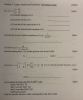
The results for A, B and C should be:


The help provided is highly appreciated as it is in preparation for my exams. Thank you in advance for answering my question.
B + (s1 3) (s+1+v3)
A(s(s1v3j)) B(s(s+1- V3j)) +C(s2+2s+4) 5
A(s2(s1+ v3i)s)B(s2(s+1- v3j)s) +C(s22s + 4) 5
s2ABC 0
:(1v3i)A (1 V3,)B+2C 0
.: 4C=5
5 5 A = 8 24
5 B = 24
Homework Answers


Add Answer to:
Dear Experts, This question correlates to the theory of complex numbers and their usage in algebra....
all of q1 please, a complex analysis question for complex numbers etc. 1. (a) Define the...
 all of q1 please, a complex analysis question for complex
numbers etc.
1. (a) Define the principal branch of Log(2). Find Log(1 + V3i). [6 marks] (b) Find all solutions to ex-1 = -ie3. (6 marks) (c) Find all solutions to 25 = 1+i. (8 marks) (d) Describe the image of the circle |z| = 5 under the mapping f(x) = Log(2). [6 marks]
all of q1 please, a complex analysis question for complex
numbers etc.
1. (a) Define the principal branch of Log(2). Find Log(1 + V3i). [6 marks] (b) Find all solutions to ex-1 = -ie3. (6 marks) (c) Find all solutions to 25 = 1+i. (8 marks) (d) Describe the image of the circle |z| = 5 under the mapping f(x) = Log(2). [6 marks]
find. inverse Laplace transfer show step buy step soultion +8 (b) s(+16) 2s3 3s +6s+4 (s2...
 find. inverse Laplace transfer show step buy step soultion
+8 (b) s(+16) 2s3 3s +6s+4 (s2 +4)(s2 +2s+2) (c) +3s + (d) 2 2 1 s-2s +s (e) (s+2)e (f 2s +1 22-6s3 (g) -3s +2 2(s22r4) (24) (h) 2 (i) (2s+1 ($2+8)e (i) (216)
+8 (b) s(+16) 2s3 3s +6s+4 (s2 +4)(s2 +2s+2) (c) +3s + (d) 2 2 1 s-2s +s (e) (s+2)e (f 2s +1 22-6s3 (g) -3s +2 2(s22r4) (24) (h) 2 (i) (2s+1 ($2+8)e (i)...
find. inverse Laplace transfer show step buy step soultion
+8 (b) s(+16) 2s3 3s +6s+4 (s2 +4)(s2 +2s+2) (c) +3s + (d) 2 2 1 s-2s +s (e) (s+2)e (f 2s +1 22-6s3 (g) -3s +2 2(s22r4) (24) (h) 2 (i) (2s+1 ($2+8)e (i) (216)
+8 (b) s(+16) 2s3 3s +6s+4 (s2 +4)(s2 +2s+2) (c) +3s + (d) 2 2 1 s-2s +s (e) (s+2)e (f 2s +1 22-6s3 (g) -3s +2 2(s22r4) (24) (h) 2 (i) (2s+1 ($2+8)e (i)...
Please only do d,h,i Thanks! a. c. 25.5. Using the tables and partial fractions, find the...
 Please only do d,h,i
Thanks!
a. c. 25.5. Using the tables and partial fractions, find the inverse Laplace transform for each of the following: 75+5 5-1 b. (8 + 2)(s - 1) 52 - 7s + 12 3s2 +65 +27 d. f. 53 +9s $3 - 452 54-81 582 + 6s - 40 253 +352 +2s +27 652 +62s +92 h. i. (s + 6) (s2 +16) (52 + 9) (52 + 1) (5 + 1) (52 + 108 +21)...
Please only do d,h,i
Thanks!
a. c. 25.5. Using the tables and partial fractions, find the inverse Laplace transform for each of the following: 75+5 5-1 b. (8 + 2)(s - 1) 52 - 7s + 12 3s2 +65 +27 d. f. 53 +9s $3 - 452 54-81 582 + 6s - 40 253 +352 +2s +27 652 +62s +92 h. i. (s + 6) (s2 +16) (52 + 9) (52 + 1) (5 + 1) (52 + 108 +21)...
I need a detailed solution please, thanks! 4. Find the initial and final values of the...
 I need a detailed solution please, thanks!
4. Find the initial and final values of the function ft) whose Laplace Transform is given by: 2s +1 F(s) = s2+ s + 1 5. Find the inverse Laplace Transform of (a) F(s)= 1 s(s2+23+2) (b) F(s)= s(s2+a2)
I need a detailed solution please, thanks!
4. Find the initial and final values of the function ft) whose Laplace Transform is given by: 2s +1 F(s) = s2+ s + 1 5. Find the inverse Laplace Transform of (a) F(s)= 1 s(s2+23+2) (b) F(s)= s(s2+a2)
Can you answer question 3 I network theory 2 3) Write the complex numbers in polar...
 Can you answer question 3 I network theory 2
3) Write the complex numbers in polar form: (b) j (c) -1+j (d) -j Answers:
Can you answer question 3 I network theory 2
3) Write the complex numbers in polar form: (b) j (c) -1+j (d) -j Answers:
Please help me with question 12, 14 and 18 In each of Problems 9 through 24,...
 Please help me with question 12, 14 and 18
In each of Problems 9 through 24, use the linearity of L-1, partial fraction expansions, and Table 5.3.1 to find the inverse Laplace transform of the given function: 9. 30s2+25 > Answer Solution 10. 4(3-3)3 11. 2s2+38-4 Answer Solution 12. 3ss2-S-6 13. 55+25s2+10s+74 > Answer Solution 14. 65-382-4 15. 2s+152-2s+2 Answer Solution 16. 9s2-125+28s(s2+4) 17. 1-2ss2+45+5 Answer Solution 18. 2s-3s2+28+10 Table of Elementary Laplace Transforms F(0) = C-F(*) F(x) = C{FC)}...
Please help me with question 12, 14 and 18
In each of Problems 9 through 24, use the linearity of L-1, partial fraction expansions, and Table 5.3.1 to find the inverse Laplace transform of the given function: 9. 30s2+25 > Answer Solution 10. 4(3-3)3 11. 2s2+38-4 Answer Solution 12. 3ss2-S-6 13. 55+25s2+10s+74 > Answer Solution 14. 65-382-4 15. 2s+152-2s+2 Answer Solution 16. 9s2-125+28s(s2+4) 17. 1-2ss2+45+5 Answer Solution 18. 2s-3s2+28+10 Table of Elementary Laplace Transforms F(0) = C-F(*) F(x) = C{FC)}...
Problem 1. Linear Algebra and Transforms (no partial credit). (1Spts) (a) Let 4 ab (4pts) (1)...
 Problem 1. Linear Algebra and Transforms (no partial credit). (1Spts) (a) Let 4 ab (4pts) (1) Find the transpose of A. (2) Find the inverse of A. (3) Find the all the eigenvalues of A (4) Find the characteristic equation of A. (b) Find the inverse Laplace transform of F(s)- (2pts) (s+3) (e) Given T)16 . find the settling time, (T.) and the percent over shoot (90S). s +3s+16 (2pts) doiven, A-F ,I-uc-l13] D-0, findthetransfer function, as). .. | -|...
Homework Set 5 f(t) F(S) Section 4.1: Apply the definition to directly find the Laplace transforms...
 Homework Set 5 f(t) F(S) Section 4.1: Apply the definition to directly find the Laplace transforms of the given functions. (s > 0) 1 (s > 0) S- 1. Kt) = 12 2. f = 23t+1 Use transforms from the Table (op right) to find the Laplace transforms of the given functions. t" ( n20) (s > 0) r(a + 1) 1a (a > -1) (s > 0) 5+1 3. f(t) = VE +8t 4. f(t) = sin(2tcos(2t) Use the...
C++ OPTION A (Basic): Complex Numbers A complex number, c, is an ordered pair of real...
 C++
OPTION A (Basic): Complex Numbers
A complex number, c,
is an ordered pair of real numbers
(doubles). For example, for any two real numbers,
s and t, we can form the complex number:
This is only part of what makes a complex number complex.
Another important aspect is the definition of special rules for
adding, multiplying, dividing, etc. these ordered pairs. Complex
numbers are more than simply x-y coordinates because of these
operations. Examples of complex numbers in this...
C++
OPTION A (Basic): Complex Numbers
A complex number, c,
is an ordered pair of real numbers
(doubles). For example, for any two real numbers,
s and t, we can form the complex number:
This is only part of what makes a complex number complex.
Another important aspect is the definition of special rules for
adding, multiplying, dividing, etc. these ordered pairs. Complex
numbers are more than simply x-y coordinates because of these
operations. Examples of complex numbers in this...
linear algebra and complex analysis variables please solve this problem quickly 1+i 1. Write in standard...
 linear algebra and complex analysis variables
please solve this problem quickly
1+i 1. Write in standard form x+yi. 2. Find the modulus and principal argument of z = 2 + 2/3 i and use it to show z' = -218 3. Give geometrical description of the set {z:2z-il 4} 4. Find the principal argument Arg(z) when a) z = -2-21 b) z=(V3 – )6 5. Find three cubic root of i. 6. Show that f(z) = |z|2 is differentiable at...
linear algebra and complex analysis variables
please solve this problem quickly
1+i 1. Write in standard form x+yi. 2. Find the modulus and principal argument of z = 2 + 2/3 i and use it to show z' = -218 3. Give geometrical description of the set {z:2z-il 4} 4. Find the principal argument Arg(z) when a) z = -2-21 b) z=(V3 – )6 5. Find three cubic root of i. 6. Show that f(z) = |z|2 is differentiable at...
 all of q1 please, a complex analysis question for complex
numbers etc.
1. (a) Define the principal branch of Log(2). Find Log(1 + V3i). [6 marks] (b) Find all solutions to ex-1 = -ie3. (6 marks) (c) Find all solutions to 25 = 1+i. (8 marks) (d) Describe the image of the circle |z| = 5 under the mapping f(x) = Log(2). [6 marks]
all of q1 please, a complex analysis question for complex
numbers etc.
1. (a) Define the principal branch of Log(2). Find Log(1 + V3i). [6 marks] (b) Find all solutions to ex-1 = -ie3. (6 marks) (c) Find all solutions to 25 = 1+i. (8 marks) (d) Describe the image of the circle |z| = 5 under the mapping f(x) = Log(2). [6 marks]
 find. inverse Laplace transfer show step buy step soultion
+8 (b) s(+16) 2s3 3s +6s+4 (s2 +4)(s2 +2s+2) (c) +3s + (d) 2 2 1 s-2s +s (e) (s+2)e (f 2s +1 22-6s3 (g) -3s +2 2(s22r4) (24) (h) 2 (i) (2s+1 ($2+8)e (i) (216)
+8 (b) s(+16) 2s3 3s +6s+4 (s2 +4)(s2 +2s+2) (c) +3s + (d) 2 2 1 s-2s +s (e) (s+2)e (f 2s +1 22-6s3 (g) -3s +2 2(s22r4) (24) (h) 2 (i) (2s+1 ($2+8)e (i)...
find. inverse Laplace transfer show step buy step soultion
+8 (b) s(+16) 2s3 3s +6s+4 (s2 +4)(s2 +2s+2) (c) +3s + (d) 2 2 1 s-2s +s (e) (s+2)e (f 2s +1 22-6s3 (g) -3s +2 2(s22r4) (24) (h) 2 (i) (2s+1 ($2+8)e (i) (216)
+8 (b) s(+16) 2s3 3s +6s+4 (s2 +4)(s2 +2s+2) (c) +3s + (d) 2 2 1 s-2s +s (e) (s+2)e (f 2s +1 22-6s3 (g) -3s +2 2(s22r4) (24) (h) 2 (i) (2s+1 ($2+8)e (i)...
 Please only do d,h,i
Thanks!
a. c. 25.5. Using the tables and partial fractions, find the inverse Laplace transform for each of the following: 75+5 5-1 b. (8 + 2)(s - 1) 52 - 7s + 12 3s2 +65 +27 d. f. 53 +9s $3 - 452 54-81 582 + 6s - 40 253 +352 +2s +27 652 +62s +92 h. i. (s + 6) (s2 +16) (52 + 9) (52 + 1) (5 + 1) (52 + 108 +21)...
Please only do d,h,i
Thanks!
a. c. 25.5. Using the tables and partial fractions, find the inverse Laplace transform for each of the following: 75+5 5-1 b. (8 + 2)(s - 1) 52 - 7s + 12 3s2 +65 +27 d. f. 53 +9s $3 - 452 54-81 582 + 6s - 40 253 +352 +2s +27 652 +62s +92 h. i. (s + 6) (s2 +16) (52 + 9) (52 + 1) (5 + 1) (52 + 108 +21)...
 I need a detailed solution please, thanks!
4. Find the initial and final values of the function ft) whose Laplace Transform is given by: 2s +1 F(s) = s2+ s + 1 5. Find the inverse Laplace Transform of (a) F(s)= 1 s(s2+23+2) (b) F(s)= s(s2+a2)
I need a detailed solution please, thanks!
4. Find the initial and final values of the function ft) whose Laplace Transform is given by: 2s +1 F(s) = s2+ s + 1 5. Find the inverse Laplace Transform of (a) F(s)= 1 s(s2+23+2) (b) F(s)= s(s2+a2)
 Can you answer question 3 I network theory 2
3) Write the complex numbers in polar form: (b) j (c) -1+j (d) -j Answers:
Can you answer question 3 I network theory 2
3) Write the complex numbers in polar form: (b) j (c) -1+j (d) -j Answers:
 Please help me with question 12, 14 and 18
In each of Problems 9 through 24, use the linearity of L-1, partial fraction expansions, and Table 5.3.1 to find the inverse Laplace transform of the given function: 9. 30s2+25 > Answer Solution 10. 4(3-3)3 11. 2s2+38-4 Answer Solution 12. 3ss2-S-6 13. 55+25s2+10s+74 > Answer Solution 14. 65-382-4 15. 2s+152-2s+2 Answer Solution 16. 9s2-125+28s(s2+4) 17. 1-2ss2+45+5 Answer Solution 18. 2s-3s2+28+10 Table of Elementary Laplace Transforms F(0) = C-F(*) F(x) = C{FC)}...
Please help me with question 12, 14 and 18
In each of Problems 9 through 24, use the linearity of L-1, partial fraction expansions, and Table 5.3.1 to find the inverse Laplace transform of the given function: 9. 30s2+25 > Answer Solution 10. 4(3-3)3 11. 2s2+38-4 Answer Solution 12. 3ss2-S-6 13. 55+25s2+10s+74 > Answer Solution 14. 65-382-4 15. 2s+152-2s+2 Answer Solution 16. 9s2-125+28s(s2+4) 17. 1-2ss2+45+5 Answer Solution 18. 2s-3s2+28+10 Table of Elementary Laplace Transforms F(0) = C-F(*) F(x) = C{FC)}...
 Problem 1. Linear Algebra and Transforms (no partial credit). (1Spts) (a) Let 4 ab (4pts) (1) Find the transpose of A. (2) Find the inverse of A. (3) Find the all the eigenvalues of A (4) Find the characteristic equation of A. (b) Find the inverse Laplace transform of F(s)- (2pts) (s+3) (e) Given T)16 . find the settling time, (T.) and the percent over shoot (90S). s +3s+16 (2pts) doiven, A-F ,I-uc-l13] D-0, findthetransfer function, as). .. | -|...
 Homework Set 5 f(t) F(S) Section 4.1: Apply the definition to directly find the Laplace transforms of the given functions. (s > 0) 1 (s > 0) S- 1. Kt) = 12 2. f = 23t+1 Use transforms from the Table (op right) to find the Laplace transforms of the given functions. t" ( n20) (s > 0) r(a + 1) 1a (a > -1) (s > 0) 5+1 3. f(t) = VE +8t 4. f(t) = sin(2tcos(2t) Use the...
 C++
OPTION A (Basic): Complex Numbers
A complex number, c,
is an ordered pair of real numbers
(doubles). For example, for any two real numbers,
s and t, we can form the complex number:
This is only part of what makes a complex number complex.
Another important aspect is the definition of special rules for
adding, multiplying, dividing, etc. these ordered pairs. Complex
numbers are more than simply x-y coordinates because of these
operations. Examples of complex numbers in this...
C++
OPTION A (Basic): Complex Numbers
A complex number, c,
is an ordered pair of real numbers
(doubles). For example, for any two real numbers,
s and t, we can form the complex number:
This is only part of what makes a complex number complex.
Another important aspect is the definition of special rules for
adding, multiplying, dividing, etc. these ordered pairs. Complex
numbers are more than simply x-y coordinates because of these
operations. Examples of complex numbers in this...
 linear algebra and complex analysis variables
please solve this problem quickly
1+i 1. Write in standard form x+yi. 2. Find the modulus and principal argument of z = 2 + 2/3 i and use it to show z' = -218 3. Give geometrical description of the set {z:2z-il 4} 4. Find the principal argument Arg(z) when a) z = -2-21 b) z=(V3 – )6 5. Find three cubic root of i. 6. Show that f(z) = |z|2 is differentiable at...
linear algebra and complex analysis variables
please solve this problem quickly
1+i 1. Write in standard form x+yi. 2. Find the modulus and principal argument of z = 2 + 2/3 i and use it to show z' = -218 3. Give geometrical description of the set {z:2z-il 4} 4. Find the principal argument Arg(z) when a) z = -2-21 b) z=(V3 – )6 5. Find three cubic root of i. 6. Show that f(z) = |z|2 is differentiable at...
Most questions answered within 3 hours.
-
Where is the error in this code sequence?
String s1 = "Hello";
String s2 = "ello";...
asked 11 months ago -
Financial data for Joel de Paris, Inc., for last year
follow:
Joel de Paris, Inc.
Balance...
asked 11 months ago -
Consider this reaction:
Al2(SO4)3 (aq)+ BaCl3
(aq) Al2Cl6 (aq)- +
3BaSO4(s) . What is the...
asked 11 months ago -
Suppose that Savneet is considering increasing her
recent random sample from 20 car rentals to 40...
asked 11 months ago -
Trucks arrive at an unloading terminal at an average rate of 120
per hour.
Trucks arrive...
asked 11 months ago -
Why are methanol and ethanol completely soluble in water while
octanol is not very little soluble....
asked 11 months ago -
A facilities manager at a university reads in a research report
that the mean amount of...
asked 11 months ago -
When the CuSO4 is rehydrated by adding water to the anhydrous
compound, is this an endothermic...
asked 11 months ago -
A ray of sunlight is passing from diamond into crown glass; the
angle of incidence is...
asked 11 months ago -
A block of mass 0.249 kg is placed on top of a light, vertical
spring of...
asked 11 months ago -
how do the kidneys compensate in the presences of acidosis
a) trigger hyperventilate
b) reserve acid...
asked 11 months ago -
Question 501 pts
The rental rate of capital to the firm increases. Which of the
following...
asked 11 months ago