a radiator uses air to cool ethylene glycol (antifreeze) in a cross flow heat exchanger the...
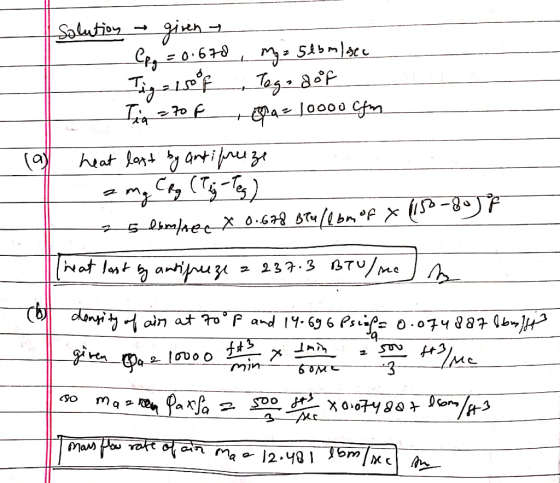
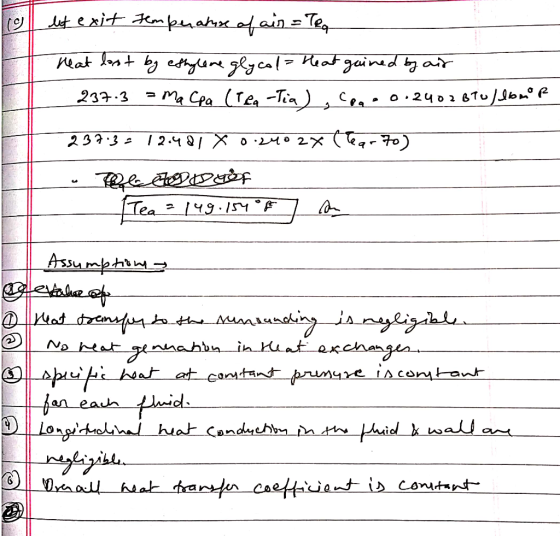
a radiator uses air to cool ethylene glycol (antifreeze) in a cross flow heat exchanger the ethylene glycol(cp= 0.678) enters the radiator, as shown in figure 1 below, at 150 f with a flow rate of 5 ibm/s. it leaves the radiator at 80 f. air at 70 f blows over the radiator at a flow rate of 10000 cfm determine (a) the heat lost by the antifreeze , (b) the mass flow rate of the air in ibm/s and (c) the exist temperature (in f) of the air.
list any assumptions made
Homework Answers
Add Answer to:
a radiator uses air to cool ethylene glycol (antifreeze) in a cross flow heat exchanger the...
An automobile radiator may be viewed as a cross-flow heat exchanger with both fluids unmixed. Water,...
 An automobile radiator may be viewed as a cross-flow heat exchanger with both fluids unmixed. Water, which has a flow rate of 0.045 kg/s, enters the radiator at 400 K and is to leave at 330 K. The water is cooled by air that enters at 0.75 kg/s and 300 K. If the overall heat transfer coefficient is 220 W/m2.K, what is the required heat transfer surface area, in mº? Assume that T =320 K when evaluating the properties of...
An automobile radiator may be viewed as a cross-flow heat exchanger with both fluids unmixed. Water,...
 An automobile radiator may be viewed as a cross-flow heat exchanger with both fluids unmixed. Water, which has a flow rate of 0.055 kg/s, enters the radiator at 400 K and is to leave at 330 K. The water is cooled by air that enters at 0.75 kg/s and 300 K. If the overall heat transfer coefficient is 180 W/m2.K, what is the required heat transfer surface area, in m?? Assume that TC,0 = 320K when evaluating the properties of...
Problem: The condenser in an air conditioning system is a heat exchanger in which cool air...
Problem: The condenser in an air conditioning system is a heat exchanger in which cool air absorbs latent energy from the refrigerant, condensing the refrigerant from vapor to liquid. Refrigerant R-134 enters the condenser at 1 MPa and 90°C. It leaves the condenser at 1 MPa and 30°C. Cool air enters the condenser at 100 kPa and 27°C at a volume flow rate of 10 m3/s, and it leaves at 95 kPa and 60°C. Assume the specific heat of the...
I. A finned-tube, cross-flow heat exchanger (F 0.96) is to use the exhaust of a gas...
 I. A finned-tube, cross-flow heat exchanger (F 0.96) is to use the exhaust of a gas turbine to heat pressurized water. Laboratory measurement are performed on a prototype version of the exchanger, which has a surface area of 8 m2, to determine the overall heat transfer coefficient as a function of operating conditions. Measurements made under particular conditions, for which in-5 kgs. Thi-350 ℃, m.-0.5 kg/s, and Tu-25℃, reveal a water outlet temperature of Tso-150℃. What is the overall heat...
4. A Cross-Flow Air-to-Water Heat Exchanger with an effectiveness of 0.58 is used to heat water, ...
 4. A Cross-Flow Air-to-Water Heat Exchanger with an effectiveness of 0.58 is used to heat water, entering at 20°C at a rate of 4 kg/s, using hot air, entering at 127oC at a rate of 10 kg/s. The Overall Heat Transfer Coefficient for the Heat exchanger is 275 W/m'K. Assuming both fluids are unmixed, determine; (i) The Heat Capacity rates for both the air and the water (ii) The heat transfer surface area. ii) The exit temperature of the water...
A thin-walled double-pipe counter-flow heat exchanger is to be used to cool oil (cp-2200 /kg K)...
 A thin-walled double-pipe counter-flow heat exchanger is to be used to cool oil (cp-2200 /kg K) from 150 C to 40°C at a rate of 2 kg/s by water (c 4180J/kg.K) that enters at 22°C at a rate of 1.5 kg/s. The diameter of the tube is 2.5 cm, O and its length is 6 m. Let the water inlet temperature vary from 5°C to 25°C. Identify the graph that depicts the overall heat transfer coefficient as a function of...
10-58) An air preheater for a power plant consists of a cross-flow heat exchanger with hot...
 10-58) An air preheater for a power plant consists of a cross-flow heat exchanger with hot exhaust gases used to heat incoming air at I atm and 300 K. The gases enter at 375°C with a flow rate of 5 kg/s. The airflow rate is 5.0 kg/s, and the heat exchanger has A = 110 m2 and U = 50 W/m2 oC. Calculate the heat-transfer rate and exit temperatures for two cases, both fluids unmixed and one fluid mixed. Assume...
Question 1- Exhaust gases from a power plant are used to preheat air in a cross-flow...
 Question 1- Exhaust gases from a power plant are used to preheat air in a cross-flow heat exchanger. The exhaust gases enter the heat exchanger at 450°C and leave at 200°C. The air enters the heat exchanger at 70°C, leaves at 250°C, and has a mass flow rate of 10 kg/s. Assume the properties of the exhaust gases can be approximated by those of air. The overall heat transfer coefficient of the heat exchanger is 154 W/m2 K. Calculate the...
Figure P2.32 shows a cross-flow heat exchanger used to condense Freon-12. Freon-12 vapor enters the unit...
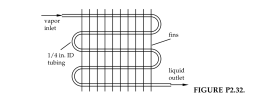 Figure P2.32 shows a cross-flow heat exchanger used to condense
Freon-12. Freon-12 vapor enters the unit at a flow rate of 0.065
kg/s. Freon-12 leaves the exchanger as a liquid (Sp. Gr. = 1.915)
at room temperature and pressure. Determine the exit velocity of
the liquid.
vapor inlet fins 1/4 in. ID tubing liquid outlet FIGURE P2.32.
Figure P2.32 shows a cross-flow heat exchanger used to condense
Freon-12. Freon-12 vapor enters the unit at a flow rate of 0.065
kg/s. Freon-12 leaves the exchanger as a liquid (Sp. Gr. = 1.915)
at room temperature and pressure. Determine the exit velocity of
the liquid.
vapor inlet fins 1/4 in. ID tubing liquid outlet FIGURE P2.32.
Could someone help with the following problem??? Helium enters a constant flow heat exchanger at 100...
Could someone help with the following problem??? Helium enters a constant flow heat exchanger at 100 kPa, 100 C, and 90 m / s, and receives heat in the amount of 120 kJ / kg as it flows through it. Helium leaves the heat exchanger at 80 kPa with a speed of 150 0 m / s. Determine the pressure and temperature of nitrogen stagnation in the input and output states. Helium enters a constant flow heat exchanger at 100...
 An automobile radiator may be viewed as a cross-flow heat exchanger with both fluids unmixed. Water, which has a flow rate of 0.045 kg/s, enters the radiator at 400 K and is to leave at 330 K. The water is cooled by air that enters at 0.75 kg/s and 300 K. If the overall heat transfer coefficient is 220 W/m2.K, what is the required heat transfer surface area, in mº? Assume that T =320 K when evaluating the properties of...
 An automobile radiator may be viewed as a cross-flow heat exchanger with both fluids unmixed. Water, which has a flow rate of 0.055 kg/s, enters the radiator at 400 K and is to leave at 330 K. The water is cooled by air that enters at 0.75 kg/s and 300 K. If the overall heat transfer coefficient is 180 W/m2.K, what is the required heat transfer surface area, in m?? Assume that TC,0 = 320K when evaluating the properties of...
 I. A finned-tube, cross-flow heat exchanger (F 0.96) is to use the exhaust of a gas turbine to heat pressurized water. Laboratory measurement are performed on a prototype version of the exchanger, which has a surface area of 8 m2, to determine the overall heat transfer coefficient as a function of operating conditions. Measurements made under particular conditions, for which in-5 kgs. Thi-350 ℃, m.-0.5 kg/s, and Tu-25℃, reveal a water outlet temperature of Tso-150℃. What is the overall heat...
 4. A Cross-Flow Air-to-Water Heat Exchanger with an effectiveness of 0.58 is used to heat water, entering at 20°C at a rate of 4 kg/s, using hot air, entering at 127oC at a rate of 10 kg/s. The Overall Heat Transfer Coefficient for the Heat exchanger is 275 W/m'K. Assuming both fluids are unmixed, determine; (i) The Heat Capacity rates for both the air and the water (ii) The heat transfer surface area. ii) The exit temperature of the water...
 A thin-walled double-pipe counter-flow heat exchanger is to be used to cool oil (cp-2200 /kg K) from 150 C to 40°C at a rate of 2 kg/s by water (c 4180J/kg.K) that enters at 22°C at a rate of 1.5 kg/s. The diameter of the tube is 2.5 cm, O and its length is 6 m. Let the water inlet temperature vary from 5°C to 25°C. Identify the graph that depicts the overall heat transfer coefficient as a function of...
 10-58) An air preheater for a power plant consists of a cross-flow heat exchanger with hot exhaust gases used to heat incoming air at I atm and 300 K. The gases enter at 375°C with a flow rate of 5 kg/s. The airflow rate is 5.0 kg/s, and the heat exchanger has A = 110 m2 and U = 50 W/m2 oC. Calculate the heat-transfer rate and exit temperatures for two cases, both fluids unmixed and one fluid mixed. Assume...
 Question 1- Exhaust gases from a power plant are used to preheat air in a cross-flow heat exchanger. The exhaust gases enter the heat exchanger at 450°C and leave at 200°C. The air enters the heat exchanger at 70°C, leaves at 250°C, and has a mass flow rate of 10 kg/s. Assume the properties of the exhaust gases can be approximated by those of air. The overall heat transfer coefficient of the heat exchanger is 154 W/m2 K. Calculate the...
 Figure P2.32 shows a cross-flow heat exchanger used to condense
Freon-12. Freon-12 vapor enters the unit at a flow rate of 0.065
kg/s. Freon-12 leaves the exchanger as a liquid (Sp. Gr. = 1.915)
at room temperature and pressure. Determine the exit velocity of
the liquid.
vapor inlet fins 1/4 in. ID tubing liquid outlet FIGURE P2.32.
Figure P2.32 shows a cross-flow heat exchanger used to condense
Freon-12. Freon-12 vapor enters the unit at a flow rate of 0.065
kg/s. Freon-12 leaves the exchanger as a liquid (Sp. Gr. = 1.915)
at room temperature and pressure. Determine the exit velocity of
the liquid.
vapor inlet fins 1/4 in. ID tubing liquid outlet FIGURE P2.32.
Most questions answered within 3 hours.
-
Where is the error in this code sequence?
String s1 = "Hello";
String s2 = "ello";...
asked 11 months ago -
Financial data for Joel de Paris, Inc., for last year
follow:
Joel de Paris, Inc.
Balance...
asked 11 months ago -
Consider this reaction:
Al2(SO4)3 (aq)+ BaCl3
(aq) Al2Cl6 (aq)- +
3BaSO4(s) . What is the...
asked 11 months ago -
Suppose that Savneet is considering increasing her
recent random sample from 20 car rentals to 40...
asked 11 months ago -
Trucks arrive at an unloading terminal at an average rate of 120
per hour.
Trucks arrive...
asked 11 months ago -
Why are methanol and ethanol completely soluble in water while
octanol is not very little soluble....
asked 11 months ago -
A facilities manager at a university reads in a research report
that the mean amount of...
asked 11 months ago -
When the CuSO4 is rehydrated by adding water to the anhydrous
compound, is this an endothermic...
asked 11 months ago -
A ray of sunlight is passing from diamond into crown glass; the
angle of incidence is...
asked 11 months ago -
A block of mass 0.249 kg is placed on top of a light, vertical
spring of...
asked 11 months ago -
how do the kidneys compensate in the presences of acidosis
a) trigger hyperventilate
b) reserve acid...
asked 11 months ago -
Question 501 pts
The rental rate of capital to the firm increases. Which of the
following...
asked 11 months ago