
Homework Answers
![N . Quese not Answer: Bry and Iy are stable, while I Lewis structure for Boj and I [; b= — Br - B5:] [:1-1 – 3:] Similarly fo](http://img.homeworklib.com/questions/275b03e0-493f-11ea-8b26-39bbc00c329e.png?x-oss-process=image/resize,w_560)
Add Answer to:
8. Use Lewis structures to explain why Br3 and 13' are stable, while F3 is not....
10. Using the tabulated bond energies, determine the approximate enthalpy change for each of the following rear (a)...
 10. Using the tabulated bond energies, determine the approximate enthalpy change for each of the following rear (a) Ha(e)+Br3(g)--2HBr(e) osing the tabulated bond energies, determine the approximate enthalpy change for each of the following reactions (b) C.H.(8)+302(B) 2Co(s)+2H2O() 12. Which compound in each of the following pairs has the larger lattice energy? Note: Baand K' have similar radil;s and i have similar radil. Explain your choices. (a)KO or Na20 (b) K.S or Bas 13. Draw all possible resonance Lewis structures...
1. Draw Lewis structures for each possible resonance form of chlorite and use formal charges to...
 1. Draw Lewis structures for each possible resonance form of chlorite and use formal charges to assign the best possible Lewis structure(s) to represent this polyatomic ion. (4 pts) CIO Calculate AHon for the oxidation of dihydrogen sulfide to sulfur dioxide. (6 pts) 2. 2H2S(g)+302(g) 2S02(g) +2H20(l) 3. Circle each of the following bonds that would be considered as pure covalent bonds: (2 pts) Al-F C-L P-F 1-1 Si List the following salts in order of increasing (lowest to highest...
6. Usina resonance structures, explain why acetaldenyde has a pka of 17, while acetone of 19. 7. Using resonance st...
 6. Usina resonance structures, explain why acetaldenyde has a pka of 17, while acetone of 19. 7. Using resonance structures, explain why methyl acetate (pka 25) is less acidic than acetone (pka 19). 8. Rank the following in order from least to most acidic. Explain your ranking, using resonance structures with your explanation. & la
1.(8) Draw the Lewis structures for the following molecules and for each molecule: 0) indicate the...
 1.(8) Draw the Lewis structures for the following molecules and for each molecule: 0) indicate the orbital rybridization on the central atom () predict the molecular shape and whether the molecule is polar or nonpolar (a) SiF4 (b) SF4 2.(8) The following energy diagrams show a slight variation for the relative energy of , and 13, molecular orbitals. (a) Use the appropriate diagram to build the electron configurations for Og and CO molecules: (label cach diagram correctly.) (b) For each...
Part 13 (8 Points) Draw complete Lewis structures for the products and reactants depicted below. Average...
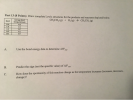 Part 13 (8 Points) Draw complete Lewis structures for the products and reactants depicted below. Average Bond CH,CH2(g) + H2(g) → CH,CH, (g) Bond Energy (kl/mol) H-H 436 CH 414 Сс C C CRC A. Use the bond energy data to determine AHºrx Predict the sign (not the specific value) of AS How does the spontaneity of this reaction change as the temperature increases (increases, decreases, change)?
9. Which of the following is not a Lewis 13. A carbocation is acid. A) BF...
 9. Which of the following is not a Lewis 13. A carbocation is acid. A) BF B) NaF C) AICl D) FeBr E) ZnCl2 A) a carbon with a negative charge B) a carbon with a positive charge C) a carbon with an unpaired electron D) a carbon with complete octet E) a carbon with five hydrogens 14. Consider the following equilibrium: 10. In which of these Lewis structures would iodine be assigned a formal charge of +2? Which of...
8. Determine whether the following LTIC systems are BIBO stable and explain why or why not (a) hi...
 8. Determine whether the following LTIC systems are BIBO stable and explain why or why not (a) hi(t)8(t) etu(t), (b) h2(t) -26(t-3)-te5u(t) 9. Consider the following zero-state input-output relations for a variety of systems. In each case, determine whetheir the system is zero-state linear, time invariant, and casual t-2 r2 (b) (t) f(12)dr Page l of ï
8. Determine whether the following LTIC systems are BIBO stable and explain why or why not (a) hi(t)8(t) etu(t), (b) h2(t) -26(t-3)-te5u(t) 9....
8. Determine whether the following LTIC systems are BIBO stable and explain why or why not (a) hi(t)8(t) etu(t), (b) h2(t) -26(t-3)-te5u(t) 9. Consider the following zero-state input-output relations for a variety of systems. In each case, determine whetheir the system is zero-state linear, time invariant, and casual t-2 r2 (b) (t) f(12)dr Page l of ï
8. Determine whether the following LTIC systems are BIBO stable and explain why or why not (a) hi(t)8(t) etu(t), (b) h2(t) -26(t-3)-te5u(t) 9....
Can you explain how and why? cular Models Pre-Lab Questions ) Lewis Structures are used to...
 Can you explain how and why?
cular Models Pre-Lab Questions ) Lewis Structures are used to represent covalently bonded molecules and polyatomic ions. a. Answer the following to draw the Lewis Structure of the molecule of OF i. How many valence electrons (total) are you working with? ii. Which atom is the central atom? What criteria must you use to decide this? Do the atoms in the molecule all obey the octet rule? Are there any lone pairs on the...
Can you explain how and why?
cular Models Pre-Lab Questions ) Lewis Structures are used to represent covalently bonded molecules and polyatomic ions. a. Answer the following to draw the Lewis Structure of the molecule of OF i. How many valence electrons (total) are you working with? ii. Which atom is the central atom? What criteria must you use to decide this? Do the atoms in the molecule all obey the octet rule? Are there any lone pairs on the...
8. Explain why the complex (Fe(H2O) has de = 14,000 cm', while [Fe(H2O) has 3 =...
 8. Explain why the complex (Fe(H2O) has de = 14,000 cm', while [Fe(H2O) has 3 = 9,350 cm. 9. Suggest a reason why copper'll) compounds are often colored but copper(l) compounds are colorless. 10. Sketch the d-orbital energy-level diagram for a square planar complex Spectrochemical series: COCN' >phen > NOx > en > NH3> NCS > H2O > F>RCOO > OH > CT > Br> 50m 750 nm 400 m Sem 430 nm 190 mm
1. [6.4% ) Write down the electron configuration for Br. 2. [6.4 %) Draw resonance structures...
 1. [6.4% ) Write down the electron configuration for Br. 2. [6.4 %) Draw resonance structures for (a) NO:, (b) NNO (a) N-NEO (b) NN-o 3. [6.4%) In which pair do both compounds exhibit predominantly covalent bonding? A. BaCl and H-O B. NaBr and SO C. K O and NBr D. CCl and Asl 4. [6.4 % ) Rank the following hydrocarbons in order of increasing vapor pressure: CHe, CvoH, CH, CH16, C22H 5. [6.4%) O and N2 in air...
 10. Using the tabulated bond energies, determine the approximate enthalpy change for each of the following rear (a) Ha(e)+Br3(g)--2HBr(e) osing the tabulated bond energies, determine the approximate enthalpy change for each of the following reactions (b) C.H.(8)+302(B) 2Co(s)+2H2O() 12. Which compound in each of the following pairs has the larger lattice energy? Note: Baand K' have similar radil;s and i have similar radil. Explain your choices. (a)KO or Na20 (b) K.S or Bas 13. Draw all possible resonance Lewis structures...
 1. Draw Lewis structures for each possible resonance form of chlorite and use formal charges to assign the best possible Lewis structure(s) to represent this polyatomic ion. (4 pts) CIO Calculate AHon for the oxidation of dihydrogen sulfide to sulfur dioxide. (6 pts) 2. 2H2S(g)+302(g) 2S02(g) +2H20(l) 3. Circle each of the following bonds that would be considered as pure covalent bonds: (2 pts) Al-F C-L P-F 1-1 Si List the following salts in order of increasing (lowest to highest...
 6. Usina resonance structures, explain why acetaldenyde has a pka of 17, while acetone of 19. 7. Using resonance structures, explain why methyl acetate (pka 25) is less acidic than acetone (pka 19). 8. Rank the following in order from least to most acidic. Explain your ranking, using resonance structures with your explanation. & la
 1.(8) Draw the Lewis structures for the following molecules and for each molecule: 0) indicate the orbital rybridization on the central atom () predict the molecular shape and whether the molecule is polar or nonpolar (a) SiF4 (b) SF4 2.(8) The following energy diagrams show a slight variation for the relative energy of , and 13, molecular orbitals. (a) Use the appropriate diagram to build the electron configurations for Og and CO molecules: (label cach diagram correctly.) (b) For each...
 Part 13 (8 Points) Draw complete Lewis structures for the products and reactants depicted below. Average Bond CH,CH2(g) + H2(g) → CH,CH, (g) Bond Energy (kl/mol) H-H 436 CH 414 Сс C C CRC A. Use the bond energy data to determine AHºrx Predict the sign (not the specific value) of AS How does the spontaneity of this reaction change as the temperature increases (increases, decreases, change)?
 9. Which of the following is not a Lewis 13. A carbocation is acid. A) BF B) NaF C) AICl D) FeBr E) ZnCl2 A) a carbon with a negative charge B) a carbon with a positive charge C) a carbon with an unpaired electron D) a carbon with complete octet E) a carbon with five hydrogens 14. Consider the following equilibrium: 10. In which of these Lewis structures would iodine be assigned a formal charge of +2? Which of...
 8. Determine whether the following LTIC systems are BIBO stable and explain why or why not (a) hi(t)8(t) etu(t), (b) h2(t) -26(t-3)-te5u(t) 9. Consider the following zero-state input-output relations for a variety of systems. In each case, determine whetheir the system is zero-state linear, time invariant, and casual t-2 r2 (b) (t) f(12)dr Page l of ï
8. Determine whether the following LTIC systems are BIBO stable and explain why or why not (a) hi(t)8(t) etu(t), (b) h2(t) -26(t-3)-te5u(t) 9....
8. Determine whether the following LTIC systems are BIBO stable and explain why or why not (a) hi(t)8(t) etu(t), (b) h2(t) -26(t-3)-te5u(t) 9. Consider the following zero-state input-output relations for a variety of systems. In each case, determine whetheir the system is zero-state linear, time invariant, and casual t-2 r2 (b) (t) f(12)dr Page l of ï
8. Determine whether the following LTIC systems are BIBO stable and explain why or why not (a) hi(t)8(t) etu(t), (b) h2(t) -26(t-3)-te5u(t) 9....
 Can you explain how and why?
cular Models Pre-Lab Questions ) Lewis Structures are used to represent covalently bonded molecules and polyatomic ions. a. Answer the following to draw the Lewis Structure of the molecule of OF i. How many valence electrons (total) are you working with? ii. Which atom is the central atom? What criteria must you use to decide this? Do the atoms in the molecule all obey the octet rule? Are there any lone pairs on the...
Can you explain how and why?
cular Models Pre-Lab Questions ) Lewis Structures are used to represent covalently bonded molecules and polyatomic ions. a. Answer the following to draw the Lewis Structure of the molecule of OF i. How many valence electrons (total) are you working with? ii. Which atom is the central atom? What criteria must you use to decide this? Do the atoms in the molecule all obey the octet rule? Are there any lone pairs on the...
 8. Explain why the complex (Fe(H2O) has de = 14,000 cm', while [Fe(H2O) has 3 = 9,350 cm. 9. Suggest a reason why copper'll) compounds are often colored but copper(l) compounds are colorless. 10. Sketch the d-orbital energy-level diagram for a square planar complex Spectrochemical series: COCN' >phen > NOx > en > NH3> NCS > H2O > F>RCOO > OH > CT > Br> 50m 750 nm 400 m Sem 430 nm 190 mm
 1. [6.4% ) Write down the electron configuration for Br. 2. [6.4 %) Draw resonance structures for (a) NO:, (b) NNO (a) N-NEO (b) NN-o 3. [6.4%) In which pair do both compounds exhibit predominantly covalent bonding? A. BaCl and H-O B. NaBr and SO C. K O and NBr D. CCl and Asl 4. [6.4 % ) Rank the following hydrocarbons in order of increasing vapor pressure: CHe, CvoH, CH, CH16, C22H 5. [6.4%) O and N2 in air...
Most questions answered within 3 hours.
-
Where is the error in this code sequence?
String s1 = "Hello";
String s2 = "ello";...
asked 11 months ago -
Financial data for Joel de Paris, Inc., for last year
follow:
Joel de Paris, Inc.
Balance...
asked 11 months ago -
Consider this reaction:
Al2(SO4)3 (aq)+ BaCl3
(aq) Al2Cl6 (aq)- +
3BaSO4(s) . What is the...
asked 11 months ago -
Suppose that Savneet is considering increasing her
recent random sample from 20 car rentals to 40...
asked 11 months ago -
Trucks arrive at an unloading terminal at an average rate of 120
per hour.
Trucks arrive...
asked 11 months ago -
Why are methanol and ethanol completely soluble in water while
octanol is not very little soluble....
asked 11 months ago -
A facilities manager at a university reads in a research report
that the mean amount of...
asked 11 months ago -
When the CuSO4 is rehydrated by adding water to the anhydrous
compound, is this an endothermic...
asked 11 months ago -
A ray of sunlight is passing from diamond into crown glass; the
angle of incidence is...
asked 11 months ago -
A block of mass 0.249 kg is placed on top of a light, vertical
spring of...
asked 11 months ago -
how do the kidneys compensate in the presences of acidosis
a) trigger hyperventilate
b) reserve acid...
asked 11 months ago -
Question 501 pts
The rental rate of capital to the firm increases. Which of the
following...
asked 11 months ago