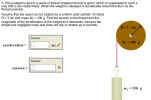
A 250-g weight is tied to a piece of thread wrapped around a spool, which is suspended in such a way that it can rotate freely. When the weight is released, it accelerates toward the floor as the thread unwinds.

Homework Answers
The concepts required to solve the given problem are Newton’s second law of motion, torque, moment of inertia of a solid cylinder about an axis passing through its center and relation of angular acceleration with linear acceleration.
Initially, write the equation of motion for the weight tied with the spool by using Newton’s second law of motion and by knowing net force on it. Then, find the tension in the thread in terms of acceleration and mass of the spool by taking expression for torque on the spool due to tension in the thread by using relation of angular acceleration with linear acceleration. After that, calculate the acceleration of the weight by solving these two equations. Finally, calculate the tension in the thread by using acceleration of the weight and mass of spool.
According to Newton’s second law of motion, the net force on an object is equal to product of mass m and acceleration a of the object.
The magnitude of torque on an object by applying force F on the object at a distance r from the pivot is given by following expression.
Torque is also defined as the product of moment of inertia I and angular acceleration
The moment of inertia I of a solid cylinder of radius R and mass M about an axis passing through its center is given by following expression.
The relation of angular acceleration of a rotating object of radius R with linear acceleration a of the object is given by following expression.
Draw the following free body diagram for weight.

Here, T is the tension, R is the radius of the spool, is the mass of the spool, g is the acceleration due to gravity and is the mass of the weight.
From the above free body diagram, the net force on the weight is given by following expression.
Assume the acceleration of the system is a.
From Newton’s second law of motion, the net force on the weight is equal to product of mass and acceleration a of the system.
Substitute for in the above equation
The torque on the spool due to tension T in the thread is given as follows:
Torque is defined as the product of moment of inertia of the spool I and angular acceleration
Substitute for I, and for in the above equation.
Substitute TR for in the above equation.
The equation of motion for weight is given by following expression.
The tension in the thread is given by following expression.
Substitute for T in the above equation to solve for a.
Substitute 250 g for 100 g for and for g in the above equation to solve for acceleration.
The tension T in the thread is given by following expression.
Substitute 100 g for and for a in the above equation.
Ans:
The acceleration of the weight is
The tension in the thread is 0.41 N.
Add Answer to:
A 250-g weight is tied to a piece of thread wrapped around a spool,
which is...
A 150-g weight is tied to a piece of thread wrapped around a spool, which is...
 A 150-g weight is tied to a piece of thread wrapped around a spool, which is suspended in such a way that it can rotate freely. When the weight is released, it accelerates toward the floor as the thread unwinds. Assume that the spool can be treated as a uniform solid cylinder of radius R 3 cm and mass Ms 100 g. Find the tension in the thread and the magnitude of the acceleration of the weight as it descends....
4HW: Fixed-Axis Rota g19-LAMP Activities and Due Dates HW: Fixed-Axis Rotation 0/1600 Resources A...
 4HW: Fixed-Axis Rota g19-LAMP Activities and Due Dates HW: Fixed-Axis Rotation 0/1600 Resources A weight with mass m., 250 g is tied to a piece of thread wrapped around a spool, which is suspended in such a way that it can rotate freely. When the weight is released, it accelerates toward the floor as the thread unwinds. Assume that the spool can be treated as a uniform solid cylinder of radius R = 3.00 cm and mass M, 100 g....
A chain with negligible mass is wrapped around a gear of radius R = 2.0 meters,...
 A chain with negligible mass is wrapped around a gear of radius R = 2.0 meters, and it cannot slip. The gear rotates without friction about an axis through its center. A weight of mass M = 14 kg a suspended from the end of the chain. When the system is released from rest it is observed that the weight descends 10 meters in 2.0 seconds. What is the moment of inertia j of the gear (assuming it is a...
A weight of mass 1.66 kg is suspended by a string wrapped around a pulley wheel,...
A weight of mass 1.66 kg is suspended by a string wrapped around a pulley wheel, which consists of a solid disk of mass 4.03 kg and radius 0.603 m. The system is released from rest. Over what vertical distance does the hanging mass move in 3.0 seconds? Ignore friction and drag forces, and assume that the string does not slip.
A weight of mass 1.03 kg is suspended by a string wrapped around a pulley wheel,...
A weight of mass 1.03 kg is suspended by a string wrapped around a pulley wheel, which consists of a solid disk of mass 4.96 kg and radius 1.37 m. The system is released from rest. Over what vertical distance does the hanging mass move in 3.0 seconds? Ignore friction and drag forces, and assume that the string does not slip.
1.) a bucket of mass 5 kg is suspended by rope that is wrapped around a...
1.) a bucket of mass 5 kg is suspended by rope that is wrapped around a pulley of twice the mass which is attached to the ceiling. when the system is released from rest the bucket descends with an acceleration of 1m/s^2 . what is the frictional torque in the pulley? assume the pulley to be solid cylinder. ( CAN YOU PLEASE SOLVE THE PROBLEM AS DETAILED AS POSSIBLE PLEASE. THANK YOU IN ADVANCE )
A string is wrapped around a uniform solid cylinder of radius r, as shown in (Figure 1). The cylinder can rota...
 A string is wrapped around a uniform solid cylinder of radius r, as shown in (Figure 1). The cylinder can rotate freely about its axis. The loose end of the string is attached to a block. The block and cylinder each have mass m. Find the magnitude alpha of the angular acceleration of the cylinder as the block descends. Express your answer in terms of the cylinder's radius r and the magnitude of the acceleration due to gravity g.
Please Answer it A string is wrapped around a uniform solid cylinder of radius r, as shown in (Figure 1). The cylinder...
 Please Answer it
A string is wrapped around a uniform solid cylinder of radius r, as shown in (Figure 1). The cylinder can rotate freely about its axis. The loose end of the string is attached to a block. The block and cylinder each have mass m. Find the magnitude alpha of the angular acceleration of the cylinder as the block descends. Express your answer in terms of the cylinder's radius r and the magnitude of the acceleration due to...
Please Answer it
A string is wrapped around a uniform solid cylinder of radius r, as shown in (Figure 1). The cylinder can rotate freely about its axis. The loose end of the string is attached to a block. The block and cylinder each have mass m. Find the magnitude alpha of the angular acceleration of the cylinder as the block descends. Express your answer in terms of the cylinder's radius r and the magnitude of the acceleration due to...
A string is wrapped around a uniform solid cylinder of radius r, as shown in (Figure 1). The cylinder can rotate freely...
A string is wrapped around a uniform solid cylinder of radius r, as shown in (Figure 1). The cylinder can rotate freely about its axis. The loose end of the string is attached to a block. The block and cylinder each have mass m. Part A. Find the magnitude α of the angular acceleration of the cylinder as the block descends. Express your answer in terms of the cylinder's radius r and the magnitude of the acceleration due to gravity...
A light cable is wrapped around a solid cylinder with mass M = 1.50 kg and...
A light cable is wrapped around a solid cylinder with mass M = 1.50 kg and radius R = 0.20 m as shown in the figure below. The cylinder rotates with negligible friction about a stationary horizontal axis. The free end of the cable is tied to a block of mass m = 0.50 kg. The block, initially at rest, is released at a height h = 1.00 m above the floor. As the block falls, the cable unwinds without...
 A 150-g weight is tied to a piece of thread wrapped around a spool, which is suspended in such a way that it can rotate freely. When the weight is released, it accelerates toward the floor as the thread unwinds. Assume that the spool can be treated as a uniform solid cylinder of radius R 3 cm and mass Ms 100 g. Find the tension in the thread and the magnitude of the acceleration of the weight as it descends....
 4HW: Fixed-Axis Rota g19-LAMP Activities and Due Dates HW: Fixed-Axis Rotation 0/1600 Resources A weight with mass m., 250 g is tied to a piece of thread wrapped around a spool, which is suspended in such a way that it can rotate freely. When the weight is released, it accelerates toward the floor as the thread unwinds. Assume that the spool can be treated as a uniform solid cylinder of radius R = 3.00 cm and mass M, 100 g....
 A chain with negligible mass is wrapped around a gear of radius R = 2.0 meters, and it cannot slip. The gear rotates without friction about an axis through its center. A weight of mass M = 14 kg a suspended from the end of the chain. When the system is released from rest it is observed that the weight descends 10 meters in 2.0 seconds. What is the moment of inertia j of the gear (assuming it is a...
 A string is wrapped around a uniform solid cylinder of radius r, as shown in (Figure 1). The cylinder can rotate freely about its axis. The loose end of the string is attached to a block. The block and cylinder each have mass m. Find the magnitude alpha of the angular acceleration of the cylinder as the block descends. Express your answer in terms of the cylinder's radius r and the magnitude of the acceleration due to gravity g.
 Please Answer it
A string is wrapped around a uniform solid cylinder of radius r, as shown in (Figure 1). The cylinder can rotate freely about its axis. The loose end of the string is attached to a block. The block and cylinder each have mass m. Find the magnitude alpha of the angular acceleration of the cylinder as the block descends. Express your answer in terms of the cylinder's radius r and the magnitude of the acceleration due to...
Please Answer it
A string is wrapped around a uniform solid cylinder of radius r, as shown in (Figure 1). The cylinder can rotate freely about its axis. The loose end of the string is attached to a block. The block and cylinder each have mass m. Find the magnitude alpha of the angular acceleration of the cylinder as the block descends. Express your answer in terms of the cylinder's radius r and the magnitude of the acceleration due to...
Most questions answered within 3 hours.
-
Where is the error in this code sequence?
String s1 = "Hello";
String s2 = "ello";...
asked 11 months ago -
Financial data for Joel de Paris, Inc., for last year
follow:
Joel de Paris, Inc.
Balance...
asked 11 months ago -
Consider this reaction:
Al2(SO4)3 (aq)+ BaCl3
(aq) Al2Cl6 (aq)- +
3BaSO4(s) . What is the...
asked 11 months ago -
Suppose that Savneet is considering increasing her
recent random sample from 20 car rentals to 40...
asked 11 months ago -
Trucks arrive at an unloading terminal at an average rate of 120
per hour.
Trucks arrive...
asked 11 months ago -
Why are methanol and ethanol completely soluble in water while
octanol is not very little soluble....
asked 11 months ago -
A facilities manager at a university reads in a research report
that the mean amount of...
asked 11 months ago -
When the CuSO4 is rehydrated by adding water to the anhydrous
compound, is this an endothermic...
asked 11 months ago -
A ray of sunlight is passing from diamond into crown glass; the
angle of incidence is...
asked 11 months ago -
A block of mass 0.249 kg is placed on top of a light, vertical
spring of...
asked 11 months ago -
how do the kidneys compensate in the presences of acidosis
a) trigger hyperventilate
b) reserve acid...
asked 11 months ago -
Question 501 pts
The rental rate of capital to the firm increases. Which of the
following...
asked 11 months ago