The figure below gives the position of a 14 g block oscillating in SHM on the...
The figure below gives the position of a 14 g block oscillating in SHM on the end of a spring. On the horizontal axis, t1 = 18 ms.
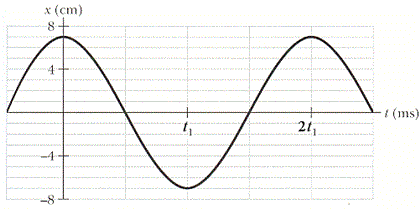
(a) What is the maximum kinetic energy of the block? (Hint:
Measuring a slope will probably not be very accurate. Can you think
of another approach?)
(b) How many times per second is the maximum kinetic energy
reached?
Homework Answers


Add Answer to:
The figure below gives the position of a 14 g block oscillating
in SHM on the...
The figure gives the position of a 120 g block oscillating in SHM on the end...
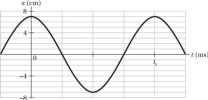 The figure gives the position of a 120 g block oscillating in SHM
on the end of a spring. The horizontal axis scale is set by ts =
140 ms. What is the maximum kinetic energy of the block?
How many times per second is that maximum reached? (Hint: measuring
a slope will probably not be very accurate. Find another
approach)
The figure gives the position of a 120 g block oscillating in SHM
on the end of a spring. The horizontal axis scale is set by ts =
140 ms. What is the maximum kinetic energy of the block?
How many times per second is that maximum reached? (Hint: measuring
a slope will probably not be very accurate. Find another
approach)
Use the data in the table below which gives the position of a block connected to...
 Use the data in the table below which gives the position of a block connected to a horizontal spring at several times for a block of mass m = 0.295 kg and assume friction is negligible Time of measurement, t (s) Position of block, x (m) 5.70 0.25 0.50 0.75 1.00 1.25 1.50 1.75 2.00 2.25 2.50 4.03 0 -4.03 -5.70 -4.03 0 4.03 5.70 4.03 0 (a) What is the spring constant k? N/m (b) What is the maximum...
In the figure below, a 4.0 kg block is accelerated from rest by a compressed spring...
 In the figure below, a 4.0 kg block is accelerated from rest by a compressed spring of spring constant 600 N/m. The block leaves the spring at the spring's relaxed length and then travels over a horizontal floor with a coefficient of kinetic friction uk= 0.30.The frictional force stops the block in the distance of D = 8.0 m. -- No friction a) Find the increase in the thermal energy of the block-floor system b) What is the original compression...
chap07-P33 Please write the answer neatly for a thumps up, thank you! The block in the...
 chap07-P33 Please write the answer neatly for a thumps up, thank
you!
The block in the figure lies on a horizontal frictionless surface, and the spring constant is 50 N/m. Initially, the spring is at its relaxed length and the block is stationary at position x = 0. Then an applied force with a constant magnitude of 3.0 N pulls the block in the positive direction of the x axis, stretching the spring until the block stops. When that stopping...
chap07-P33 Please write the answer neatly for a thumps up, thank
you!
The block in the figure lies on a horizontal frictionless surface, and the spring constant is 50 N/m. Initially, the spring is at its relaxed length and the block is stationary at position x = 0. Then an applied force with a constant magnitude of 3.0 N pulls the block in the positive direction of the x axis, stretching the spring until the block stops. When that stopping...
wooden block with mass M 3 kg is lying on a horizontal table and is attached to a spring in its equilibrium position. It is hit by a bullet with mass m 5 g which moves horizontally. The bullet re...
 wooden block with mass M 3 kg is lying on a horizontal table and is attached to a spring in its equilibrium position. It is hit by a bullet with mass m 5 g which moves horizontally. The bullet remains in the block after colliding with it. The block moves on the table compressing the spring, with spring constant k 50 Nm, a distance 10 cm. The coefficient of kinetic friction uk 0.2. a) Find the elastic energy stored in...
A child's toy consists of a block that attaches to a table with a suction cup,...
 A child's toy consists of a block that attaches to a table with
a suction cup, a spring connected to that block, a ball, and a
launching ramp. (Figure 1)The spring has a spring constant k, the
ball has a mass m, and the ramp rises a height y above the table,
the surface of which is a height H above the floor. Initially, the
spring rests at its equilibrium length. The spring then is
compressed a distance s, where...
A child's toy consists of a block that attaches to a table with
a suction cup, a spring connected to that block, a ball, and a
launching ramp. (Figure 1)The spring has a spring constant k, the
ball has a mass m, and the ramp rises a height y above the table,
the surface of which is a height H above the floor. Initially, the
spring rests at its equilibrium length. The spring then is
compressed a distance s, where...
part F and G The function describing the predicted velocity as a function of time, u(t),...
 part F and G
The function describing the predicted velocity as a function of time, u(t), for a student-designed prototype two-stage model rocket a = 3.0 m/s. B = -24 m/s, and y = 54 m/s. Due to ignition rates of the fuel in the two stages and external forces acting on th minimum and a local maximum during the time interval. Part F Determine the times at which u(t) has a local minimum and maximum. Express your answer as...
part F and G
The function describing the predicted velocity as a function of time, u(t), for a student-designed prototype two-stage model rocket a = 3.0 m/s. B = -24 m/s, and y = 54 m/s. Due to ignition rates of the fuel in the two stages and external forces acting on th minimum and a local maximum during the time interval. Part F Determine the times at which u(t) has a local minimum and maximum. Express your answer as...
we will look ar sa simple form or Niler with mass mois classic physics lab apparatus...
 we will look ar sa simple form or Niler with mass mois classic physics lab apparatus for measuring the speed of a projectile. Figure 8.13 of the apparatus, known as a ballistic pendulum, composed of a block and some string. is fired into a block of wood with mass mw suspended like a pendulum. The bullet lastic collision with the block, becoming embedded in it. After the impact of the bul- un to a maximum height h. Given values of...
PLEASE EXPLAIN ALL ANSWERS 3 kg vertically cing is 10 kg g is used to frictionless...
 PLEASE EXPLAIN ALL ANSWERS
3 kg vertically cing is 10 kg g is used to frictionless maximum these ag is most 11. Three blocks, A, B, and C. of masses 1, 2, and 3 kg, respectively, are initially at rest on a frictionless surface as indicated in the figure above. What force has to be applied on block C 5= 200 mis? to accelerate the three blocks at 2 m/s? (A) 0.33 N (2) +22) 4362) 16 V=20mis (B) 1.5...
PLEASE EXPLAIN ALL ANSWERS
3 kg vertically cing is 10 kg g is used to frictionless maximum these ag is most 11. Three blocks, A, B, and C. of masses 1, 2, and 3 kg, respectively, are initially at rest on a frictionless surface as indicated in the figure above. What force has to be applied on block C 5= 200 mis? to accelerate the three blocks at 2 m/s? (A) 0.33 N (2) +22) 4362) 16 V=20mis (B) 1.5...
Please work out 3 clearly and with units. Thanks! 1. A 10-g bullet travels vertically upwards...
 Please work out 3 clearly and with units. Thanks!
1. A 10-g bullet travels vertically upwards at 1000 m/s, then strikes and passes through a 2.0-kg block initially at rest. The bullet emerges from the block with a speed of 400 m/s because it transfers momentum to the block. (a) How much momentum did the block gain? (b) How fast is the block now moving, and what is its kinetic energy? (c) Using energy considerations only, to what maximum height...
Please work out 3 clearly and with units. Thanks!
1. A 10-g bullet travels vertically upwards at 1000 m/s, then strikes and passes through a 2.0-kg block initially at rest. The bullet emerges from the block with a speed of 400 m/s because it transfers momentum to the block. (a) How much momentum did the block gain? (b) How fast is the block now moving, and what is its kinetic energy? (c) Using energy considerations only, to what maximum height...
 The figure gives the position of a 120 g block oscillating in SHM
on the end of a spring. The horizontal axis scale is set by ts =
140 ms. What is the maximum kinetic energy of the block?
How many times per second is that maximum reached? (Hint: measuring
a slope will probably not be very accurate. Find another
approach)
The figure gives the position of a 120 g block oscillating in SHM
on the end of a spring. The horizontal axis scale is set by ts =
140 ms. What is the maximum kinetic energy of the block?
How many times per second is that maximum reached? (Hint: measuring
a slope will probably not be very accurate. Find another
approach)
 Use the data in the table below which gives the position of a block connected to a horizontal spring at several times for a block of mass m = 0.295 kg and assume friction is negligible Time of measurement, t (s) Position of block, x (m) 5.70 0.25 0.50 0.75 1.00 1.25 1.50 1.75 2.00 2.25 2.50 4.03 0 -4.03 -5.70 -4.03 0 4.03 5.70 4.03 0 (a) What is the spring constant k? N/m (b) What is the maximum...
 In the figure below, a 4.0 kg block is accelerated from rest by a compressed spring of spring constant 600 N/m. The block leaves the spring at the spring's relaxed length and then travels over a horizontal floor with a coefficient of kinetic friction uk= 0.30.The frictional force stops the block in the distance of D = 8.0 m. -- No friction a) Find the increase in the thermal energy of the block-floor system b) What is the original compression...
 chap07-P33 Please write the answer neatly for a thumps up, thank
you!
The block in the figure lies on a horizontal frictionless surface, and the spring constant is 50 N/m. Initially, the spring is at its relaxed length and the block is stationary at position x = 0. Then an applied force with a constant magnitude of 3.0 N pulls the block in the positive direction of the x axis, stretching the spring until the block stops. When that stopping...
chap07-P33 Please write the answer neatly for a thumps up, thank
you!
The block in the figure lies on a horizontal frictionless surface, and the spring constant is 50 N/m. Initially, the spring is at its relaxed length and the block is stationary at position x = 0. Then an applied force with a constant magnitude of 3.0 N pulls the block in the positive direction of the x axis, stretching the spring until the block stops. When that stopping...
 wooden block with mass M 3 kg is lying on a horizontal table and is attached to a spring in its equilibrium position. It is hit by a bullet with mass m 5 g which moves horizontally. The bullet remains in the block after colliding with it. The block moves on the table compressing the spring, with spring constant k 50 Nm, a distance 10 cm. The coefficient of kinetic friction uk 0.2. a) Find the elastic energy stored in...
 A child's toy consists of a block that attaches to a table with
a suction cup, a spring connected to that block, a ball, and a
launching ramp. (Figure 1)The spring has a spring constant k, the
ball has a mass m, and the ramp rises a height y above the table,
the surface of which is a height H above the floor. Initially, the
spring rests at its equilibrium length. The spring then is
compressed a distance s, where...
A child's toy consists of a block that attaches to a table with
a suction cup, a spring connected to that block, a ball, and a
launching ramp. (Figure 1)The spring has a spring constant k, the
ball has a mass m, and the ramp rises a height y above the table,
the surface of which is a height H above the floor. Initially, the
spring rests at its equilibrium length. The spring then is
compressed a distance s, where...
 part F and G
The function describing the predicted velocity as a function of time, u(t), for a student-designed prototype two-stage model rocket a = 3.0 m/s. B = -24 m/s, and y = 54 m/s. Due to ignition rates of the fuel in the two stages and external forces acting on th minimum and a local maximum during the time interval. Part F Determine the times at which u(t) has a local minimum and maximum. Express your answer as...
part F and G
The function describing the predicted velocity as a function of time, u(t), for a student-designed prototype two-stage model rocket a = 3.0 m/s. B = -24 m/s, and y = 54 m/s. Due to ignition rates of the fuel in the two stages and external forces acting on th minimum and a local maximum during the time interval. Part F Determine the times at which u(t) has a local minimum and maximum. Express your answer as...
 we will look ar sa simple form or Niler with mass mois classic physics lab apparatus for measuring the speed of a projectile. Figure 8.13 of the apparatus, known as a ballistic pendulum, composed of a block and some string. is fired into a block of wood with mass mw suspended like a pendulum. The bullet lastic collision with the block, becoming embedded in it. After the impact of the bul- un to a maximum height h. Given values of...
 PLEASE EXPLAIN ALL ANSWERS
3 kg vertically cing is 10 kg g is used to frictionless maximum these ag is most 11. Three blocks, A, B, and C. of masses 1, 2, and 3 kg, respectively, are initially at rest on a frictionless surface as indicated in the figure above. What force has to be applied on block C 5= 200 mis? to accelerate the three blocks at 2 m/s? (A) 0.33 N (2) +22) 4362) 16 V=20mis (B) 1.5...
PLEASE EXPLAIN ALL ANSWERS
3 kg vertically cing is 10 kg g is used to frictionless maximum these ag is most 11. Three blocks, A, B, and C. of masses 1, 2, and 3 kg, respectively, are initially at rest on a frictionless surface as indicated in the figure above. What force has to be applied on block C 5= 200 mis? to accelerate the three blocks at 2 m/s? (A) 0.33 N (2) +22) 4362) 16 V=20mis (B) 1.5...
 Please work out 3 clearly and with units. Thanks!
1. A 10-g bullet travels vertically upwards at 1000 m/s, then strikes and passes through a 2.0-kg block initially at rest. The bullet emerges from the block with a speed of 400 m/s because it transfers momentum to the block. (a) How much momentum did the block gain? (b) How fast is the block now moving, and what is its kinetic energy? (c) Using energy considerations only, to what maximum height...
Please work out 3 clearly and with units. Thanks!
1. A 10-g bullet travels vertically upwards at 1000 m/s, then strikes and passes through a 2.0-kg block initially at rest. The bullet emerges from the block with a speed of 400 m/s because it transfers momentum to the block. (a) How much momentum did the block gain? (b) How fast is the block now moving, and what is its kinetic energy? (c) Using energy considerations only, to what maximum height...
Most questions answered within 3 hours.
-
Where is the error in this code sequence?
String s1 = "Hello";
String s2 = "ello";...
asked 11 months ago -
Financial data for Joel de Paris, Inc., for last year
follow:
Joel de Paris, Inc.
Balance...
asked 11 months ago -
Consider this reaction:
Al2(SO4)3 (aq)+ BaCl3
(aq) Al2Cl6 (aq)- +
3BaSO4(s) . What is the...
asked 11 months ago -
Suppose that Savneet is considering increasing her
recent random sample from 20 car rentals to 40...
asked 11 months ago -
Trucks arrive at an unloading terminal at an average rate of 120
per hour.
Trucks arrive...
asked 11 months ago -
Why are methanol and ethanol completely soluble in water while
octanol is not very little soluble....
asked 11 months ago -
A facilities manager at a university reads in a research report
that the mean amount of...
asked 11 months ago -
When the CuSO4 is rehydrated by adding water to the anhydrous
compound, is this an endothermic...
asked 11 months ago -
A ray of sunlight is passing from diamond into crown glass; the
angle of incidence is...
asked 11 months ago -
A block of mass 0.249 kg is placed on top of a light, vertical
spring of...
asked 11 months ago -
how do the kidneys compensate in the presences of acidosis
a) trigger hyperventilate
b) reserve acid...
asked 11 months ago -
Question 501 pts
The rental rate of capital to the firm increases. Which of the
following...
asked 11 months ago