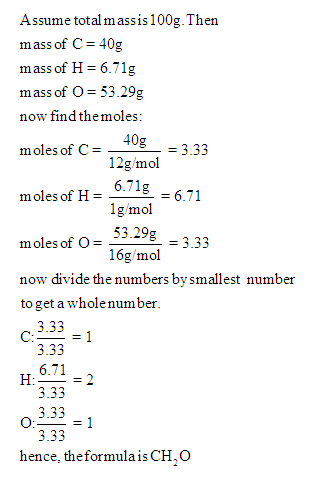
Glucose (a source of energy and metabolic intermediate): 40.00%C, 6.71%H, and 53.29%O. Express your answer as...
Glucose (a source of energy and metabolic intermediate): 40.00%C, 6.71%H, and 53.29%O.
Express your answer as a chemical formula.
Homework Answers
Add Answer to:
Glucose (a source of energy and metabolic intermediate): 40.00%C, 6.71%H, and 53.29%O. Express your answer as...
Calculate the empirical formula for each of the following natural flavors based on their elemental mass...
Calculate the empirical formula for each of the following natural flavors based on their elemental mass percent composition: Methyl butyrate (component of apple taste and smell): 58.80%C, 9.87%H, and 31.33%O. Glucose (a source of energy and metabolic intermediate): 40.00%C, 6.71%H, and 53.29%O.
Glucose, C 6 H 12 O 6 , is used as an energy source by the...
Glucose, C 6 H 12 O 6 , is used as an energy source by the human body. The overall reaction in the body is described by the equation C 6 H 12 O 6 ( aq ) + 6 O 2 ( g ) ⟶ 6 CO 2 ( g ) + 6 H 2 O ( l ) Calculate the number of grams of oxygen required to convert 58.0 g of glucose to CO 2 and H 2...
Glucose, C,H,O, is used as an energy source by the human body. The overall reaction in...
 Glucose, C,H,O, is used as an energy source by the human body. The overall reaction in the body is described by the equation C,H,O (aq) + 60,(g) = 6CO,(g) + 6 H, O). Calculate the number of grams of oxygen required to convert 28.0 g of glucose to CO, and H.O. mass of O, Calculate the number of grams of Co, produced. mass of CO2:
Acetic acid has a molar mass of 60.05 g/mol and consists of 40.00 % C ,...
 Acetic acid has a molar mass of 60.05 g/mol and consists of 40.00 % C , 6.714 % H, and 53.29 % O. What is the molecular formula of acetic acid? Multiple Choice C3.33H6.6603.33 СзН6Оз CH20 C2H402 Cнзо
C 4 H 9 , 114.21 g/mol Express your answer as a chemical formula.
C 4 H 9 , 114.21 g/mol Express your answer as a chemical formula.
< Question 5 of 11 > Glucose, C, H, , is used as an energy source by the human body. The overall reaction in...
 < Question 5 of 11 > Glucose, C, H, , is used as an energy source by the human body. The overall reaction in the body is described by the equation CH20. (aq) + 60,(3) — 600,(8) + 6H,01) Calculate the number of grams of oxygen required to convert 43.0 g of glucose to CO, and H.O. mass of Oz: Calculate the number of grams of CO, produced. mass of CO, terms of use contact us help about us |...
Chemoorganotrophic heterotrophs oxidize carbohydrates as their primary source of energy. Glucose is the most common energy...
Chemoorganotrophic heterotrophs oxidize carbohydrates as their primary source of energy. Glucose is the most common energy source for such organisms and energy may be extracted from glucose via respiration or fermentation. a. Explain the difference between aerobic respiration, anaerobic respiration, and fermentation. b. Identify and briefly define the metabolic pathways involved in aerobic respiration. For each metabolic pathway your response should address the forms of carbon that enter and exit, the amount of ATP produced, and the number and types...
Part A C,H,O(1) +O2(g) →CO2(g) + H2O(g) Express your answer as a chemical equation. Identify all...
 Part A C,H,O(1) +O2(g) →CO2(g) + H2O(g) Express your answer as a chemical equation. Identify all of the phases in your answer. F AX O ? Submit Request Answer Part B CH, O(l) +O2(g) + CO2(g) + H2O(g) Express your answer as a chemical equation. Identify all of the phases in your answer.
NO2− Express your answer as a chemical formula or an ion. H2O Express your answer as...
NO2− Express your answer as a chemical formula or an ion. H2O Express your answer as a chemical formula or an ion. ClO2− Express your answer as a chemical formula or an ion.
AgC,H,O, (aq) + BaCl(aq) → Express your answer as a chemical equation. Identify all of the...
 AgC,H,O, (aq) + BaCl(aq) → Express your answer as a chemical equation. Identify all of the phases in your answer. Enter noreaction if there is no reaction. - AED ROO? Submit Previous Answers Request Answer X Incorrect; Try Again; 5 attempts remaining Part B BaCl(aq) + K, CO3(aq) → Express your answer as a chemical equation. Identity all of the phases in your answer. Enter normation if there is no reaction. ΑΣΦ 6 * Ο ?
 Glucose, C,H,O, is used as an energy source by the human body. The overall reaction in the body is described by the equation C,H,O (aq) + 60,(g) = 6CO,(g) + 6 H, O). Calculate the number of grams of oxygen required to convert 28.0 g of glucose to CO, and H.O. mass of O, Calculate the number of grams of Co, produced. mass of CO2:
 Acetic acid has a molar mass of 60.05 g/mol and consists of 40.00 % C , 6.714 % H, and 53.29 % O. What is the molecular formula of acetic acid? Multiple Choice C3.33H6.6603.33 СзН6Оз CH20 C2H402 Cнзо
 < Question 5 of 11 > Glucose, C, H, , is used as an energy source by the human body. The overall reaction in the body is described by the equation CH20. (aq) + 60,(3) — 600,(8) + 6H,01) Calculate the number of grams of oxygen required to convert 43.0 g of glucose to CO, and H.O. mass of Oz: Calculate the number of grams of CO, produced. mass of CO, terms of use contact us help about us |...
 Part A C,H,O(1) +O2(g) →CO2(g) + H2O(g) Express your answer as a chemical equation. Identify all of the phases in your answer. F AX O ? Submit Request Answer Part B CH, O(l) +O2(g) + CO2(g) + H2O(g) Express your answer as a chemical equation. Identify all of the phases in your answer.
 AgC,H,O, (aq) + BaCl(aq) → Express your answer as a chemical equation. Identify all of the phases in your answer. Enter noreaction if there is no reaction. - AED ROO? Submit Previous Answers Request Answer X Incorrect; Try Again; 5 attempts remaining Part B BaCl(aq) + K, CO3(aq) → Express your answer as a chemical equation. Identity all of the phases in your answer. Enter normation if there is no reaction. ΑΣΦ 6 * Ο ?
Most questions answered within 3 hours.
-
Where is the error in this code sequence?
String s1 = "Hello";
String s2 = "ello";...
asked 11 months ago -
Financial data for Joel de Paris, Inc., for last year
follow:
Joel de Paris, Inc.
Balance...
asked 11 months ago -
Consider this reaction:
Al2(SO4)3 (aq)+ BaCl3
(aq) Al2Cl6 (aq)- +
3BaSO4(s) . What is the...
asked 11 months ago -
Suppose that Savneet is considering increasing her
recent random sample from 20 car rentals to 40...
asked 11 months ago -
Trucks arrive at an unloading terminal at an average rate of 120
per hour.
Trucks arrive...
asked 11 months ago -
Why are methanol and ethanol completely soluble in water while
octanol is not very little soluble....
asked 11 months ago -
A facilities manager at a university reads in a research report
that the mean amount of...
asked 11 months ago -
When the CuSO4 is rehydrated by adding water to the anhydrous
compound, is this an endothermic...
asked 11 months ago -
A ray of sunlight is passing from diamond into crown glass; the
angle of incidence is...
asked 11 months ago -
A block of mass 0.249 kg is placed on top of a light, vertical
spring of...
asked 11 months ago -
how do the kidneys compensate in the presences of acidosis
a) trigger hyperventilate
b) reserve acid...
asked 11 months ago -
Question 501 pts
The rental rate of capital to the firm increases. Which of the
following...
asked 11 months ago