
Homework Answers
1/f noise is inversely proportional to the frequency. So this noise is maximum at lowest frequency. Therefore Option (A) 1 Hz is most likely to suffer from 1/f noise.
Thermal noise is equal in all frequencies and dependent on temperature. So it will be equal for all frequencies.
Add Answer to:
Problem #3 (2 points) Which signal is most likely to suffer from 1/fnoise? Which signal is...
Problem #2 (2 points) ive resistance of 1 MOhm. Calculate the shot noise when using three...
 Problem #2 (2 points) ive resistance of 1 MOhm. Calculate the shot noise when using three A system has an effecti different bandwidth oscilloscopes (80 GHz, 200 MHz, and 50 MHz), assuming that the different scopes do not alter the effective resistance Problem #3 (2 points) Which signal is most likely to suffer from 1/noase? Which signal is most likely to suffer from thermal noise? (a) 1Hz (b) 10Hz (c) 100Hz (d) 1kHz
Solve parts a, b, c, and d 2. Design a differentiator circuit with an input signal that varies in frequency from 100Hz to 1KHz. Follow the differentiator guideline procedure. Select th...
 Solve parts a, b, c, and d
2. Design a differentiator circuit with an input signal that varies in frequency from 100Hz to 1KHz. Follow the differentiator guideline procedure. Select the capacitor value to be 0.1uf. Use the differentiator schematic shown on the next page. a. Draw the complete circuit showing values being used +s b. Write the expression for Vo. c. If a sine wave of 20mvp at a frequency of 1khz is applied to the input circuit. With...
Solve parts a, b, c, and d
2. Design a differentiator circuit with an input signal that varies in frequency from 100Hz to 1KHz. Follow the differentiator guideline procedure. Select the capacitor value to be 0.1uf. Use the differentiator schematic shown on the next page. a. Draw the complete circuit showing values being used +s b. Write the expression for Vo. c. If a sine wave of 20mvp at a frequency of 1khz is applied to the input circuit. With...
1. Choose the correct answer from the choices given. (2 points) a. Select the most likely...
 1. Choose the correct answer from the choices given. (2 points) a. Select the most likely answer for the coefficient of linear correlation for the two the number of hours spent studying for a test y = the number of points earned on the test variables described below: x= r= 1.20 B. r 0.70 C. r= -0.85 D. r= 0.05 1. Choose the correct answer from the choices given. (2 points) a. Select the most likely answer for the coefficient...
Problem 4: A signal x(t) is given mathematically as follows: x(t) = 4.5+ 3.8cos(27 74t -...
 Problem 4: A signal x(t) is given mathematically as follows: x(t) = 4.5+ 3.8cos(27 74t - 31/11) - 2 cos(21 296t+1/3) 4.1. Sketch the spectrum of the signal. Is x(t) periodic? If so, what is its fundamental frequency and what are the signal harmonics? Write down the number of each harmonic (0, 1, 2, ... etc) and the frequency of each harmonic. Verify in MATLAB 4.2. A new signal z(t) is created by adding a sinusoidal signal y(t) to x(t)....
Which of the following health problems are low-birthweight babies likely to suffer from later n life?...
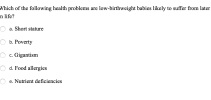 Which of the following health problems are low-birthweight babies likely to suffer from later n life? O a. Short stature 0 b. Poverty O c. Gigantism O d. Food allergies o e. Nutrient deficiencies
e. We have a signal which function is Inoimbo V13 (t) = sin(0.1 2 * t)...
 e. We have a signal which function is Inoimbo V13 (t) = sin(0.1 2 * t) + sin(10 * 2 t) We will design a low-pass filter with cutoff of frequency = 0.5Hz to extract the 0.1Hz signal sin(0.1 * 2 * t) and filter 10HZ noise sin(10 * 2 * t) ). e.1(N) (3 pts) Please find a suitable value of Resistor R(N), where C=1.5915 * 10-6 (F) to implement a cutoff frequency 0.5Hz low-pass filter. e.2(N) (4 pts)...
Problem 1. (15 points each) For the signal f (t) f(t) 3 2 せ - 1...
 Problem 1. (15 points each) For the signal f (t) f(t) 3 2 せ - 1 2 3 a) Describe signal f (t) in a compact form by using unit step functions b) Find and sketch(t) dt
1. Which of the compounds shown below would be the most likely product expected from the...
 1. Which of the compounds shown below would be the most likely
product expected from the reaction scheme shown?
2. Select the expected major product(s) from the treatment of
1-pentyne with 1 equivalent of Br2.
Select one:
a. 1,1-dibromo-1-pentene
b. (E)-1,2-dibromo-1-pentene
c. (Z)-1-bromo-1-pentene
d. A and B
e. B and C
Which of the compounds shown below would be the most likely product expected from the reaction scheme shown? (CH3)2CHCH2CECH ROOR Br 산- Br Br Select one: O a. I...
1. Which of the compounds shown below would be the most likely
product expected from the reaction scheme shown?
2. Select the expected major product(s) from the treatment of
1-pentyne with 1 equivalent of Br2.
Select one:
a. 1,1-dibromo-1-pentene
b. (E)-1,2-dibromo-1-pentene
c. (Z)-1-bromo-1-pentene
d. A and B
e. B and C
Which of the compounds shown below would be the most likely product expected from the reaction scheme shown? (CH3)2CHCH2CECH ROOR Br 산- Br Br Select one: O a. I...
Problem 1 A sinusodial signal x(t)- sin2t (t in seconds) is input to a system with frequency resp...
 Problem 1 A sinusodial signal x(t)- sin2t (t in seconds) is input to a system with frequency response: H(G What signal y(t) is observed at the output? Problem 2 The inverse Fourier transform of a system frequency response is given by h(t)t. The signal x(t) 3 cos(4t 0.5) is input to the system (t in seconds). (a) What is the expression of the signal y(t) at the system output? (b) What is the power attenuation in dB caused by the...
Channel with noise power spectral density Sn (f) 1. No/2 a. Compute the signal to noise ratio (Eb...
 channel with noise power spectral density Sn (f) 1. No/2 a. Compute the signal to noise ratio (Eb/No b. Obtain the optimum matched filter impulse response. c. Assuming equally likely transmission, devise the optimum decision device. d. lextral Compute the probability of error in terms ofy Eb/No- S2(0) S1(t) T t T/27/2 7
channel with noise power spectral density Sn (f) 1. No/2 a. Compute the signal to noise ratio (Eb/No b. Obtain the optimum matched filter impulse response. c....
channel with noise power spectral density Sn (f) 1. No/2 a. Compute the signal to noise ratio (Eb/No b. Obtain the optimum matched filter impulse response. c. Assuming equally likely transmission, devise the optimum decision device. d. lextral Compute the probability of error in terms ofy Eb/No- S2(0) S1(t) T t T/27/2 7
channel with noise power spectral density Sn (f) 1. No/2 a. Compute the signal to noise ratio (Eb/No b. Obtain the optimum matched filter impulse response. c....
 Problem #2 (2 points) ive resistance of 1 MOhm. Calculate the shot noise when using three A system has an effecti different bandwidth oscilloscopes (80 GHz, 200 MHz, and 50 MHz), assuming that the different scopes do not alter the effective resistance Problem #3 (2 points) Which signal is most likely to suffer from 1/noase? Which signal is most likely to suffer from thermal noise? (a) 1Hz (b) 10Hz (c) 100Hz (d) 1kHz
 Solve parts a, b, c, and d
2. Design a differentiator circuit with an input signal that varies in frequency from 100Hz to 1KHz. Follow the differentiator guideline procedure. Select the capacitor value to be 0.1uf. Use the differentiator schematic shown on the next page. a. Draw the complete circuit showing values being used +s b. Write the expression for Vo. c. If a sine wave of 20mvp at a frequency of 1khz is applied to the input circuit. With...
Solve parts a, b, c, and d
2. Design a differentiator circuit with an input signal that varies in frequency from 100Hz to 1KHz. Follow the differentiator guideline procedure. Select the capacitor value to be 0.1uf. Use the differentiator schematic shown on the next page. a. Draw the complete circuit showing values being used +s b. Write the expression for Vo. c. If a sine wave of 20mvp at a frequency of 1khz is applied to the input circuit. With...
 1. Choose the correct answer from the choices given. (2 points) a. Select the most likely answer for the coefficient of linear correlation for the two the number of hours spent studying for a test y = the number of points earned on the test variables described below: x= r= 1.20 B. r 0.70 C. r= -0.85 D. r= 0.05 1. Choose the correct answer from the choices given. (2 points) a. Select the most likely answer for the coefficient...
 Problem 4: A signal x(t) is given mathematically as follows: x(t) = 4.5+ 3.8cos(27 74t - 31/11) - 2 cos(21 296t+1/3) 4.1. Sketch the spectrum of the signal. Is x(t) periodic? If so, what is its fundamental frequency and what are the signal harmonics? Write down the number of each harmonic (0, 1, 2, ... etc) and the frequency of each harmonic. Verify in MATLAB 4.2. A new signal z(t) is created by adding a sinusoidal signal y(t) to x(t)....
 Which of the following health problems are low-birthweight babies likely to suffer from later n life? O a. Short stature 0 b. Poverty O c. Gigantism O d. Food allergies o e. Nutrient deficiencies
 e. We have a signal which function is Inoimbo V13 (t) = sin(0.1 2 * t) + sin(10 * 2 t) We will design a low-pass filter with cutoff of frequency = 0.5Hz to extract the 0.1Hz signal sin(0.1 * 2 * t) and filter 10HZ noise sin(10 * 2 * t) ). e.1(N) (3 pts) Please find a suitable value of Resistor R(N), where C=1.5915 * 10-6 (F) to implement a cutoff frequency 0.5Hz low-pass filter. e.2(N) (4 pts)...
 Problem 1. (15 points each) For the signal f (t) f(t) 3 2 せ - 1 2 3 a) Describe signal f (t) in a compact form by using unit step functions b) Find and sketch(t) dt
 1. Which of the compounds shown below would be the most likely
product expected from the reaction scheme shown?
2. Select the expected major product(s) from the treatment of
1-pentyne with 1 equivalent of Br2.
Select one:
a. 1,1-dibromo-1-pentene
b. (E)-1,2-dibromo-1-pentene
c. (Z)-1-bromo-1-pentene
d. A and B
e. B and C
Which of the compounds shown below would be the most likely product expected from the reaction scheme shown? (CH3)2CHCH2CECH ROOR Br 산- Br Br Select one: O a. I...
1. Which of the compounds shown below would be the most likely
product expected from the reaction scheme shown?
2. Select the expected major product(s) from the treatment of
1-pentyne with 1 equivalent of Br2.
Select one:
a. 1,1-dibromo-1-pentene
b. (E)-1,2-dibromo-1-pentene
c. (Z)-1-bromo-1-pentene
d. A and B
e. B and C
Which of the compounds shown below would be the most likely product expected from the reaction scheme shown? (CH3)2CHCH2CECH ROOR Br 산- Br Br Select one: O a. I...
 Problem 1 A sinusodial signal x(t)- sin2t (t in seconds) is input to a system with frequency response: H(G What signal y(t) is observed at the output? Problem 2 The inverse Fourier transform of a system frequency response is given by h(t)t. The signal x(t) 3 cos(4t 0.5) is input to the system (t in seconds). (a) What is the expression of the signal y(t) at the system output? (b) What is the power attenuation in dB caused by the...
 channel with noise power spectral density Sn (f) 1. No/2 a. Compute the signal to noise ratio (Eb/No b. Obtain the optimum matched filter impulse response. c. Assuming equally likely transmission, devise the optimum decision device. d. lextral Compute the probability of error in terms ofy Eb/No- S2(0) S1(t) T t T/27/2 7
channel with noise power spectral density Sn (f) 1. No/2 a. Compute the signal to noise ratio (Eb/No b. Obtain the optimum matched filter impulse response. c....
channel with noise power spectral density Sn (f) 1. No/2 a. Compute the signal to noise ratio (Eb/No b. Obtain the optimum matched filter impulse response. c. Assuming equally likely transmission, devise the optimum decision device. d. lextral Compute the probability of error in terms ofy Eb/No- S2(0) S1(t) T t T/27/2 7
channel with noise power spectral density Sn (f) 1. No/2 a. Compute the signal to noise ratio (Eb/No b. Obtain the optimum matched filter impulse response. c....
Most questions answered within 3 hours.
-
Where is the error in this code sequence?
String s1 = "Hello";
String s2 = "ello";...
asked 10 months ago -
Financial data for Joel de Paris, Inc., for last year
follow:
Joel de Paris, Inc.
Balance...
asked 10 months ago -
Consider this reaction:
Al2(SO4)3 (aq)+ BaCl3
(aq) Al2Cl6 (aq)- +
3BaSO4(s) . What is the...
asked 10 months ago -
Suppose that Savneet is considering increasing her
recent random sample from 20 car rentals to 40...
asked 10 months ago -
Trucks arrive at an unloading terminal at an average rate of 120
per hour.
Trucks arrive...
asked 10 months ago -
Why are methanol and ethanol completely soluble in water while
octanol is not very little soluble....
asked 10 months ago -
A facilities manager at a university reads in a research report
that the mean amount of...
asked 10 months ago -
When the CuSO4 is rehydrated by adding water to the anhydrous
compound, is this an endothermic...
asked 10 months ago -
A ray of sunlight is passing from diamond into crown glass; the
angle of incidence is...
asked 10 months ago -
A block of mass 0.249 kg is placed on top of a light, vertical
spring of...
asked 10 months ago -
how do the kidneys compensate in the presences of acidosis
a) trigger hyperventilate
b) reserve acid...
asked 10 months ago -
Question 501 pts
The rental rate of capital to the firm increases. Which of the
following...
asked 10 months ago