
Homework Answers
a) To summarise the facts in the question please refer the below table which would give a good understanding.
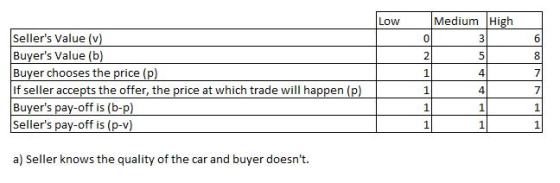
Based on the table the extensive form of the game will be as below.
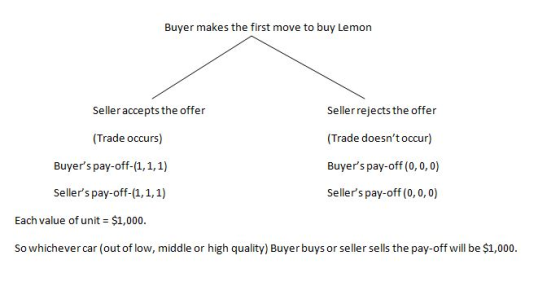
b) The pure strategy under Perfect Bayesian equilibria of the game is shown in the extensive form below. Please refer the table below as other possibilities have also been added.
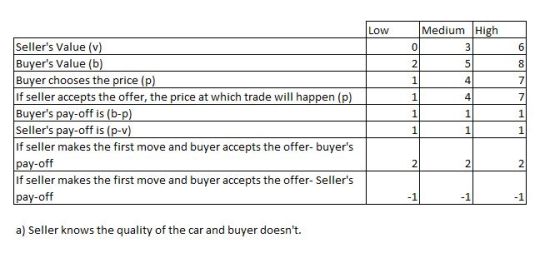
Since the seller would have been in advantage if buyer makes the first move. On gaining one more point on each value buyer's gain would increase by 1 and seller would be in loss.
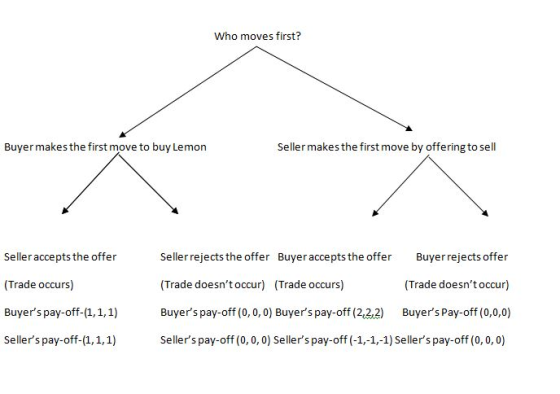
The perfect equilibria will be at (1,1,1),(1,1,1) which is an optimum gain for both buyer and seller.
Add Answer to:
2. (The Dynamic Model of the Market for Lemon) Consider the dynamic version of the model...
1. Buyer-Seller Game. A seller of a used car wants to sell it to a prospective...
 1. Buyer-Seller Game. A seller of a used car wants to sell it to a prospective buyer. The seller first decides whether to repair the car hidden defects or not. Then she decides whether to charge a low price pl or a high price Ph. The buyer does not observe sellers' decision about repairing the car. After being offered a price by the seller, he decides whether to buy the car and pay the price or not. The payoff to...
(Normal to Extensive Form Game) Consider the following pricing game between Bernie's Lemon Fizz and Adam's...
 (Normal to Extensive Form Game) Consider the following pricing game between Bernie's Lemon Fizz and Adam's Orange Zip. Each can set a high, medium, or low price for the drink and their profits are given by the following table: Adam's Orange Zip High Price Medium Price Low Price Bernie's Lemon High Price 650, 300 200, 650 -400, 400 Fizz Medium Price 900, 150 600, 400 100, 100 Low Price 550, -200 400, 50 200, 100 a. What is the Nash...
3. [Normal to Extensive Form Game) Consider the following pricing game between Bernie's Lemon Fizz and...
 3. [Normal to Extensive Form Game) Consider the following pricing game between Bernie's Lemon Fizz and Adam's Orange Zip. Bernie can set a high, medium, or low price for the drink while Adam is only considering a High or Low price, and their profits are given by the following table: Adam's Orange Zip High Price Low Price High Price 650, 300 -400, 400 Bernie's Lemon Medium Price 900, 150 100, 100 Fizz Low Price 550, -200 200, 100 a. What...
3. [Normal to Extensive Form Game) Consider the following pricing game between Bernie's Lemon Fizz and...
 3. [Normal to Extensive Form Game) Consider the following pricing game between Bernie's Lemon Fizz and Adam's Orange Zip. Bernie can set a high, medium, or low price for the drink while Adam is only considering a High or Low price, and their profits are given by the following table: Adam's Orange Zip High Price Low Price High Price 650, 300 -400, 400 Bernie's Lemon Medium Price 900, 150 100, 100 Low Price 550,-200 200, 100 Fizz a. What is...
3. [Normal to Extensive Form Game) Consider the following pricing game between Bernie's Lemon Fizz and...
 3. [Normal to Extensive Form Game) Consider the following pricing game between Bernie's Lemon Fizz and Adam's Orange Zip. Bernie can set a high, medium, or low price for the drink while Adam is only considering a High or Low price, and their profits are given by the following table: Adam's Orange Zip High Price Low Price High Price 650, 300 -400, 400 Bernie's Lemon Fizz Medium Price 900, 150 100, 100 Low Price 550, -200 200, 100 a. What...
Drop down options only low-quality sellers no sellers all types of sellers only high quality sellers...
 Drop down options
only low-quality sellers
no sellers
all types of sellers
only high quality sellers
Consider a market in which there are many potential buyers and sellers of used cars. Each potential seller has one car, which is either of high quality (a plum) or low quality (a lemon). A seller with a low-quality car is willing to sell it for $3,500, whereas a seller with a high-quality car is willing to SALE sell it for $9,000. A buyer...
Drop down options
only low-quality sellers
no sellers
all types of sellers
only high quality sellers
Consider a market in which there are many potential buyers and sellers of used cars. Each potential seller has one car, which is either of high quality (a plum) or low quality (a lemon). A seller with a low-quality car is willing to sell it for $3,500, whereas a seller with a high-quality car is willing to SALE sell it for $9,000. A buyer...
Problem VI: Consider the following dynamic game: An entrant chooses whether to enter the market or...
Problem VI: Consider the following dynamic game: An entrant chooses whether to enter the market or stay out. If he chooses to stay out he will get $0, while the incumbent gets $20. If he enters the market, the entrant and the incumbent play the following simultaneous pricing game: they both choose whether to price high or low. If they both price low, they each get $5. If they both price high, they each get $10. If one prices low...
Seller : $(P-C) Buyer : $(V-P) I have 4 of these to do so if you could include how its done that would be great!!...
 Seller : $(P-C)
Buyer : $(V-P)
I have 4 of these to do so if you could include how its done
that would be great!!
Session / Round 2 We are trading again under the roles and values specified for Session 1. There are no changes This round is to let you learn from what happened in the first round. Buyer's Profit Total Profit 800 Table 3: Transactions and Outcomes for Session 1 Round 2 Transaction Price Seller Cost Buyer...
Seller : $(P-C)
Buyer : $(V-P)
I have 4 of these to do so if you could include how its done
that would be great!!
Session / Round 2 We are trading again under the roles and values specified for Session 1. There are no changes This round is to let you learn from what happened in the first round. Buyer's Profit Total Profit 800 Table 3: Transactions and Outcomes for Session 1 Round 2 Transaction Price Seller Cost Buyer...
Consider a used-car market with asymmetric information. The owners of used cars know what their vehicles...
 Consider a used-car market with asymmetric information. The owners of used cars know what their vehicles are worth but have no way of credibly demonstrating those values to potential buyers. Thus, potential buyers must always worry that the used car they are being offered may be a low-quality "lemon." Instructions: Enter your answers as whole numbers. a. Suppose that there are equal numbers of good and bad used cars in the market and that good used cars are worth $13,000 while bad...
can someone explain how to work out part b *edit*: better picture 1. Consider the market for used cars shown in the figure below. The left panel (a) shows the market for low-quality cars (lemo...
 can someone explain how to work out part b
*edit*: better picture
1. Consider the market for used cars shown in the figure below. The left panel (a) shows the market for low-quality cars (lemons); the right panel (b) shows the market for high-quality cars (plums). If all buyers and sellers had full information about the quality of automobiles being offered for sale, lemons would sell for $8,000 and plums would sell for $16,000. Price,() (S/car) (a) Lemons (b) Plums...
can someone explain how to work out part b
*edit*: better picture
1. Consider the market for used cars shown in the figure below. The left panel (a) shows the market for low-quality cars (lemons); the right panel (b) shows the market for high-quality cars (plums). If all buyers and sellers had full information about the quality of automobiles being offered for sale, lemons would sell for $8,000 and plums would sell for $16,000. Price,() (S/car) (a) Lemons (b) Plums...
 1. Buyer-Seller Game. A seller of a used car wants to sell it to a prospective buyer. The seller first decides whether to repair the car hidden defects or not. Then she decides whether to charge a low price pl or a high price Ph. The buyer does not observe sellers' decision about repairing the car. After being offered a price by the seller, he decides whether to buy the car and pay the price or not. The payoff to...
 (Normal to Extensive Form Game) Consider the following pricing game between Bernie's Lemon Fizz and Adam's Orange Zip. Each can set a high, medium, or low price for the drink and their profits are given by the following table: Adam's Orange Zip High Price Medium Price Low Price Bernie's Lemon High Price 650, 300 200, 650 -400, 400 Fizz Medium Price 900, 150 600, 400 100, 100 Low Price 550, -200 400, 50 200, 100 a. What is the Nash...
 3. [Normal to Extensive Form Game) Consider the following pricing game between Bernie's Lemon Fizz and Adam's Orange Zip. Bernie can set a high, medium, or low price for the drink while Adam is only considering a High or Low price, and their profits are given by the following table: Adam's Orange Zip High Price Low Price High Price 650, 300 -400, 400 Bernie's Lemon Medium Price 900, 150 100, 100 Fizz Low Price 550, -200 200, 100 a. What...
 3. [Normal to Extensive Form Game) Consider the following pricing game between Bernie's Lemon Fizz and Adam's Orange Zip. Bernie can set a high, medium, or low price for the drink while Adam is only considering a High or Low price, and their profits are given by the following table: Adam's Orange Zip High Price Low Price High Price 650, 300 -400, 400 Bernie's Lemon Medium Price 900, 150 100, 100 Low Price 550,-200 200, 100 Fizz a. What is...
 3. [Normal to Extensive Form Game) Consider the following pricing game between Bernie's Lemon Fizz and Adam's Orange Zip. Bernie can set a high, medium, or low price for the drink while Adam is only considering a High or Low price, and their profits are given by the following table: Adam's Orange Zip High Price Low Price High Price 650, 300 -400, 400 Bernie's Lemon Fizz Medium Price 900, 150 100, 100 Low Price 550, -200 200, 100 a. What...
 Drop down options
only low-quality sellers
no sellers
all types of sellers
only high quality sellers
Consider a market in which there are many potential buyers and sellers of used cars. Each potential seller has one car, which is either of high quality (a plum) or low quality (a lemon). A seller with a low-quality car is willing to sell it for $3,500, whereas a seller with a high-quality car is willing to SALE sell it for $9,000. A buyer...
Drop down options
only low-quality sellers
no sellers
all types of sellers
only high quality sellers
Consider a market in which there are many potential buyers and sellers of used cars. Each potential seller has one car, which is either of high quality (a plum) or low quality (a lemon). A seller with a low-quality car is willing to sell it for $3,500, whereas a seller with a high-quality car is willing to SALE sell it for $9,000. A buyer...
 Seller : $(P-C)
Buyer : $(V-P)
I have 4 of these to do so if you could include how its done
that would be great!!
Session / Round 2 We are trading again under the roles and values specified for Session 1. There are no changes This round is to let you learn from what happened in the first round. Buyer's Profit Total Profit 800 Table 3: Transactions and Outcomes for Session 1 Round 2 Transaction Price Seller Cost Buyer...
Seller : $(P-C)
Buyer : $(V-P)
I have 4 of these to do so if you could include how its done
that would be great!!
Session / Round 2 We are trading again under the roles and values specified for Session 1. There are no changes This round is to let you learn from what happened in the first round. Buyer's Profit Total Profit 800 Table 3: Transactions and Outcomes for Session 1 Round 2 Transaction Price Seller Cost Buyer...
 Consider a used-car market with asymmetric information. The owners of used cars know what their vehicles are worth but have no way of credibly demonstrating those values to potential buyers. Thus, potential buyers must always worry that the used car they are being offered may be a low-quality "lemon." Instructions: Enter your answers as whole numbers. a. Suppose that there are equal numbers of good and bad used cars in the market and that good used cars are worth $13,000 while bad...
 can someone explain how to work out part b
*edit*: better picture
1. Consider the market for used cars shown in the figure below. The left panel (a) shows the market for low-quality cars (lemons); the right panel (b) shows the market for high-quality cars (plums). If all buyers and sellers had full information about the quality of automobiles being offered for sale, lemons would sell for $8,000 and plums would sell for $16,000. Price,() (S/car) (a) Lemons (b) Plums...
can someone explain how to work out part b
*edit*: better picture
1. Consider the market for used cars shown in the figure below. The left panel (a) shows the market for low-quality cars (lemons); the right panel (b) shows the market for high-quality cars (plums). If all buyers and sellers had full information about the quality of automobiles being offered for sale, lemons would sell for $8,000 and plums would sell for $16,000. Price,() (S/car) (a) Lemons (b) Plums...
Most questions answered within 3 hours.
-
Where is the error in this code sequence?
String s1 = "Hello";
String s2 = "ello";...
asked 11 months ago -
Financial data for Joel de Paris, Inc., for last year
follow:
Joel de Paris, Inc.
Balance...
asked 11 months ago -
Consider this reaction:
Al2(SO4)3 (aq)+ BaCl3
(aq) Al2Cl6 (aq)- +
3BaSO4(s) . What is the...
asked 11 months ago -
Suppose that Savneet is considering increasing her
recent random sample from 20 car rentals to 40...
asked 11 months ago -
Trucks arrive at an unloading terminal at an average rate of 120
per hour.
Trucks arrive...
asked 11 months ago -
Why are methanol and ethanol completely soluble in water while
octanol is not very little soluble....
asked 11 months ago -
A facilities manager at a university reads in a research report
that the mean amount of...
asked 11 months ago -
When the CuSO4 is rehydrated by adding water to the anhydrous
compound, is this an endothermic...
asked 11 months ago -
A ray of sunlight is passing from diamond into crown glass; the
angle of incidence is...
asked 11 months ago -
A block of mass 0.249 kg is placed on top of a light, vertical
spring of...
asked 11 months ago -
how do the kidneys compensate in the presences of acidosis
a) trigger hyperventilate
b) reserve acid...
asked 11 months ago -
Question 501 pts
The rental rate of capital to the firm increases. Which of the
following...
asked 11 months ago