
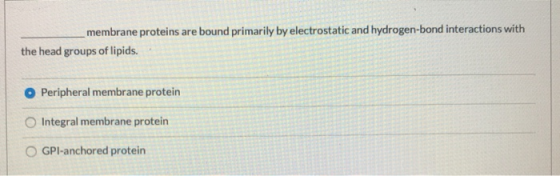


membrane proteins are bound primarily by electrostatic and hydrogen-bond interactions with the head groups of lipids. Peripheral membrane protein O Integral membrane protein GPI-anchored protein
An antiporter and a symporter are examples of: passive diffusion Osecondary active transport O primary active transporters
is the movement of a single solute across a membrane, through a carrier protein, powered by a chemical gradient. O Active transport Facilitated diffusion O Simple diffusion Passive diffusion None of the given choices
Which of the following is selective for solute? (Select any/all that apply) Protein pump O Channel protein O None of the given choices Carrier protein
Which of the following type(s) of transport requires the transport protein to change conformation? (Select any/all that apply) Protein pump Channel protein Carrier protein
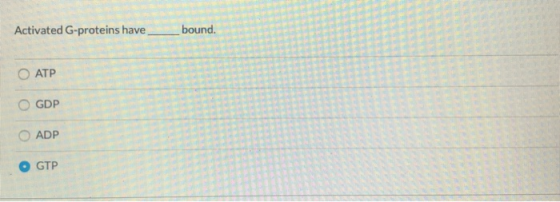
Activated G-proteins have bound. ATP GDP ADP GTP
Homework Answers
Answer 1
GPI anchored protien.
Gycophosphatidylinositol, or GPI in short, is a glycolipid that can be attached to the C-terminus of a protein during posttranslational modification.
Answer 5
Channel protien
Carrier protien
Protien pump.
All of which help to transport substance across the plasma membrane.
Answer 6
Carrier protien.
Add Answer to:
NH HO HO Man Protein HO HO- Man or What type of membrane protein is shown...
1.Select 5-10 of the following vocabulary terms located near the bottom of the document. 2.. show...
1.Select 5-10 of the following vocabulary terms located near the bottom of the document. 2.. show how you relate the terms to one another (write down to the piece paper) 3. Prepare a short-written justification for your arrangement that explains how the terms are related. Vocabulary terms - Membrane, Permeability ,Phospholipid ,Cholesterol, Glycosylation ,Hydrophobic ,Hydrophilic ,Amphiphilic, Lipid bilayer, Peripheral proteins, Integral proteins, Fluidity, Channel, protein ,Concentration, gradient, Diffusion Facilitated transport Hypertonic Hypotonic Isotonic Osmosis Plasmolysis Passive transport Transport protein Solute...
Which type of membrane transport protein can perform either passive or active transport? Choose one: A....
 Which type of membrane transport protein can perform either passive or active transport? Choose one: A. transporters B. channels C. both channels and transporters D. Neither type of membrane transport protein can perform both passive and active transport.
Matching protein kinase :pinocytosis Na-K pump : Paracrine A. long-distance long term signaling B. cholestero C....
 Matching protein kinase :pinocytosis Na-K pump : Paracrine A. long-distance long term signaling B. cholestero C. facilitated diffusion D. Steroid hormone E. uses ATP and works against concentration F active transport example G local short term signaling H. liquid droplet internalization L phosphorylation J. associated with one monolayer Endocrine .channel and carrier protein regulates membrane fluidity : active transport intracellular receptor :peripheral protein
Membrane Transport 1. What is the difference between a carrier and a channel? 2. What are...
Membrane Transport 1. What is the difference between a carrier and a channel? 2. What are the two ways energy can be coupled to active transporters? 3. What are the driving forces behind solute transport? Consider charged and uncharged solutes separately.
WORD BANK For each of the following sentences, fill in the blanks with the best word...
 WORD BANK
For each of the following sentences, fill in the blanks with the best word or phrase selected from the list below. Not all words or phrases will be used; each word or phrase should be used only once. _ pathway th Transporter proteins and ion channels function in membrane transport by providing a _pathway through the membrane for specific polar solutes or inorganic ions. A _2__ is highly selective in the solute it transports, binding the solute at...
WORD BANK
For each of the following sentences, fill in the blanks with the best word or phrase selected from the list below. Not all words or phrases will be used; each word or phrase should be used only once. _ pathway th Transporter proteins and ion channels function in membrane transport by providing a _pathway through the membrane for specific polar solutes or inorganic ions. A _2__ is highly selective in the solute it transports, binding the solute at...
Not all words or phrases will be used. Each word or phrase should be used only...
 Not all words or phrases will be used. Each word or phrase
should be used only once:
membrane potential, free diffusion, hydrophilic, transporter
protein, facilitated diffusion, active transport, concentration,
hydrophobic, noncovalent, amino acid, symport, amphipathic, ion
channel, passive transport, passive, light driven.
For each of the following sentences, fill in the blanks with the best word or phrase selected from the list below. Not all words or phrases will be used; each word or phrase should be used only once....
Not all words or phrases will be used. Each word or phrase
should be used only once:
membrane potential, free diffusion, hydrophilic, transporter
protein, facilitated diffusion, active transport, concentration,
hydrophobic, noncovalent, amino acid, symport, amphipathic, ion
channel, passive transport, passive, light driven.
For each of the following sentences, fill in the blanks with the best word or phrase selected from the list below. Not all words or phrases will be used; each word or phrase should be used only once....
Why are biological membranes considered to be “fluid mosaics”? - Discuss two factors that may determine...
Why are biological membranes considered to be “fluid mosaics”? - Discuss two factors that may determine membrane fluidity. - Draw labeled diagrams to illustrate: the Fluid-mosaic model of biological membranes three types of transport proteins - How does ATP provide chemical energy for active transport? - Discuss similarities and differences between any of the following pairs: soluble (globular) proteins vs. integral membrane proteins ,channel proteins vs. carrier proteins, active transport vs. facilitated diffusion ion pumps vs. ion channels and endocytosis...
can i have some help filling in the rest of the table/ making sure what i...
 can i have some help filling in the rest of the table/ making
sure what i have is correct?
3. Fill out the table below for each of the different modes of transportation into/out of a cell. Is there a gradient? If Requires a protein? If Give an example of this yes, indicate the yes, what type? mode of transportation direction H>L or L>H (be specific). Simple Diffusion high low passive transport Osmosis high low Facilitated diffusion using low high...
can i have some help filling in the rest of the table/ making
sure what i have is correct?
3. Fill out the table below for each of the different modes of transportation into/out of a cell. Is there a gradient? If Requires a protein? If Give an example of this yes, indicate the yes, what type? mode of transportation direction H>L or L>H (be specific). Simple Diffusion high low passive transport Osmosis high low Facilitated diffusion using low high...
Match the following: Integral (intrinsic) membrane proteins Transmembrane protein Porins C-- Lipid-linked proteins Peri...
 Match the following: Integral (intrinsic) membrane proteins Transmembrane protein Porins C-- Lipid-linked proteins Peripheral (extrinsic) proteins 1. Channel-forming proteins found in the outer membranes of bacteria, with a beta-barrel motif. 2. Proteins that are associated with membranes, but can be dissociated by relatively mild procedures. 3. Proteins that completely span the membrane. 4. A general class of proteins that are tightly bound to membranes by hydrophobic interactions. 5. Membrane-associated proteins that have covalently-bonded lipids.
How does facilitated diffusion differ from simple diffusion? Facilitated diffusion requires ATP Facilitated diffusion requires a...
How does facilitated diffusion differ from simple diffusion? Facilitated diffusion requires ATP Facilitated diffusion requires a solute-specific protein carrier Facilitated diffusion transports solute against its’ concentration gradient Which of the following is TRUE about primary active cell membrane transport? It is a form of transport that requires a protein “pump” It is a form of transport that transports ions and/or solute against their concentration gradient It is a transport mechanism that requires energy released from the splitting of ATP by...
 Which type of membrane transport protein can perform either passive or active transport? Choose one: A. transporters B. channels C. both channels and transporters D. Neither type of membrane transport protein can perform both passive and active transport.
 Matching protein kinase :pinocytosis Na-K pump : Paracrine A. long-distance long term signaling B. cholestero C. facilitated diffusion D. Steroid hormone E. uses ATP and works against concentration F active transport example G local short term signaling H. liquid droplet internalization L phosphorylation J. associated with one monolayer Endocrine .channel and carrier protein regulates membrane fluidity : active transport intracellular receptor :peripheral protein
 WORD BANK
For each of the following sentences, fill in the blanks with the best word or phrase selected from the list below. Not all words or phrases will be used; each word or phrase should be used only once. _ pathway th Transporter proteins and ion channels function in membrane transport by providing a _pathway through the membrane for specific polar solutes or inorganic ions. A _2__ is highly selective in the solute it transports, binding the solute at...
WORD BANK
For each of the following sentences, fill in the blanks with the best word or phrase selected from the list below. Not all words or phrases will be used; each word or phrase should be used only once. _ pathway th Transporter proteins and ion channels function in membrane transport by providing a _pathway through the membrane for specific polar solutes or inorganic ions. A _2__ is highly selective in the solute it transports, binding the solute at...
 Not all words or phrases will be used. Each word or phrase
should be used only once:
membrane potential, free diffusion, hydrophilic, transporter
protein, facilitated diffusion, active transport, concentration,
hydrophobic, noncovalent, amino acid, symport, amphipathic, ion
channel, passive transport, passive, light driven.
For each of the following sentences, fill in the blanks with the best word or phrase selected from the list below. Not all words or phrases will be used; each word or phrase should be used only once....
Not all words or phrases will be used. Each word or phrase
should be used only once:
membrane potential, free diffusion, hydrophilic, transporter
protein, facilitated diffusion, active transport, concentration,
hydrophobic, noncovalent, amino acid, symport, amphipathic, ion
channel, passive transport, passive, light driven.
For each of the following sentences, fill in the blanks with the best word or phrase selected from the list below. Not all words or phrases will be used; each word or phrase should be used only once....
 can i have some help filling in the rest of the table/ making
sure what i have is correct?
3. Fill out the table below for each of the different modes of transportation into/out of a cell. Is there a gradient? If Requires a protein? If Give an example of this yes, indicate the yes, what type? mode of transportation direction H>L or L>H (be specific). Simple Diffusion high low passive transport Osmosis high low Facilitated diffusion using low high...
can i have some help filling in the rest of the table/ making
sure what i have is correct?
3. Fill out the table below for each of the different modes of transportation into/out of a cell. Is there a gradient? If Requires a protein? If Give an example of this yes, indicate the yes, what type? mode of transportation direction H>L or L>H (be specific). Simple Diffusion high low passive transport Osmosis high low Facilitated diffusion using low high...
 Match the following: Integral (intrinsic) membrane proteins Transmembrane protein Porins C-- Lipid-linked proteins Peripheral (extrinsic) proteins 1. Channel-forming proteins found in the outer membranes of bacteria, with a beta-barrel motif. 2. Proteins that are associated with membranes, but can be dissociated by relatively mild procedures. 3. Proteins that completely span the membrane. 4. A general class of proteins that are tightly bound to membranes by hydrophobic interactions. 5. Membrane-associated proteins that have covalently-bonded lipids.
Most questions answered within 3 hours.
-
Where is the error in this code sequence?
String s1 = "Hello";
String s2 = "ello";...
asked 11 months ago -
Financial data for Joel de Paris, Inc., for last year
follow:
Joel de Paris, Inc.
Balance...
asked 11 months ago -
Consider this reaction:
Al2(SO4)3 (aq)+ BaCl3
(aq) Al2Cl6 (aq)- +
3BaSO4(s) . What is the...
asked 11 months ago -
Suppose that Savneet is considering increasing her
recent random sample from 20 car rentals to 40...
asked 11 months ago -
Trucks arrive at an unloading terminal at an average rate of 120
per hour.
Trucks arrive...
asked 11 months ago -
Why are methanol and ethanol completely soluble in water while
octanol is not very little soluble....
asked 11 months ago -
A facilities manager at a university reads in a research report
that the mean amount of...
asked 11 months ago -
When the CuSO4 is rehydrated by adding water to the anhydrous
compound, is this an endothermic...
asked 11 months ago -
A ray of sunlight is passing from diamond into crown glass; the
angle of incidence is...
asked 11 months ago -
A block of mass 0.249 kg is placed on top of a light, vertical
spring of...
asked 11 months ago -
how do the kidneys compensate in the presences of acidosis
a) trigger hyperventilate
b) reserve acid...
asked 11 months ago -
Question 501 pts
The rental rate of capital to the firm increases. Which of the
following...
asked 11 months ago