


Homework Answers
 please
upvote if it helps
please
upvote if it helps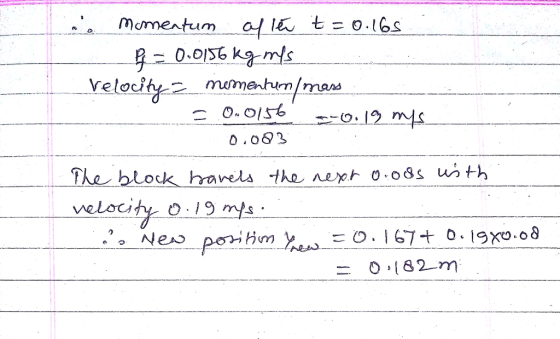
Add Answer to:
Extra 2.6.07 (Multistep) Use the exact values you enter to make later calculations. Push down, from...
"Extra 2.6.07 (Multistep) Use the exact values you enter to make later calculations. Push down, Relaxed...
 "Extra 2.6.07 (Multistep) Use the exact values you enter to make later calculations. Push down, Relaxed ; length release from rest A spring has a relaxed length of 29 cm (0.29 m) and its spring stiffness is 6 N/m. You glue a 76 gram block (0.076 kg) to the top of the spring, and push the block down, compressing the spring so its total length is 16 cm. You make sure the block is at rest, then at time t...
A spring has a relaxed length of 36 cm (0.36 m) and its spring stiffness is...
 A spring has a relaxed length of 36 cm (0.36 m) and its spring stiffness is 9 N/m. You glue a 83 gram block (0.083 kg) to the top of the spring, and push the block down, compressing the spring so its total length is 19 cm. You make sure the block is at rest, then at time t = 0 you quickly move your hand away、The block begins to move upward, because the upward forc.e on th€ block by...
STEP 1 Force: Just after releasing the block, calculate the force exerted on the block by...
 STEP 1 Force: Just after releasing the block, calculate the force exerted on the block by the spring, the force exerted on the block by the Earth, and the net force: spring,r# 2.64 Earthy-6769 net.y - 1.96 0.676N 1.96 N Momentum update: Just after releasing the block, the momentum of the block is zero. Approximate the average net force during the next timel by the force you just calculated. At t0.07 seconds, what will the new momentum and velocity of...
Use the exact values you enter to make later calculations. A group of students performed the...
Use the exact values you enter to make later calculations. A group of students performed the same "Newton's Second Law" experiment that you did in class. For this lab, assume g = 9.81 m/s2. They obtained the following results: m1(kg) t1(s) v1(m/s) t2(s) v2(m/s) 0.050 1.2000 0.2500 1.7279 0.5177 0.100 1.2300 0.3240 1.6064 0.7186 0.150 1.1500 0.3820 1.4591 0.9120 0.200 1.1100 0.4240 1.3806 1.0839 where m1 is the value of the hanging mass (including the mass of the hanger), v1...
Use the exact values you enter to make later calculations. A group of students performed the...
Use the exact values you enter to make later calculations. A group of students performed the same "Newton's Second Law" experiment that you did in class. For this lab, assume g = 9.81 m/s2. They obtained the following results: m1(kg) t1(s) v1(m/s) t2(s) v2(m/s) 0.050 1.2000 0.2500 1.8108 0.3849 0.100 1.2300 0.3240 1.6360 0.6412 0.150 1.1500 0.3820 1.4768 0.8120 0.200 1.1100 0.4240 1.3935 1.0067 where m1 is the value of the hanging mass (including the mass of the hanger), v1...
Please help. Show work. Use the exact values you enter to make later calculations A ray...
 Please help. Show work.
Use the exact values you enter to make later calculations A ray of light strikes a flat, 2.00-cm-thick block of glass (n-1.67) at an angle of θ-40.0° with respect to the normal (see figure below). 2.00 cm (a) Find the angle of refraction at the top surface and the angle of incidence at the bottom surface. 6 638 Your response differs from the correct answer by more than 10%. Double check your calculations. (b) Find the...
Please help. Show work.
Use the exact values you enter to make later calculations A ray of light strikes a flat, 2.00-cm-thick block of glass (n-1.67) at an angle of θ-40.0° with respect to the normal (see figure below). 2.00 cm (a) Find the angle of refraction at the top surface and the angle of incidence at the bottom surface. 6 638 Your response differs from the correct answer by more than 10%. Double check your calculations. (b) Find the...
Use the exact values you enter to make later calculations. A uniformly accelerated car passes three...
Use the exact values you enter to make later calculations. A uniformly accelerated car passes three equally spaced traffic signs. The signs are separated by a distance d = 21 m. The car passes the first sign at t = 1.3 s, the second sign at t = 3.7 s, and the third sign at t = 5.5 s. (a) What is the magnitude of the average velocity of the car during the time that it is moving between the...
Problem 3.29 Astar ofmass 6 x1000 kg is located at <6 x ío» 5x10a, o> m....
 Problem 3.29 Astar ofmass 6 x1000 kg is located at <6 x ío» 5x10a, o> m. A planet of mass 9 × iO24 kg s located at eston 10x10ao, m and is me 0> m/s. yofea nofil nr. ng w haves (a) During a time interval of 1 10 seconds, what is the change in the planet's velocity? m/s (b) During this time interval of 1 x 10⁶ seconds, what is the change in the planet's position? (e) why are...
Problem 3.29 A star of mass 6 x 1030 kg is located at <6 x 10¹²,...
 Problem 3.29 A star of mass 6 x 1030 kg is located at <6 x 10¹², 4 x 10¹², 0> m. A planet of mass 2 x 1024 kg is located at <5 x 10¹², 9 x 10¹², 0> m and is moving with a velocity of <0.5 x 10⁴, 1.4 x 10⁴, 0> m/s. (a) During a time interval of 1 x 10° seconds, what is the change in the planet's velocity? > m/s (b) During this time interval...
 "Extra 2.6.07 (Multistep) Use the exact values you enter to make later calculations. Push down, Relaxed ; length release from rest A spring has a relaxed length of 29 cm (0.29 m) and its spring stiffness is 6 N/m. You glue a 76 gram block (0.076 kg) to the top of the spring, and push the block down, compressing the spring so its total length is 16 cm. You make sure the block is at rest, then at time t...
 A spring has a relaxed length of 36 cm (0.36 m) and its spring stiffness is 9 N/m. You glue a 83 gram block (0.083 kg) to the top of the spring, and push the block down, compressing the spring so its total length is 19 cm. You make sure the block is at rest, then at time t = 0 you quickly move your hand away、The block begins to move upward, because the upward forc.e on th€ block by...
 STEP 1 Force: Just after releasing the block, calculate the force exerted on the block by the spring, the force exerted on the block by the Earth, and the net force: spring,r# 2.64 Earthy-6769 net.y - 1.96 0.676N 1.96 N Momentum update: Just after releasing the block, the momentum of the block is zero. Approximate the average net force during the next timel by the force you just calculated. At t0.07 seconds, what will the new momentum and velocity of...
 Please help. Show work.
Use the exact values you enter to make later calculations A ray of light strikes a flat, 2.00-cm-thick block of glass (n-1.67) at an angle of θ-40.0° with respect to the normal (see figure below). 2.00 cm (a) Find the angle of refraction at the top surface and the angle of incidence at the bottom surface. 6 638 Your response differs from the correct answer by more than 10%. Double check your calculations. (b) Find the...
Please help. Show work.
Use the exact values you enter to make later calculations A ray of light strikes a flat, 2.00-cm-thick block of glass (n-1.67) at an angle of θ-40.0° with respect to the normal (see figure below). 2.00 cm (a) Find the angle of refraction at the top surface and the angle of incidence at the bottom surface. 6 638 Your response differs from the correct answer by more than 10%. Double check your calculations. (b) Find the...
 Problem 3.29 Astar ofmass 6 x1000 kg is located at <6 x ío» 5x10a, o> m. A planet of mass 9 × iO24 kg s located at eston 10x10ao, m and is me 0> m/s. yofea nofil nr. ng w haves (a) During a time interval of 1 10 seconds, what is the change in the planet's velocity? m/s (b) During this time interval of 1 x 10⁶ seconds, what is the change in the planet's position? (e) why are...
 Problem 3.29 A star of mass 6 x 1030 kg is located at <6 x 10¹², 4 x 10¹², 0> m. A planet of mass 2 x 1024 kg is located at <5 x 10¹², 9 x 10¹², 0> m and is moving with a velocity of <0.5 x 10⁴, 1.4 x 10⁴, 0> m/s. (a) During a time interval of 1 x 10° seconds, what is the change in the planet's velocity? > m/s (b) During this time interval...
Most questions answered within 3 hours.
-
Where is the error in this code sequence?
String s1 = "Hello";
String s2 = "ello";...
asked 10 months ago -
Financial data for Joel de Paris, Inc., for last year
follow:
Joel de Paris, Inc.
Balance...
asked 10 months ago -
Consider this reaction:
Al2(SO4)3 (aq)+ BaCl3
(aq) Al2Cl6 (aq)- +
3BaSO4(s) . What is the...
asked 10 months ago -
Suppose that Savneet is considering increasing her
recent random sample from 20 car rentals to 40...
asked 10 months ago -
Trucks arrive at an unloading terminal at an average rate of 120
per hour.
Trucks arrive...
asked 10 months ago -
Why are methanol and ethanol completely soluble in water while
octanol is not very little soluble....
asked 10 months ago -
A facilities manager at a university reads in a research report
that the mean amount of...
asked 10 months ago -
When the CuSO4 is rehydrated by adding water to the anhydrous
compound, is this an endothermic...
asked 10 months ago -
A ray of sunlight is passing from diamond into crown glass; the
angle of incidence is...
asked 10 months ago -
A block of mass 0.249 kg is placed on top of a light, vertical
spring of...
asked 10 months ago -
how do the kidneys compensate in the presences of acidosis
a) trigger hyperventilate
b) reserve acid...
asked 10 months ago -
Question 501 pts
The rental rate of capital to the firm increases. Which of the
following...
asked 10 months ago