
Homework Answers

Add Answer to:
at the origin that is plate of plate 0-2.0 mm. r the potential difference between the...
The figure below shows an electron at the origin that is released with initial speed vo...
 The figure below shows an electron at the origin that is released with initial speed vo = 3.1 106 m/s at an angle θ。= 45° between the plates of a parallel plate capacitor of plate separation D = 2.0 mm. If the potential difference between the plates is Δν 160 V, calculate the closest proximity, d, of the electron to the bottom plate (in mm) D 0 0o 0
The figure below shows an electron at the origin that is released with initial speed vo...
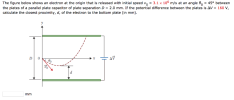 The figure below shows an electron at the origin that is released with initial speed vo = 3.1 106 m/s at an angle θ。= 45° between the plates of a parallel plate capacitor of plate separation D = 2.0 mm. If the potential difference between the plates is Δν 160 V, calculate the closest proximity, d, of the electron to the bottom plate (in mm) D 0 0o 0
17 P The figure below shows an electron at the origin that is released with initial...
 17 P The figure below shows an electron at the origin that is released with initial speed vo4 plate separation D -2.0 mm. If the potential difference plate separation D-2.0 mm. If the potential difference between the plates is aV - 125 V, calculate the closest proximity, d, of the electron to the bottom m/s at an angle 80 45 the plates of a parallel plate capacitor of
The figure below shows an electron at the origin that is released with initial speed v0...
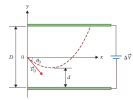 The figure below shows an electron at the origin that is
released with initial speed v0 = 3.5 ✕ 106 m/s at an angle θ0 = 45°
between the plates of a parallel plate capacitor of plate
separation D = 2.0 mm. If the potential difference between the
plates is ΔV = 185 V, calculate the closest proximity, d, of the
electron to the bottom plate (in mm).
The figure below shows an electron at the origin that is
released with initial speed v0 = 3.5 ✕ 106 m/s at an angle θ0 = 45°
between the plates of a parallel plate capacitor of plate
separation D = 2.0 mm. If the potential difference between the
plates is ΔV = 185 V, calculate the closest proximity, d, of the
electron to the bottom plate (in mm).
Suppose that a parallel-plate capacitor has circular plates with radius R = 37 mm and a...
Suppose that a parallel-plate capacitor has circular plates with radius R = 37 mm and a plate separation of 6.8 mm. Suppose also that a sinusoidal potential difference with a maximum value of 120 V and a frequency of 47 Hz is applied across the plates; that is, V = (120 V) sin[2π(47 Hz)t]. Find Bmax(R), the maximum value of the induced magnetic field that occurs at r = R.
Oppositely charged parallel plates are separated by 3.53 mm. A potential difference of 600 V exists...
Oppositely charged parallel plates are separated by 3.53 mm. A potential difference of 600 V exists between the plates. (a) What is the magnitude of the electric field between the plates? (b) What is the magnitude of the force on an electron between the plates? (c) How much work must be done on the electron to move it to the negative plate if it is initially positioned 2.72 mm from the positive plate?
Oppositely charged parallel plates are separated by 6.50 mm. A potential difference of 600 V exists...
 Oppositely charged parallel plates are separated by 6.50 mm. A potential difference of 600 V exists between the plates. (a) What is the magnitude of the electric field between the plates? N/C (b) What is the magnitude of the force on an electron between the plates? (c) How much work must be done on the electron to move it to the negative plate if it is initially positioned 2.98 mm from the positive plate?
A)A pair of oppositely charged parallel plates is separated by 5.52 mm. A potential difference of...
A)A pair of oppositely charged parallel plates is separated by 5.52 mm. A potential difference of 610 V exists between the plates. What is the strength of the electric field between the plates? The fundamental charge is 1.602 × 10⁻¹⁹ . Answer in units of V/m. B)What is the magnitude of the force on an electron between the plates? Answer in units of N. C)How much work must be done on the electron to move it to the negative plate...
Oppositely charged parallel plates are separated by 5.31 mm. A potential difference of 600 V exists...
Oppositely charged parallel plates are separated by 5.31 mm. A potential difference of 600 V exists between the plates. (a) What is the magnitude of the electric field between the plates? N/C (b) What is the magnitude of the force on an electron between the plates? N (c) How much work must be done on the electron to move it to the negative plate if it is initially positioned 2.95 mm from the positive plate? J
Oppositely charged parallel plates are separated by 3.95 mm. A potential difference of 600 V exists...
 Oppositely charged parallel plates are separated by 3.95 mm. A potential difference of 600 V exists between the plates. (a) What is the magnitude of the electric field between the plates? ______ N/C (b) What is the magnitude of the force on an electron between the plates? _______N (c) How much work must be done on the electron to move it to the negative plate if it is initially positioned 3.08 mm from the positive plate? _________ J
 The figure below shows an electron at the origin that is released with initial speed vo = 3.1 106 m/s at an angle θ。= 45° between the plates of a parallel plate capacitor of plate separation D = 2.0 mm. If the potential difference between the plates is Δν 160 V, calculate the closest proximity, d, of the electron to the bottom plate (in mm) D 0 0o 0
 The figure below shows an electron at the origin that is released with initial speed vo = 3.1 106 m/s at an angle θ。= 45° between the plates of a parallel plate capacitor of plate separation D = 2.0 mm. If the potential difference between the plates is Δν 160 V, calculate the closest proximity, d, of the electron to the bottom plate (in mm) D 0 0o 0
 17 P The figure below shows an electron at the origin that is released with initial speed vo4 plate separation D -2.0 mm. If the potential difference plate separation D-2.0 mm. If the potential difference between the plates is aV - 125 V, calculate the closest proximity, d, of the electron to the bottom m/s at an angle 80 45 the plates of a parallel plate capacitor of
 The figure below shows an electron at the origin that is
released with initial speed v0 = 3.5 ✕ 106 m/s at an angle θ0 = 45°
between the plates of a parallel plate capacitor of plate
separation D = 2.0 mm. If the potential difference between the
plates is ΔV = 185 V, calculate the closest proximity, d, of the
electron to the bottom plate (in mm).
The figure below shows an electron at the origin that is
released with initial speed v0 = 3.5 ✕ 106 m/s at an angle θ0 = 45°
between the plates of a parallel plate capacitor of plate
separation D = 2.0 mm. If the potential difference between the
plates is ΔV = 185 V, calculate the closest proximity, d, of the
electron to the bottom plate (in mm).
 Oppositely charged parallel plates are separated by 6.50 mm. A potential difference of 600 V exists between the plates. (a) What is the magnitude of the electric field between the plates? N/C (b) What is the magnitude of the force on an electron between the plates? (c) How much work must be done on the electron to move it to the negative plate if it is initially positioned 2.98 mm from the positive plate?
 Oppositely charged parallel plates are separated by 3.95 mm. A potential difference of 600 V exists between the plates. (a) What is the magnitude of the electric field between the plates? ______ N/C (b) What is the magnitude of the force on an electron between the plates? _______N (c) How much work must be done on the electron to move it to the negative plate if it is initially positioned 3.08 mm from the positive plate? _________ J
Most questions answered within 3 hours.
-
Where is the error in this code sequence?
String s1 = "Hello";
String s2 = "ello";...
asked 11 months ago -
Financial data for Joel de Paris, Inc., for last year
follow:
Joel de Paris, Inc.
Balance...
asked 11 months ago -
Consider this reaction:
Al2(SO4)3 (aq)+ BaCl3
(aq) Al2Cl6 (aq)- +
3BaSO4(s) . What is the...
asked 11 months ago -
Suppose that Savneet is considering increasing her
recent random sample from 20 car rentals to 40...
asked 11 months ago -
Trucks arrive at an unloading terminal at an average rate of 120
per hour.
Trucks arrive...
asked 11 months ago -
Why are methanol and ethanol completely soluble in water while
octanol is not very little soluble....
asked 11 months ago -
A facilities manager at a university reads in a research report
that the mean amount of...
asked 11 months ago -
When the CuSO4 is rehydrated by adding water to the anhydrous
compound, is this an endothermic...
asked 11 months ago -
A ray of sunlight is passing from diamond into crown glass; the
angle of incidence is...
asked 11 months ago -
A block of mass 0.249 kg is placed on top of a light, vertical
spring of...
asked 11 months ago -
how do the kidneys compensate in the presences of acidosis
a) trigger hyperventilate
b) reserve acid...
asked 11 months ago -
Question 501 pts
The rental rate of capital to the firm increases. Which of the
following...
asked 11 months ago