The figure below shows an electron at the origin that is released with initial speed v0...
The figure below shows an electron at the origin that is
released with initial speed v0 = 3.5 ✕ 106 m/s at an angle θ0 = 45°
between the plates of a parallel plate capacitor of plate
separation D = 2.0 mm. If the potential difference between the
plates is ΔV = 185 V, calculate the closest proximity, d, of the
electron to the bottom plate (in mm).
Homework Answers
Force on the electron
F=qE =q(V/D) =(1.6*10-19)(185/2*10-3)
F=1.48*10-14 N
acceleration
ay=F/m =(1.48*10-14)/(9.11*10-31) =1.6246*1016 m/s2
From
Vy2=Voy2+2ayy
0 =(-3.5*106Sin45)2+2*1.6246*1016*y
y=-1.885*10-4 m=-0.1885 mm
It will reach
d=(3/2) -0.1885
d=1.3115 mm
Add Answer to:
The figure below shows an electron at the origin that is released with initial speed v0...
The figure below shows an electron at the origin that is released with initial speed vo...
 The figure below shows an electron at the origin that is released with initial speed vo = 3.1 106 m/s at an angle θ。= 45° between the plates of a parallel plate capacitor of plate separation D = 2.0 mm. If the potential difference between the plates is Δν 160 V, calculate the closest proximity, d, of the electron to the bottom plate (in mm) D 0 0o 0
The figure below shows an electron at the origin that is released with initial speed vo...
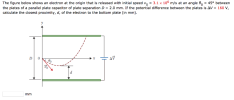 The figure below shows an electron at the origin that is released with initial speed vo = 3.1 106 m/s at an angle θ。= 45° between the plates of a parallel plate capacitor of plate separation D = 2.0 mm. If the potential difference between the plates is Δν 160 V, calculate the closest proximity, d, of the electron to the bottom plate (in mm) D 0 0o 0
17 P The figure below shows an electron at the origin that is released with initial...
 17 P The figure below shows an electron at the origin that is released with initial speed vo4 plate separation D -2.0 mm. If the potential difference plate separation D-2.0 mm. If the potential difference between the plates is aV - 125 V, calculate the closest proximity, d, of the electron to the bottom m/s at an angle 80 45 the plates of a parallel plate capacitor of
An electron is fired at a speed v0 = 5.3 ✕ 106 m/s and at an angle θ0...
 An electron is fired at a
speed v0 = 5.3 ✕ 106 m/s
and at an angle θ0 = −45° between
two parallel conducting plates that are D = 2.5
mm apart, as in the figure below. The voltage difference between
the plates is ΔV = 105 V. (a) Determine how close,
d, the electron will get to the bottom
plate. mm (b) Determine where the electron will strike
the top plate. mm
Path of the electron 0
An electron is fired at a
speed v0 = 5.3 ✕ 106 m/s
and at an angle θ0 = −45° between
two parallel conducting plates that are D = 2.5
mm apart, as in the figure below. The voltage difference between
the plates is ΔV = 105 V. (a) Determine how close,
d, the electron will get to the bottom
plate. mm (b) Determine where the electron will strike
the top plate. mm
Path of the electron 0
at the origin that is plate of plate 0-2.0 mm. r the potential difference between the...
 at the origin that is plate of plate 0-2.0 mm. r the potential difference between the plates is Δν. 120 v, calculate the closest proximity, d, of the electron to the bottom plate (in mm)
Question 2 45° In the figure above, an electron is released at an angle of 45...
 Question 2 45° In the figure above, an electron is released at an angle of 45 degrees from the parallel-plate capacitor's positive side. The distance between the plates is 3.50 cm and the electric field strength inside the capacitor is 4.25x10⁴ N/C. If the electron avoids touching the negative plate, what is its maximum possible initial speed?
The figure shows a parallel-plate capacitor of plate area A and plate separation d. A potential differenceV0 is applied between the plates.
 The figure shows a parallel-plate capacitor of plate area A and plate separation d. A potential differenceV0 is applied between the plates. While the
battery remains connected, a dielectric slab of thickness b and dielectric constant κ is placed between the plates
as shown. Assume A = 130 cm2, d = 1.94
cm, V0 = 72.6 V, b = 0.735 cm, and κ =
3.15. Calculate (a) the capacitance,(b) the charge on the capacitor plates,(c) the electric field in the gap, and(d)...
The figure shows a parallel-plate capacitor of plate area A and plate separation d. A potential differenceV0 is applied between the plates. While the
battery remains connected, a dielectric slab of thickness b and dielectric constant κ is placed between the plates
as shown. Assume A = 130 cm2, d = 1.94
cm, V0 = 72.6 V, b = 0.735 cm, and κ =
3.15. Calculate (a) the capacitance,(b) the charge on the capacitor plates,(c) the electric field in the gap, and(d)...
An electron is released from rest at the negative plate of a parallel plate capacitor and...
 An electron is released from rest at the negative plate of a
parallel plate capacitor and accelerates to the positive plate (see
the drawing). The plates are separated by a distance of 1.7 cm, and
the electric field within the capacitor has a magnitude of 2.7 x
106 V/m. What is the kinetic energy of the electron just as it
reaches the positive plate? The figure shows a vertical plate on
the left that is negatively charged and another vertical...
An electron is released from rest at the negative plate of a
parallel plate capacitor and accelerates to the positive plate (see
the drawing). The plates are separated by a distance of 1.7 cm, and
the electric field within the capacitor has a magnitude of 2.7 x
106 V/m. What is the kinetic energy of the electron just as it
reaches the positive plate? The figure shows a vertical plate on
the left that is negatively charged and another vertical...
An electron is projected with an initial speed v0 = 4.80x10⁶ m/s into the uniform field between the parallel plates in(Figure 1).
 An electron is projected with an initial speed v0 = 4.80x10⁶ m/s into the uniform field between the parallel plates in(Figure 1). The direction of the field is vertically downward, and the field is zero except in the space between the two plates. Part A If the electron just misses the upper plate as it emerges from the field, find the magnitude of the electric field.
An electron is released between the plates of a charged parallel-plate capacitor very close to the...
 An electron is released between the plates of a charged
parallel-plate capacitor very close to the right-hand plate. Just
as it reaches the left-hand plate, its speed is v.
If the distance between the plates were halved without changing
the electric potential between them, then the speed of the electron
when it reached the left-hand plate would be
a) 2v
b) sqrt2v
c) v
d) v/sqrt2
e) v/2
An .sect。, is weased between Pe pain of ehaged Darate stane
An electron is released between the plates of a charged
parallel-plate capacitor very close to the right-hand plate. Just
as it reaches the left-hand plate, its speed is v.
If the distance between the plates were halved without changing
the electric potential between them, then the speed of the electron
when it reached the left-hand plate would be
a) 2v
b) sqrt2v
c) v
d) v/sqrt2
e) v/2
An .sect。, is weased between Pe pain of ehaged Darate stane
 The figure below shows an electron at the origin that is released with initial speed vo = 3.1 106 m/s at an angle θ。= 45° between the plates of a parallel plate capacitor of plate separation D = 2.0 mm. If the potential difference between the plates is Δν 160 V, calculate the closest proximity, d, of the electron to the bottom plate (in mm) D 0 0o 0
 The figure below shows an electron at the origin that is released with initial speed vo = 3.1 106 m/s at an angle θ。= 45° between the plates of a parallel plate capacitor of plate separation D = 2.0 mm. If the potential difference between the plates is Δν 160 V, calculate the closest proximity, d, of the electron to the bottom plate (in mm) D 0 0o 0
 17 P The figure below shows an electron at the origin that is released with initial speed vo4 plate separation D -2.0 mm. If the potential difference plate separation D-2.0 mm. If the potential difference between the plates is aV - 125 V, calculate the closest proximity, d, of the electron to the bottom m/s at an angle 80 45 the plates of a parallel plate capacitor of
 An electron is fired at a
speed v0 = 5.3 ✕ 106 m/s
and at an angle θ0 = −45° between
two parallel conducting plates that are D = 2.5
mm apart, as in the figure below. The voltage difference between
the plates is ΔV = 105 V. (a) Determine how close,
d, the electron will get to the bottom
plate. mm (b) Determine where the electron will strike
the top plate. mm
Path of the electron 0
An electron is fired at a
speed v0 = 5.3 ✕ 106 m/s
and at an angle θ0 = −45° between
two parallel conducting plates that are D = 2.5
mm apart, as in the figure below. The voltage difference between
the plates is ΔV = 105 V. (a) Determine how close,
d, the electron will get to the bottom
plate. mm (b) Determine where the electron will strike
the top plate. mm
Path of the electron 0
 at the origin that is plate of plate 0-2.0 mm. r the potential difference between the plates is Δν. 120 v, calculate the closest proximity, d, of the electron to the bottom plate (in mm)
 Question 2 45° In the figure above, an electron is released at an angle of 45 degrees from the parallel-plate capacitor's positive side. The distance between the plates is 3.50 cm and the electric field strength inside the capacitor is 4.25x10⁴ N/C. If the electron avoids touching the negative plate, what is its maximum possible initial speed?
 An electron is released from rest at the negative plate of a
parallel plate capacitor and accelerates to the positive plate (see
the drawing). The plates are separated by a distance of 1.7 cm, and
the electric field within the capacitor has a magnitude of 2.7 x
106 V/m. What is the kinetic energy of the electron just as it
reaches the positive plate? The figure shows a vertical plate on
the left that is negatively charged and another vertical...
An electron is released from rest at the negative plate of a
parallel plate capacitor and accelerates to the positive plate (see
the drawing). The plates are separated by a distance of 1.7 cm, and
the electric field within the capacitor has a magnitude of 2.7 x
106 V/m. What is the kinetic energy of the electron just as it
reaches the positive plate? The figure shows a vertical plate on
the left that is negatively charged and another vertical...
 An electron is released between the plates of a charged
parallel-plate capacitor very close to the right-hand plate. Just
as it reaches the left-hand plate, its speed is v.
If the distance between the plates were halved without changing
the electric potential between them, then the speed of the electron
when it reached the left-hand plate would be
a) 2v
b) sqrt2v
c) v
d) v/sqrt2
e) v/2
An .sect。, is weased between Pe pain of ehaged Darate stane
An electron is released between the plates of a charged
parallel-plate capacitor very close to the right-hand plate. Just
as it reaches the left-hand plate, its speed is v.
If the distance between the plates were halved without changing
the electric potential between them, then the speed of the electron
when it reached the left-hand plate would be
a) 2v
b) sqrt2v
c) v
d) v/sqrt2
e) v/2
An .sect。, is weased between Pe pain of ehaged Darate stane
Most questions answered within 3 hours.
-
Where is the error in this code sequence?
String s1 = "Hello";
String s2 = "ello";...
asked 10 months ago -
Financial data for Joel de Paris, Inc., for last year
follow:
Joel de Paris, Inc.
Balance...
asked 10 months ago -
Consider this reaction:
Al2(SO4)3 (aq)+ BaCl3
(aq) Al2Cl6 (aq)- +
3BaSO4(s) . What is the...
asked 10 months ago -
Suppose that Savneet is considering increasing her
recent random sample from 20 car rentals to 40...
asked 10 months ago -
Trucks arrive at an unloading terminal at an average rate of 120
per hour.
Trucks arrive...
asked 10 months ago -
Why are methanol and ethanol completely soluble in water while
octanol is not very little soluble....
asked 10 months ago -
A facilities manager at a university reads in a research report
that the mean amount of...
asked 10 months ago -
When the CuSO4 is rehydrated by adding water to the anhydrous
compound, is this an endothermic...
asked 10 months ago -
A ray of sunlight is passing from diamond into crown glass; the
angle of incidence is...
asked 10 months ago -
A block of mass 0.249 kg is placed on top of a light, vertical
spring of...
asked 10 months ago -
how do the kidneys compensate in the presences of acidosis
a) trigger hyperventilate
b) reserve acid...
asked 10 months ago -
Question 501 pts
The rental rate of capital to the firm increases. Which of the
following...
asked 10 months ago