An electron is fired at a speed v0 = 5.3 ✕ 106 m/s and at an angle θ0...
An electron is fired at a speed v0 = 5.3 ✕ 106 m/s and at an angle θ0 = −45° between two parallel conducting plates that are D = 2.5 mm apart, as in the figure below. The voltage difference between the plates is ΔV = 105 V. (a) Determine how close, d, the electron will get to the bottom plate. mm (b) Determine where the electron will strike the top plate. mm

Homework Answers
Given that,
vo = 5.3*10^6 m/s
 = 45 deg
d = 2.5 mm
 V = 105 V
(a)
vertical component of velocity,
vy = vo*sin45
vy = 5.3*10^6*sin45 = 3.76*10^6 m/s
horizontal component, vx = vo*sin45
vx = 3.76*10^6 m/s
Electric field E = V / d
E = 105 / 2.5*10^(-3) = 42*10^3 N/C
acceleration of electron,
a = qE / m
a = 1.6*10^(-19)*42*10^3 / 9.1*10^(-31) = 7.38*10^(15) m/s^2
From kinematic equation,
v^2 - u^2 = 2*a*s
s = (3.76*10^6)^2 / 2*7.38*10^15
s = 0.962 mm
d = D/2 - s
d = (2.5 / 2) - 0.962
d = 0.287 mm
(b)
Let, Time taken by electron to reach the top plate = t
From kinematic equation,
-D/2 = vy*t - (1/2)at^2
-1.25*10^(-3) = 3.76*10^6*t - (1/2)*7.38*10^15*t^2
(3.69*10^15)t^2 - (3.76*10^6)t - 1.25*10^(-3) = 0
by solving the quadratic equation,
t = 1.124*10^(-9) s
Distance where electron will strike the top plate,
x = vx*t
x = 3.76*10^6*1.124*10^(-9)
x = 4.22 mm
Add Answer to:
An electron is fired at a
speed v0 = 5.3 ✕ 106 m/s
and at an angle θ0...
The figure below shows an electron at the origin that is released with initial speed v0...
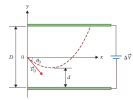 The figure below shows an electron at the origin that is
released with initial speed v0 = 3.5 ✕ 106 m/s at an angle θ0 = 45°
between the plates of a parallel plate capacitor of plate
separation D = 2.0 mm. If the potential difference between the
plates is ΔV = 185 V, calculate the closest proximity, d, of the
electron to the bottom plate (in mm).
The figure below shows an electron at the origin that is
released with initial speed v0 = 3.5 ✕ 106 m/s at an angle θ0 = 45°
between the plates of a parallel plate capacitor of plate
separation D = 2.0 mm. If the potential difference between the
plates is ΔV = 185 V, calculate the closest proximity, d, of the
electron to the bottom plate (in mm).
As shown in the figure, an electron is fired with a speed of 3.59 × 10⁶ m/s through a hole in one of the two parallel plates and into the region between the plates separated by a distance of 0.24 m
 As shown in the figure, an electron is fired with a speed of 3.59 × 10⁶ m/s through a hole in one of the two parallel plates and into the region between the plates separated by a distance of 0.24 m. There is a magnetic field in the region between the plates and, as shown, it is directed into the plane of the page (perpendicular to the velocity of the electron). Determine the magnitude of the magnetic field so that...
Two parallel plates (2 cm by 2.5 cm) generate an electric field. An electron is fired...
 Two parallel plates (2 cm by 2.5 cm) generate an electric field. An electron is fired with a speed of 4.4 x 10⁷ m/s between the plates, perpendicular to the electric field direction. (See figure). The plates are charged to +/- 25 nC. a. Which plate must be positive, the top or the bottom plate? b. If the plates are 2 cm long in the direction the electron is travelling, the electron's trajectory when it leaves the plates will be...
The figure below shows an electron at the origin that is released with initial speed vo...
 The figure below shows an electron at the origin that is released with initial speed vo = 3.1 106 m/s at an angle θ。= 45° between the plates of a parallel plate capacitor of plate separation D = 2.0 mm. If the potential difference between the plates is Δν 160 V, calculate the closest proximity, d, of the electron to the bottom plate (in mm) D 0 0o 0
The figure below shows an electron at the origin that is released with initial speed vo...
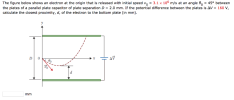 The figure below shows an electron at the origin that is released with initial speed vo = 3.1 106 m/s at an angle θ。= 45° between the plates of a parallel plate capacitor of plate separation D = 2.0 mm. If the potential difference between the plates is Δν 160 V, calculate the closest proximity, d, of the electron to the bottom plate (in mm) D 0 0o 0
My Notes As shown in the figure, an electron is fired with a speed of 3.64...
 My Notes As shown in the figure, an electron is fired with a speed of 3.64 x 10⁶ m/s through a hole in one of the two parallel plates and into the region between the plates separated by a distance of 0.19 m. There is a magnetic field in the region between the plates and, as shown, it is directed into the plane of the page (perpendicular to the velooty of the electron). Determine the magnitude of the magnetic field...
An electron at point A has a speed v0 of 1.41 x 10⁶ m/s...
An electron at point A has a speed v0 of 1.41 x 10⁶ m/s. FindA. The magnitude and direction of the magnetic field that will cause the lectron to follow the semicircular path from A to B, and;B. The time required for the electron to move from A to B.
As shown in the figure, an electron is fired with a speed of 3.73 x 10...
 As shown in the figure, an electron is fired with a speed of 3.73 x 10 m/s through a hole in one of the two parallel plates and into the region between the plates separated by a distance of 0.24 m. There is a magnetic field in the region between the plates and, as shown, it is directed into the plane of the page (perpendicular to the velocity of the electron). Determine the magnitude of the magnetic field so that...
An electron is projected with an initial speed v0 = 4.80x10⁶ m/s into the uniform field between the parallel plates in(Figure 1).
 An electron is projected with an initial speed v0 = 4.80x10⁶ m/s into the uniform field between the parallel plates in(Figure 1). The direction of the field is vertically downward, and the field is zero except in the space between the two plates. Part A If the electron just misses the upper plate as it emerges from the field, find the magnitude of the electric field.
An electron has a speed v0 = 1.41 × 10⁶ m/s in the +z-direction. Find (a)...
An electron has a speed v0 = 1.41 × 10⁶ m/s in the +z-direction. Find (a) the magnitude and direction of the magnetic field that will cause the electron to follow the semicircular path of 10.0-cm diameter clockwise in the yz-plane, and (b) the time required for the electron to traverse one complete circle
 The figure below shows an electron at the origin that is
released with initial speed v0 = 3.5 ✕ 106 m/s at an angle θ0 = 45°
between the plates of a parallel plate capacitor of plate
separation D = 2.0 mm. If the potential difference between the
plates is ΔV = 185 V, calculate the closest proximity, d, of the
electron to the bottom plate (in mm).
The figure below shows an electron at the origin that is
released with initial speed v0 = 3.5 ✕ 106 m/s at an angle θ0 = 45°
between the plates of a parallel plate capacitor of plate
separation D = 2.0 mm. If the potential difference between the
plates is ΔV = 185 V, calculate the closest proximity, d, of the
electron to the bottom plate (in mm).
 Two parallel plates (2 cm by 2.5 cm) generate an electric field. An electron is fired with a speed of 4.4 x 10⁷ m/s between the plates, perpendicular to the electric field direction. (See figure). The plates are charged to +/- 25 nC. a. Which plate must be positive, the top or the bottom plate? b. If the plates are 2 cm long in the direction the electron is travelling, the electron's trajectory when it leaves the plates will be...
 The figure below shows an electron at the origin that is released with initial speed vo = 3.1 106 m/s at an angle θ。= 45° between the plates of a parallel plate capacitor of plate separation D = 2.0 mm. If the potential difference between the plates is Δν 160 V, calculate the closest proximity, d, of the electron to the bottom plate (in mm) D 0 0o 0
 The figure below shows an electron at the origin that is released with initial speed vo = 3.1 106 m/s at an angle θ。= 45° between the plates of a parallel plate capacitor of plate separation D = 2.0 mm. If the potential difference between the plates is Δν 160 V, calculate the closest proximity, d, of the electron to the bottom plate (in mm) D 0 0o 0
 My Notes As shown in the figure, an electron is fired with a speed of 3.64 x 10⁶ m/s through a hole in one of the two parallel plates and into the region between the plates separated by a distance of 0.19 m. There is a magnetic field in the region between the plates and, as shown, it is directed into the plane of the page (perpendicular to the velooty of the electron). Determine the magnitude of the magnetic field...
 As shown in the figure, an electron is fired with a speed of 3.73 x 10 m/s through a hole in one of the two parallel plates and into the region between the plates separated by a distance of 0.24 m. There is a magnetic field in the region between the plates and, as shown, it is directed into the plane of the page (perpendicular to the velocity of the electron). Determine the magnitude of the magnetic field so that...
Most questions answered within 3 hours.
-
Where is the error in this code sequence?
String s1 = "Hello";
String s2 = "ello";...
asked 10 months ago -
Financial data for Joel de Paris, Inc., for last year
follow:
Joel de Paris, Inc.
Balance...
asked 10 months ago -
Consider this reaction:
Al2(SO4)3 (aq)+ BaCl3
(aq) Al2Cl6 (aq)- +
3BaSO4(s) . What is the...
asked 10 months ago -
Suppose that Savneet is considering increasing her
recent random sample from 20 car rentals to 40...
asked 10 months ago -
Trucks arrive at an unloading terminal at an average rate of 120
per hour.
Trucks arrive...
asked 10 months ago -
Why are methanol and ethanol completely soluble in water while
octanol is not very little soluble....
asked 10 months ago -
A facilities manager at a university reads in a research report
that the mean amount of...
asked 10 months ago -
When the CuSO4 is rehydrated by adding water to the anhydrous
compound, is this an endothermic...
asked 10 months ago -
A ray of sunlight is passing from diamond into crown glass; the
angle of incidence is...
asked 10 months ago -
A block of mass 0.249 kg is placed on top of a light, vertical
spring of...
asked 10 months ago -
how do the kidneys compensate in the presences of acidosis
a) trigger hyperventilate
b) reserve acid...
asked 10 months ago -
Question 501 pts
The rental rate of capital to the firm increases. Which of the
following...
asked 10 months ago