
Homework Answers
surface charge density of glass tube is,
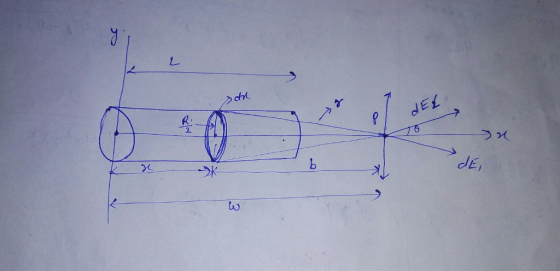
now electric field at point P is given by,
The component dEx of that electric field along the direction of the axis perpendicular to the plane of the ring is,
dEx = dE cos 
whrer r is ,
and
hence,
by integrating,
by pluging the given values, of L , R and
Add Answer to:
A hollow glass tube A thin-walled hollow circular glass tube, open at both ends, has a...
A thin walled cylindrical tube open at both ends is made from a metal that has...
A thin walled cylindrical tube open at both ends is made from a metal that has a shear yield stress of k=550-MPa and has a diameter of 0.5-m. The maximum intended internal pressure during use is 35-MPa. If the cylinder tube is not to yield, what is its minimum wall thickness according to: a.) Von Mises yield criterion b.) Tresca’s yield criterion
(a) Consider a uniformly charged, thin-walled, right circular cylindrical shell having total charge Q, radius R,...
 (a) Consider a uniformly charged, thin-walled, right circular cylindrical shell having total charge Q, radius R, and length l. Determine the electric field at a point a distance d from the right side of the cylinder as shown in Figure P23.46. Suggestion: Use the result of Example 23.8 and treat the cylinder as a collection of ring charges, (b) What If? Consider now a solid cylinder with the same dimensions and carrying the same charge, uniformly distributed through its volume....
9. (a) Consider a uniformly charged, thin-walled, right circular s cylindrical shell having total charge Q....
 9. (a) Consider a uniformly charged, thin-walled, right circular s cylindrical shell having total charge Q. radius R, and length . Determine the electric field at a point a distance d from the right side of the cylinder as shown in Figure P23.9. Suggestion: Use the result of Example 23.2 and treat the cylinder as a col- lection of ring charges. (b) What If? Consider now a solid cyl- inder with the same dimensions and carrying the same charge, uniformly...
A thin disk with a circular hole at its center, called an annulus, has inner radius...
 A thin disk with a circular hole at its center, called an
annulus, has inner radius R1 and outer radius R2. The disk has a
uniform positive surface charge density σ on its surface. (Figure
1)
A)The annulus lies in the yz-plane, with its center at
the origin. For an arbitrary point on the x-axis (the axis
of the annulus), find the magnitude of the electric field E⃗ .
Consider points above the annulus in the figure.
Express your answer...
A thin disk with a circular hole at its center, called an
annulus, has inner radius R1 and outer radius R2. The disk has a
uniform positive surface charge density σ on its surface. (Figure
1)
A)The annulus lies in the yz-plane, with its center at
the origin. For an arbitrary point on the x-axis (the axis
of the annulus), find the magnitude of the electric field E⃗ .
Consider points above the annulus in the figure.
Express your answer...
Please help with both parts a and b, thank you. 57. The thin glass rod of...
 Please help with both parts a and b, thank you.
57. The thin glass rod of length e in Figure P23.57 has a linear charge density that starts out as zero at the left end of the rod and increases linearly from left to right. The positive charge on the rod is grod- (a) What is the electric field along the rod's axis at position P, which lies a distance d from the right end of the rod? (b) What...
Please help with both parts a and b, thank you.
57. The thin glass rod of length e in Figure P23.57 has a linear charge density that starts out as zero at the left end of the rod and increases linearly from left to right. The positive charge on the rod is grod- (a) What is the electric field along the rod's axis at position P, which lies a distance d from the right end of the rod? (b) What...
The hollow thin-walled hollow section of aluminium alloy illustrated below is 1200 mm long. It has one free end and the...
 The hollow thin-walled hollow section of aluminium alloy
illustrated below is 1200 mm long. It has one free end and the
other is built into a solid wall. At the free end, the following
loads are applied in the directions illustrated and distributed
evenly over the perimeter of the section:- A central, axial
compressive load, P = 10 kN; and A torque, T = 0.2 kN.m. Properties
of the aluminium alloy are given as E = 72 GPa and =...
The hollow thin-walled hollow section of aluminium alloy
illustrated below is 1200 mm long. It has one free end and the
other is built into a solid wall. At the free end, the following
loads are applied in the directions illustrated and distributed
evenly over the perimeter of the section:- A central, axial
compressive load, P = 10 kN; and A torque, T = 0.2 kN.m. Properties
of the aluminium alloy are given as E = 72 GPa and =...
Consider a uniformly charged, thin-walled, right circular cylindrical shell having total charge Q, radius R, and...
 Consider a uniformly charged, thin-walled, right circular cylindrical shell having total charge Q, radius R, and length l. Determine the electric field at a point a distance d from the right side of the cylinder as shown in the figure. Show that you recover the same expression if the cylinder is treated as a collection of ring charges. Consider now a solid cylinder with the same dimensions and carrying the same charge, uniformly distributed through its volume. Find the field...
Question 8 In the figure a thin glass rod forms a semicircle of radius r 1.67...
 Question 8 In the figure a thin glass rod forms a semicircle of radius r 1.67 cm. Charge is uniformly distributed along the rod, with q 1.38 pC in the upper half and -q-1.38 pC in the lower half. What is the magnitude of the electric field at P, the center of the semicircle? Number the tolerance is +/-5% Click if you would like to Show Worlv/s Units N/C or V/m ion: Open Show Work V/m-s N/C.m Question 9 Figure...
In the figure, a thin glass rod forms a semicircle of radius r = 2.50 cm....
 In the figure, a thin glass rod forms a semicircle of radius r =
2.50 cm. Charge is uniformly distributed along the rod, with +q =
5.50 pC in the upper half and −q = −5.50 pC in the lower half.
(a) What is the magnitude of the electric field at P, the center
of the semicircle?
(b) What is its direction? ???° counterclockwise from the
+x-axis
+q -9
In the figure, a thin glass rod forms a semicircle of radius r =
2.50 cm. Charge is uniformly distributed along the rod, with +q =
5.50 pC in the upper half and −q = −5.50 pC in the lower half.
(a) What is the magnitude of the electric field at P, the center
of the semicircle?
(b) What is its direction? ???° counterclockwise from the
+x-axis
+q -9
In the figure, a thin glass rod forms a semicircle of radius r = 2.50 cm....
 In the figure, a thin glass rod forms a semicircle of radius r =
2.50 cm. Charge is uniformly distributed along the rod, with +q =
5.50 pC in the upper half and −q = −5.50 pC in the lower half.
(a) What is the magnitude of the electric field at P,
the center of the semicircle?
(b) What is its direction?
° counterclockwise from the +x-axis
+q -9
In the figure, a thin glass rod forms a semicircle of radius r =
2.50 cm. Charge is uniformly distributed along the rod, with +q =
5.50 pC in the upper half and −q = −5.50 pC in the lower half.
(a) What is the magnitude of the electric field at P,
the center of the semicircle?
(b) What is its direction?
° counterclockwise from the +x-axis
+q -9
 (a) Consider a uniformly charged, thin-walled, right circular cylindrical shell having total charge Q, radius R, and length l. Determine the electric field at a point a distance d from the right side of the cylinder as shown in Figure P23.46. Suggestion: Use the result of Example 23.8 and treat the cylinder as a collection of ring charges, (b) What If? Consider now a solid cylinder with the same dimensions and carrying the same charge, uniformly distributed through its volume....
 9. (a) Consider a uniformly charged, thin-walled, right circular s cylindrical shell having total charge Q. radius R, and length . Determine the electric field at a point a distance d from the right side of the cylinder as shown in Figure P23.9. Suggestion: Use the result of Example 23.2 and treat the cylinder as a col- lection of ring charges. (b) What If? Consider now a solid cyl- inder with the same dimensions and carrying the same charge, uniformly...
 A thin disk with a circular hole at its center, called an
annulus, has inner radius R1 and outer radius R2. The disk has a
uniform positive surface charge density σ on its surface. (Figure
1)
A)The annulus lies in the yz-plane, with its center at
the origin. For an arbitrary point on the x-axis (the axis
of the annulus), find the magnitude of the electric field E⃗ .
Consider points above the annulus in the figure.
Express your answer...
A thin disk with a circular hole at its center, called an
annulus, has inner radius R1 and outer radius R2. The disk has a
uniform positive surface charge density σ on its surface. (Figure
1)
A)The annulus lies in the yz-plane, with its center at
the origin. For an arbitrary point on the x-axis (the axis
of the annulus), find the magnitude of the electric field E⃗ .
Consider points above the annulus in the figure.
Express your answer...
 Please help with both parts a and b, thank you.
57. The thin glass rod of length e in Figure P23.57 has a linear charge density that starts out as zero at the left end of the rod and increases linearly from left to right. The positive charge on the rod is grod- (a) What is the electric field along the rod's axis at position P, which lies a distance d from the right end of the rod? (b) What...
Please help with both parts a and b, thank you.
57. The thin glass rod of length e in Figure P23.57 has a linear charge density that starts out as zero at the left end of the rod and increases linearly from left to right. The positive charge on the rod is grod- (a) What is the electric field along the rod's axis at position P, which lies a distance d from the right end of the rod? (b) What...
 The hollow thin-walled hollow section of aluminium alloy
illustrated below is 1200 mm long. It has one free end and the
other is built into a solid wall. At the free end, the following
loads are applied in the directions illustrated and distributed
evenly over the perimeter of the section:- A central, axial
compressive load, P = 10 kN; and A torque, T = 0.2 kN.m. Properties
of the aluminium alloy are given as E = 72 GPa and =...
The hollow thin-walled hollow section of aluminium alloy
illustrated below is 1200 mm long. It has one free end and the
other is built into a solid wall. At the free end, the following
loads are applied in the directions illustrated and distributed
evenly over the perimeter of the section:- A central, axial
compressive load, P = 10 kN; and A torque, T = 0.2 kN.m. Properties
of the aluminium alloy are given as E = 72 GPa and =...
 Consider a uniformly charged, thin-walled, right circular cylindrical shell having total charge Q, radius R, and length l. Determine the electric field at a point a distance d from the right side of the cylinder as shown in the figure. Show that you recover the same expression if the cylinder is treated as a collection of ring charges. Consider now a solid cylinder with the same dimensions and carrying the same charge, uniformly distributed through its volume. Find the field...
 Question 8 In the figure a thin glass rod forms a semicircle of radius r 1.67 cm. Charge is uniformly distributed along the rod, with q 1.38 pC in the upper half and -q-1.38 pC in the lower half. What is the magnitude of the electric field at P, the center of the semicircle? Number the tolerance is +/-5% Click if you would like to Show Worlv/s Units N/C or V/m ion: Open Show Work V/m-s N/C.m Question 9 Figure...
 In the figure, a thin glass rod forms a semicircle of radius r =
2.50 cm. Charge is uniformly distributed along the rod, with +q =
5.50 pC in the upper half and −q = −5.50 pC in the lower half.
(a) What is the magnitude of the electric field at P, the center
of the semicircle?
(b) What is its direction? ???° counterclockwise from the
+x-axis
+q -9
In the figure, a thin glass rod forms a semicircle of radius r =
2.50 cm. Charge is uniformly distributed along the rod, with +q =
5.50 pC in the upper half and −q = −5.50 pC in the lower half.
(a) What is the magnitude of the electric field at P, the center
of the semicircle?
(b) What is its direction? ???° counterclockwise from the
+x-axis
+q -9
 In the figure, a thin glass rod forms a semicircle of radius r =
2.50 cm. Charge is uniformly distributed along the rod, with +q =
5.50 pC in the upper half and −q = −5.50 pC in the lower half.
(a) What is the magnitude of the electric field at P,
the center of the semicircle?
(b) What is its direction?
° counterclockwise from the +x-axis
+q -9
In the figure, a thin glass rod forms a semicircle of radius r =
2.50 cm. Charge is uniformly distributed along the rod, with +q =
5.50 pC in the upper half and −q = −5.50 pC in the lower half.
(a) What is the magnitude of the electric field at P,
the center of the semicircle?
(b) What is its direction?
° counterclockwise from the +x-axis
+q -9
Most questions answered within 3 hours.
-
Where is the error in this code sequence?
String s1 = "Hello";
String s2 = "ello";...
asked 11 months ago -
Financial data for Joel de Paris, Inc., for last year
follow:
Joel de Paris, Inc.
Balance...
asked 11 months ago -
Consider this reaction:
Al2(SO4)3 (aq)+ BaCl3
(aq) Al2Cl6 (aq)- +
3BaSO4(s) . What is the...
asked 11 months ago -
Suppose that Savneet is considering increasing her
recent random sample from 20 car rentals to 40...
asked 11 months ago -
Trucks arrive at an unloading terminal at an average rate of 120
per hour.
Trucks arrive...
asked 11 months ago -
Why are methanol and ethanol completely soluble in water while
octanol is not very little soluble....
asked 11 months ago -
A facilities manager at a university reads in a research report
that the mean amount of...
asked 11 months ago -
When the CuSO4 is rehydrated by adding water to the anhydrous
compound, is this an endothermic...
asked 11 months ago -
A ray of sunlight is passing from diamond into crown glass; the
angle of incidence is...
asked 11 months ago -
A block of mass 0.249 kg is placed on top of a light, vertical
spring of...
asked 11 months ago -
how do the kidneys compensate in the presences of acidosis
a) trigger hyperventilate
b) reserve acid...
asked 11 months ago -
Question 501 pts
The rental rate of capital to the firm increases. Which of the
following...
asked 11 months ago