
Homework Answers
The forcing function (in black) in essence forces the system to resonate with it (although with a slight delay)
It can be seen that the different solutions start out from different positions (blue, red, orange graphs) but eventually fall in line with the forcing function. Thus we can say that eventually the forcing function forces out system to resonate with it drowning any effects of initial position or velocity.
Add Answer to:
G.3.a.i) Forced by 5 Sin[1.5 t) Here are three plots of solutions of a random forced...
Here are three plots of solutions of the forced exponential diffeq y'[t] + 2.13 y[t] =...
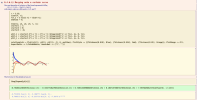 Here are three plots of
solutions of the forced exponential diffeq y'[t] + 2.13 y[t] = 3
Sin[2 t] + Sin[4 t] with starter values on y[0] equal to -6, 0, and
7:
G.4.b.i) Merging onto a certain curve Here are three plats of solutions of the forced exponential diffeq with 0,and 7 r 2.13 fit 13 Sin [2 t]Sin [4 t]; endtine 9; Clearly, yl, y2, y3, t, s]; starterl 7; starter3 = -6: 1[t v2[t starter2 E(-r t)...
Here are three plots of
solutions of the forced exponential diffeq y'[t] + 2.13 y[t] = 3
Sin[2 t] + Sin[4 t] with starter values on y[0] equal to -6, 0, and
7:
G.4.b.i) Merging onto a certain curve Here are three plats of solutions of the forced exponential diffeq with 0,and 7 r 2.13 fit 13 Sin [2 t]Sin [4 t]; endtine 9; Clearly, yl, y2, y3, t, s]; starterl 7; starter3 = -6: 1[t v2[t starter2 E(-r t)...
Problem 5 . This question considers uniform random points on the unit disc x2+92 〈 1...
 Problem 5 . This question considers uniform random points on the unit disc x2+92 〈 1 (a) A point (X, Y) is uniformly chosen in the unit disc. Find the CDF and PDF of its distance from the origin R X2 +Y2 (b) Compute the expected distance from the origin. (c) Determine the marginal PDF of X and Y (d) Are X and Y independent? (Justify your claims) e) One way to generate uniform random points on this disc is...
Consider these three moment generating functions, for X, Y and Z: (5 points each) m (t)=W-3...
 Consider these three moment generating functions, for X, Y and Z: (5 points each) m (t)=W-3 m, (t)=e + m,(t)=eW-7 a. What is the mean of X? b. What is the mean of Y? c. What is the mean of Z? d. What is the variance of X? e. What is the variance of Y? f. What is the variance of Z? Consider independent random variables X and Y with the following pmfs: y=1 (0.5 x=1 S(x)= {0.5 x =...
Can you please help me answer Task 2.b? Please show all work. fs=44100; no_pts=8192; t=([0:no_pts-1]')/fs; y1=sin(2...
 Can you please help me answer Task 2.b?
Please show all work.
fs=44100; no_pts=8192;
t=([0:no_pts-1]')/fs;
y1=sin(2*pi*1000*t);
figure;
plot(t,y1);
xlabel('t (second)')
ylabel('y(t)')
axis([0,.004,-1.2,1.2]) % constrain axis so you can actually see
the wave
sound(y1,fs); % play sound using windows driver.
%%
% Check the frequency domain signal. fr is the frequency vector and
f1 is the magnitude of F{y1}.
fr=([0:no_pts-1]')/no_pts*fs; %in Hz
fr=fr(1:no_pts/2); % single-sided spectrum
f1=abs(fft(y1)); % compute fft
f1=f1(1:no_pts/2)/fs;
%%
% F is the continuous time Fourier. (See derivation...
Can you please help me answer Task 2.b?
Please show all work.
fs=44100; no_pts=8192;
t=([0:no_pts-1]')/fs;
y1=sin(2*pi*1000*t);
figure;
plot(t,y1);
xlabel('t (second)')
ylabel('y(t)')
axis([0,.004,-1.2,1.2]) % constrain axis so you can actually see
the wave
sound(y1,fs); % play sound using windows driver.
%%
% Check the frequency domain signal. fr is the frequency vector and
f1 is the magnitude of F{y1}.
fr=([0:no_pts-1]')/no_pts*fs; %in Hz
fr=fr(1:no_pts/2); % single-sided spectrum
f1=abs(fft(y1)); % compute fft
f1=f1(1:no_pts/2)/fs;
%%
% F is the continuous time Fourier. (See derivation...
Someone plz plz help with this Statistics Intro to R programming question!!! Here are the examples and follow by my question!! Thank you so much!! I appreciate it !!!!My question!!!! Question T...
 Someone plz plz help with this Statistics Intro to R programming
question!!!
Here are the examples and follow by my question!!
Thank you so much!! I appreciate it
!!!!My question!!!!
Question Type 1: If possible, calculate the 90% confidence intervals for the temperature it takes for crickets to chirp 15 chirps per second. Code (you must copy and paste your code like below in blue color): # Reading in the data Crickets-read.table(C:/Desktop/CricketChirpsvsTemperature.csv', header TRUE, #View Data View Crickets) #Data analysis...
Someone plz plz help with this Statistics Intro to R programming
question!!!
Here are the examples and follow by my question!!
Thank you so much!! I appreciate it
!!!!My question!!!!
Question Type 1: If possible, calculate the 90% confidence intervals for the temperature it takes for crickets to chirp 15 chirps per second. Code (you must copy and paste your code like below in blue color): # Reading in the data Crickets-read.table(C:/Desktop/CricketChirpsvsTemperature.csv', header TRUE, #View Data View Crickets) #Data analysis...
 Here are three plots of
solutions of the forced exponential diffeq y'[t] + 2.13 y[t] = 3
Sin[2 t] + Sin[4 t] with starter values on y[0] equal to -6, 0, and
7:
G.4.b.i) Merging onto a certain curve Here are three plats of solutions of the forced exponential diffeq with 0,and 7 r 2.13 fit 13 Sin [2 t]Sin [4 t]; endtine 9; Clearly, yl, y2, y3, t, s]; starterl 7; starter3 = -6: 1[t v2[t starter2 E(-r t)...
Here are three plots of
solutions of the forced exponential diffeq y'[t] + 2.13 y[t] = 3
Sin[2 t] + Sin[4 t] with starter values on y[0] equal to -6, 0, and
7:
G.4.b.i) Merging onto a certain curve Here are three plats of solutions of the forced exponential diffeq with 0,and 7 r 2.13 fit 13 Sin [2 t]Sin [4 t]; endtine 9; Clearly, yl, y2, y3, t, s]; starterl 7; starter3 = -6: 1[t v2[t starter2 E(-r t)...
 Problem 5 . This question considers uniform random points on the unit disc x2+92 〈 1 (a) A point (X, Y) is uniformly chosen in the unit disc. Find the CDF and PDF of its distance from the origin R X2 +Y2 (b) Compute the expected distance from the origin. (c) Determine the marginal PDF of X and Y (d) Are X and Y independent? (Justify your claims) e) One way to generate uniform random points on this disc is...
 Consider these three moment generating functions, for X, Y and Z: (5 points each) m (t)=W-3 m, (t)=e + m,(t)=eW-7 a. What is the mean of X? b. What is the mean of Y? c. What is the mean of Z? d. What is the variance of X? e. What is the variance of Y? f. What is the variance of Z? Consider independent random variables X and Y with the following pmfs: y=1 (0.5 x=1 S(x)= {0.5 x =...
 Can you please help me answer Task 2.b?
Please show all work.
fs=44100; no_pts=8192;
t=([0:no_pts-1]')/fs;
y1=sin(2*pi*1000*t);
figure;
plot(t,y1);
xlabel('t (second)')
ylabel('y(t)')
axis([0,.004,-1.2,1.2]) % constrain axis so you can actually see
the wave
sound(y1,fs); % play sound using windows driver.
%%
% Check the frequency domain signal. fr is the frequency vector and
f1 is the magnitude of F{y1}.
fr=([0:no_pts-1]')/no_pts*fs; %in Hz
fr=fr(1:no_pts/2); % single-sided spectrum
f1=abs(fft(y1)); % compute fft
f1=f1(1:no_pts/2)/fs;
%%
% F is the continuous time Fourier. (See derivation...
Can you please help me answer Task 2.b?
Please show all work.
fs=44100; no_pts=8192;
t=([0:no_pts-1]')/fs;
y1=sin(2*pi*1000*t);
figure;
plot(t,y1);
xlabel('t (second)')
ylabel('y(t)')
axis([0,.004,-1.2,1.2]) % constrain axis so you can actually see
the wave
sound(y1,fs); % play sound using windows driver.
%%
% Check the frequency domain signal. fr is the frequency vector and
f1 is the magnitude of F{y1}.
fr=([0:no_pts-1]')/no_pts*fs; %in Hz
fr=fr(1:no_pts/2); % single-sided spectrum
f1=abs(fft(y1)); % compute fft
f1=f1(1:no_pts/2)/fs;
%%
% F is the continuous time Fourier. (See derivation...
 Someone plz plz help with this Statistics Intro to R programming
question!!!
Here are the examples and follow by my question!!
Thank you so much!! I appreciate it
!!!!My question!!!!
Question Type 1: If possible, calculate the 90% confidence intervals for the temperature it takes for crickets to chirp 15 chirps per second. Code (you must copy and paste your code like below in blue color): # Reading in the data Crickets-read.table(C:/Desktop/CricketChirpsvsTemperature.csv', header TRUE, #View Data View Crickets) #Data analysis...
Someone plz plz help with this Statistics Intro to R programming
question!!!
Here are the examples and follow by my question!!
Thank you so much!! I appreciate it
!!!!My question!!!!
Question Type 1: If possible, calculate the 90% confidence intervals for the temperature it takes for crickets to chirp 15 chirps per second. Code (you must copy and paste your code like below in blue color): # Reading in the data Crickets-read.table(C:/Desktop/CricketChirpsvsTemperature.csv', header TRUE, #View Data View Crickets) #Data analysis...
Most questions answered within 3 hours.
-
Where is the error in this code sequence?
String s1 = "Hello";
String s2 = "ello";...
asked 10 months ago -
Financial data for Joel de Paris, Inc., for last year
follow:
Joel de Paris, Inc.
Balance...
asked 10 months ago -
Consider this reaction:
Al2(SO4)3 (aq)+ BaCl3
(aq) Al2Cl6 (aq)- +
3BaSO4(s) . What is the...
asked 10 months ago -
Suppose that Savneet is considering increasing her
recent random sample from 20 car rentals to 40...
asked 10 months ago -
Trucks arrive at an unloading terminal at an average rate of 120
per hour.
Trucks arrive...
asked 10 months ago -
Why are methanol and ethanol completely soluble in water while
octanol is not very little soluble....
asked 10 months ago -
A facilities manager at a university reads in a research report
that the mean amount of...
asked 10 months ago -
When the CuSO4 is rehydrated by adding water to the anhydrous
compound, is this an endothermic...
asked 10 months ago -
A ray of sunlight is passing from diamond into crown glass; the
angle of incidence is...
asked 10 months ago -
A block of mass 0.249 kg is placed on top of a light, vertical
spring of...
asked 10 months ago -
how do the kidneys compensate in the presences of acidosis
a) trigger hyperventilate
b) reserve acid...
asked 10 months ago -
Question 501 pts
The rental rate of capital to the firm increases. Which of the
following...
asked 10 months ago