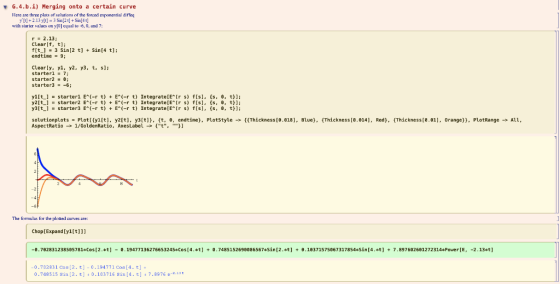
![Chop[Expand[y2[t] ]] y2[t Chop[Expand[y3[t]1 0.7485152690086567+Sin [2.*t] 0.10371575067317854+Sin [4 . *t ] - 5.102397398727](http://img.homeworklib.com/images/b5489293-ec20-4b68-82f4-6e7b9523d968.png?x-oss-process=image/resize,w_560) Here are three plots of
solutions of the forced exponential diffeq y'[t] + 2.13 y[t] = 3
Sin[2 t] + Sin[4 t] with starter values on y[0] equal to -6, 0, and
7:
Here are three plots of
solutions of the forced exponential diffeq y'[t] + 2.13 y[t] = 3
Sin[2 t] + Sin[4 t] with starter values on y[0] equal to -6, 0, and
7:
Chop[Expand[y2[t] ]] y2[t Chop[Expand[y3[t]1 0.7485152690086567+Sin [2.*t] 0.10371575067317854+Sin [4 . *t ] - 5.102397398727686+Power [ E, -2.13*t] 0.702831238505781*Cos [2.t] - .19477136276653245+Cos [4.t .702831 Cos [2. t] - 0.194771 Cos [4. t 0.748515 Sin [2. t0.103716 Sin [4. tl 5.1024 e2.13 All tiese sului evua d iplt s the salutiqn ples
Homework Answers
Note that as 
So removing such exponential decay terms, we get the eventual solution as

This is the eventual solution

Please do rate this answer positively if you found it helpful. Thanks and have a good day!
Add Answer to:
Here are three plots of solutions of the forced exponential diffeq y'[t] + 2.13 y[t] =...
G.3.a.i) Forced by 5 Sin[1.5 t) Here are three plots of solutions of a random forced...
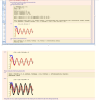 G.3.a.i) Forced by 5 Sin[1.5 t) Here are three plots of solutions of a random forced exponential diffeq r>0) with random starting values on viOl: Bacics Te rRandon[Real, (e.5, 1.] n[1.5 tl Try 1 Try 1 endtime 28; Try 1. Clea starter1 Random[Real, (5, 1e)]; starter2 Randon[Real, (-2, 2}]; starter3 Randon[ Real, -10, -5)] s]; Try 1. Try 1. y1t starter1 E^(-r t) + E^(-r t) Integrate [ E^ (r_ s) f[s], {s, e, t}]; Try 1 Try 1 узit...
Find the trigonometric Fourier series (FS) and the exponential FS of the following: 2 *(1) 1.5...
 Find the trigonometric Fourier series (FS) and the exponential FS of the following: 2 *(1) 1.5 1 0.5 O -0.5 1 -1 2 -1 0 2 b) 2 3 4 6 exponential FS Cnejnwot f(t) = En=-00 Where Cn 7Se+ f(t)e-inwot dt trigonometric f(t)= a, +Ža, cos(n6,t)+b, sin(n0,1 ao 1 T. 2 to an S f(t)dt sº f(t)cos(n0,1)dt f(t)sin (no,t)dt To 2 pt b,
QUESTION 2: Consider this forced translational mass-spring-damper (MSD) system: The input is the external force "F(t)"...
 QUESTION 2: Consider this forced translational mass-spring-damper (MSD) system: The input is the external force "F(t)" and the output is position "x(t)." The transfer function for this system is g) - 6 - Mz? +BS+K It is known that M - 1 kg. B - 10 mm, and there are three possible values of K: (K = 16 K = 34 NK-89 The only possible external forces "F(t)" have the following Laplace transforms: 1) F,(s) - 0 (corresponding to external...
3. A shape is defined as: (x, y, z) = (rcos 0 sin 0,r sin sin d, r cos ø) with 0r1, T/4 < 0< 7t/4 and 0 < ¢ &l...
 3. A shape is defined as: (x, y, z) = (rcos 0 sin 0,r sin sin d, r cos ø) with 0r1, T/4 < 0< 7t/4 and 0 < ¢ < T* 2 marks (a) Describe this region. an appropriate integration, determine the volume of this shape [4 marks (b) Using 3 (Continued) 3 marks (c) Parametrise the surface of this shape. 3 marks (d) Find a normal to the surface [4 marks (e) What is the surface area of...
002 10.0 points Find the Jacobian of the transformation T: (r, 0) + (x, y) when...
 002 10.0 points Find the Jacobian of the transformation T: (r, 0) + (x, y) when x = e" cose, y = 2e-" sin . 1. O(x, y) = 2 cos 20 a(r, 0) 2. 8(x, y) a(r, 0j = -3e2r 2(x, y) a(r, 0) = -2 cos 20 4. (x, y) = 2 4. Əlr, o) 5. 0(x, y) = 3er cos 20 5. Ə(r, ) 2(x, y) - 2.21 DA a(r, 0) = -3e4
4. Let C be the closed curve defined by r(t) = costi + sin tj +...
 4. Let C be the closed curve defined by r(t) = costi + sin tj + sin 2tk for 0 <t<2n. (a) [5 pts] Show that this curve C lies on the surface S defined by z = 2.cy. F. dr (b) (20 pts] By using Stokes' Theorem, evaluate the line integral| " where F(t,y,z) = (y2 + cos z)i + (sin y+z)j + tk
4. Let C be the closed curve defined by r(t) = costi + sin tj +...
 4. Let C be the closed curve defined by r(t) = costi + sin tj + sin 2tk for 0 <t<2n. (a) [5 pts] Show that this curve C lies on the surface S defined by z = 2.cy. (b) [20 pts] By using Stokes’ Theorem, evaluate the line integral| vi F. dr where F(x, y, z) = (y2 + cos x)i + (sin y + z2)j + xk
question #6 1. Sketch the following surfaces: (a) z-+y2/9 (b) a2 =y2 +22 (c) 2/4+(y-1)2+(z+1)/9 1...
 question #6
1. Sketch the following surfaces: (a) z-+y2/9 (b) a2 =y2 +22 (c) 2/4+(y-1)2+(z+1)/9 1 (d) r2+y-22+1 0 (e) -y2+-1 0. 2. Find an equation for the surface consisting of all points that are- point (1,-3, 5) and the plane r = 3. 3. Sketch the curve F(t)<t cos(t), t sin (t), t > 4. Find a vector equation that represents the curve of the intersec r2y =9 and the plane y + z = 2. 5. Find a...
question #6
1. Sketch the following surfaces: (a) z-+y2/9 (b) a2 =y2 +22 (c) 2/4+(y-1)2+(z+1)/9 1 (d) r2+y-22+1 0 (e) -y2+-1 0. 2. Find an equation for the surface consisting of all points that are- point (1,-3, 5) and the plane r = 3. 3. Sketch the curve F(t)<t cos(t), t sin (t), t > 4. Find a vector equation that represents the curve of the intersec r2y =9 and the plane y + z = 2. 5. Find a...
Page 2 II. (7) Use the Laplace transform to solve the IVP y" - 5y' +...
 Page 2 II. (7) Use the Laplace transform to solve the IVP y" - 5y' + 6y = 8(t-1), y(0) = 0,0) = 0, where the right hand side is the Dirac Delta Function (t - to) for to = 1. You may use the partial fraction decomposition 1 + 52-58 +6 2 S-3 but you need to show all the steps needed to arrive to the expression 1 52-58 +6 in order to receive credit. f(t)=L-'{F(s) Table of Laplace...
1. Evaluate the line integral S3x2yz ds, C: x = t, y = t?, z =...
 1. Evaluate the line integral S3x2yz ds, C: x = t, y = t?, z = t3,0 st 51. 2. Evaluate the line integral Scyz dx - xz dy + xy dz , C: x = e', y = e3t, z = e-4,0 st 51. 3. Evaluate SF. dr if F(x,y) = x?i + xyj and r(t) = 2 costi + 2 sin tj, 0 st St. 4. Determine whether F(x,y) = xi + yj is a conservative vector field....
 G.3.a.i) Forced by 5 Sin[1.5 t) Here are three plots of solutions of a random forced exponential diffeq r>0) with random starting values on viOl: Bacics Te rRandon[Real, (e.5, 1.] n[1.5 tl Try 1 Try 1 endtime 28; Try 1. Clea starter1 Random[Real, (5, 1e)]; starter2 Randon[Real, (-2, 2}]; starter3 Randon[ Real, -10, -5)] s]; Try 1. Try 1. y1t starter1 E^(-r t) + E^(-r t) Integrate [ E^ (r_ s) f[s], {s, e, t}]; Try 1 Try 1 узit...
 Find the trigonometric Fourier series (FS) and the exponential FS of the following: 2 *(1) 1.5 1 0.5 O -0.5 1 -1 2 -1 0 2 b) 2 3 4 6 exponential FS Cnejnwot f(t) = En=-00 Where Cn 7Se+ f(t)e-inwot dt trigonometric f(t)= a, +Ža, cos(n6,t)+b, sin(n0,1 ao 1 T. 2 to an S f(t)dt sº f(t)cos(n0,1)dt f(t)sin (no,t)dt To 2 pt b,
 QUESTION 2: Consider this forced translational mass-spring-damper (MSD) system: The input is the external force "F(t)" and the output is position "x(t)." The transfer function for this system is g) - 6 - Mz? +BS+K It is known that M - 1 kg. B - 10 mm, and there are three possible values of K: (K = 16 K = 34 NK-89 The only possible external forces "F(t)" have the following Laplace transforms: 1) F,(s) - 0 (corresponding to external...
 3. A shape is defined as: (x, y, z) = (rcos 0 sin 0,r sin sin d, r cos ø) with 0r1, T/4 < 0< 7t/4 and 0 < ¢ < T* 2 marks (a) Describe this region. an appropriate integration, determine the volume of this shape [4 marks (b) Using 3 (Continued) 3 marks (c) Parametrise the surface of this shape. 3 marks (d) Find a normal to the surface [4 marks (e) What is the surface area of...
 002 10.0 points Find the Jacobian of the transformation T: (r, 0) + (x, y) when x = e" cose, y = 2e-" sin . 1. O(x, y) = 2 cos 20 a(r, 0) 2. 8(x, y) a(r, 0j = -3e2r 2(x, y) a(r, 0) = -2 cos 20 4. (x, y) = 2 4. Əlr, o) 5. 0(x, y) = 3er cos 20 5. Ə(r, ) 2(x, y) - 2.21 DA a(r, 0) = -3e4
 4. Let C be the closed curve defined by r(t) = costi + sin tj + sin 2tk for 0 <t<2n. (a) [5 pts] Show that this curve C lies on the surface S defined by z = 2.cy. F. dr (b) (20 pts] By using Stokes' Theorem, evaluate the line integral| " where F(t,y,z) = (y2 + cos z)i + (sin y+z)j + tk
 4. Let C be the closed curve defined by r(t) = costi + sin tj + sin 2tk for 0 <t<2n. (a) [5 pts] Show that this curve C lies on the surface S defined by z = 2.cy. (b) [20 pts] By using Stokes’ Theorem, evaluate the line integral| vi F. dr where F(x, y, z) = (y2 + cos x)i + (sin y + z2)j + xk
 question #6
1. Sketch the following surfaces: (a) z-+y2/9 (b) a2 =y2 +22 (c) 2/4+(y-1)2+(z+1)/9 1 (d) r2+y-22+1 0 (e) -y2+-1 0. 2. Find an equation for the surface consisting of all points that are- point (1,-3, 5) and the plane r = 3. 3. Sketch the curve F(t)<t cos(t), t sin (t), t > 4. Find a vector equation that represents the curve of the intersec r2y =9 and the plane y + z = 2. 5. Find a...
question #6
1. Sketch the following surfaces: (a) z-+y2/9 (b) a2 =y2 +22 (c) 2/4+(y-1)2+(z+1)/9 1 (d) r2+y-22+1 0 (e) -y2+-1 0. 2. Find an equation for the surface consisting of all points that are- point (1,-3, 5) and the plane r = 3. 3. Sketch the curve F(t)<t cos(t), t sin (t), t > 4. Find a vector equation that represents the curve of the intersec r2y =9 and the plane y + z = 2. 5. Find a...
 Page 2 II. (7) Use the Laplace transform to solve the IVP y" - 5y' + 6y = 8(t-1), y(0) = 0,0) = 0, where the right hand side is the Dirac Delta Function (t - to) for to = 1. You may use the partial fraction decomposition 1 + 52-58 +6 2 S-3 but you need to show all the steps needed to arrive to the expression 1 52-58 +6 in order to receive credit. f(t)=L-'{F(s) Table of Laplace...
 1. Evaluate the line integral S3x2yz ds, C: x = t, y = t?, z = t3,0 st 51. 2. Evaluate the line integral Scyz dx - xz dy + xy dz , C: x = e', y = e3t, z = e-4,0 st 51. 3. Evaluate SF. dr if F(x,y) = x?i + xyj and r(t) = 2 costi + 2 sin tj, 0 st St. 4. Determine whether F(x,y) = xi + yj is a conservative vector field....
Most questions answered within 3 hours.
-
Where is the error in this code sequence?
String s1 = "Hello";
String s2 = "ello";...
asked 11 months ago -
Financial data for Joel de Paris, Inc., for last year
follow:
Joel de Paris, Inc.
Balance...
asked 11 months ago -
Consider this reaction:
Al2(SO4)3 (aq)+ BaCl3
(aq) Al2Cl6 (aq)- +
3BaSO4(s) . What is the...
asked 11 months ago -
Suppose that Savneet is considering increasing her
recent random sample from 20 car rentals to 40...
asked 11 months ago -
Trucks arrive at an unloading terminal at an average rate of 120
per hour.
Trucks arrive...
asked 11 months ago -
Why are methanol and ethanol completely soluble in water while
octanol is not very little soluble....
asked 11 months ago -
A facilities manager at a university reads in a research report
that the mean amount of...
asked 11 months ago -
When the CuSO4 is rehydrated by adding water to the anhydrous
compound, is this an endothermic...
asked 11 months ago -
A ray of sunlight is passing from diamond into crown glass; the
angle of incidence is...
asked 11 months ago -
A block of mass 0.249 kg is placed on top of a light, vertical
spring of...
asked 11 months ago -
how do the kidneys compensate in the presences of acidosis
a) trigger hyperventilate
b) reserve acid...
asked 11 months ago -
Question 501 pts
The rental rate of capital to the firm increases. Which of the
following...
asked 11 months ago