
Rank the relative nucleophilicity of halide ions in dimethyl sulfoxide solution.
Homework Answers
The problem is based on the concepts of Nucleophile and solvent.
Nucleophile are the electron rich chemical species and have the tendency to donate electron pair. The solvent is the compound which can dissolve other compound. When the nucleophiles come in contact with the solvent, the solvent affects the reactivity of the nucleophiles.
Nucleophiles are the negatively charged species or the compound with the lone pairs. They have the tendency to donate the electron pairs. The solvent has the effect on the nucleophile. The polar protic solvent has the hydrogen atom. Therefore, polar protic solvent has the ability to form the hydrogen bond with the electronegative element. The polar aprotic solvent do not form the hydrogen bond with the nucleophile. Therefore, they do not affect the nucleophilic nature of the nucleophile.
Part 1
Dimethyl sulfoxide is the polar aprotic solvent. The ion is the unstable ion and has the most nucleophilic character. The ion is the most stable ion and therefore, the nucleophilic character is of iodide ion is the least.
The nucleophilic character of the halide ion is as follows:
Part 2
Consider the structure of dimethyl sulfoxide as follows:
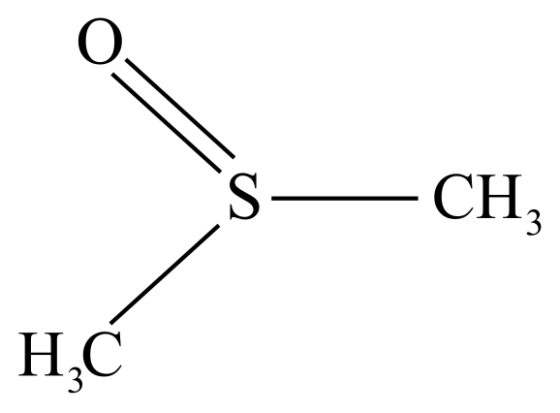
Dimethyl sulfoxide is not a polar solvent.
Polar aprotic solvent do not has the ability to donate the hydrogen atom. Therefore, dimethyl sulfoxide is a polar aprotic solvent.
Ans: Part 1The nucleophilic character of the halide ion is as follows:
Part 2
Dimethyl sulfoxide is a polar aprotic solvent.
Add Answer to:
Rank the relative nucleophilicity of halide ions in dimethyl
sulfoxide solution.
Rank the relative nucleophilicity of...
Rank the relative nucleophilicity of halide ions in acetone solution. Rank the relative nucleophilicity of halide...
 Rank the relative
nucleophilicity of halide ions in acetone solution.
Rank the relative nucleophilicity of halide ions in acetone solution. How is acetone classified?
Rank the relative
nucleophilicity of halide ions in acetone solution.
Rank the relative nucleophilicity of halide ions in acetone solution. How is acetone classified?
Rank the relative nucleophilicity of halide ions in acetic acid solution. Rank the relative nucleophilicity of...
 Rank the relative nucleophilicity of halide ions in acetic acid
solution.
Rank the relative nucleophilicity of halide ions in acetic acid solution, How is acetic acid classified?
Rank the relative nucleophilicity of halide ions in acetic acid
solution.
Rank the relative nucleophilicity of halide ions in acetic acid solution, How is acetic acid classified?
Rank the relative nucleophilicity of halide ions in acetonitrile solution. How is acetonitrile classified? a polar...
 Rank the relative nucleophilicity of halide ions in acetonitrile solution. How is acetonitrile classified? a polar aprotic solvent a polar protic solvent
Rank the relative nucleophilicity of the indicated species in water. Rank the relative nucleophilicity of the indicated...
 Rank the relative nucleophilicity of the indicated species in
water.
Rank the relative nucleophilicity of the indicated species in water.
Rank the relative nucleophilicity of the indicated species in
water.
Rank the relative nucleophilicity of the indicated species in water.
Rank the relative nucleophilicity of the indicated species in water. CH3COO-, CH3COOH, CH3O-, CH3OH, CH3S-
Rank the relative nucleophilicity of the indicated species in water. CH3COO-, CH3COOH, CH3O-, CH3OH, CH3S-
Rank the relative nucleophilicity of the indicated species in ethanol. CH3OH CH3S- CH3COOH CH3O- CH3COO-
Rank the relative nucleophilicity of the indicated species in ethanol. CH3OH CH3S- CH3COOH CH3O- CH3COO-
Rank the following halides in order of decreasing nucleophilicity in an aqueous solution, by entering a...
 Rank the following halides in order of decreasing nucleophilicity in an aqueous solution, by entering a ranking number (1-4) next to each structure (1-most nucleophilic).
What relative masses of dimethyl amine and dimethyl ammonium chloride do you need to prepare a...
What relative masses of dimethyl amine and dimethyl ammonium chloride do you need to prepare a buffer solution of pH = 10.19?
10. What is true about the relative concentrations of hydronium ions and hydroxide ions in each...
 10. What is true about the relative concentrations of hydronium ions and hydroxide ions in each of the following solutions? (Put in a >, < or = sign for each case.) neutral solution: (H,0") - [OH-], basic solution: [H30") - (OH)
2) Rank the nucleophiles given below based on high, mediocre, and low nucleophilicity and reason why...
 2) Rank the nucleophiles given below based on high, mediocre,
and low nucleophilicity and reason why based on their structures.
HO-CH3, H2N-CH3, KO-CH3, KO-C(CH3)3
Introduction Alkyl halides can be prepared from alcohols by reactions with hydrogen halides (HCI, HBr, or HI) via nucleophilic substitution. In this type of reaction, the nucleophile displaces a leaving group from a carbon atom of an organic substrate (here the alcohol once protonated). Both electrons of the new bond to the carbon are provided by...
2) Rank the nucleophiles given below based on high, mediocre,
and low nucleophilicity and reason why based on their structures.
HO-CH3, H2N-CH3, KO-CH3, KO-C(CH3)3
Introduction Alkyl halides can be prepared from alcohols by reactions with hydrogen halides (HCI, HBr, or HI) via nucleophilic substitution. In this type of reaction, the nucleophile displaces a leaving group from a carbon atom of an organic substrate (here the alcohol once protonated). Both electrons of the new bond to the carbon are provided by...
 Rank the relative
nucleophilicity of halide ions in acetone solution.
Rank the relative nucleophilicity of halide ions in acetone solution. How is acetone classified?
Rank the relative
nucleophilicity of halide ions in acetone solution.
Rank the relative nucleophilicity of halide ions in acetone solution. How is acetone classified?
 Rank the relative nucleophilicity of halide ions in acetic acid
solution.
Rank the relative nucleophilicity of halide ions in acetic acid solution, How is acetic acid classified?
Rank the relative nucleophilicity of halide ions in acetic acid
solution.
Rank the relative nucleophilicity of halide ions in acetic acid solution, How is acetic acid classified?
 Rank the relative nucleophilicity of halide ions in acetonitrile solution. How is acetonitrile classified? a polar aprotic solvent a polar protic solvent
 Rank the relative nucleophilicity of the indicated species in
water.
Rank the relative nucleophilicity of the indicated species in water.
Rank the relative nucleophilicity of the indicated species in
water.
Rank the relative nucleophilicity of the indicated species in water.
 Rank the following halides in order of decreasing nucleophilicity in an aqueous solution, by entering a ranking number (1-4) next to each structure (1-most nucleophilic).
 10. What is true about the relative concentrations of hydronium ions and hydroxide ions in each of the following solutions? (Put in a >, < or = sign for each case.) neutral solution: (H,0") - [OH-], basic solution: [H30") - (OH)
 2) Rank the nucleophiles given below based on high, mediocre,
and low nucleophilicity and reason why based on their structures.
HO-CH3, H2N-CH3, KO-CH3, KO-C(CH3)3
Introduction Alkyl halides can be prepared from alcohols by reactions with hydrogen halides (HCI, HBr, or HI) via nucleophilic substitution. In this type of reaction, the nucleophile displaces a leaving group from a carbon atom of an organic substrate (here the alcohol once protonated). Both electrons of the new bond to the carbon are provided by...
2) Rank the nucleophiles given below based on high, mediocre,
and low nucleophilicity and reason why based on their structures.
HO-CH3, H2N-CH3, KO-CH3, KO-C(CH3)3
Introduction Alkyl halides can be prepared from alcohols by reactions with hydrogen halides (HCI, HBr, or HI) via nucleophilic substitution. In this type of reaction, the nucleophile displaces a leaving group from a carbon atom of an organic substrate (here the alcohol once protonated). Both electrons of the new bond to the carbon are provided by...
Most questions answered within 3 hours.
-
Where is the error in this code sequence?
String s1 = "Hello";
String s2 = "ello";...
asked 11 months ago -
Financial data for Joel de Paris, Inc., for last year
follow:
Joel de Paris, Inc.
Balance...
asked 11 months ago -
Consider this reaction:
Al2(SO4)3 (aq)+ BaCl3
(aq) Al2Cl6 (aq)- +
3BaSO4(s) . What is the...
asked 11 months ago -
Suppose that Savneet is considering increasing her
recent random sample from 20 car rentals to 40...
asked 11 months ago -
Trucks arrive at an unloading terminal at an average rate of 120
per hour.
Trucks arrive...
asked 11 months ago -
Why are methanol and ethanol completely soluble in water while
octanol is not very little soluble....
asked 11 months ago -
A facilities manager at a university reads in a research report
that the mean amount of...
asked 11 months ago -
When the CuSO4 is rehydrated by adding water to the anhydrous
compound, is this an endothermic...
asked 11 months ago -
A ray of sunlight is passing from diamond into crown glass; the
angle of incidence is...
asked 11 months ago -
A block of mass 0.249 kg is placed on top of a light, vertical
spring of...
asked 11 months ago -
how do the kidneys compensate in the presences of acidosis
a) trigger hyperventilate
b) reserve acid...
asked 11 months ago -
Question 501 pts
The rental rate of capital to the firm increases. Which of the
following...
asked 11 months ago