Rank the relative nucleophilicity of the indicated species in water. CH3COO-, CH3COOH, CH3O-, CH3OH, CH3S-
Rank the relative nucleophilicity of the indicated species in water.
CH3COO-, CH3COOH, CH3O-, CH3OH, CH3S-
Homework Answers
First consider the nucleophilicity of these species without water as solvent :
* conjugate bases are more nucleophilic (more basic) than their equivalent neutral species.
therefore, CH3COO- > CH3COOH and CH3O- > CH3OH
* methoxide is stronger nucleophile than carboxylate because carboxylate is resonance stabilized therefore the lone pair of oxygen is less available for donation (attack on electrophilic carbon center).
CH3O- > CH3COO-
And as you move down along a group in periodic table, nucleophilicity increases because the atom size increases and therefore more polarizable
CH3S- > CH3O-
so overall the nucleophilicity order is as follows :
CH3COOH < CH3OH < CH3COO- < CH3CO- < CH3S-
Now water is polar protic solvent and can form hydrogen bond with nucleophiles and alter the nucleophilicity strength dramatically.
Methanol and acetic acid forms hydrogen bonds with water and completely miscible in water.
water solvates the CH3CO- by forming hydrogen bonds and now the nucleophile is less available for nucleophilic attack. Oxygen forms stronger H-bonds than Sulfar.
therefore, in these case the nucleophilicity order doesn't change and is as follows :
CH3COOH < CH3OH < CH3COO- < CH3CO- < CH3S-
Add Answer to:
Rank the relative nucleophilicity of the indicated species in
water.
CH3COO-, CH3COOH, CH3O-, CH3OH, CH3S-
Rank the relative nucleophilicity of the indicated species in ethanol. CH3OH CH3S- CH3COOH CH3O- CH3COO-
Rank the relative nucleophilicity of the indicated species in ethanol. CH3OH CH3S- CH3COOH CH3O- CH3COO-
Rank the relative nucleophilicity of the indicated species in water. Rank the relative nucleophilicity of the indicated...
 Rank the relative nucleophilicity of the indicated species in
water.
Rank the relative nucleophilicity of the indicated species in water.
Rank the relative nucleophilicity of the indicated species in
water.
Rank the relative nucleophilicity of the indicated species in water.
which is a stronger base in water? Ch3O-, or Ch3COO-? A) CH3O-, because the negative charge...
which is a stronger base in water? Ch3O-, or Ch3COO-? A) CH3O-, because the negative charge is localized on the oxygen making the species less stable and therefore a better proton acceptor. B) CH3O-, because the negative charge Is de-localized on the oxygen, making the species more stable and therefore less likely to accept a proton. C) CH3COO-, because the negative charge is de-localized over the two oxygens, making the species more stable and therefore less likely to accept a...
Rank the relative nucleophilicity of halide ions in acetone solution. Rank the relative nucleophilicity of halide...
 Rank the relative
nucleophilicity of halide ions in acetone solution.
Rank the relative nucleophilicity of halide ions in acetone solution. How is acetone classified?
Rank the relative
nucleophilicity of halide ions in acetone solution.
Rank the relative nucleophilicity of halide ions in acetone solution. How is acetone classified?
Rank the relative nucleophilicity of halide ions in dimethyl sulfoxide solution. Rank the relative nucleophilicity of...
 Rank the relative nucleophilicity of halide ions in dimethyl
sulfoxide solution.
Rank the relative nucleophilicity of halide ions in dimethl sulfoxide solution. How is dimethyl sulfoxide classified?
Rank the relative nucleophilicity of halide ions in dimethyl
sulfoxide solution.
Rank the relative nucleophilicity of halide ions in dimethl sulfoxide solution. How is dimethyl sulfoxide classified?
Rank the relative nucleophilicity of halide ions in acetic acid solution. Rank the relative nucleophilicity of...
 Rank the relative nucleophilicity of halide ions in acetic acid
solution.
Rank the relative nucleophilicity of halide ions in acetic acid solution, How is acetic acid classified?
Rank the relative nucleophilicity of halide ions in acetic acid
solution.
Rank the relative nucleophilicity of halide ions in acetic acid solution, How is acetic acid classified?
Consider titrating aqueous CH3COOH with aqueous NaOH (delivered from the burette). Other than water, which species...
Consider titrating aqueous CH3COOH with aqueous NaOH (delivered from the burette). Other than water, which species would exist at the equivalence point? a. CH3COOH b. CH3COO- c. OH- d. CH3COOH and CH3COO- e. OH- and CH3COOH
Rank the relative nucleophilicity of halide ions in acetonitrile solution. How is acetonitrile classified? a polar...
 Rank the relative nucleophilicity of halide ions in acetonitrile solution. How is acetonitrile classified? a polar aprotic solvent a polar protic solvent
The following equilibrium is established in water solution: CH3COOH + H20 = CH3COO +H30+ K a...
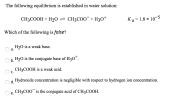 The following equilibrium is established in water solution: CH3COOH + H20 = CH3COO +H30+ K a = 1.8 x 10⁻⁵ Which of the following is false? a H20 is a weak base. b.H20 is the conjugate base of H30*. CH3COOH is a weak acid. O هنا Hydroxide concentration is negligible with respect to hydrogen ion concentration. e. CH3COO is the conjugate acid of CH3COOH.
Rank the following species in order of decreasing nucleophilicity (best to worst): CH2CH20 CH3CH2OH CH3CH2 CH3CO...
 Rank the following species in order of decreasing nucleophilicity (best to worst): CH2CH20 CH3CH2OH CH3CH2 CH3CO (A) 1>2>3>4 (C) 3>4>1>2 (B) 3>1>4>2 (D) 2>4>1>3
 Rank the relative nucleophilicity of the indicated species in
water.
Rank the relative nucleophilicity of the indicated species in water.
Rank the relative nucleophilicity of the indicated species in
water.
Rank the relative nucleophilicity of the indicated species in water.
 Rank the relative
nucleophilicity of halide ions in acetone solution.
Rank the relative nucleophilicity of halide ions in acetone solution. How is acetone classified?
Rank the relative
nucleophilicity of halide ions in acetone solution.
Rank the relative nucleophilicity of halide ions in acetone solution. How is acetone classified?
 Rank the relative nucleophilicity of halide ions in dimethyl
sulfoxide solution.
Rank the relative nucleophilicity of halide ions in dimethl sulfoxide solution. How is dimethyl sulfoxide classified?
Rank the relative nucleophilicity of halide ions in dimethyl
sulfoxide solution.
Rank the relative nucleophilicity of halide ions in dimethl sulfoxide solution. How is dimethyl sulfoxide classified?
 Rank the relative nucleophilicity of halide ions in acetic acid
solution.
Rank the relative nucleophilicity of halide ions in acetic acid solution, How is acetic acid classified?
Rank the relative nucleophilicity of halide ions in acetic acid
solution.
Rank the relative nucleophilicity of halide ions in acetic acid solution, How is acetic acid classified?
 Rank the relative nucleophilicity of halide ions in acetonitrile solution. How is acetonitrile classified? a polar aprotic solvent a polar protic solvent
 The following equilibrium is established in water solution: CH3COOH + H20 = CH3COO +H30+ K a = 1.8 x 10⁻⁵ Which of the following is false? a H20 is a weak base. b.H20 is the conjugate base of H30*. CH3COOH is a weak acid. O هنا Hydroxide concentration is negligible with respect to hydrogen ion concentration. e. CH3COO is the conjugate acid of CH3COOH.
 Rank the following species in order of decreasing nucleophilicity (best to worst): CH2CH20 CH3CH2OH CH3CH2 CH3CO (A) 1>2>3>4 (C) 3>4>1>2 (B) 3>1>4>2 (D) 2>4>1>3
Most questions answered within 3 hours.
-
Where is the error in this code sequence?
String s1 = "Hello";
String s2 = "ello";...
asked 11 months ago -
Financial data for Joel de Paris, Inc., for last year
follow:
Joel de Paris, Inc.
Balance...
asked 11 months ago -
Consider this reaction:
Al2(SO4)3 (aq)+ BaCl3
(aq) Al2Cl6 (aq)- +
3BaSO4(s) . What is the...
asked 11 months ago -
Suppose that Savneet is considering increasing her
recent random sample from 20 car rentals to 40...
asked 11 months ago -
Trucks arrive at an unloading terminal at an average rate of 120
per hour.
Trucks arrive...
asked 11 months ago -
Why are methanol and ethanol completely soluble in water while
octanol is not very little soluble....
asked 11 months ago -
A facilities manager at a university reads in a research report
that the mean amount of...
asked 11 months ago -
When the CuSO4 is rehydrated by adding water to the anhydrous
compound, is this an endothermic...
asked 11 months ago -
A ray of sunlight is passing from diamond into crown glass; the
angle of incidence is...
asked 11 months ago -
A block of mass 0.249 kg is placed on top of a light, vertical
spring of...
asked 11 months ago -
how do the kidneys compensate in the presences of acidosis
a) trigger hyperventilate
b) reserve acid...
asked 11 months ago -
Question 501 pts
The rental rate of capital to the firm increases. Which of the
following...
asked 11 months ago