
Homework Answers
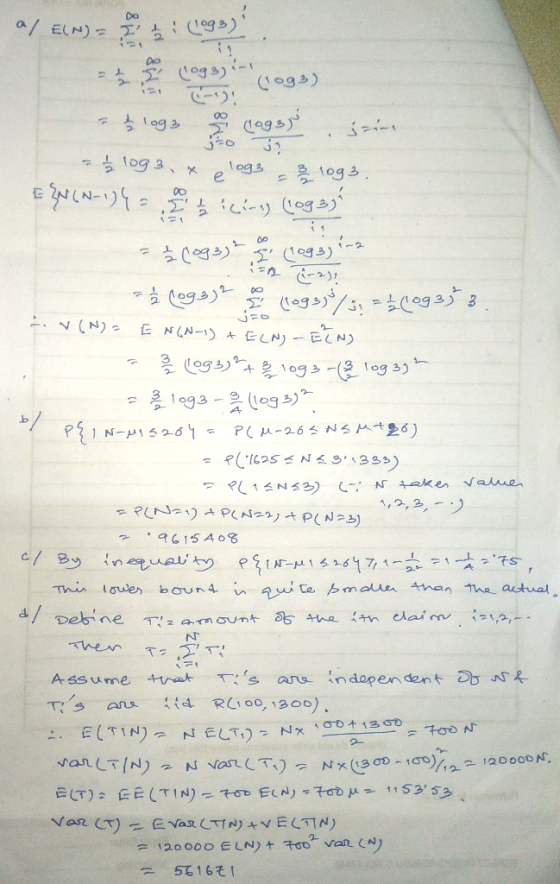
Cov((T,N)=E(TN)-E(T)E(N)=E{NE(T|N)}-E(T)E(N)=E(N*700N)-1153.53*1.6479
=700*{V(N)+E2(N)}-1153.53*1.6479
=700*(.7427+1.6479*1.6479)-1153.53*1.6479=519.89
corr(T,N)=519.89/[SD(T)SD(N)]=519.89/square root of (561671*.7427)= 0.8049404
For query, comment.
Add Answer to:
4. Suppose that N is a random variable having a conditional Poisson distribution with ability mass...
3.14. Problem*. (Section 10.4) Suppose that for a Poisson random variable N, the param- eter is...
 3.14. Problem*. (Section 10.4) Suppose that for a Poisson random variable N, the param- eter is not constant, rather, it an exponential random variable with parameter 1. (a) Find an expression for P(N = j). (b) Compute the conditional probability that i < 1 given that N = 2.
This is Probability and Statistics in Engineering and Science Please show your work! especially for part B A Poisson distribution with λ=2 X~Pois(2) A binomial distribution with n=10 and π=0.45. X~bin...
 This is Probability and Statistics in Engineering and
Science
Please show your work! especially for part B
A Poisson distribution with λ=2 X~Pois(2)
A binomial distribution with n=10 and π=0.45.
X~binom(10,0.45)
Question 4. An inequality developed by Russian mathematician Chebyshev gives the minimum percentage of values in ANY sample that can be found within some number (k21) standard deviations from the mean. Let P be the percentage of values within k standard deviations of the mean value. Chebyshev's inequality states...
This is Probability and Statistics in Engineering and
Science
Please show your work! especially for part B
A Poisson distribution with λ=2 X~Pois(2)
A binomial distribution with n=10 and π=0.45.
X~binom(10,0.45)
Question 4. An inequality developed by Russian mathematician Chebyshev gives the minimum percentage of values in ANY sample that can be found within some number (k21) standard deviations from the mean. Let P be the percentage of values within k standard deviations of the mean value. Chebyshev's inequality states...
The number of customers arriving at a fast food restaurant are modelled on a Poisson random...
 The number of customers arriving at a fast food restaurant are modelled on a Poisson random variable X with parameter A = 1. The total time that it takes to serve k customers, k> 1, is modelled on a continuous random variable T that is uniform in 0,k+ 1]. (a) (2 points) Compute the probability P(T 1 (b) (2 points) Compute the expected value of T
The number of customers arriving at a fast food restaurant are modelled on a...
The number of customers arriving at a fast food restaurant are modelled on a Poisson random variable X with parameter A = 1. The total time that it takes to serve k customers, k> 1, is modelled on a continuous random variable T that is uniform in 0,k+ 1]. (a) (2 points) Compute the probability P(T 1 (b) (2 points) Compute the expected value of T
The number of customers arriving at a fast food restaurant are modelled on a...
Question 3 (5101) Suppose that N ~ Poisson(A), and that X has a conditional distribution that...
 Question 3 (5101) Suppose that N ~ Poisson(A), and that X has a conditional distribution that depends on N. There are two possible models for this conditional distribution: . Model M: X|N=n~ N(2*n, o2 = 1) • Model M2: X|N=n~ N(2+n + n2,02 = 1) The only difference between M and M2 is the conditional mean function - the mean function is linear in M, and quadratic in M2. a If Mi is true: Find Ej[X] and V1 [X] as...
Question 3 (5101) Suppose that N ~ Poisson(2), and that X has a conditional distribution that...
 Question 3 (5101) Suppose that N ~ Poisson(2), and that X has a conditional distribution that depends on N. There are two possible models for this conditional distribution: • Model M: X|N=n~ N(2*n, 02 = 1) • Model M2: X|N=n~ N(2+n + n2,02 = 1) The only difference between M, and M2 is the conditional mean function - the mean function is linear in M, and quadratic in M2. a If M is true: Find E(X) and V. [X] as...
chebyshev’s inequality Problem 2 Chebyshev's Inequality Suppose that the random variable ? has a Poisson distribution...
 chebyshev’s inequality
Problem 2 Chebyshev's Inequality Suppose that the random variable ? has a Poisson distribution with the parameter ? > 0, ~ ?(A). Using the Chebyshev's inequality prove that Problem 3 - Application of the Chebyshev's Inequality Suppose that a player plays a game where he gains a dollar with the probability or loses a dollar with the probability . That is, his gain from one game can be modeled as a random variable fi, such that If the...
chebyshev’s inequality
Problem 2 Chebyshev's Inequality Suppose that the random variable ? has a Poisson distribution with the parameter ? > 0, ~ ?(A). Using the Chebyshev's inequality prove that Problem 3 - Application of the Chebyshev's Inequality Suppose that a player plays a game where he gains a dollar with the probability or loses a dollar with the probability . That is, his gain from one game can be modeled as a random variable fi, such that If the...
Suppose that N ~ Poisson(1), and that X has a conditional distribution that depends on N....
 Suppose that N ~ Poisson(1), and that X has a conditional distribution that depends on N. There are two possible models for this conditional distribution: • Model M1: X|N = n ~ N(2* n,o2 = 1) • Model M2: X|N = n ~ N(2*n+n2,02 = 1) The only difference between My and M2 is the conditional mean function - the mean function is linear in M1 and quadratic in M2. a If M1 is true: Find E1[X] and V1[X] as...
2. Let R be a continuous random variable with the following conditional distribution Rlo~N(0, o2) where...
 2. Let R be a continuous random variable with the following conditional distribution Rlo~N(0, o2) where o is a discrete valued random variable with the following distribution 1 P(o 1) P(o 100) =. 2 Compute the mean, variance and kurtosis of the random variable R. Hint: use the double expectation formula
2. Let R be a continuous random variable with the following conditional distribution Rlo~N(0, o2) where o is a discrete valued random variable with the following distribution 1 P(o...
2. Let R be a continuous random variable with the following conditional distribution Rlo~N(0, o2) where o is a discrete valued random variable with the following distribution 1 P(o 1) P(o 100) =. 2 Compute the mean, variance and kurtosis of the random variable R. Hint: use the double expectation formula
2. Let R be a continuous random variable with the following conditional distribution Rlo~N(0, o2) where o is a discrete valued random variable with the following distribution 1 P(o...
Recall that a discrete random variable X has Poisson distribution with parameter λ if the probability...
 Recall that a discrete random variable X has Poisson
distribution with parameter λ if the probability mass function of
X
Recall that a discrete random variable X has Poisson distribution with parameter λ if the probability mass function of X is r E 0,1,2,...) This distribution is often used to model the number of events which will occur in a given time span, given that λ such events occur on average a) Prove by direct computation that the mean of...
Recall that a discrete random variable X has Poisson
distribution with parameter λ if the probability mass function of
X
Recall that a discrete random variable X has Poisson distribution with parameter λ if the probability mass function of X is r E 0,1,2,...) This distribution is often used to model the number of events which will occur in a given time span, given that λ such events occur on average a) Prove by direct computation that the mean of...
4. Compare the Chebyshev inequality and the exact probability for the event X ->c as a function of c for the following cases. (a) X is a uniform random variable in the intervall-b, b (b) X is a bi...
 4. Compare the Chebyshev inequality and the exact probability for the event X ->c as a function of c for the following cases. (a) X is a uniform random variable in the intervall-b, b (b) X is a binomial random variable with n-10, p-05.
4. Compare the Chebyshev inequality and the exact probability for the event X ->c as a function of c for the following cases. (a) X is a uniform random variable in the intervall-b, b (b) X...
4. Compare the Chebyshev inequality and the exact probability for the event X ->c as a function of c for the following cases. (a) X is a uniform random variable in the intervall-b, b (b) X is a binomial random variable with n-10, p-05.
4. Compare the Chebyshev inequality and the exact probability for the event X ->c as a function of c for the following cases. (a) X is a uniform random variable in the intervall-b, b (b) X...
 3.14. Problem*. (Section 10.4) Suppose that for a Poisson random variable N, the param- eter is not constant, rather, it an exponential random variable with parameter 1. (a) Find an expression for P(N = j). (b) Compute the conditional probability that i < 1 given that N = 2.
 This is Probability and Statistics in Engineering and
Science
Please show your work! especially for part B
A Poisson distribution with λ=2 X~Pois(2)
A binomial distribution with n=10 and π=0.45.
X~binom(10,0.45)
Question 4. An inequality developed by Russian mathematician Chebyshev gives the minimum percentage of values in ANY sample that can be found within some number (k21) standard deviations from the mean. Let P be the percentage of values within k standard deviations of the mean value. Chebyshev's inequality states...
This is Probability and Statistics in Engineering and
Science
Please show your work! especially for part B
A Poisson distribution with λ=2 X~Pois(2)
A binomial distribution with n=10 and π=0.45.
X~binom(10,0.45)
Question 4. An inequality developed by Russian mathematician Chebyshev gives the minimum percentage of values in ANY sample that can be found within some number (k21) standard deviations from the mean. Let P be the percentage of values within k standard deviations of the mean value. Chebyshev's inequality states...
 The number of customers arriving at a fast food restaurant are modelled on a Poisson random variable X with parameter A = 1. The total time that it takes to serve k customers, k> 1, is modelled on a continuous random variable T that is uniform in 0,k+ 1]. (a) (2 points) Compute the probability P(T 1 (b) (2 points) Compute the expected value of T
The number of customers arriving at a fast food restaurant are modelled on a...
The number of customers arriving at a fast food restaurant are modelled on a Poisson random variable X with parameter A = 1. The total time that it takes to serve k customers, k> 1, is modelled on a continuous random variable T that is uniform in 0,k+ 1]. (a) (2 points) Compute the probability P(T 1 (b) (2 points) Compute the expected value of T
The number of customers arriving at a fast food restaurant are modelled on a...
 Question 3 (5101) Suppose that N ~ Poisson(A), and that X has a conditional distribution that depends on N. There are two possible models for this conditional distribution: . Model M: X|N=n~ N(2*n, o2 = 1) • Model M2: X|N=n~ N(2+n + n2,02 = 1) The only difference between M and M2 is the conditional mean function - the mean function is linear in M, and quadratic in M2. a If Mi is true: Find Ej[X] and V1 [X] as...
 Question 3 (5101) Suppose that N ~ Poisson(2), and that X has a conditional distribution that depends on N. There are two possible models for this conditional distribution: • Model M: X|N=n~ N(2*n, 02 = 1) • Model M2: X|N=n~ N(2+n + n2,02 = 1) The only difference between M, and M2 is the conditional mean function - the mean function is linear in M, and quadratic in M2. a If M is true: Find E(X) and V. [X] as...
 chebyshev’s inequality
Problem 2 Chebyshev's Inequality Suppose that the random variable ? has a Poisson distribution with the parameter ? > 0, ~ ?(A). Using the Chebyshev's inequality prove that Problem 3 - Application of the Chebyshev's Inequality Suppose that a player plays a game where he gains a dollar with the probability or loses a dollar with the probability . That is, his gain from one game can be modeled as a random variable fi, such that If the...
chebyshev’s inequality
Problem 2 Chebyshev's Inequality Suppose that the random variable ? has a Poisson distribution with the parameter ? > 0, ~ ?(A). Using the Chebyshev's inequality prove that Problem 3 - Application of the Chebyshev's Inequality Suppose that a player plays a game where he gains a dollar with the probability or loses a dollar with the probability . That is, his gain from one game can be modeled as a random variable fi, such that If the...
 Suppose that N ~ Poisson(1), and that X has a conditional distribution that depends on N. There are two possible models for this conditional distribution: • Model M1: X|N = n ~ N(2* n,o2 = 1) • Model M2: X|N = n ~ N(2*n+n2,02 = 1) The only difference between My and M2 is the conditional mean function - the mean function is linear in M1 and quadratic in M2. a If M1 is true: Find E1[X] and V1[X] as...
 2. Let R be a continuous random variable with the following conditional distribution Rlo~N(0, o2) where o is a discrete valued random variable with the following distribution 1 P(o 1) P(o 100) =. 2 Compute the mean, variance and kurtosis of the random variable R. Hint: use the double expectation formula
2. Let R be a continuous random variable with the following conditional distribution Rlo~N(0, o2) where o is a discrete valued random variable with the following distribution 1 P(o...
2. Let R be a continuous random variable with the following conditional distribution Rlo~N(0, o2) where o is a discrete valued random variable with the following distribution 1 P(o 1) P(o 100) =. 2 Compute the mean, variance and kurtosis of the random variable R. Hint: use the double expectation formula
2. Let R be a continuous random variable with the following conditional distribution Rlo~N(0, o2) where o is a discrete valued random variable with the following distribution 1 P(o...
 Recall that a discrete random variable X has Poisson
distribution with parameter λ if the probability mass function of
X
Recall that a discrete random variable X has Poisson distribution with parameter λ if the probability mass function of X is r E 0,1,2,...) This distribution is often used to model the number of events which will occur in a given time span, given that λ such events occur on average a) Prove by direct computation that the mean of...
Recall that a discrete random variable X has Poisson
distribution with parameter λ if the probability mass function of
X
Recall that a discrete random variable X has Poisson distribution with parameter λ if the probability mass function of X is r E 0,1,2,...) This distribution is often used to model the number of events which will occur in a given time span, given that λ such events occur on average a) Prove by direct computation that the mean of...
 4. Compare the Chebyshev inequality and the exact probability for the event X ->c as a function of c for the following cases. (a) X is a uniform random variable in the intervall-b, b (b) X is a binomial random variable with n-10, p-05.
4. Compare the Chebyshev inequality and the exact probability for the event X ->c as a function of c for the following cases. (a) X is a uniform random variable in the intervall-b, b (b) X...
4. Compare the Chebyshev inequality and the exact probability for the event X ->c as a function of c for the following cases. (a) X is a uniform random variable in the intervall-b, b (b) X is a binomial random variable with n-10, p-05.
4. Compare the Chebyshev inequality and the exact probability for the event X ->c as a function of c for the following cases. (a) X is a uniform random variable in the intervall-b, b (b) X...
Most questions answered within 3 hours.
-
Where is the error in this code sequence?
String s1 = "Hello";
String s2 = "ello";...
asked 11 months ago -
Financial data for Joel de Paris, Inc., for last year
follow:
Joel de Paris, Inc.
Balance...
asked 11 months ago -
Consider this reaction:
Al2(SO4)3 (aq)+ BaCl3
(aq) Al2Cl6 (aq)- +
3BaSO4(s) . What is the...
asked 11 months ago -
Suppose that Savneet is considering increasing her
recent random sample from 20 car rentals to 40...
asked 11 months ago -
Trucks arrive at an unloading terminal at an average rate of 120
per hour.
Trucks arrive...
asked 11 months ago -
Why are methanol and ethanol completely soluble in water while
octanol is not very little soluble....
asked 11 months ago -
A facilities manager at a university reads in a research report
that the mean amount of...
asked 11 months ago -
When the CuSO4 is rehydrated by adding water to the anhydrous
compound, is this an endothermic...
asked 11 months ago -
A ray of sunlight is passing from diamond into crown glass; the
angle of incidence is...
asked 11 months ago -
A block of mass 0.249 kg is placed on top of a light, vertical
spring of...
asked 11 months ago -
how do the kidneys compensate in the presences of acidosis
a) trigger hyperventilate
b) reserve acid...
asked 11 months ago -
Question 501 pts
The rental rate of capital to the firm increases. Which of the
following...
asked 11 months ago