This problem is about "Modeling with Itô Stochastic Differential Equations - E. Allen"

Please explain every thing.
Please write in the paper and then take a photo.
Homework Answers
Add Answer to:
This problem is about "Modeling with Itô Stochastic
Differential Equations - E. Allen"
Please explain every...
This problem is about "Modeling with Itô Stochastic Differential Equations - E. Allen" Please explain every...
 This problem is about "Modeling with Itô Stochastic
Differential Equations - E. Allen"
Please explain every thing.
Please write in the paper and then take a photo.
1.5. Let X1, X2, X3 be independent and identically distributed with the prob- ability Show that E(Y1Y2) / E(Y1) E(Y2) and thus infer that Yı and Y2 independent measure defined in Exercise 1.4. Let Yi = X1 +X2 and Y2 = X2 - X3 are not
1.5. Let X1, X2, X3 be independent...
This problem is about "Modeling with Itô Stochastic
Differential Equations - E. Allen"
Please explain every thing.
Please write in the paper and then take a photo.
1.5. Let X1, X2, X3 be independent and identically distributed with the prob- ability Show that E(Y1Y2) / E(Y1) E(Y2) and thus infer that Yı and Y2 independent measure defined in Exercise 1.4. Let Yi = X1 +X2 and Y2 = X2 - X3 are not
1.5. Let X1, X2, X3 be independent...
This problem is about "Modeling with Itô Stochastic Differential Equations - E. Allen" Please explain every...
 This problem is about "Modeling with Itô Stochastic Differential
Equations - E. Allen"
Please explain every thing.
Please write in the paper and then take a photo.
1.1. Consider the random experiment of rolling one die. (a) Find the sample space N (b) Carefully determine the o-algebra, A, of sets generated by A1 and A2 2, 3} (c) Define a probability {1,2} measure P on the sample space 2.
1.1. Consider the random experiment of rolling one die. (a) Find...
This problem is about "Modeling with Itô Stochastic Differential
Equations - E. Allen"
Please explain every thing.
Please write in the paper and then take a photo.
1.1. Consider the random experiment of rolling one die. (a) Find the sample space N (b) Carefully determine the o-algebra, A, of sets generated by A1 and A2 2, 3} (c) Define a probability {1,2} measure P on the sample space 2.
1.1. Consider the random experiment of rolling one die. (a) Find...
This problem is about Probability. Please explain every thing. Please write in the paper and the...
 This problem is about Probability.
Please explain every thing.
Please write in the paper and then take high quality photos.
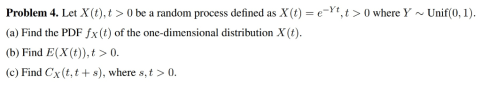
Problem 4. Let X(t),t >0 be a random process defined as X(t) e-Yt,t> 0 where Y~Unif(0,1) (a) Find the PDF fx(t) of the one-dimensional distribution X(t) (b) Find E(X(t)),t> 0 (c) Find Cx(t,t+s), where s,t > 0
Problem 4. Let X(t),t >0 be a random process defined as X(t) e-Yt,t> 0 where Y~Unif(0,1) (a) Find the PDF fx(t) of the...
This problem is about Probability.
Please explain every thing.
Please write in the paper and then take high quality photos.
Problem 4. Let X(t),t >0 be a random process defined as X(t) e-Yt,t> 0 where Y~Unif(0,1) (a) Find the PDF fx(t) of the one-dimensional distribution X(t) (b) Find E(X(t)),t> 0 (c) Find Cx(t,t+s), where s,t > 0
Problem 4. Let X(t),t >0 be a random process defined as X(t) e-Yt,t> 0 where Y~Unif(0,1) (a) Find the PDF fx(t) of the...
Please answer ALL parts of the question. Will rate immediately!! Thank you!! 3. Modeling with Differential Equations a. Provide slope fields for the following differential equations: DE#1: y'-y-c...
 Please answer ALL parts of the question. Will rate immediately!!
Thank you!!
3. Modeling with Differential Equations a. Provide slope fields for the following differential equations: DE#1: y'-y-cos x; DE#3: y'-y-cos y. (4pts) DE#2: y-x-cos y, b. For each slope field, draw the solution curve for the initial condition y(0) 1. (4pts) Attach separate pages c. Use Euler's method to estimate y(2), using steps of h 0.5 and h0.1 '-y cosx,y(0)-1 You can use technology. Write your results accurate to...
Please answer ALL parts of the question. Will rate immediately!!
Thank you!!
3. Modeling with Differential Equations a. Provide slope fields for the following differential equations: DE#1: y'-y-cos x; DE#3: y'-y-cos y. (4pts) DE#2: y-x-cos y, b. For each slope field, draw the solution curve for the initial condition y(0) 1. (4pts) Attach separate pages c. Use Euler's method to estimate y(2), using steps of h 0.5 and h0.1 '-y cosx,y(0)-1 You can use technology. Write your results accurate to...
PLEASE USE MATLAB! Thank you in advance! Problem 4: Consider the following system differential equations for...
 PLEASE USE MATLAB!
Thank you in advance!
Problem 4: Consider the following system differential equations for a plug flow reactor ar,=-2k,C,'; F,(0) = 2 dV dV dV where k 0.25, k2 0.05 and Cr-1. If you were to solve this system of differential equation using the Euler Method determine the values of F, FB, F for the first two iterations of the procedure. Use a sample period of 0
PLEASE USE MATLAB!
Thank you in advance!
Problem 4: Consider the following system differential equations for a plug flow reactor ar,=-2k,C,'; F,(0) = 2 dV dV dV where k 0.25, k2 0.05 and Cr-1. If you were to solve this system of differential equation using the Euler Method determine the values of F, FB, F for the first two iterations of the procedure. Use a sample period of 0
Please answer a. - e. You are given a homogeneous system of first-order linear differential equations...
 Please answer a. - e.
You are given a homogeneous system of first-order linear differential equations and two vector- valued functions, x(1) and x(2). <=(3 – )x;x") = (*), * x(2) (*)+-0) a. Show that the given functions are solutions of the given system of differential equations. b. Show that x = C1X(1) + czx(2) is also a solution of the given system for any values of cı and c2. c. Show that the given functions form a fundamental set...
Please answer a. - e.
You are given a homogeneous system of first-order linear differential equations and two vector- valued functions, x(1) and x(2). <=(3 – )x;x") = (*), * x(2) (*)+-0) a. Show that the given functions are solutions of the given system of differential equations. b. Show that x = C1X(1) + czx(2) is also a solution of the given system for any values of cı and c2. c. Show that the given functions form a fundamental set...
Can someone please explain to me the solution to this problem! I don't understand the solution,...
 Can someone please explain to me the solution to this
problem! I don't understand the solution, I just need a detail
explanation step by step so I can understand this problem with all
the subparts! Thanks!
3.5 Find the power spectrum for each of the following wide-sense stationary random processes that have the given autocorrelation sequences (a) rx(k) 26(k)j8(k -1)-j(k+1) (b) T(k)(k)2(0.5) (c) T(k)26(k)+cos(Tk/4) (d) rx(k)=' 10 k k< 10 ; otherwise Solutioin (a) This autocorrelation sequence is finite in...
Can someone please explain to me the solution to this
problem! I don't understand the solution, I just need a detail
explanation step by step so I can understand this problem with all
the subparts! Thanks!
3.5 Find the power spectrum for each of the following wide-sense stationary random processes that have the given autocorrelation sequences (a) rx(k) 26(k)j8(k -1)-j(k+1) (b) T(k)(k)2(0.5) (c) T(k)26(k)+cos(Tk/4) (d) rx(k)=' 10 k k< 10 ; otherwise Solutioin (a) This autocorrelation sequence is finite in...
Hello! I need help with this college level differential equations question. Please show work and ...
 Hello! I need help with this
college level differential equations question. Please show work and
thank you.
3. Consider the initial value problem y' (t) 1 0y(t) y(0) Clearly, the solution to the system is y(t) = et and 2(t) = e-10 t. Suppose we tried solving the system using forward Euler. This would give us with to 0, y(to) 1, and z(to-1. a. Show that the numerical solution for z(t) will only tend to zero if Δι < 2...
Hello! I need help with this
college level differential equations question. Please show work and
thank you.
3. Consider the initial value problem y' (t) 1 0y(t) y(0) Clearly, the solution to the system is y(t) = et and 2(t) = e-10 t. Suppose we tried solving the system using forward Euler. This would give us with to 0, y(to) 1, and z(to-1. a. Show that the numerical solution for z(t) will only tend to zero if Δι < 2...
Julius D. Cagampang's question: This is a solving problem with the use of the differential equations....
 Julius D. Cagampang's question:
This is a solving problem with the use of the differential
equations. Help me to answer this. Thank you.
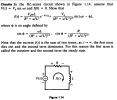
Circuits In the RL-series circuit shown in Figure 1.14, assume that V(t) = V, sin wt and I(0) = 0. Show that Vowl I(t) Ve e-RT/L+ sin (wt - o), R? + w?L? (R? + w?L?)12 = = where 0 is an angle defined by wL R sin cos (R? + w?L?)12) (R+ w?L?)12 Note that the...
Julius D. Cagampang's question:
This is a solving problem with the use of the differential
equations. Help me to answer this. Thank you.
Circuits In the RL-series circuit shown in Figure 1.14, assume that V(t) = V, sin wt and I(0) = 0. Show that Vowl I(t) Ve e-RT/L+ sin (wt - o), R? + w?L? (R? + w?L?)12 = = where 0 is an angle defined by wL R sin cos (R? + w?L?)12) (R+ w?L?)12 Note that the...
I only need help with d, e, and f. Can you please explain especially d in...
 I only need help with d, e, and f. Can you
please explain especially d in detail? Thank
you
1. Here you will prove the famous identity that 1 1 1 3+5+7+ Do not use the Ratio Test anywhere in this question. (a) Express h as a power series centered at 0. Determine its interval of convergence. Hint: This should be short. (b) Let S(:) be the Taylor series of arctan x at 0. Without computing S(2), briefly explain why...
I only need help with d, e, and f. Can you
please explain especially d in detail? Thank
you
1. Here you will prove the famous identity that 1 1 1 3+5+7+ Do not use the Ratio Test anywhere in this question. (a) Express h as a power series centered at 0. Determine its interval of convergence. Hint: This should be short. (b) Let S(:) be the Taylor series of arctan x at 0. Without computing S(2), briefly explain why...
 This problem is about "Modeling with Itô Stochastic
Differential Equations - E. Allen"
Please explain every thing.
Please write in the paper and then take a photo.
1.5. Let X1, X2, X3 be independent and identically distributed with the prob- ability Show that E(Y1Y2) / E(Y1) E(Y2) and thus infer that Yı and Y2 independent measure defined in Exercise 1.4. Let Yi = X1 +X2 and Y2 = X2 - X3 are not
1.5. Let X1, X2, X3 be independent...
This problem is about "Modeling with Itô Stochastic
Differential Equations - E. Allen"
Please explain every thing.
Please write in the paper and then take a photo.
1.5. Let X1, X2, X3 be independent and identically distributed with the prob- ability Show that E(Y1Y2) / E(Y1) E(Y2) and thus infer that Yı and Y2 independent measure defined in Exercise 1.4. Let Yi = X1 +X2 and Y2 = X2 - X3 are not
1.5. Let X1, X2, X3 be independent...
 This problem is about "Modeling with Itô Stochastic Differential
Equations - E. Allen"
Please explain every thing.
Please write in the paper and then take a photo.
1.1. Consider the random experiment of rolling one die. (a) Find the sample space N (b) Carefully determine the o-algebra, A, of sets generated by A1 and A2 2, 3} (c) Define a probability {1,2} measure P on the sample space 2.
1.1. Consider the random experiment of rolling one die. (a) Find...
This problem is about "Modeling with Itô Stochastic Differential
Equations - E. Allen"
Please explain every thing.
Please write in the paper and then take a photo.
1.1. Consider the random experiment of rolling one die. (a) Find the sample space N (b) Carefully determine the o-algebra, A, of sets generated by A1 and A2 2, 3} (c) Define a probability {1,2} measure P on the sample space 2.
1.1. Consider the random experiment of rolling one die. (a) Find...
 This problem is about Probability.
Please explain every thing.
Please write in the paper and then take high quality photos.
Problem 4. Let X(t),t >0 be a random process defined as X(t) e-Yt,t> 0 where Y~Unif(0,1) (a) Find the PDF fx(t) of the one-dimensional distribution X(t) (b) Find E(X(t)),t> 0 (c) Find Cx(t,t+s), where s,t > 0
Problem 4. Let X(t),t >0 be a random process defined as X(t) e-Yt,t> 0 where Y~Unif(0,1) (a) Find the PDF fx(t) of the...
This problem is about Probability.
Please explain every thing.
Please write in the paper and then take high quality photos.
Problem 4. Let X(t),t >0 be a random process defined as X(t) e-Yt,t> 0 where Y~Unif(0,1) (a) Find the PDF fx(t) of the one-dimensional distribution X(t) (b) Find E(X(t)),t> 0 (c) Find Cx(t,t+s), where s,t > 0
Problem 4. Let X(t),t >0 be a random process defined as X(t) e-Yt,t> 0 where Y~Unif(0,1) (a) Find the PDF fx(t) of the...
 Please answer ALL parts of the question. Will rate immediately!!
Thank you!!
3. Modeling with Differential Equations a. Provide slope fields for the following differential equations: DE#1: y'-y-cos x; DE#3: y'-y-cos y. (4pts) DE#2: y-x-cos y, b. For each slope field, draw the solution curve for the initial condition y(0) 1. (4pts) Attach separate pages c. Use Euler's method to estimate y(2), using steps of h 0.5 and h0.1 '-y cosx,y(0)-1 You can use technology. Write your results accurate to...
Please answer ALL parts of the question. Will rate immediately!!
Thank you!!
3. Modeling with Differential Equations a. Provide slope fields for the following differential equations: DE#1: y'-y-cos x; DE#3: y'-y-cos y. (4pts) DE#2: y-x-cos y, b. For each slope field, draw the solution curve for the initial condition y(0) 1. (4pts) Attach separate pages c. Use Euler's method to estimate y(2), using steps of h 0.5 and h0.1 '-y cosx,y(0)-1 You can use technology. Write your results accurate to...
 PLEASE USE MATLAB!
Thank you in advance!
Problem 4: Consider the following system differential equations for a plug flow reactor ar,=-2k,C,'; F,(0) = 2 dV dV dV where k 0.25, k2 0.05 and Cr-1. If you were to solve this system of differential equation using the Euler Method determine the values of F, FB, F for the first two iterations of the procedure. Use a sample period of 0
PLEASE USE MATLAB!
Thank you in advance!
Problem 4: Consider the following system differential equations for a plug flow reactor ar,=-2k,C,'; F,(0) = 2 dV dV dV where k 0.25, k2 0.05 and Cr-1. If you were to solve this system of differential equation using the Euler Method determine the values of F, FB, F for the first two iterations of the procedure. Use a sample period of 0
 Please answer a. - e.
You are given a homogeneous system of first-order linear differential equations and two vector- valued functions, x(1) and x(2). <=(3 – )x;x") = (*), * x(2) (*)+-0) a. Show that the given functions are solutions of the given system of differential equations. b. Show that x = C1X(1) + czx(2) is also a solution of the given system for any values of cı and c2. c. Show that the given functions form a fundamental set...
Please answer a. - e.
You are given a homogeneous system of first-order linear differential equations and two vector- valued functions, x(1) and x(2). <=(3 – )x;x") = (*), * x(2) (*)+-0) a. Show that the given functions are solutions of the given system of differential equations. b. Show that x = C1X(1) + czx(2) is also a solution of the given system for any values of cı and c2. c. Show that the given functions form a fundamental set...
 Can someone please explain to me the solution to this
problem! I don't understand the solution, I just need a detail
explanation step by step so I can understand this problem with all
the subparts! Thanks!
3.5 Find the power spectrum for each of the following wide-sense stationary random processes that have the given autocorrelation sequences (a) rx(k) 26(k)j8(k -1)-j(k+1) (b) T(k)(k)2(0.5) (c) T(k)26(k)+cos(Tk/4) (d) rx(k)=' 10 k k< 10 ; otherwise Solutioin (a) This autocorrelation sequence is finite in...
Can someone please explain to me the solution to this
problem! I don't understand the solution, I just need a detail
explanation step by step so I can understand this problem with all
the subparts! Thanks!
3.5 Find the power spectrum for each of the following wide-sense stationary random processes that have the given autocorrelation sequences (a) rx(k) 26(k)j8(k -1)-j(k+1) (b) T(k)(k)2(0.5) (c) T(k)26(k)+cos(Tk/4) (d) rx(k)=' 10 k k< 10 ; otherwise Solutioin (a) This autocorrelation sequence is finite in...
 Hello! I need help with this
college level differential equations question. Please show work and
thank you.
3. Consider the initial value problem y' (t) 1 0y(t) y(0) Clearly, the solution to the system is y(t) = et and 2(t) = e-10 t. Suppose we tried solving the system using forward Euler. This would give us with to 0, y(to) 1, and z(to-1. a. Show that the numerical solution for z(t) will only tend to zero if Δι < 2...
Hello! I need help with this
college level differential equations question. Please show work and
thank you.
3. Consider the initial value problem y' (t) 1 0y(t) y(0) Clearly, the solution to the system is y(t) = et and 2(t) = e-10 t. Suppose we tried solving the system using forward Euler. This would give us with to 0, y(to) 1, and z(to-1. a. Show that the numerical solution for z(t) will only tend to zero if Δι < 2...
 Julius D. Cagampang's question:
This is a solving problem with the use of the differential
equations. Help me to answer this. Thank you.
Circuits In the RL-series circuit shown in Figure 1.14, assume that V(t) = V, sin wt and I(0) = 0. Show that Vowl I(t) Ve e-RT/L+ sin (wt - o), R? + w?L? (R? + w?L?)12 = = where 0 is an angle defined by wL R sin cos (R? + w?L?)12) (R+ w?L?)12 Note that the...
Julius D. Cagampang's question:
This is a solving problem with the use of the differential
equations. Help me to answer this. Thank you.
Circuits In the RL-series circuit shown in Figure 1.14, assume that V(t) = V, sin wt and I(0) = 0. Show that Vowl I(t) Ve e-RT/L+ sin (wt - o), R? + w?L? (R? + w?L?)12 = = where 0 is an angle defined by wL R sin cos (R? + w?L?)12) (R+ w?L?)12 Note that the...
 I only need help with d, e, and f. Can you
please explain especially d in detail? Thank
you
1. Here you will prove the famous identity that 1 1 1 3+5+7+ Do not use the Ratio Test anywhere in this question. (a) Express h as a power series centered at 0. Determine its interval of convergence. Hint: This should be short. (b) Let S(:) be the Taylor series of arctan x at 0. Without computing S(2), briefly explain why...
I only need help with d, e, and f. Can you
please explain especially d in detail? Thank
you
1. Here you will prove the famous identity that 1 1 1 3+5+7+ Do not use the Ratio Test anywhere in this question. (a) Express h as a power series centered at 0. Determine its interval of convergence. Hint: This should be short. (b) Let S(:) be the Taylor series of arctan x at 0. Without computing S(2), briefly explain why...
Most questions answered within 3 hours.
-
Where is the error in this code sequence?
String s1 = "Hello";
String s2 = "ello";...
asked 1 year ago -
Financial data for Joel de Paris, Inc., for last year
follow:
Joel de Paris, Inc.
Balance...
asked 1 year ago -
Consider this reaction:
Al2(SO4)3 (aq)+ BaCl3
(aq) Al2Cl6 (aq)- +
3BaSO4(s) . What is the...
asked 1 year ago -
Suppose that Savneet is considering increasing her
recent random sample from 20 car rentals to 40...
asked 1 year ago -
Trucks arrive at an unloading terminal at an average rate of 120
per hour.
Trucks arrive...
asked 1 year ago -
Why are methanol and ethanol completely soluble in water while
octanol is not very little soluble....
asked 1 year ago -
A facilities manager at a university reads in a research report
that the mean amount of...
asked 1 year ago -
When the CuSO4 is rehydrated by adding water to the anhydrous
compound, is this an endothermic...
asked 1 year ago -
A ray of sunlight is passing from diamond into crown glass; the
angle of incidence is...
asked 1 year ago -
A block of mass 0.249 kg is placed on top of a light, vertical
spring of...
asked 1 year ago -
how do the kidneys compensate in the presences of acidosis
a) trigger hyperventilate
b) reserve acid...
asked 1 year ago -
Question 501 pts
The rental rate of capital to the firm increases. Which of the
following...
asked 1 year ago