
Homework Answers
Sol :-
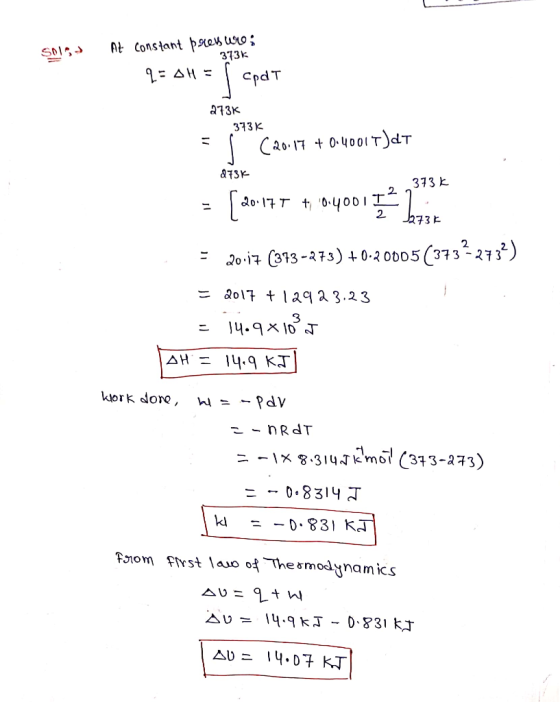

Add Answer to:
(b) The constant-pressure heat capacity of a sample of 1 00 mol of a perfect gas...
The molar heat capacity at constant pressure Cp,m of certain ideal gas was found to vary...
 The molar heat capacity at constant pressure Cp,m of
certain ideal gas was found to vary according to the
expression
Cp,m = co + ciT, where co = 6.723 J K-1 mol-1 and cı = 0.1222 J K-2 mol-1 are constants peculiar to the gas. Calculate q, w, AU, and AH for a system comprising 3.0 mol of the gas undergoing the following reversible transformations: (a) the temperature of the gas is raised from 25.00°C to 100°C at constant pressure....
The molar heat capacity at constant pressure Cp,m of
certain ideal gas was found to vary according to the
expression
Cp,m = co + ciT, where co = 6.723 J K-1 mol-1 and cı = 0.1222 J K-2 mol-1 are constants peculiar to the gas. Calculate q, w, AU, and AH for a system comprising 3.0 mol of the gas undergoing the following reversible transformations: (a) the temperature of the gas is raised from 25.00°C to 100°C at constant pressure....
1 00 mol of a perfect gas initially at 1 00 atm and 298 K with...
 1 00 mol of a perfect gas initially at 1 00 atm and 298 K with Cpm (7/2) R is put through the following cycle () constant-volume heating to twice its initial temperature (u) reversible, adiabatic expansion back to its onginal temperature () reversible, isothermal compression back to 1 00 atm Calculate q, w, AU, and AH for each of the steps ()-(m) above Hints First calculate AU, then q AH easily follows Remember the meaning of an adiabatic process...
The molar heat capacity at constant pressure for water vapor varies with temperature according the equation:...
The molar heat capacity at constant pressure for water vapor varies with temperature according the equation: Cp / J.K mol-1 = 30.54 + 0.0103T/K Calculate the first law parameters (w, q, ΔU, and ΔH) when one mole of water vapor behaving as an ideal gas is heated at constant volume from 25° C to 200° C.
Nitrous oxide (N2O) behaves as an ideal gas and has a heat capacity at constant pressure...
Nitrous oxide (N2O) behaves as an ideal gas and has a heat capacity at constant pressure CP = 38.6 J/K∙mol. 4.2 moles of N2O initially at 298 K are heated at constant pressure until a final temperature of 358 K is reached. (a) Calculate the enthalpy change of N2O during that process. (b) Calculate the heat transfer Q during that process. (c) Calculate the work W performed during that process. (d) Calculate the change in internal energy ΔU during that...
(b) Consider an adiabatic, reversible expansion of 0 020 mol Ar (perfect gas), initially at 25...
 (b) Consider an adiabatic, reversible expansion of 0 020 mol Ar (perfect gas), initially at 25 C, from 0 50 L to 1 00 L The molar heat capacity of argon is, Cvm 12 48 J K mol- Calculate the work (w) done and heat transferred (q) for this process HINT first calculate the final temperature under the adiabatic, reversible expansion process (8)
(b) Consider an adiabatic, reversible expansion of 0 020 mol Ar (perfect gas), initially at 25 C,...
(b) Consider an adiabatic, reversible expansion of 0 020 mol Ar (perfect gas), initially at 25 C, from 0 50 L to 1 00 L The molar heat capacity of argon is, Cvm 12 48 J K mol- Calculate the work (w) done and heat transferred (q) for this process HINT first calculate the final temperature under the adiabatic, reversible expansion process (8)
(b) Consider an adiabatic, reversible expansion of 0 020 mol Ar (perfect gas), initially at 25 C,...
A sample of 1.00 mol perfect gas molecules
A sample of 1.00 mol perfect gas molecules with Cp,m = 7/2 R is put through the following cycle:(a) Constant-volume heating to twice its initial volume,(b) Reversible, adiabatic expansion back to its initial temperature,(c) Reversible isothermal compression back to 1.00 atm. Calculate q, w, ?U, and ?H for each step and overall.
Heat Capacity of a Gas at Constant Pressure A system comprised of 5.500x101 g of Ar(g)...
 Heat Capacity of a Gas at Constant Pressure A system comprised of 5.500x101 g of Ar(g) cools from 165.0°C to 30.0°C at a constant pressure of 3.0 atm. The molar heat capacity at constant pressure for Ar(g) is 20.80 J K-1 mol-1. Calculate q. 1pts Submit Answer Tries 0/5 Calculate w 1pts Submit Answer Tries 0/5 Calculate ΔΕ. 1 pts Submit Answer Tries 0/5 Calculate ΔΗ. 1pts Submit Answer Tries 0/5
Need work step by step please! Heat Capacity of a Gas at Constant Pressure A system...
 Need work step by step please!
Heat Capacity of a Gas at Constant Pressure A system comprised of 1.900x100 g of C2H6(9) cools from 180.0°C to 45.0°C at a constant pressure of 2.5 atm. The molar heat capacity at constant pressure for C2H6(9) is 52.92 J K-1 mol-1. Calculate q. 1 pts Submit Answer Tries 0/5 Calculate w. 1 pts Submit Answer Tries 0/5 Calculate ΔΕ. 1pts Submit Answer Tries 0/5 Calculate ΔΗ. 1pts Submit Answer Tries 0/5
Need work step by step please!
Heat Capacity of a Gas at Constant Pressure A system comprised of 1.900x100 g of C2H6(9) cools from 180.0°C to 45.0°C at a constant pressure of 2.5 atm. The molar heat capacity at constant pressure for C2H6(9) is 52.92 J K-1 mol-1. Calculate q. 1 pts Submit Answer Tries 0/5 Calculate w. 1 pts Submit Answer Tries 0/5 Calculate ΔΕ. 1pts Submit Answer Tries 0/5 Calculate ΔΗ. 1pts Submit Answer Tries 0/5
The constant pressure molar heat capacity of argon is 20.79 J K-1 mol-1 at 298 K....
The constant pressure molar heat capacity of argon is 20.79 J K-1 mol-1 at 298 K. Predict the value of the constant volume molar heat capacity of argon at this temperature.
Heat Capacity of a Gas at Constant Pressure A system comprised of 7.900×101 g of H2(g)...
 Heat Capacity of a Gas at Constant Pressure
A system comprised of 7.900×101 g of
H2(g) cools from 170.0°C to
35.0°C at a constant pressure of 4.5
atm.
The molar heat capacity at constant pressure for
H2(g) is 28.86 J K−1
mol−1.
a) Calculate q.
b) Calculate w.
c) Calculate
.
d) Calculate
.
Note - for part a) I have tried -1.54*10^5 J, 1.54*10^5 J and
-3.08*10^5 J (these are all wrong). I'm on my last try, please
help!
Heat Capacity of a Gas at Constant Pressure
A system comprised of 7.900×101 g of
H2(g) cools from 170.0°C to
35.0°C at a constant pressure of 4.5
atm.
The molar heat capacity at constant pressure for
H2(g) is 28.86 J K−1
mol−1.
a) Calculate q.
b) Calculate w.
c) Calculate
.
d) Calculate
.
Note - for part a) I have tried -1.54*10^5 J, 1.54*10^5 J and
-3.08*10^5 J (these are all wrong). I'm on my last try, please
help!
 The molar heat capacity at constant pressure Cp,m of
certain ideal gas was found to vary according to the
expression
Cp,m = co + ciT, where co = 6.723 J K-1 mol-1 and cı = 0.1222 J K-2 mol-1 are constants peculiar to the gas. Calculate q, w, AU, and AH for a system comprising 3.0 mol of the gas undergoing the following reversible transformations: (a) the temperature of the gas is raised from 25.00°C to 100°C at constant pressure....
The molar heat capacity at constant pressure Cp,m of
certain ideal gas was found to vary according to the
expression
Cp,m = co + ciT, where co = 6.723 J K-1 mol-1 and cı = 0.1222 J K-2 mol-1 are constants peculiar to the gas. Calculate q, w, AU, and AH for a system comprising 3.0 mol of the gas undergoing the following reversible transformations: (a) the temperature of the gas is raised from 25.00°C to 100°C at constant pressure....
 1 00 mol of a perfect gas initially at 1 00 atm and 298 K with Cpm (7/2) R is put through the following cycle () constant-volume heating to twice its initial temperature (u) reversible, adiabatic expansion back to its onginal temperature () reversible, isothermal compression back to 1 00 atm Calculate q, w, AU, and AH for each of the steps ()-(m) above Hints First calculate AU, then q AH easily follows Remember the meaning of an adiabatic process...
 (b) Consider an adiabatic, reversible expansion of 0 020 mol Ar (perfect gas), initially at 25 C, from 0 50 L to 1 00 L The molar heat capacity of argon is, Cvm 12 48 J K mol- Calculate the work (w) done and heat transferred (q) for this process HINT first calculate the final temperature under the adiabatic, reversible expansion process (8)
(b) Consider an adiabatic, reversible expansion of 0 020 mol Ar (perfect gas), initially at 25 C,...
(b) Consider an adiabatic, reversible expansion of 0 020 mol Ar (perfect gas), initially at 25 C, from 0 50 L to 1 00 L The molar heat capacity of argon is, Cvm 12 48 J K mol- Calculate the work (w) done and heat transferred (q) for this process HINT first calculate the final temperature under the adiabatic, reversible expansion process (8)
(b) Consider an adiabatic, reversible expansion of 0 020 mol Ar (perfect gas), initially at 25 C,...
 Heat Capacity of a Gas at Constant Pressure A system comprised of 5.500x101 g of Ar(g) cools from 165.0°C to 30.0°C at a constant pressure of 3.0 atm. The molar heat capacity at constant pressure for Ar(g) is 20.80 J K-1 mol-1. Calculate q. 1pts Submit Answer Tries 0/5 Calculate w 1pts Submit Answer Tries 0/5 Calculate ΔΕ. 1 pts Submit Answer Tries 0/5 Calculate ΔΗ. 1pts Submit Answer Tries 0/5
 Need work step by step please!
Heat Capacity of a Gas at Constant Pressure A system comprised of 1.900x100 g of C2H6(9) cools from 180.0°C to 45.0°C at a constant pressure of 2.5 atm. The molar heat capacity at constant pressure for C2H6(9) is 52.92 J K-1 mol-1. Calculate q. 1 pts Submit Answer Tries 0/5 Calculate w. 1 pts Submit Answer Tries 0/5 Calculate ΔΕ. 1pts Submit Answer Tries 0/5 Calculate ΔΗ. 1pts Submit Answer Tries 0/5
Need work step by step please!
Heat Capacity of a Gas at Constant Pressure A system comprised of 1.900x100 g of C2H6(9) cools from 180.0°C to 45.0°C at a constant pressure of 2.5 atm. The molar heat capacity at constant pressure for C2H6(9) is 52.92 J K-1 mol-1. Calculate q. 1 pts Submit Answer Tries 0/5 Calculate w. 1 pts Submit Answer Tries 0/5 Calculate ΔΕ. 1pts Submit Answer Tries 0/5 Calculate ΔΗ. 1pts Submit Answer Tries 0/5
Most questions answered within 3 hours.
-
Where is the error in this code sequence?
String s1 = "Hello";
String s2 = "ello";...
asked 11 months ago -
Financial data for Joel de Paris, Inc., for last year
follow:
Joel de Paris, Inc.
Balance...
asked 11 months ago -
Consider this reaction:
Al2(SO4)3 (aq)+ BaCl3
(aq) Al2Cl6 (aq)- +
3BaSO4(s) . What is the...
asked 11 months ago -
Suppose that Savneet is considering increasing her
recent random sample from 20 car rentals to 40...
asked 11 months ago -
Trucks arrive at an unloading terminal at an average rate of 120
per hour.
Trucks arrive...
asked 11 months ago -
Why are methanol and ethanol completely soluble in water while
octanol is not very little soluble....
asked 11 months ago -
A facilities manager at a university reads in a research report
that the mean amount of...
asked 11 months ago -
When the CuSO4 is rehydrated by adding water to the anhydrous
compound, is this an endothermic...
asked 11 months ago -
A ray of sunlight is passing from diamond into crown glass; the
angle of incidence is...
asked 11 months ago -
A block of mass 0.249 kg is placed on top of a light, vertical
spring of...
asked 11 months ago -
how do the kidneys compensate in the presences of acidosis
a) trigger hyperventilate
b) reserve acid...
asked 11 months ago -
Question 501 pts
The rental rate of capital to the firm increases. Which of the
following...
asked 11 months ago