
Homework Answers
Add Answer to:
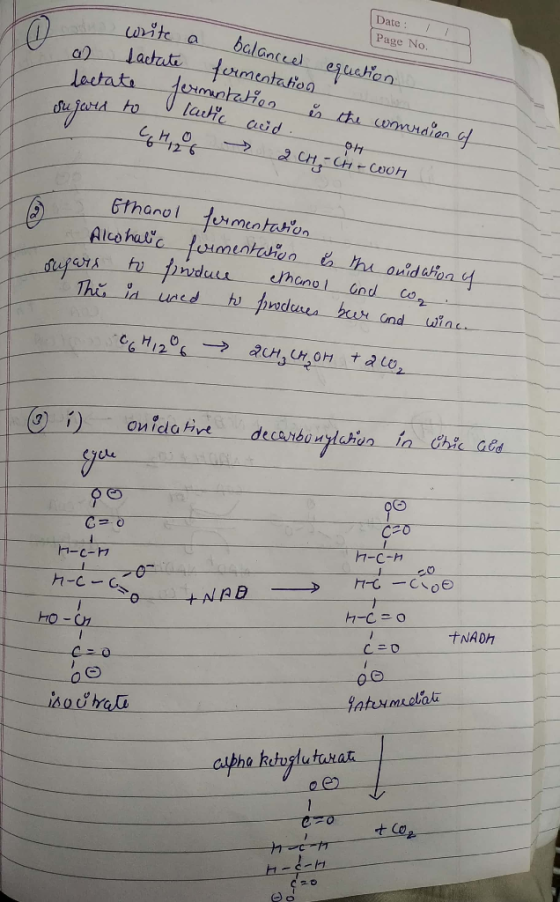
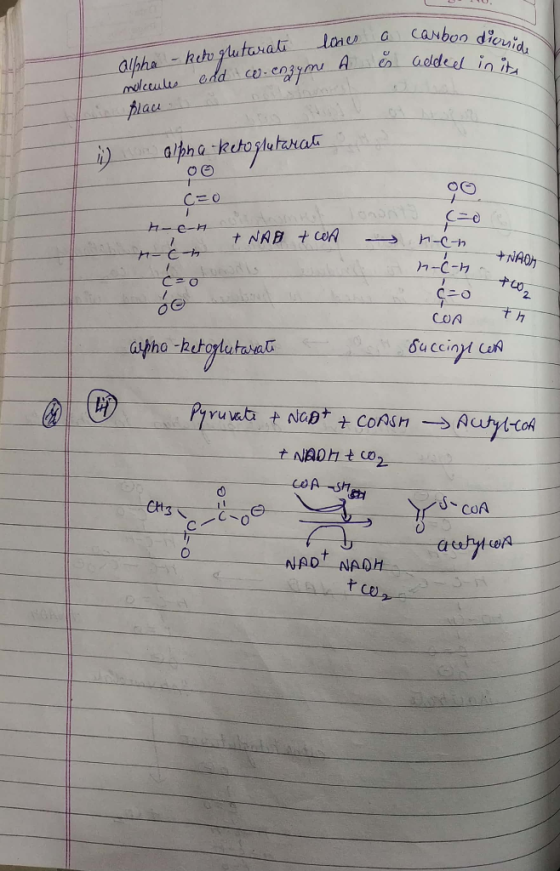
2) Write a balanced equation for each the following pathways a) Lactate Fermentation b) Ethanol fermentation...
QUESTION 1 Which of the following processes/pathways CANNOT occur in the absence of O2? Oxidative phosphorylation...
QUESTION 1 Which of the following processes/pathways CANNOT occur in the absence of O2? Oxidative phosphorylation Substrate level phosphorylation Oxidation of NADH Photosynthesis Fermentation 1 points QUESTION 2 Phosphofructokinase (PFK-1) is one of the most regulated enzymes in metabolism. Which of the following would be expected to be an allosteric inhibitor of PFK-1? Glucose Fructose-6-phosphate Acetyl CoA AMP 1 points QUESTION 3 Which of the following is a reactant of the first reaction of glycolysis? Glucose ADP ATP...
3. (30 pts) Fermentation Pathways: Write out the balanced chemical reaction for each of the following...
 3. (30 pts) Fermentation Pathways: Write out the balanced chemical reaction for each of the following reactions listed, in accordance with the appropriate pathway given in Figure P3.1 on the next page. In each case, write only one reaction without intermediates. You may need to include hydrogen ions or molecular hydrogen, carbon dioxide, oxygen, the acetyl group or water to balance the reactions a. Pyruvic acid (CH,COCOOH) > isopropanol (CH,CHOHCH,) b. Pyruvic acid (CH,COCOOH) 2,3-butanediol (CH,CHOHCHOHCH)
Fatty acids can fuel the citric acid cycle through a process called _______ to produce _______
 Fatty acids can fuel the citric acid cycle through a process called _______ to produce _______ A. beta-oxidation; pyruvate B. None of these answers are correct C. beta-oxidation; acetyl-CoA D. fermentation; ethanol E. oxidative phosphorylation; citrate F. oxidative phosphorylation; NADH G. fermentation; lactate
Read the following choices and identify the one that is NOT correct. (A) Aerobically, oxidative decarboxylation...
 Read the following choices and identify the one that is NOT correct. (A) Aerobically, oxidative decarboxylation of pyruvate forms acetate that enters the citric acid cycle. (B) In anaerobic muscle, pyruvate is converted to lactate. (C) In yeast growing anaerobically, pyruvate is converted to ethanol. (D) Reduction of pyruvate to lactate regenerates a cofactor essential for glycolysis. (E) Under anaerobic conditions pyruvate does not form because glycolysis does not occur.
3 20 The conversion pyruvate to either ethanol or lactate occurs A. when there is an abundance of pyruvate but a deficiency of onygen B. when there is an abundance of BOTH pyruvate and oxygen C....
 3 20 The conversion pyruvate to either ethanol or lactate occurs A. when there is an abundance of pyruvate but a deficiency of onygen B. when there is an abundance of BOTH pyruvate and oxygen C. when there is a deficiency of BOTH pyruvate and oxygen D. for the regeneration of NADH so that hydrolysis of ATP can continue to fuel the glycolysis pathway Explain how gluconeogenesis differs from gtycolysis 21 Gluconeogenesis is simply the reverse of all 10 steps...
1- Consider the fermentation pathways of Clostridium as diagrammed. A common goal of metabolic engineering is...
 1- Consider the fermentation pathways of Clostridium as diagrammed. A common goal of metabolic engineering is to focus the metabolism of the cell to yield just one or two primary products rather than the entire spectrum of products. Which of the following overall outcomes (these are not balanced reactions) could be metabolically engineered while preserving a balanced redox state (NAD+/NADH ratio)? Write Yes or No in the blank. 2ADP - 2ATP + Hexose I 2 Pyruvate NAD NADH 2 CO2...
tospan Student Name: Grader Name Instruction: Starting with a single glucose in a yeast cell, please...
 tospan Student Name: Grader Name Instruction: Starting with a single glucose in a yeast cell, please fill in the following table according to what happened during aerobic cellular respiration or fermentation. Make sure that you includes proper numbers of each chemical used or produced from a single glucose molecule 02 Chemicals Used or Produced FAD+/FADH2 NADP+/NADPH X х CO2 Location Cytoplasm H2O Starting Ending ADP/ATP NAD+/NADH 1 Glucose 2 Pyruvate 2ATPs->4ATP 2 NAD+->2NADH х х Pathways Glycolysis Transition Step (Connecting...
Energetics: fermentation. In fermentation reactions, "good" electron acceptors (like O_2 and NO_3^-) are unavailable. In ethanol...
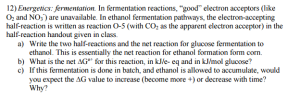 Energetics: fermentation. In fermentation reactions, "good" electron acceptors (like O_2 and NO_3^-) are unavailable. In ethanol fermentation pathways, the electron-accepting half-reaction is written as reaction 0-5 (with CO_2 as the apparent electron acceptor) in the half-reaction handout given in class. a) Write the two half-reactions and the net reaction for glucose fermentation to ethanol. This is essentially the net reaction for ethanol formation form corn. b) What is the net Delta G degree' for this reaction, in kJ/e- eq and...
25. Which of the following process takes place only in the stroma of chloroplast? (a) Calvin...
 25. Which of the following process takes place only in the stroma of chloroplast? (a) Calvin cycle (c) Glycolysis (b) Krebs cycle (d) chemiosmosis 26. The citric acid cycle can produce (a) NADH (c) FAD (b) FADH; (d) both a and b 27. The alcohol fermentation produces (a) ethanol only (c) ethanol and CO2 (b) lactate only (d) lactate and CO2 28. Which of the following polymers of glucose is! used as a vehicle to store energy reserves in animal...
Ethanol, used in alcoholic beverages, can be produced by fermentation of sucrose. The balanced equation for...
 Ethanol, used in alcoholic beverages, can be produced by fermentation of sucrose. The balanced equation for the fermentation process is shown below. What mass of ethanol (C2H5OH) would be produced when 2.02 g sucrose reacts by this process? C12H22011()H0()-4 C^H20H) + 4 CO2(g) g
 3. (30 pts) Fermentation Pathways: Write out the balanced chemical reaction for each of the following reactions listed, in accordance with the appropriate pathway given in Figure P3.1 on the next page. In each case, write only one reaction without intermediates. You may need to include hydrogen ions or molecular hydrogen, carbon dioxide, oxygen, the acetyl group or water to balance the reactions a. Pyruvic acid (CH,COCOOH) > isopropanol (CH,CHOHCH,) b. Pyruvic acid (CH,COCOOH) 2,3-butanediol (CH,CHOHCHOHCH)
 Fatty acids can fuel the citric acid cycle through a process called _______ to produce _______ A. beta-oxidation; pyruvate B. None of these answers are correct C. beta-oxidation; acetyl-CoA D. fermentation; ethanol E. oxidative phosphorylation; citrate F. oxidative phosphorylation; NADH G. fermentation; lactate
 Read the following choices and identify the one that is NOT correct. (A) Aerobically, oxidative decarboxylation of pyruvate forms acetate that enters the citric acid cycle. (B) In anaerobic muscle, pyruvate is converted to lactate. (C) In yeast growing anaerobically, pyruvate is converted to ethanol. (D) Reduction of pyruvate to lactate regenerates a cofactor essential for glycolysis. (E) Under anaerobic conditions pyruvate does not form because glycolysis does not occur.
 3 20 The conversion pyruvate to either ethanol or lactate occurs A. when there is an abundance of pyruvate but a deficiency of onygen B. when there is an abundance of BOTH pyruvate and oxygen C. when there is a deficiency of BOTH pyruvate and oxygen D. for the regeneration of NADH so that hydrolysis of ATP can continue to fuel the glycolysis pathway Explain how gluconeogenesis differs from gtycolysis 21 Gluconeogenesis is simply the reverse of all 10 steps...
 1- Consider the fermentation pathways of Clostridium as diagrammed. A common goal of metabolic engineering is to focus the metabolism of the cell to yield just one or two primary products rather than the entire spectrum of products. Which of the following overall outcomes (these are not balanced reactions) could be metabolically engineered while preserving a balanced redox state (NAD+/NADH ratio)? Write Yes or No in the blank. 2ADP - 2ATP + Hexose I 2 Pyruvate NAD NADH 2 CO2...
 tospan Student Name: Grader Name Instruction: Starting with a single glucose in a yeast cell, please fill in the following table according to what happened during aerobic cellular respiration or fermentation. Make sure that you includes proper numbers of each chemical used or produced from a single glucose molecule 02 Chemicals Used or Produced FAD+/FADH2 NADP+/NADPH X х CO2 Location Cytoplasm H2O Starting Ending ADP/ATP NAD+/NADH 1 Glucose 2 Pyruvate 2ATPs->4ATP 2 NAD+->2NADH х х Pathways Glycolysis Transition Step (Connecting...
 Energetics: fermentation. In fermentation reactions, "good" electron acceptors (like O_2 and NO_3^-) are unavailable. In ethanol fermentation pathways, the electron-accepting half-reaction is written as reaction 0-5 (with CO_2 as the apparent electron acceptor) in the half-reaction handout given in class. a) Write the two half-reactions and the net reaction for glucose fermentation to ethanol. This is essentially the net reaction for ethanol formation form corn. b) What is the net Delta G degree' for this reaction, in kJ/e- eq and...
 25. Which of the following process takes place only in the stroma of chloroplast? (a) Calvin cycle (c) Glycolysis (b) Krebs cycle (d) chemiosmosis 26. The citric acid cycle can produce (a) NADH (c) FAD (b) FADH; (d) both a and b 27. The alcohol fermentation produces (a) ethanol only (c) ethanol and CO2 (b) lactate only (d) lactate and CO2 28. Which of the following polymers of glucose is! used as a vehicle to store energy reserves in animal...
 Ethanol, used in alcoholic beverages, can be produced by fermentation of sucrose. The balanced equation for the fermentation process is shown below. What mass of ethanol (C2H5OH) would be produced when 2.02 g sucrose reacts by this process? C12H22011()H0()-4 C^H20H) + 4 CO2(g) g
Most questions answered within 3 hours.
-
Where is the error in this code sequence?
String s1 = "Hello";
String s2 = "ello";...
asked 1 year ago -
Financial data for Joel de Paris, Inc., for last year
follow:
Joel de Paris, Inc.
Balance...
asked 1 year ago -
Consider this reaction:
Al2(SO4)3 (aq)+ BaCl3
(aq) Al2Cl6 (aq)- +
3BaSO4(s) . What is the...
asked 1 year ago -
Suppose that Savneet is considering increasing her
recent random sample from 20 car rentals to 40...
asked 1 year ago -
Trucks arrive at an unloading terminal at an average rate of 120
per hour.
Trucks arrive...
asked 1 year ago -
Why are methanol and ethanol completely soluble in water while
octanol is not very little soluble....
asked 1 year ago -
A facilities manager at a university reads in a research report
that the mean amount of...
asked 1 year ago -
When the CuSO4 is rehydrated by adding water to the anhydrous
compound, is this an endothermic...
asked 1 year ago -
A ray of sunlight is passing from diamond into crown glass; the
angle of incidence is...
asked 1 year ago -
A block of mass 0.249 kg is placed on top of a light, vertical
spring of...
asked 1 year ago -
how do the kidneys compensate in the presences of acidosis
a) trigger hyperventilate
b) reserve acid...
asked 1 year ago -
Question 501 pts
The rental rate of capital to the firm increases. Which of the
following...
asked 1 year ago