
Homework Answers
Add Answer to:
Prelab IV: Parallel Circuit Analysis
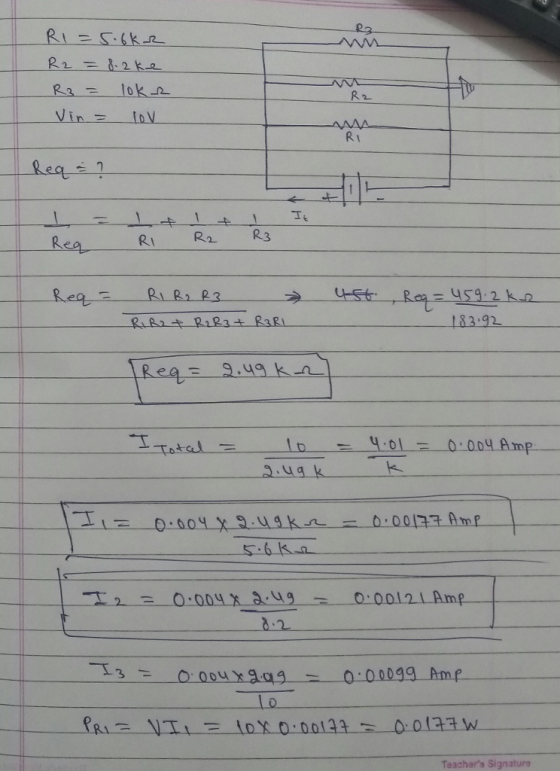
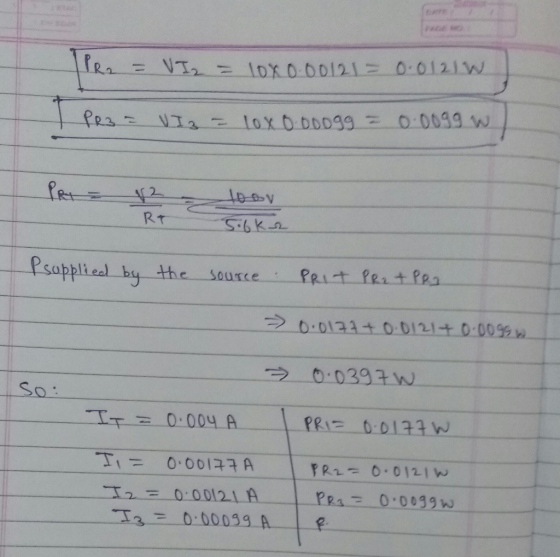
Prelab IV: Parallel Circuit Analysis Vin-10V Ri-5.6k2 R2-8.2k2 VT Calculate the...
Please answer clearly 2. Consider the circuit shown in Figure 1. Determine values of Ri, R2, and Rc to provide the quie...
 Please answer clearly
2. Consider the circuit shown in Figure 1. Determine values of Ri, R2, and Rc to provide the quiescent emitter current 1.5 mA and the quiescent collector to emitter voltage 5V. Assume β 100, Re-I㏀、Va= 200V, VBEon-0.7V, and VT= 25mV. R1 Rc Vcc に 10v R2 Re Figure 1: BJT biasing configuration
2. Consider the circuit shown in Figure 1. Determine values of Ri, R2, and Rc to provide the quiescent emitter current 1.5 mA and the...
Please answer clearly
2. Consider the circuit shown in Figure 1. Determine values of Ri, R2, and Rc to provide the quiescent emitter current 1.5 mA and the quiescent collector to emitter voltage 5V. Assume β 100, Re-I㏀、Va= 200V, VBEon-0.7V, and VT= 25mV. R1 Rc Vcc に 10v R2 Re Figure 1: BJT biasing configuration
2. Consider the circuit shown in Figure 1. Determine values of Ri, R2, and Rc to provide the quiescent emitter current 1.5 mA and the...
For the circuit of Figure 1, choose values for resistors R1, R2, and R3
 C.la For the circuit of Figure 1, choose values for resistors R1, R2, and R3(all resistances must be greater than one Kilo ohm). Given that the voltage source Vs1 = 8V and Vs2 = 10V determine the output voltage Vout. C.1b For the same resistor values Ri, R2, and Rs you chose in part C.la Given that the voltage source Vsi = 8V and Vs2 = 10V, use Figure 2(a) to determine the output voltage Vout/ and Figure 2(b) to determine the output voltage Vout2. Discussion:...
Use measured resistance values and node analysis to calculate the node voltages. Use measured resistance values...
 Use measured resistance values and node analysis to calculate
the node voltages.
Use measured resistance values and mesh analysis to calculate
the mesh currents.
Show that the calculated values agree with the measured values
and explain any discrepancies between measured and calculated
values.
Introduction: In this pre-lab we will look at node voltages, mesh currents and bridge circuits. Bridge Circuits are used to make precision measurements, and in this lab -- -0 V2 will look at a DC Bridge Circuit...
Use measured resistance values and node analysis to calculate
the node voltages.
Use measured resistance values and mesh analysis to calculate
the mesh currents.
Show that the calculated values agree with the measured values
and explain any discrepancies between measured and calculated
values.
Introduction: In this pre-lab we will look at node voltages, mesh currents and bridge circuits. Bridge Circuits are used to make precision measurements, and in this lab -- -0 V2 will look at a DC Bridge Circuit...
4) RLC parallel circuits R1 R2 500 1E-2 1E-8 U2 1500 In the above circuit, the...
 4) RLC parallel circuits R1 R2 500 1E-2 1E-8 U2 1500 In the above circuit, the source turns on at t-0 with a voltage of 10V. Additionally, switch U1 is closed and switch U2 is open. At 15E-6 s switch U1 opens and switch U2 closes. The source also tuns off at 15E-6 s a. Use Laplace analysis to determine the voltage across the capacitor as a function of time for 0<t< 15E-6 (s) b. Use Laplace analysis to determine...
Prelab 10.1: Active lowpass filter Given the circuit shown in Figure 10.1 with Ri-R2-Rs-R4-R-1.0 [k2, and...
 Prelab 10.1: Active lowpass filter Given the circuit shown in Figure 10.1 with Ri-R2-Rs-R4-R-1.0 [k2, and C 0.1 [uF (a) Represent the circuit in state-space form given by i(t) = ar(t) + bu(t), i.e., find the values of parameters a, b, c, and d. (b) Find the expression for the transfer function, G(s) the complex frequency (Laplace) domain. (c) Find the expression of the frequency transfer function H(f) and the value of the half power frequency, fB in Hz (d)...
i)draw the transafer charcheristics for this circuit? ii)Derive expressions for VTH and VTL? iii)Let L+ = - L- = 10 V, and R1=1 k Ω , choose R2 in order to get a hysteresis of 100mV width? iv).An engi...
 i)draw the transafer
charcheristics for this circuit?
ii)Derive expressions for VTH and VTL?
iii)Let L+ = - L- = 10 V, and R1=1 k Ω , choose R2 in order to
get a hysteresis of
100mV width?
iv).An engineer decided to modify the given circuit by
disconnecting the inverting
input of the op-amp from the ground and connecting it to a constant
voltage
source Vx. Derive expressions for VTH and VTL and Draw the transfer
characteristics in this case.?
Question...
i)draw the transafer
charcheristics for this circuit?
ii)Derive expressions for VTH and VTL?
iii)Let L+ = - L- = 10 V, and R1=1 k Ω , choose R2 in order to
get a hysteresis of
100mV width?
iv).An engineer decided to modify the given circuit by
disconnecting the inverting
input of the op-amp from the ground and connecting it to a constant
voltage
source Vx. Derive expressions for VTH and VTL and Draw the transfer
characteristics in this case.?
Question...
Determine the current through R3=50Ω in the circuit shown in (Figure 1), where vs=60V, R1=30Ω, R2=30Ω,...
 Determine the current through R3=50Ω in the circuit shown in
(Figure 1), where vs=60V, R1=30Ω, R2=30Ω, and R4=60Ω. Express your
answer in amperes to three significant figures.
I need both parts A and B please
▼ Part B Determine the current through R3-50 Ω in the circuit shown in Figure 1), where us Rs 60 S2 Express your answer in amperes to three significant figures. Review 60 V. R-30 Ω. R2 30 Ω, and Learning Goal: To determine the voltage,...
Determine the current through R3=50Ω in the circuit shown in
(Figure 1), where vs=60V, R1=30Ω, R2=30Ω, and R4=60Ω. Express your
answer in amperes to three significant figures.
I need both parts A and B please
▼ Part B Determine the current through R3-50 Ω in the circuit shown in Figure 1), where us Rs 60 S2 Express your answer in amperes to three significant figures. Review 60 V. R-30 Ω. R2 30 Ω, and Learning Goal: To determine the voltage,...
2. (2000) Electromagnetics (DC Circuit) Problem a. Calculate the voltages across all resistors and the currents through all the resistors and voltage sources in the following circuit using Kirchhoff&...
 2. (2000) Electromagnetics (DC Circuit) Problem a. Calculate the voltages across all resistors and the currents through all the resistors and voltage sources in the following circuit using Kirchhoff's junction rule (nodal analysis). Show the directions initially assumed for the junction (node) currents. Use the minimum number of junctions (nodes) necessary to accomplish this b. Calculate the power dissipation in each resistor and the sum (or total) of these individual power dissipation values c. Calculate the power associated with each...
Determine the voltage across resistor R2=40ΩR2=40Ω in the circuit shown in (Figure 1), where vs=60Vvs=60V, R1=20ΩR1=20Ω,...
 Determine the voltage across resistor R2=40ΩR2=40Ω in the
circuit shown in (Figure 1), where vs=60Vvs=60V, R1=20ΩR1=20Ω,
R3=30ΩR3=30Ω, and R4=40Ω
Question 6 Part A Determine the voltage across resistor R2 = 40 2 in the circuit shown in (Figure 1), where us = 60 V, R1 = 20 12 R3 = 30 12, and R4 = 40 12 Express your answer in volts to three significant figures. View Available Hint(s) Learning Goal: To determine the voltage, current, and power of circuit...
Determine the voltage across resistor R2=40ΩR2=40Ω in the
circuit shown in (Figure 1), where vs=60Vvs=60V, R1=20ΩR1=20Ω,
R3=30ΩR3=30Ω, and R4=40Ω
Question 6 Part A Determine the voltage across resistor R2 = 40 2 in the circuit shown in (Figure 1), where us = 60 V, R1 = 20 12 R3 = 30 12, and R4 = 40 12 Express your answer in volts to three significant figures. View Available Hint(s) Learning Goal: To determine the voltage, current, and power of circuit...
It's a simple circuit analysis with actually a few questions. But i'm confused of some basic...
 It's a simple circuit analysis with actually a few questions.
But i'm confused of some basic circuit principals and concepts. I
hope you can explian it in detail... Thx a million!
(1) why i3 is going this way? i usually see in this kind of
graph i3 usually go to the negative side of the battery. Is this
graph's direction prescribed?
So in this graph, the battery is supplying power (left circuit)
and absorbing power (right circuit) at the same...
It's a simple circuit analysis with actually a few questions.
But i'm confused of some basic circuit principals and concepts. I
hope you can explian it in detail... Thx a million!
(1) why i3 is going this way? i usually see in this kind of
graph i3 usually go to the negative side of the battery. Is this
graph's direction prescribed?
So in this graph, the battery is supplying power (left circuit)
and absorbing power (right circuit) at the same...
 Please answer clearly
2. Consider the circuit shown in Figure 1. Determine values of Ri, R2, and Rc to provide the quiescent emitter current 1.5 mA and the quiescent collector to emitter voltage 5V. Assume β 100, Re-I㏀、Va= 200V, VBEon-0.7V, and VT= 25mV. R1 Rc Vcc に 10v R2 Re Figure 1: BJT biasing configuration
2. Consider the circuit shown in Figure 1. Determine values of Ri, R2, and Rc to provide the quiescent emitter current 1.5 mA and the...
Please answer clearly
2. Consider the circuit shown in Figure 1. Determine values of Ri, R2, and Rc to provide the quiescent emitter current 1.5 mA and the quiescent collector to emitter voltage 5V. Assume β 100, Re-I㏀、Va= 200V, VBEon-0.7V, and VT= 25mV. R1 Rc Vcc に 10v R2 Re Figure 1: BJT biasing configuration
2. Consider the circuit shown in Figure 1. Determine values of Ri, R2, and Rc to provide the quiescent emitter current 1.5 mA and the...
 C.la For the circuit of Figure 1, choose values for resistors R1, R2, and R3(all resistances must be greater than one Kilo ohm). Given that the voltage source Vs1 = 8V and Vs2 = 10V determine the output voltage Vout. C.1b For the same resistor values Ri, R2, and Rs you chose in part C.la Given that the voltage source Vsi = 8V and Vs2 = 10V, use Figure 2(a) to determine the output voltage Vout/ and Figure 2(b) to determine the output voltage Vout2. Discussion:...
 Use measured resistance values and node analysis to calculate
the node voltages.
Use measured resistance values and mesh analysis to calculate
the mesh currents.
Show that the calculated values agree with the measured values
and explain any discrepancies between measured and calculated
values.
Introduction: In this pre-lab we will look at node voltages, mesh currents and bridge circuits. Bridge Circuits are used to make precision measurements, and in this lab -- -0 V2 will look at a DC Bridge Circuit...
Use measured resistance values and node analysis to calculate
the node voltages.
Use measured resistance values and mesh analysis to calculate
the mesh currents.
Show that the calculated values agree with the measured values
and explain any discrepancies between measured and calculated
values.
Introduction: In this pre-lab we will look at node voltages, mesh currents and bridge circuits. Bridge Circuits are used to make precision measurements, and in this lab -- -0 V2 will look at a DC Bridge Circuit...
 4) RLC parallel circuits R1 R2 500 1E-2 1E-8 U2 1500 In the above circuit, the source turns on at t-0 with a voltage of 10V. Additionally, switch U1 is closed and switch U2 is open. At 15E-6 s switch U1 opens and switch U2 closes. The source also tuns off at 15E-6 s a. Use Laplace analysis to determine the voltage across the capacitor as a function of time for 0<t< 15E-6 (s) b. Use Laplace analysis to determine...
 Prelab 10.1: Active lowpass filter Given the circuit shown in Figure 10.1 with Ri-R2-Rs-R4-R-1.0 [k2, and C 0.1 [uF (a) Represent the circuit in state-space form given by i(t) = ar(t) + bu(t), i.e., find the values of parameters a, b, c, and d. (b) Find the expression for the transfer function, G(s) the complex frequency (Laplace) domain. (c) Find the expression of the frequency transfer function H(f) and the value of the half power frequency, fB in Hz (d)...
 i)draw the transafer
charcheristics for this circuit?
ii)Derive expressions for VTH and VTL?
iii)Let L+ = - L- = 10 V, and R1=1 k Ω , choose R2 in order to
get a hysteresis of
100mV width?
iv).An engineer decided to modify the given circuit by
disconnecting the inverting
input of the op-amp from the ground and connecting it to a constant
voltage
source Vx. Derive expressions for VTH and VTL and Draw the transfer
characteristics in this case.?
Question...
i)draw the transafer
charcheristics for this circuit?
ii)Derive expressions for VTH and VTL?
iii)Let L+ = - L- = 10 V, and R1=1 k Ω , choose R2 in order to
get a hysteresis of
100mV width?
iv).An engineer decided to modify the given circuit by
disconnecting the inverting
input of the op-amp from the ground and connecting it to a constant
voltage
source Vx. Derive expressions for VTH and VTL and Draw the transfer
characteristics in this case.?
Question...
 Determine the current through R3=50Ω in the circuit shown in
(Figure 1), where vs=60V, R1=30Ω, R2=30Ω, and R4=60Ω. Express your
answer in amperes to three significant figures.
I need both parts A and B please
▼ Part B Determine the current through R3-50 Ω in the circuit shown in Figure 1), where us Rs 60 S2 Express your answer in amperes to three significant figures. Review 60 V. R-30 Ω. R2 30 Ω, and Learning Goal: To determine the voltage,...
Determine the current through R3=50Ω in the circuit shown in
(Figure 1), where vs=60V, R1=30Ω, R2=30Ω, and R4=60Ω. Express your
answer in amperes to three significant figures.
I need both parts A and B please
▼ Part B Determine the current through R3-50 Ω in the circuit shown in Figure 1), where us Rs 60 S2 Express your answer in amperes to three significant figures. Review 60 V. R-30 Ω. R2 30 Ω, and Learning Goal: To determine the voltage,...
 2. (2000) Electromagnetics (DC Circuit) Problem a. Calculate the voltages across all resistors and the currents through all the resistors and voltage sources in the following circuit using Kirchhoff's junction rule (nodal analysis). Show the directions initially assumed for the junction (node) currents. Use the minimum number of junctions (nodes) necessary to accomplish this b. Calculate the power dissipation in each resistor and the sum (or total) of these individual power dissipation values c. Calculate the power associated with each...
 Determine the voltage across resistor R2=40ΩR2=40Ω in the
circuit shown in (Figure 1), where vs=60Vvs=60V, R1=20ΩR1=20Ω,
R3=30ΩR3=30Ω, and R4=40Ω
Question 6 Part A Determine the voltage across resistor R2 = 40 2 in the circuit shown in (Figure 1), where us = 60 V, R1 = 20 12 R3 = 30 12, and R4 = 40 12 Express your answer in volts to three significant figures. View Available Hint(s) Learning Goal: To determine the voltage, current, and power of circuit...
Determine the voltage across resistor R2=40ΩR2=40Ω in the
circuit shown in (Figure 1), where vs=60Vvs=60V, R1=20ΩR1=20Ω,
R3=30ΩR3=30Ω, and R4=40Ω
Question 6 Part A Determine the voltage across resistor R2 = 40 2 in the circuit shown in (Figure 1), where us = 60 V, R1 = 20 12 R3 = 30 12, and R4 = 40 12 Express your answer in volts to three significant figures. View Available Hint(s) Learning Goal: To determine the voltage, current, and power of circuit...
 It's a simple circuit analysis with actually a few questions.
But i'm confused of some basic circuit principals and concepts. I
hope you can explian it in detail... Thx a million!
(1) why i3 is going this way? i usually see in this kind of
graph i3 usually go to the negative side of the battery. Is this
graph's direction prescribed?
So in this graph, the battery is supplying power (left circuit)
and absorbing power (right circuit) at the same...
It's a simple circuit analysis with actually a few questions.
But i'm confused of some basic circuit principals and concepts. I
hope you can explian it in detail... Thx a million!
(1) why i3 is going this way? i usually see in this kind of
graph i3 usually go to the negative side of the battery. Is this
graph's direction prescribed?
So in this graph, the battery is supplying power (left circuit)
and absorbing power (right circuit) at the same...
Most questions answered within 3 hours.
-
Where is the error in this code sequence?
String s1 = "Hello";
String s2 = "ello";...
asked 10 months ago -
Financial data for Joel de Paris, Inc., for last year
follow:
Joel de Paris, Inc.
Balance...
asked 10 months ago -
Consider this reaction:
Al2(SO4)3 (aq)+ BaCl3
(aq) Al2Cl6 (aq)- +
3BaSO4(s) . What is the...
asked 10 months ago -
Suppose that Savneet is considering increasing her
recent random sample from 20 car rentals to 40...
asked 10 months ago -
Trucks arrive at an unloading terminal at an average rate of 120
per hour.
Trucks arrive...
asked 10 months ago -
Why are methanol and ethanol completely soluble in water while
octanol is not very little soluble....
asked 10 months ago -
A facilities manager at a university reads in a research report
that the mean amount of...
asked 10 months ago -
When the CuSO4 is rehydrated by adding water to the anhydrous
compound, is this an endothermic...
asked 10 months ago -
A ray of sunlight is passing from diamond into crown glass; the
angle of incidence is...
asked 10 months ago -
A block of mass 0.249 kg is placed on top of a light, vertical
spring of...
asked 10 months ago -
how do the kidneys compensate in the presences of acidosis
a) trigger hyperventilate
b) reserve acid...
asked 10 months ago -
Question 501 pts
The rental rate of capital to the firm increases. Which of the
following...
asked 10 months ago